
UN Crime Congress Panelists Chart New Paths on AI, Bail Reform and Cross-Border Abuse Protections
United Nations Congress on Crime Prevention and Criminal Justice • United NationsSeptember 27, 2026
Locunity is an independent informational service and is not an official government page for this commission. All information is sourced from public footage and an analysis of official agendas with the aid of responsible, fact-checked AI. to report an error or omission.
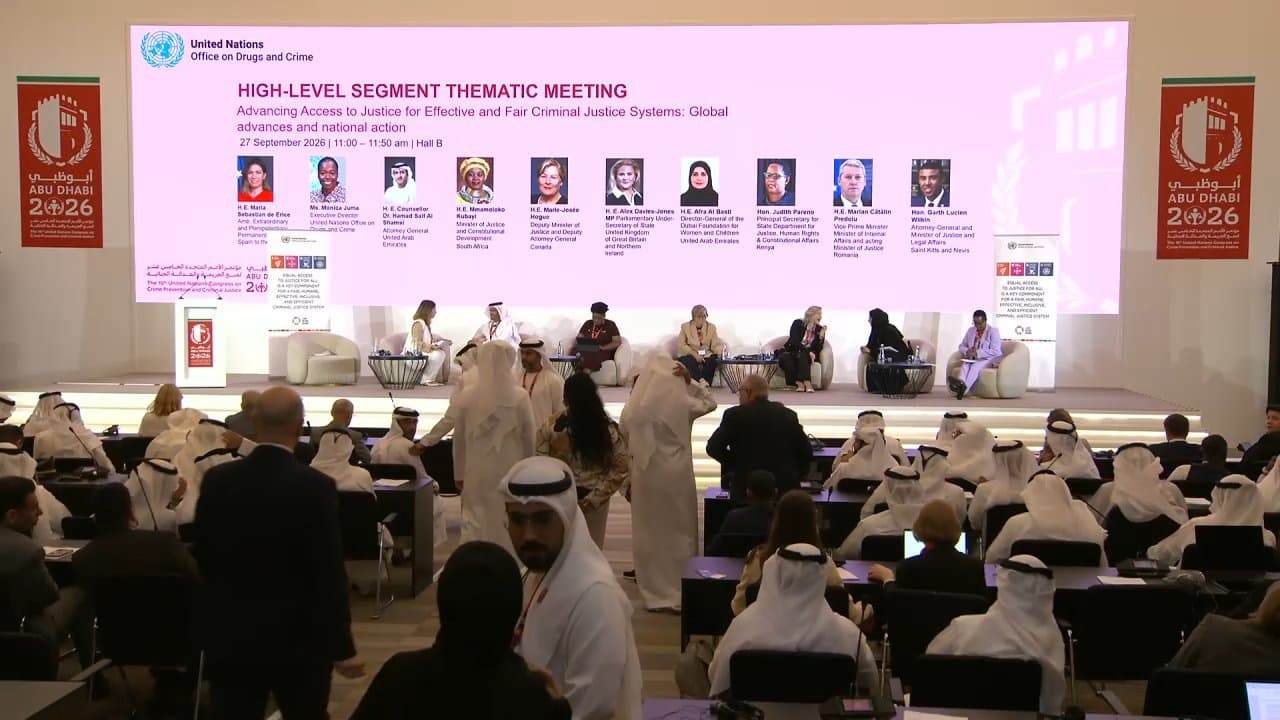
Senior officials from the UAE, South Africa, Canada, the United Kingdom and UNODC used a special event at the 15th UN Congress on Crime Prevention and Criminal Justice to move access-to-justice commitments from General Assembly resolutions into concrete national action — proposing new international treaties, mandatory data reporting, and guardrails for artificial intelligence in courtrooms. The Sept. 27 panel, organized by UNODC and the Group of Friends of Access to Justice and co-chaired by Spain, Brazil and Canada, surfaced a shared diagnosis: justice systems worldwide are still failing the people who need them most.
- UAE attorney general sets "golden rule" for AI in justice: prediction cannot become conviction, probability cannot replace evidence
- UK proposes new international treaty to enforce domestic abuse protection orders across national borders, with Hague Conference working group meeting in London in November
- Canada enacts stricter bail laws with mandatory annual parliamentary reporting on bail outcomes, compliance and recidivism
- South Africa announces international access-to-justice conference for Nov. 12–13, 2026, and details post-apartheid court overhaul
- UNODC chief warns one-third of global prisoners remain in prolonged pretrial detention; fewer than half of violent-assault victims report to authorities
AI Can Assist, but Humans Must Decide
Why it matters: As governments race to deploy artificial intelligence in investigations, evidence analysis and judicial administration, the framework articulated by the UAE's top prosecutor — that AI must never substitute for human judgment — could shape emerging global standards.
Federal Attorney General Dr. Hamad Saif Al Shamsi of the United Arab Emirates delivered the panel's most detailed remarks, spanning roughly 15 minutes of floor time. He began not with technology but with people, describing the moment a person first encounters the justice system:
"At that very moment, the only thing that they are concerned about is very personal. They ask one question: to whom should I go? Will I be able to understand the procedures? Will I be able to have access to help, to assistance? Will my voice be heard?" said Dr. Al Shamsi.
He argued that digital transformation must go beyond moving paper processes onto screens, instead re-engineering procedures to simplify access without compromising rights guarantees. Linguistic barriers, age-related challenges and the unique circumstances of victims all mean that making services available does not guarantee that everyone can reach them.
"Equitable access to justice requires services and procedures designed in a way that takes into consideration the different needs of people and which provides different means to access justice," he said.
The AI Guardrail
On artificial intelligence, Dr. Al Shamsi said the UAE has begun deploying AI assistants in labor and services cases but drew a firm boundary: "Predicting something cannot become conviction, and probability cannot replace evidence." AI can support analysis and efficiency, he said, but "it cannot replace discretion. It cannot replace responsibility and accountability for a decision. Thus, humans should continue to be the final decision makers."
He also pushed back against output-focused metrics, urging governments to track whether justice reforms actually change lives: "We should not stop short at measuring what we have achieved. We have to measure the impact thereof in the lives of people."
What's next: Dr. Al Shamsi called for deepening international cooperation through frameworks such as General Assembly Resolution 78/227 and the Group of Friends of Access to Justice, and referenced the Brasilia Declaration and UNODC as vehicles for coordinating reform.
UK Seeks International Treaty on Cross-Border Domestic Abuse Orders
Why it matters: Domestic abusers currently exploit national borders to evade protection orders. A new international treaty — proposed by the UK at the Hague Conference on Private International Law — could close that gap for victims who relocate or travel between countries.
Minister Alex Davies-Jones, the UK's Minister for Victims, Violence Against Women and Girls and International Justice, described the government's pledge to halve violence against women and girls over the next decade. She detailed the country's new Domestic Abuse Protection Orders, or DAPOs, which recognize forms of abuse beyond physical violence — including coercive control and economic abuse — and shift the burden onto perpetrators.
"Crucially, they punish the perpetrator rather than forcing victims to change the way that they live their lives to stay safe," Minister Davies-Jones said. DAPOs can require perpetrators to attend behavior-change programs, enable electronic monitoring, and carry penalties of up to five years in prison for a breach.
The Cross-Border Gap
Minister Davies-Jones identified a critical limitation: protection orders lose their power at national borders. She announced that the UK has proposed a working group at the Hague Conference on Private International Law to develop a potential new international treaty.
"The group will explore the potential for a new international treaty that would make the difference and secure that these protections continue to apply when victims move between countries," she said.
The UK will host the working group's first meeting in London in November. Minister Davies-Jones also referenced the UK's International Rule of Law Programme, which supports justice reform globally.
Canada Mandates Data-Driven Bail Accountability
Why it matters: Canada's requirement that its justice minister annually report bail compliance, recidivism and accessibility data to Parliament creates a replicable accountability model for other nations grappling with pretrial detention backlogs.
Deputy Minister of Justice Marie-Josée Aughe of Canada described an evidence-based approach to criminal justice reform, rooted in the country's co-chairing role in the Open Government Partnership's Coalition on Justice alongside the Supreme Court of Chile.
She detailed recent Criminal Code amendments — enacted after extensive consultation — that imposed stricter bail conditions targeting violent and repeat offending as well as organized crime.
"Importantly, the new legislation also requires that the Minister of Justice table an annual report in Parliament on the state of bail in Canada. The report is to include data on bail outcomes, such as compliance and recidivism, as well as on the accessibility of bail," Deputy Minister Aughe said.
Provincial and territorial governments administer bail courts and supervision programs, and Deputy Minister Aughe said the federal government has provided funding to strengthen national data collection and analysis to measure reform effectiveness. "We know that data and evidence are crucial for designing criminal justice systems that deliver fair and effective outcomes," she said.
South Africa Confronts Apartheid's Justice Legacy, Plans Global Summit
Why it matters: South Africa is reconfiguring its entire court system to undo apartheid-era spatial planning that forced disadvantaged communities — disproportionately rural and Black — to travel long distances for basic justice services.
Minister Mamoloko Kentsai Kubayi, South Africa's Minister of Justice and Constitutional Development, described access to justice as a constitutional obligation rooted in the country's democratic transformation. "Since the advent of our democracy, we have worked continuously to transform our justice system into one that is accessible, responsive, and people-centered," she said.
She detailed the Integrated Justice System and Court Online program for electronic case management, along with specialized courts for sexual offenses, children, equality and commercial matters. Legal Aid South Africa and community advice offices serve as vehicles for legal empowerment in underserved areas.
Minister Kubayi framed justice access expansively: "Access to justice is more than access to courts. It is access to rights, remedies, protection, and opportunities." She added bluntly: "Justice must never be the preserve of those who can afford it."
What's next: South Africa announced it will host an international conference on access to justice from Nov. 12–13, 2026, inviting global partners. Minister Kubayi also highlighted evolving challenges including cybercrime, climate-related pressures, organized crime and growing inequalities.
UNODC Sets Three Priorities for Closing Global Justice Gaps
UNODC Executive Director Monica Juma opened with sobering numbers: "One-third of the global prison population is still held in prolonged pretrial detention, and fewer than half of victims of violent assault report it to authorities."
She identified poverty, discrimination, geographic isolation, conflict and limited legal assistance as persistent barriers, and warned that the consequences extend beyond individual cases: "When people cannot access justice, trust in institutions suffers. When people do not trust institutions, our ability to prevent and respond to crime weakens."
Executive Director Juma outlined three priorities: ensuring justice responses are guided by the needs and experiences of the people they serve, particularly those most at risk; ensuring technology enhances rather than hinders access; and building stronger partnerships across police, prosecutors, courts, legal aid providers, corrections, civil society and the private sector. UNODC serves as Secretariat of the Vienna-based Group of Friends on Access to Justice.
- Afra Al Basti, Director General of the Dubai Foundation for Women and Children, began remarks framing access to justice as an intersection of innovation, judicial reforms and international cooperation. Her full remarks were not captured in the available record.
- The special event panel was facilitated by a representative of Spain serving as co-chair of the Group of Friends of Access to Justice, who framed access to justice as "essential to building societies that are fair, inclusive, peaceful, and resilient."