
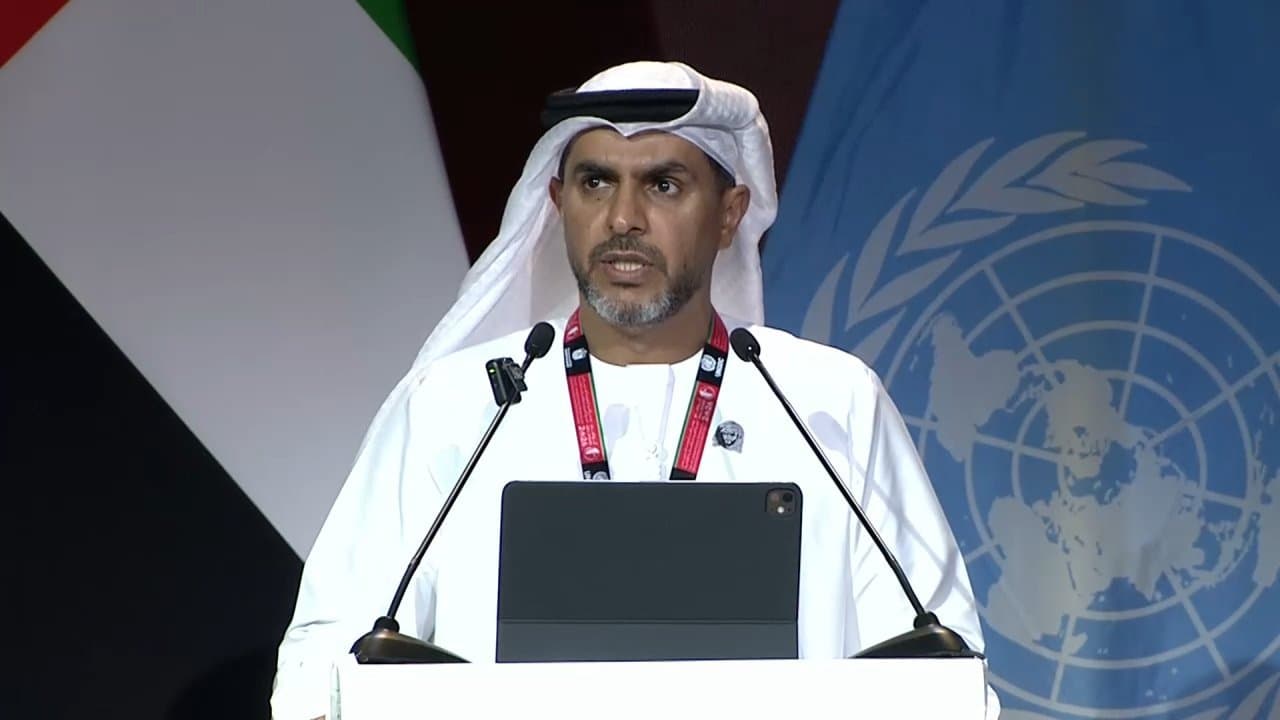
Crime Congress Adopts Final Report After U.S. Edits, Tallies 61 Pledges
United Nations Congress on Crime Prevention and Criminal Justice • United NationsOctober 1, 2026
Locunity is an independent informational service and is not an official government page for this commission. All information is sourced from public footage and an analysis of official agendas with the aid of responsible, fact-checked AI. to report an error or omission.
The 15th United Nations Congress on Crime Prevention and Criminal Justice closed in Abu Dhabi on Oct. 1, 2026, by adopting its final report. The U.S. delegation first won late wording changes on economic sanctions, "superintelligence" and asset recovery. Every chapter passed without objection, and the U.N. Office on Drugs and Crime announced 61 member-state pledges to put the consensus Abu Dhabi Declaration into practice through 2031.
- Final Congress report adopted as a whole without objection, after chapter-by-chapter approval
- U.S. amendments insert a sanctions defense and a "superintelligence" label for AI into the official record
- Iran pushes back, seeking an "in their view" qualifier on all single-speaker claims
- 61 Pledge for Justice commitments announced to implement the Abu Dhabi Declaration toward 2031
- Committee II flags AI risks in policing, surveillance and risk assessment; findings declared non-negotiated
- EU and Morocco demand human oversight as justice systems go digital
The Record Is the Battleground: U.S. Rewrites Key Chapters
The Congress's last formal act was adopting its report. A routine step became a contest over how the official record frames disputed positions.
The basics: The report bundles the plenary chapters (A/CONF.241/L.3 and Add.1 through Add.5), committee reports, a procedural report on the high-level segment's thematic meetings (L.7) and the Abu Dhabi Declaration (L.1), which delegates adopted on the Congress's first day. The Rapporteur-General proposed taking the report document by document.
Where things stand: The organizational and high-level segment chapters passed without comment. Then the U.S. delegate offered what the delegation called "minor amendments" to the chapter on crime prevention strategies (Add.2):
- Insert "(referred to as superintelligence by some delegations)" after "artificial intelligence"
- Add "in their view" before "impeded" in the chapter's last sentence
- Move a "some speakers stressed" sentence to open paragraph 5
- Add a sentence stating that "one speaker stated that economic sanctions can be a legitimate and effective tool for responding to threats to peace and security"
The chapter was adopted as orally amended.
A second superintelligence insertion followed after a podium voice told the presiding officer, "No, no, no, no, the US is asking for the floor." The record does not make clear whether that edit landed in the chapter on criminal justice systems (Add.3) or the one on organized crime and terrorism (Add.4). Both chapters were adopted.
On the cooperation and technical assistance chapter (Add.5), the U.S. added "in their view" to paragraph 11, the superintelligence label to paragraph 13, and a line to paragraph 15: "and that his delegation is a global leader in asset recovery and return."
The other side: The Iranian delegate responded by proposing that "in their view" be added wherever the text cites "one speaker," saying the goal was "to make it a balanced text." The chapter was adopted "as orally amended," but the record does not confirm whether Iran's proposal was incorporated.
Decisions and stakeholder impacts: Every chapter and the full report were adopted without objection. No tally was recorded. Washington now has a defense of economic sanctions, a contested issue among member states, in a U.N. outcome document. The "in their view" fight matters because qualifiers decide whether a national position reads as one delegation's claim or as broader sentiment. Advocates and researchers who cite the report should check the final text, especially the chapter that received the second U.S. edit.
What's next: The Presiding Officer closed the item by asking, "May I take that the Congress wish to adopt the report as a whole? It is self-decided. It's adopted."
61 Pledges Turn a Declaration Into Commitments
Why it matters: Declarations are easy to sign and hard to enforce. The Pledge for Justice initiative attaches specific state commitments to the Abu Dhabi Declaration, with a 2031 horizon.
Where things stand: "I am therefore pleased to announce that Member States made 61 pledges this week," said Monica Juma, Executive Director of the U.N. Office on Drugs and Crime and Secretary-General of the Congress. She presented the record of pledges to the host country's justice minister and asked the United Arab Emirates to keep championing the effort.
Juma cast the Declaration, adopted by acclamation, as a test of whether multilateral diplomacy still works. "Abu Dhabi demonstrated that consensus is still possible, even at a time when multilateralism is considered under considerable pressure," she said. She described the Declaration as building on the 2021 Kyoto Declaration and the Kyoto Model Strategies on reducing reoffending. She also warned that crime trends are evolving toward an existential threat, calling for "more, not less cooperation, for more, not less interoperability."
The other side: Juma acknowledged the limits of the approach. "Of course, the responsibility for delivering pledges rests with each and every member state that made them," she said. Follow-up runs through the Commission on Crime Prevention and Criminal Justice, with UAE support for implementation.
Decisions and stakeholder impacts: Abdullah Al Nuaimi, President of the Congress and UAE Minister of Justice, said the gathering drew 121 countries, 31 ministers, 205 governmental and nongovernmental organizations, 137 experts and about 9,000 attendees. "The Congress may conclude today, but our work begins today," Al Nuaimi said. For justice ministries, civil society groups and donors, the pledges create benchmarks they can track over the cycle.
Committee II Warns AI Could Undermine Justice
Why it matters: The report gives an official airing to concerns about AI in policing, surveillance and sentencing-adjacent decisions. Those concerns reach well beyond diplomats, to defense lawyers, police agencies and technology vendors.
Where things stand: The Committee II Chair reported on two workshops. Workshop 2 covered equal access to justice, including people-centered justice, legal empowerment and participation of affected people. Workshop 4 covered responsible use of technology. It found that AI can streamline reporting, identify patterns and process large volumes of data. But the chair warned that "the use of AI in law enforcement, forensics, surveillance, threat prediction, risk assessment, and decision-making on criminal justice outcomes could threaten the integrity of criminal justice process." The workshop identified capacity building for criminal justice actors as a priority.
The other side: The chair stressed the findings carry limited weight. "These points were not negotiated by Member States and simply reflect the points that I, as Chair, wish to highlight," the Committee II Chair said. The U.S. delegate welcomed that clarification and asked that it appear in the final report. The Presiding Officer agreed it would be recorded as a statement upon adoption.
Decisions and stakeholder impacts: The plenary approved the committee report (A/CONF.241/L.5 and L.5/Add.1) without objection. Anyone citing the AI findings should treat them as the chair's views, not agreed state positions.
EU, Morocco Press for Human-Centered Justice
Only two delegations gave closing statements.
Where things stand: Morocco's head of delegation called the Declaration a compass and roadmap for the next five years. The delegation said Morocco had made a pledge to continue its reforms and that technology must not replace the guarantees of justice. "Our main challenge will be to move from declaration to action, and from coordination to effective cooperation," the Moroccan delegate said.
The European Union delegate, speaking for the EU and its member states, urged the Commission to draw on the Congress report. The EU called for investment in prevention, including education, social inclusion, youth opportunity and stopping child recruitment by criminal networks. It also called for independent institutions, legal aid, victim support, and data collection with privacy safeguards. "Digital tools can improve access to justice and support investigations. But their use requires clear legal safeguards, accountability, and meaningful human oversight," the EU delegate said.
Decisions and stakeholder impacts: The EU cited its Pledge for Justice commitment, including forthcoming Temis and intercept initiatives. It closed with a marker for future negotiations: "We reiterate our unequivocal opposition to the death penalty in all circumstances."
Minor Items
- The Committee II chair thanked Vice-Chair Ambassador Angela Bigliotta of the Dominican Republic and rapporteur Refilwe Timunye of South Africa.
- The Secretariat aired a tribute video thanking the UAE for hosting the Congress.
- Uzbekistan will host the 16th U.N. Crime Congress, closing the "Abu Dhabi cycle."
- Al Nuaimi formally closed the 15th Congress after a video from Uzbekistan.
Looking Ahead
Intergovernmental follow-up begins at the Commission on Crime Prevention and Criminal Justice's reconvened 35th session in early December. Watch which of the 61 pledges states report on first, and how the final text treats the disputed U.S. and Iranian edits. As Juma put it, "we leave Abu Dhabi not with a full stop but with a comma, because the work goes on."