Transparency and Integrity in Public Procurement: Global Trends, Emerging Challenges and Lessons Learned
UNHQ Side Events • United NationsSeptember 17, 2026
Locunity is a independent informational service and is not an official government page for this commission.We use AI-assisted analysis and human editorial review to publish information.
UNDP Finds Global Procurement Integrity Flat Despite Decade of Reform Efforts
A landmark analysis of 74 million public contracts worth $36 trillion across 59 countries reveals that nearly one in three contracts is awarded through non-open procedures or draws only a single bidder — and that the situation has not improved since 2017. The findings, presented at a United Nations Headquarters side event on Sept. 17, set off a charged exchange when Russia challenged UNDP's authority to produce what it warned could become a UN-branded country ranking.
- Analysis of 74 million contracts shows global procurement integrity stagnation, with 29% awarded through non-open procedures and 30% receiving only a single bid
- Healthcare and IT sectors flag highest procurement integrity risks across 59 countries studied
- Italy's network analysis reveals politically driven supplier turnover in municipalities around elections
- Saudi Arabia caught buyers gaming regulatory contract thresholds, setting values just under openness requirements
- Russia challenges UNDP's mandate to produce comparable country data, warning of "very serious" implications
- AI-powered oversight platforms deployed: Saudi Arabia's Raqeeb and the World Bank's GRAS system detect sophisticated fraud schemes
- Partners develop methods for data-scarce countries, linking procurement data to school meals, medicines and reconstruction outcomes
The Numbers Don't Lie — They Don't Move, Either
The basics: UNDP and the Government Transparency Institute analyzed public procurement data from 59 countries covering 2017–2024, using five objective red-flag indicators — non-open procedures, lack of tender publication, single bidding, tax haven suppliers and contract modification — rather than perception-based measures. The data covers approximately $36 trillion in spending measured by purchasing power parity.
Why it matters: Public procurement represents 13%–20% of GDP globally, with an estimated 10%–25% of contract value potentially lost to corruption. If the integrity of that spending isn't improving, reform efforts over the past decade are failing to reach the systems where public money actually changes hands.
Where things stand: "We see 29% of public contracts are awarded through non-open procedure, which is like 3 in 10. And same goes with 3 in 10 receive only a single bid," said Anga Timilsina, Global Anti-Corruption Advisor, UNDP. The stagnation mirrors broader governance trends: "If we look at just the perception index as well, we see there is no change in 135 countries during the last 12 years. So the global average is 43," he added. Healthcare showed the highest prevalence of red flags, followed by IT services, while construction accounted for the largest share of procurement value. OECD members showed lower risk than non-OECD countries. Only two countries showed significant progress with more than 10 data points, while three deteriorated.
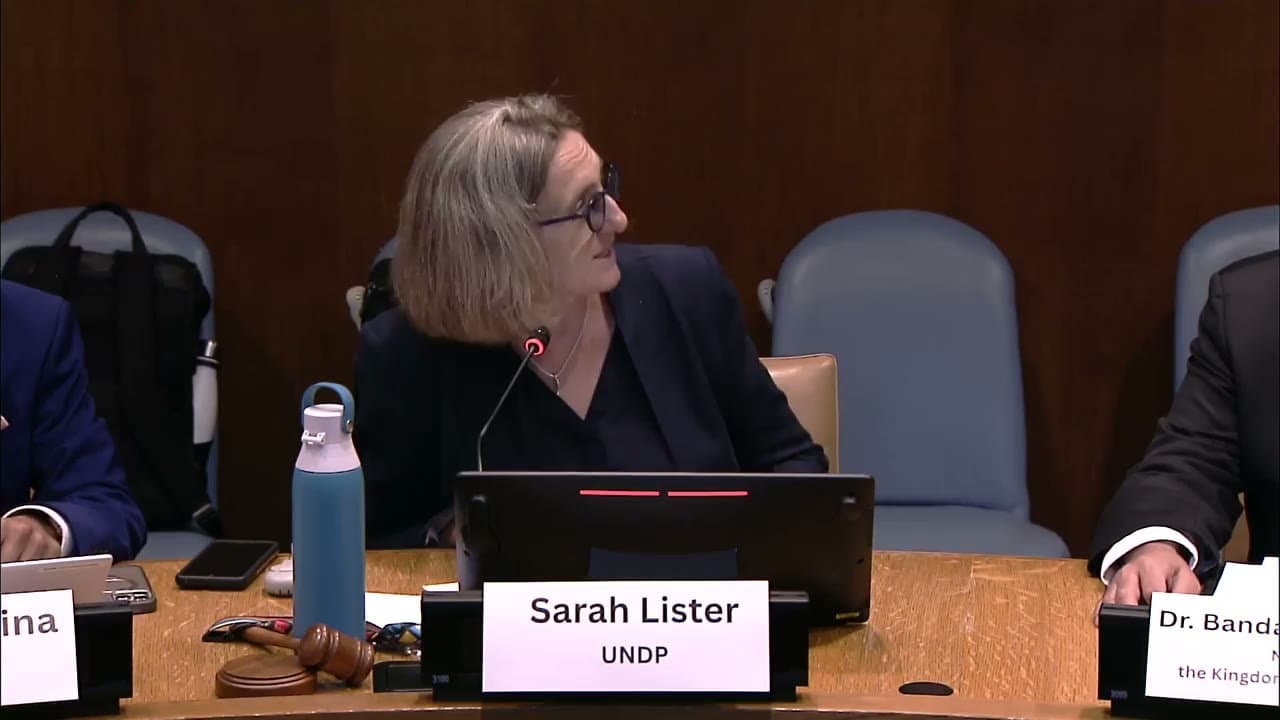
Sarah Lister, Co-Director, Governance, Rule of Law and Peacebuilding, UNDP, who moderated the event, framed the stakes early: "Data can make integrity risks more visible and actionable, but measurement is a means and not an end."
What's next: UNDP expects to publish a full global report within three to four months, pending further member state consultations. Data is currently available for 64 countries, with mapping underway for 98 additional countries where indicators could not be calculated due to data limitations.
Where the Data Gets Granular: Italy and Saudi Arabia
Why it matters: Standardized global indicators reveal broad trends but miss the specific mechanisms through which corruption operates locally. Two deep-dive case studies demonstrated how tailored analytics can pinpoint actionable vulnerabilities that aggregate data cannot.
Italy — political turnover, supplier turnover: Dr. Mihaly Fazekas, Scientific Director and Founder, Government Transparency Institute, presented a network analysis of Italian municipalities using data from Italy's anti-corruption authority covering more than 100,000 contracts per year from 2011 to 2025. The analysis mapped how shared suppliers link municipalities and then flagged anomalies. "These are the municipalities where we see a suspiciously large dissimilarities, a large change in the composition of suppliers when the mayor changes compared to normal years when there is no elections," Dr. Fazekas said. Red flags in Italy held steady until COVID-19, after which they slightly increased, declining only recently in 2025.
Saudi Arabia — gaming the threshold: The same analysis found that some Saudi procurement buyers appeared to set contract values just under regulatory openness thresholds — the point at which competitive bidding requirements kick in. "There are some buyers who, if you like, game the contract values to go just under the threshold, so they have just a few dollars, a few riyals fewer, lowered contract value than the threshold," Dr. Fazekas explained. He recommended Saudi Arabia publish organization IDs in public data and embed analytics into regular oversight operations.
Decisions: Both case studies were presented as proof-of-concept for extending tailored country diagnostics beyond the pilot phase. The presenters emphasized that red flags are signals for investigation, not evidence of wrongdoing.
From Digital Footprints to Intelligent Governance
Why it matters: As governments digitize procurement, the question shifts from whether data exists to whether anyone has the capacity and tools to act on it. Several countries and international organizations are building AI-powered platforms to close that gap.
Where things stand: Khaled Bubshait, Director, G20 Department, NAZAHA (Saudi Arabia), described the kingdom's progression from its IRTiMAD digital procurement platform to Raqeeb, an AI-powered analytics system. "Digital systems create a footprint. That footprint makes risks visible. Analytics give us foresight, and foresight enables timely action. This is our journey from digital procurement to intelligent governance," he said. But Bubshait drew a clear line: "The most important principle is the distinction between identifying risk and determining misconduct. A statistical or analytical red flag does not establish that corruption has occurred."
On the Italian side, Giuseppe Abbatino, Italian National Anti-Corruption Authority (ANAC), described 17 procurement indicators embedded within a broader 70-indicator framework — and warned against drowning in data: "To avoid, as I used to say, the risk of bulimia of data, that is too much data, but anorexia of knowledge." He noted the European Commission's September 2026 proposal for a new Public Procurement Act would require all EU member states to build national procurement data spaces and risk analysis tools — a direction Italy had already invested in.
The World Bank is building complementary capacity. Vartika Neeraj, Governance Analyst, Anti-Corruption for Development Program, World Bank, described the Governance Risk Assessment System, which processes millions of data points with capacity for over 200 red flags. She highlighted a Guatemala case: "In Guatemala, where it was able to pick up a scheme where suppliers were piggybacking on each other every other year. And we thought that's pretty clever for a data system to pick up something so nuanced."
Bridging the Data Desert
Why it matters: The countries with the weakest procurement data are often those most in need of integrity safeguards. If the initiative cannot reach them, its global credibility is limited.
Where things stand: UNDP could only collect usable data from 64 of a target 130–140 countries, partly due to cost and partly due to the absence of modern e-procurement systems and open data standards. Lindsay Marchessault, Director of Impact and Innovation, Open Contracting Partnership, described a new methodology for data-scarce environments using offline methods and sampling — designed to help partners understand the value of available information rather than measure for its own sake.
She pointed to concrete examples of linking procurement data to outcomes: in Paraguay, tracking school meal procurement; in Brazil, AI-supported analytics for medicine purchasing; and in Tanzania, where supplier outreach paired with red flag dashboards led to dramatic results. "In Tanzania, working with the government to build red flags and efficiency dashboards that paired with supplier outreach has led to a tripling of suppliers awarded contracts," Marchessault said.
Faryal Ahmed, Statistician Manager, Data for Now Initiative, UN Statistical Division, urged a reorientation: "Rather than beginning with the question, what do we already have, it encourages countries to start to a more strategic question, what anti-corruption priorities need to be informed by better statistics?"
Russia Pushes Back: Rankings, Mandate and Context
Why it matters: If major member states withhold cooperation over concerns about rankings or institutional overreach, the initiative's political legitimacy and global coverage could be significantly constrained.
Where things stand: The Delegate of the Russian Federation delivered the sharpest challenge of the session, questioning four dimensions: what specific actions countries can take based on the indicators; how UNDP will expand beyond the current group of mostly OECD and G20 nations; how domestic legal and economic context is incorporated; and whether comparable data could effectively create a ranking system. He questioned how UNDP accounts for varying legal frameworks: "How do you take into consideration domestic context, how do you analyze the different domestic laws, and not only on procurement, because many things can be related to procurement but do not have the word procurement in the title."
The delegate's most pointed concern was institutional: "This can potentially be a ranking branded the United Nations. And this is a very serious thing, and this is great responsibility for UNDP, also because actually countries didn't mandate UNDP to undertake this exercise through any sort of resolution or decision whatsoever."
The other side: Timilsina responded that the initiative is deliberately avoiding combining indicators into a single index to prevent rankings, that country footnotes will explain context, and that ongoing consultations specifically address these sensitivities. Saudi Arabia's Bubshait provided supporting testimony from direct experience: "We spoke with GTI and explained to them, well, our legislation has X, Y, and Z in it, and this is used to prevent corruption in these areas. This is how we use it. It might be different than how, I would say, Europeans, South Americans, Africans would use it, but at the same time, it works for us." Dr. Fazekas added that the dashboard allows filtering by region, sector and contract value so country-specific users can isolate relevant data from structural market limitations.
What's next: The exchange underscored that the three-to-four-month window before the full global report launch will be politically sensitive. How UNDP navigates member state concerns over comparability and mandate will likely determine whether additional countries engage with or distance themselves from the tool.
Minor Items
- Dr. Bandar Al-Khalil, Vice President, NAZAHA (Saudi Arabia), opened by arguing countries should not shy from publishing assessments: "For too long, the international conversation on corruption has rested on indices and perception-based rankings that offer limited practical value."
- Dr. Giuseppe Busia, President, ANAC (Italy), argued that Italy's existing digital infrastructure validates the European Commission's direction, noting "transparency alone, without the analytical capacity to make sense of what is disclosed, produces volume of information and data without insight."
- Xiaohong Li, UNODC Representative in New York, provided opening remarks on behalf of the UN Office on Drugs and Crime, connecting the initiative to the UN Convention against Corruption framework.
- A Columbia University student asked during Q&A whether rapid digitalization of procurement data could create a false sense of transparency if institutions lack the capacity to investigate or enforce findings — a concern several panelists acknowledged.