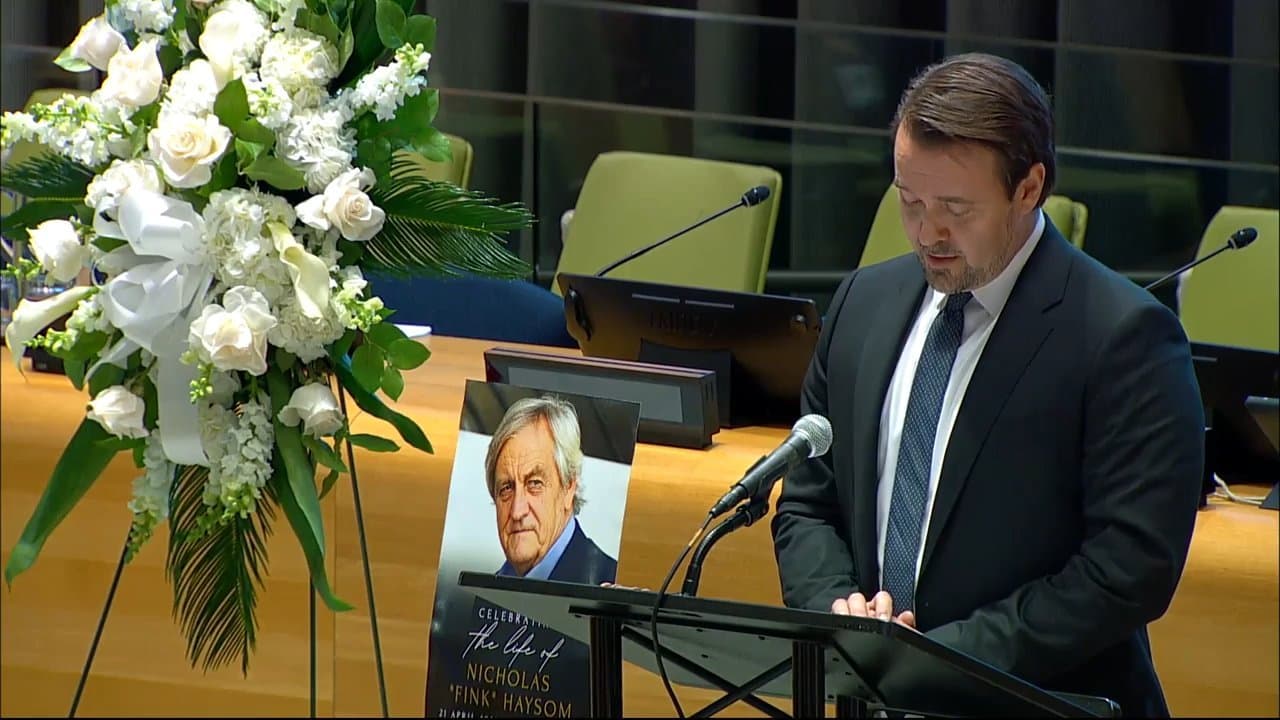
Memorial for Nicholas 'Fink' Haysom
UNHQ Side Events • United NationsSeptember 18, 2026
Locunity is a independent informational service and is not an official government page for this commission.We use AI-assisted analysis and human editorial review to publish information.
UN Honors Peacemaker Nicholas Haysom, Who Shaped Constitutions and Brokered Peace Across Africa
The United Nations gathered during General Assembly week to memorialize Nicholas "Fink" Haysom, the veteran peacemaker and constitutional architect who died in March 2026 while serving as the Secretary-General's Special Representative in South Sudan — a country whose very existence owes a debt to his mediation. Senior UN officials, ambassadors from South Africa and South Sudan, the African Union, and personal friends traced a career that stretched from apartheid prison cells to the helm of the world's largest peacekeeping mission, offering a rare portrait of how one person's moral conviction can bend the arc of nations.
- Senior UN leaders call Haysom a "tireless peacemaker" whose constitutional and mediation work helped enable South Africa's democracy, South Sudan's independence, and peace efforts in Burundi, Sudan, Iraq, Afghanistan, and Somalia
- South Sudan's ambassador delivers emotional tribute, crediting Haysom's 2002 Machakos Protocol mediation as foundational to the nation's birth
- African Union's permanent observer urges "patience with South Sudan's peace" as the surest tribute to Haysom's legacy
- Colleagues recall a leader who was detained six times under apartheid, never scapegoated staff, and was "the only person who had no enemies" — even amid deep conflict
A Life Dedicated to Solving Crises Through Diplomacy
The memorial, held Sept. 18 at UNHQ, brought together the upper ranks of the UN's peace and security architecture, member-state diplomats, and Haysom's personal circle to honor a figure whose career arc is nearly synonymous with modern UN peacemaking itself.
Why it matters: Haysom's work spanned the most consequential peace transitions of the past four decades — from drafting South Africa's post-apartheid constitution alongside Nelson Mandela, to brokering the Burundi and Sudan/South Sudan Comprehensive Peace Agreements, to leading UN missions in Iraq, Afghanistan, Somalia, and finally South Sudan. His death in post leaves an institutional void at a moment when multilateral peacemaking faces mounting skepticism.
Where things stand: Chef de Cabinet Courtney Rattray, delivering remarks on behalf of the Secretary-General, set the frame: "Those of us who worked with Nicholas, or Fink as many affectionately knew him, felt the power of his convictions, his commitment to justice no matter how deep the wounds, his devotion to dialogue, no matter how great the tensions, and his pursuit of reconciliation, even when differences seemed insurmountable." Rattray recalled that Haysom's activism began as a student leader and human rights lawyer who "stood up to apartheid, even when it landed him in jail."
Under-Secretary-General for Peace Operations Jean-Pierre Lacroix drew out the quality that colleagues most often invoked — the rare combination of principle and pragmatism: "He could be deeply principled without being dogmatic, firm without losing sight of the human dimension, and pragmatic while remaining deeply committed to the principles that guided his work." Lacroix added that Haysom understood peace processes are "not about documents or political arrangements, alone. They're about people — their dignity, their rights, their security, and their hopes for a better future."
Under-Secretary-General Rosemary DiCarlo, who leads the Department of Political and Peacebuilding Affairs, called Haysom "a peacemaker and a mediator of rare intuition and unparalleled capacity to bring people together." DiCarlo offered a vivid window into Haysom's standing inside the institution, recalling her early days as a deputy permanent representative at the U.S. Mission: "When there were heated procedural or other disagreements in the Security Council and the General Assembly, we novice DPRs knew whom to call for help. It was Fink, always Fink." She concluded simply: "He was a mentor to many of his colleagues. He became a hero to all of them."
Deputy Permanent Representative Jay Dharma Deekari, speaking on behalf of the Security Council Presidency, commended "a life dedicated to trying to solve crises through diplomacy, combining deep legal expertise and a pragmatic drive in the pursuit of peace."
South Sudan's Ambassador: "He Was Part of Our Story"
The most emotionally charged tribute came from Ambassador Cele Adeng, South Sudan's Permanent Representative, who spoke at length about a relationship between a diplomat and a nation that predates the nation itself.
"For South Sudan, Nicholas was not simply a senior official of the United Nations. He was part of our story," Adeng said. "Long before the Republic of South Sudan existed, Nicholas had already committed himself to the difficult work of helping our people find a peaceful path towards determining their own future."
The basics: Haysom served as a key mediator in the Intergovernmental Authority on Development (IGAD)-led peace process that produced the Machakos Protocol, signed July 20, 2002. That agreement recognized the right of the people of Southern Sudan to determine their future through a referendum — a provision that ultimately led to independence in 2011.
Adeng credited Haysom's mediation directly: "The result was the historical Machakos Protocol. Among its most consequential provisions was the recognition of the right of the people of Southern Sudan to determine their own future through referendum following 6 years after the interim period."
Beyond the protocol, Adeng described a deeper philosophy. "Nicholas understood that peace was not an event. It was not simply signing of an agreement. Its continuation process requiring patience, institutions, compromises, political courage, and above all, determination of the country's own people to live together."
Adeng closed with a line that drew the sharpest emotional response in the room: "South Sudan has not only lost the Secretary-General's representative, it has lost a witness to our history, it has lost a participant in our journey, and it has lost a friend of peace."
South Africa and the African Union Claim "One of Our Own"
Ambassador Nkosi, South Africa's Permanent Representative, highlighted Haysom's work with Nelson Mandela on the South African Constitution and his later efforts to bridge his two worlds — South Africa and South Sudan. "In his position as the Special Representative of the Secretary-General, he lobbied the South African government to leverage its good relations with the leadership of South Sudan to mediate and build confidence, particularly between President Salva Kiir and Vice President Riek Machar."
Ambassador Idriss, the African Union's Permanent Observer to the United Nations, framed Haysom's legacy in continental terms. He described Haysom's constitutional philosophy — that constitutions should be understood as peace agreements, and that the process of writing them matters more than the elegance of the final text: "A constitution people have helped to write is one they will defend."
Idriss noted that Haysom "carried the continent's constitutional experience outwards to the constitutional files of Iraq and Afghanistan, and reminded this organization that peacemaking wisdom travels from Africa as well as to Africa." He ended with a pointed call to action: "The surest tribute within our reach is the one he would have asked of us: patience with South Sudan's peace."
Apartheid Prisons, Moral Courage, and the Person Behind the Peacemaker
Colleagues and friends offered personal reflections that revealed the human architecture behind the diplomatic résumé.
Sean Cain, a UN mediation professional and colleague, detailed the cost Haysom paid for his convictions under apartheid: "He was, by his own count, detained without trial a half dozen times and placed under house arrest for 2 years. He shared that he was subject to sleep deprivation during interrogations and held in solitary confinement on 3 occasions."
Cain also shared a story that captured Haysom's irreverent humor. During one interrogation, apartheid security forces asked young Haysom to name the political figures who most inspired him. He named Martin Luther King Jr. and John F. Kennedy. "Eager to make more arrests, Fink said the interrogator immediately followed up, and where can we find this King and Kennedy?"
Cain quoted Haysom's own words from a eulogy for a colleague killed in Afghanistan — a passage that doubled as a statement of professional creed: "Mere knowledge on its own is not a valuable asset unless it is willingly shared, professionally applied, and is placed in the service of meeting the challenges faced by society." Cain added that even amid deep conflict, Haysom "was the only person who had no enemies."
Keela Janda, a UN staff member, described a leader who empowered those around him by absorbing personal risk: "He always told him, you have to do what you believe is morally right and then apologize later for the bureaucratic mishaps. He never, ever scapegoated anyone. He was always the boss. He was always in charge." Janda noted that many colleagues who were inspired by Haysom's approach call themselves "Finksters" — and pledged to keep his memory alive.
Michael Keating, a colleague and friend, and Vaughn Wiles, Haysom's brother-in-law, also offered personal tributes. Poetry readings — "Ceasefire" by Michael Longley and "The Child Is Not Dead" by Ingrid Jonker, the latter a South African poem Nelson Mandela read at the opening of the country's first democratic parliament — and a UN Choir performance of "My Soul Is a River" framed the event's emotional arc.
The moderator closed by asking attendees to carry forward Haysom's humanity, compassion, and moral courage, followed by a moment of silence.