Cities Launch First Data Center Compact as Mayors Build Climate Power Beyond National Governments
UNHQ Side Events • United NationsSeptember 24, 2026
Locunity is an independent informational service and is not an official government page for this commission. All information is sourced from public footage and an analysis of official agendas with the aid of responsible, fact-checked AI. to report an error or omission.
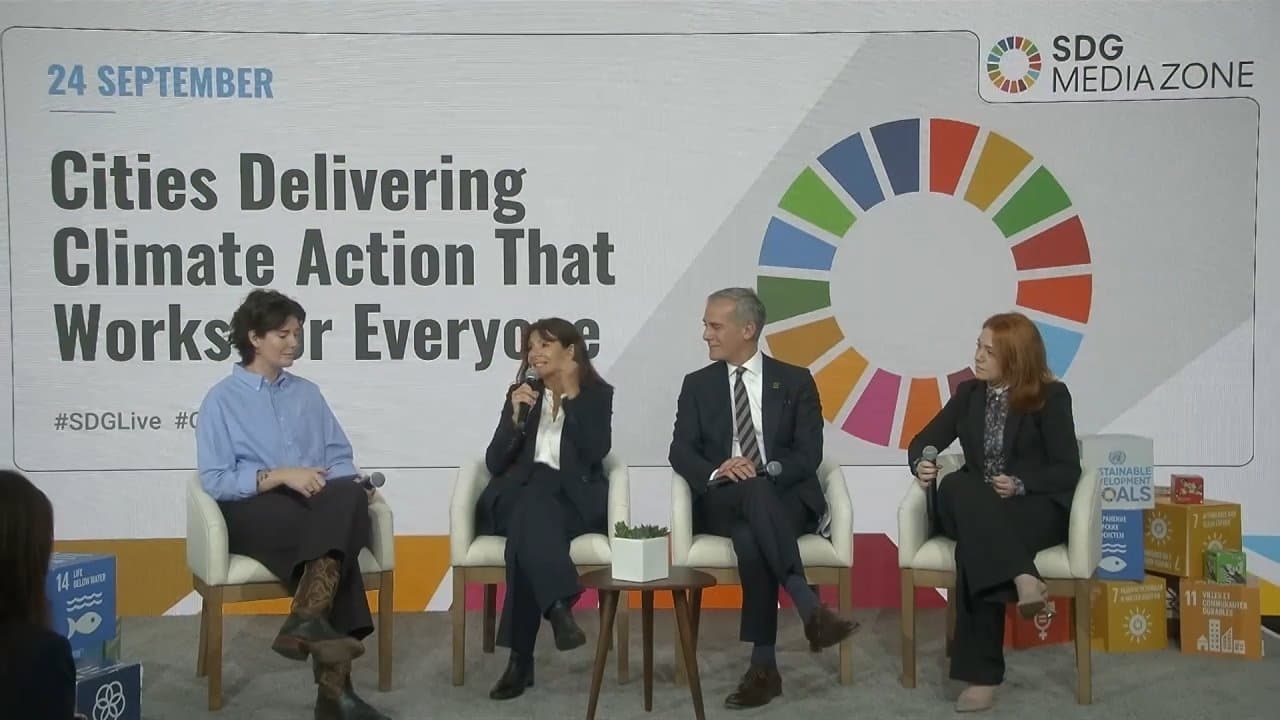
At the United Nations General Assembly's SDG Media Zone, city leaders from Los Angeles, Paris and São Paulo made the case that mayors — not national governments — are delivering on the Paris Agreement, unveiling new tools to regulate AI-driven energy demand and channel climate action toward social inclusion.
- C40 Cities, Global Covenant of Mayors and Climate Mayors launch the first data center compact, banning gas-powered and coal-powered facilities across cities representing more than 200 million people
- Former Paris Mayor Anne Hidalgo pushes to give mayors a formal seat at COP climate negotiations through the CHAMP initiative, now involving 78 countries
- São Paulo debuts green jobs pilot linking migrant inclusion to ecological transition, with training tied to the city's bus fleet electrification
- Eric Garcetti recounts how 360 U.S. mayors pledged Paris compliance after the first Trump withdrawal — a coalition the UN calculated as equivalent to the world's fifth-largest country
A New Rulebook for Data Centers
Why it matters: As AI demand triggers a global buildout of energy-hungry data centers, cities are watching fossil-fuel plants proposed to power them — threatening local grids, air quality and climate goals. The new compact gives cities collective bargaining power to set the terms.
Where things stand: Eric Garcetti, former chair of C40 Cities, announced that C40, the Global Covenant of Mayors and Climate Mayors have launched the first data center compact, establishing standards that require clean energy and address water use and heat containment.
"C40 Cities launched with the Global Covenant of Mayors and Climate Mayors the first data center compact that establishes the standards that say no, unless you play by our rules, which means no gas-powered plants, no dirty coal energy," said Garcetti.
The coalition already represents more than 200 million citizens, and Garcetti predicted the number would double within a month. The scale is designed to prevent tech companies from playing cities against each other — a dynamic familiar from decades of corporate incentive shopping.
Molly Taft, senior climate writer for WIRED and the panel's moderator, framed the urgency: "The Super El Niño forming in the Pacific threatens to compound on the extreme weather we've already seen so much of and really threatens to raise global temperatures significantly by next year. And then the second is also data centers."
What's next: The compact's membership is expected to expand rapidly. Cities that join would commit to clean energy requirements for any new data center development, a framework that could reshape site-selection dynamics for major tech firms.
Hidalgo Makes the Case for Mayors at the Negotiating Table
Why it matters: Cities implement Paris Agreement targets, bear the direct costs of climate impacts and increasingly fund adaptation — but they have no formal role in COP negotiations and limited access to international climate finance. The CHAMP initiative seeks to change that.
Where things stand: Anne Hidalgo, former mayor of Paris and now Global Ambassador for the Global Covenant of Mayors, described using the COVID-19 pandemic and the 2024 Olympic Games as accelerators for urban transformation. During the pandemic, she rapidly expanded bicycle lane infrastructure across Paris to reduce air pollution and reshape mobility.
"COVID gave me the opportunity to change that very quickly, and it was an accelerator," Hidalgo said.
She then turned to the CHAMP initiative, born at COP28 in Dubai, which now involves 78 countries committed to bringing mayors into formal climate negotiations. The Global Covenant of Mayors encompasses 14,000 cities worldwide, mostly smaller than C40's megacity membership.
"They need to have direct access to the finance. They need to be present in the discussion, in the negotiation about climate change, because they are facing directly with the citizens the impact of the climate change," Hidalgo said.
What's next: The CHAMP initiative aims to secure multilevel, multi-actor implementation of the Paris Agreement — giving cities both a voice and a funding pipeline at future COP summits.
São Paulo Links Green Jobs to Migrant Inclusion
Why it matters: São Paulo is testing whether a city's ecological transition can simultaneously address climate adaptation, workforce development and migration — a model relevant to megacities across the global south.
Where things stand: Camila Assis, General Coordinator for International Relations at São Paulo's Municipal Secretariat for International Relations, described the city's approach as inseparable from social equity.
"From the perspective for São Paulo, the ecological transition cannot be only about reducing emissions or adapting our city. It also needs to create opportunities for people, especially for those who are already facing great social and economic" vulnerability, Assis said.
The centerpiece is the Novo Solo — "New Soil" — pilot project, funded by a grant from the Mayors Migration Council, which connects migrants in vulnerable situations with training and employment in sectors critical to the city's ecological transition, including bus fleet electrification.
"It brings together three important issues like migrant inclusion, decent work, and urban climate resilience," Assis said.
São Paulo has also launched Hubi Green Sampa, a public incubator providing grants to green startups. Assis noted that 32% of São Paulo's territory is rural, requiring the city to engage agricultural producers alongside urban entrepreneurs in its climate strategy.
From a Dozen to 360: How City Coalitions Grew Into a Global Force
Why it matters: With a second Trump administration again weakening federal climate commitments, the trajectory of U.S. city-level climate pledges — from reactive solidarity to proactive governance — offers a test of whether subnational actors can sustain global ambition independently.
Where things stand: Garcetti traced the arc from C40's COVID-era rapid-response calls — where more than 60 of the world's 100 largest-city mayors shared innovations like Seoul's drive-through testing and Milan's hospital logistics — to the formation of Climate Mayors after the first Paris Agreement withdrawal.
"We got on the phone. And by the end of that day when he made that announcement, we had over 50 folks signed on saying that if he's out, we're in. We will implement Paris in our cities," Garcetti said.
The coalition grew to more than 360 mayors across 47 states. At COP in Glasgow, Garcetti was the only non-national leader on stage during the opening days, presenting on behalf of 1,000 cities that pledged carbon neutrality.
"The UN made the calculation that's the equivalent of the fifth-largest country in the world. And we're actually doing it, unlike the empty words of a lot of nations that are falling short," he said.
Garcetti also drew a sharp contrast between mayoral speed and national bureaucracy, recounting a story about then-British Prime Minister Boris Johnson learning from C40's city-to-city COVID briefings: "Boris Johnson turned to his cabinet and said, why aren't we doing this stuff? And they said, sir, we're preparing a report. It'll be ready in a week or two."
What's next: The panel's broader argument — that cities have moved from symbolic pledges to enforceable governance frameworks like the data center compact — will be tested as AI infrastructure demand accelerates and the next round of COP negotiations approaches. Whether cities secure the direct finance access and formal negotiating roles that Hidalgo and the CHAMP initiative are pushing for could determine how much power actually shifts from national capitals to city halls.