
UN Launches Data Commons, Proposes Hormuz Corridor as SDG Media Zone Opens
UNHQ Side Events • United NationsSeptember 21, 2026
Locunity is an independent informational service and is not an official government page for this commission. All information is sourced from public footage and an analysis of official agendas with the aid of responsible, fact-checked AI. to report an error or omission.
The 10th-anniversary SDG Media Zone at UNGA 81 opened with a paradox: new tools to fight global crises arriving alongside deepening evidence that existing systems are failing the most vulnerable. From a fertilizer corridor that could prevent 45 million people from going hungry to an AI-ready data platform that exposed how often chatbots get basic statistics wrong, Day 1 laid bare the gap between what's technically possible and what political will allows.
- UN Data Commons launches at data.un.org, pooling statistics from 26 agencies — but tests show AI chatbots return different answers to the same question 50% of the time
- UN Task Force proposes fertilizer corridor through Strait of Hormuz, deployable in 7–10 days, as oil prices spike 40% and 45 million face food insecurity
- UNHCR High Commissioner pledges to halve protracted refugee dependency within a decade, calling education the $20-per-dollar-invested path to self-reliance
- Joseph Gordon-Levitt calls for global AI regulation to protect children, comparing algorithmic feeds to casinos and invoking the General Assembly's first-ever resolution on nuclear weapons
- Save the Children and CPJ demand accountability as funding cuts slash humanitarian reach and more than 200 journalists have been killed in Gaza
- UN Technology Accelerator shows shared platforms can save billions, with Microsoft helping build an OCHA grant system in three weeks that unlocked $1B+ in aid
- Youth peace advocates from six countries call for rebalancing the $2.9 trillion global military budget toward development and education
Strait of Hormuz: A Fertilizer Corridor Ready in Days, Blocked by Politics
The basics: One-third of the world's seaborne fertilizers, 20% of crude oil, and 19% of liquefied natural gas transit the Strait of Hormuz. A crisis in the region has driven Brent crude prices up 40%, urea and ammonia prices up 20%, and phosphate prices up nearly 200%.
Why it matters: The World Food Program estimates 45 million people face acute food insecurity as a direct result of the trade disruption. The UN Secretary-General's Task Force has proposed a "time-bound, limited, and exceptional" mechanism to allow 5–7 fertilizer vessels through the Strait daily.
Where things stand: UNOPS Executive Director Jorge Moreira da Silva, who coordinates the Task Force, described a system involving vessel registration, deconfliction, monitoring, verification, tracking, and reporting. He cited two precedents: UNOPS managing the 2720 mechanism for Gaza truck inspections and a decade of vessel inspections between Djibouti and Yemen covering more than 3,000 ships.
"My team at UNOPS, the monitors, can be put on the ground in 7 to 10 days," said da Silva.
IMO Secretary-General Arsenio Dominguez stressed that until guarantees are obtained that ships will not be targeted, he will continue advising commercial vessels to stay away. More than 80 vessels have been attacked, and 6,000 seafarers remain trapped in the Persian Gulf. He cited the IMO Council resolution from July reiterating that navigation through international straits should not be impeded.
The other side: Gulf Cooperation Council countries insist any mechanism must not be perceived as replacing freedom of navigation — a concern that any workaround could normalize restrictions on an international waterway.
Decisions: The technical solution is ready. Both speakers identified US and Iranian political will as the missing element.
What's next: The Task Force is positioned to deploy within days of a political agreement. The corridor remains on the table as UNGA High-Level Week continues.
AI Gets the Facts Wrong Half the Time — and the UN Just Built a Fix
The basics: The UN System Data Commons, launched at data.un.org, consolidates statistics from 26 UN entities into a single searchable, AI-ready platform built on Google's open-source Data Commons infrastructure. Users can ask natural-language questions — such as "How has maternal mortality changed over time?" — and receive charts and related indicators instantly.
Why it matters: UNICEF Chief Statistician João Pedro Azevedo ran 133,000 queries across six AI models and found that chatbots gave inconsistent answers to the same official statistics question half the time.
"Even when we ask about the same country, the same year, the same indicator twice, 50% of the times we don't get the same value," said Azevedo. He called the problem "totally solvable" with coordination among data producers, consumers, and AI labs.
Where things stand: Google Head of Data Commons Prem Ramaswami demonstrated creating shock-detection and outlier dashboards in one hour using the platform's open endpoints. UN Global Pulse Portfolio Manager Talea von Lupin outlined plans for "data products" — automated reporting and predictive analysis — built on top of the commons, and invited external communities to participate.
Within 24 hours of launch, the platform received 120,000 hits and 1.1 million data requests.
What's next: The platform is live and open. The next phase involves building automated analysis tools on top of the shared data and expanding participation beyond the initial 26 agencies.
Gordon-Levitt: Regulate AI Like Casinos and Cigarettes
Why it matters: No coordinated international rules exist for addictive algorithms targeting children. UN Global Advocate for Human-Centric Digital Governance Joseph Gordon-Levitt argued that AI toys and chatbots optimize for business revenue rather than child well-being, risking damage to attention spans and authentic human relationships.
Where things stand: As a father of three, Gordon-Levitt described strict household rules — no exposure to algorithmic feeds, though his children may use creative digital tools with restrictions. But he pushed back against the "just parent your kids" argument, noting that when every child's classmate uses harmful products, individual families face an impossible choice.
"There's a reason why you have to be 21 years old to go into a casino. That's a law," he said, comparing algorithmic regulation to existing consumer protections.
On the case for global governance, he reached for historical precedent: "The first resolution ever passed by the UN General Assembly was about nuclear weapons and nuclear energy." He urged audiences to "follow the money" and recognize AI products as commercial tools, not "new beings."
What's next: Gordon-Levitt's appearance is part of the UN's broader push on digital governance during UNGA week.
UNHCR Chief Sets Ambitious Target: Halve Refugee Dependency in a Decade
Why it matters: Nearly 6 million refugees cannot attend school. Only 10–11% access higher education. But every dollar invested in refugee education returns $20 in host-country GDP — an argument UNHCR High Commissioner Barham Salih made the centerpiece of a new strategic push.
Where things stand: Salih, who drew on his own experience as a 14-year-old Kurdish refugee in 1974, announced an ambitious goal: "reducing people who are in long-term displacement and dependent on humanitarian assistance by half within 10 years."
He highlighted concrete programs already underway: the DAFFI scholarship program, Kenya's Sherika Plan offering refugees documentation and job access, and Ethiopia's Metekatit plan offering land. He noted that 1.9 million internally displaced persons and 1.8 million refugees have returned to Syria.
The other side: UNHCR Goodwill Ambassador Mary Maker described the barriers that statistics don't capture: 200 children per classroom, inability to leave camp borders for scholarships, lack of conventional travel documents, hidden costs of flights and standardized tests, and no access to loans. She urged leaders to act with urgency.
"I'm already aging out of education," Maker said. "As much as they're putting laws to be able to engage refugees and employers, it needs to be now."
What's next: The UNHCR's decade-long target reframes refugee policy from crisis response to development investment. Implementation will depend on host-country cooperation and sustained funding.
Save the Children, CPJ Sound Alarm on Shrinking Space for Aid and Press
Why it matters: Collective funding cuts have forced Save the Children to reduce its global footprint even as needs surge, while the Committee to Protect Journalists documented an unprecedented wave of violence against the press.
Where things stand: Save the Children UN Representative Mohamad Alasmar described how funding reductions forced the organization to reassess operations while still serving 38 million children in 107 countries — a significant drop from prior years. He emphasized that in Gaza, supplies sit kilometers away but cannot enter due to lack of political will, not funding.
CPJ Chief Global Affairs Officer Gypsy Guillen Kaiser detailed escalating threats: drone killings, sexual violence, surveillance, and denial of access. She highlighted that the White House press pool paused coverage that same day after three outlets were removed, and Pentagon reporters were forced from their desks. More than 200 journalists have been killed in Gaza, and CPJ has documented 20 years of uninvestigated journalist killings by the Israeli military.
Kaiser outlined four demands: a standing independent international investigative task force for crimes against journalists; media freedom provisions in ceasefire agreements; targeted sanctions against perpetrators; and international press access to Gaza.
Alasmar closed by insisting there must not be a "hierarchy of needs" determining which children receive support, and that political will and accountability mechanisms are essential.
UN Tech Accelerator: $2.5B IT Spend, Less Than 10% Shared
The Scale of the Problem
ITU Secretary-General Doreen Bogdan-Martin reported that the UN system employs 9,000 IT staff and spends $2.5 billion annually on technology — but less than 10% uses shared services. The Technology Accelerator Platform is designed to change that.
Bogdan-Martin highlighted an expertise-on-demand platform developed with UNDP cataloguing 4,000 types of expertise across 1,000 teams and 30-plus organizations, now running 14 pilots.
Deal Math
Microsoft Elevate President Justin Spelhaug described how a grant management system for OCHA was built in three weeks: "A recent project we did with OCHA to build a grant management system and an improved reporting capability took 3 weeks and helped unlock $1 billion or more for OCHA to deploy for humanitarian assistance."
He emphasized that all projects must be UN-led and owned.
What's Next
Under-Secretary-General for Policy Guy Ryder described technology coming "center stage" in UN reform over the past 18 months. He flagged the importance of the incoming new Secretary-General continuing this foundational work. Next frontiers include cybersecurity — with UNICC growing from 5 to 40 clients — predictive analysis capabilities, and a beneficiary digital ID system.
Youth Demand Rebalancing of $2.9 Trillion Military Budget
An intergenerational Peace Circle brought together advocates from South Sudan, Syria, Vietnam, India, and Ukraine to press for redirecting resources from military spending to development and education. Global military spending was cited at $2.9 trillion in 2025, while official development assistance fell 23%.
UNHCR Goodwill Ambassador Mary Maker described research showing that refugees in Kenya's Kakuma camp could not name 10 of more than 70 organizations operating there — illustrating deep communication gaps between aid providers and the people they serve. "Refugees already have those solutions and they're already doing the work," she said. "Funding those opportunities is the best way to achieve peace quicker."
UNICEF Goodwill Ambassador Muzoon Almellehan recounted returning to Syria and meeting children determined to become doctors and teachers. Migration Youth and Children Platform Representative Jonathan Lam proposed a four-part framework for peace mobilization: intergenerational engagement, racial inclusivity, diaspora connection, and addressing root causes like unexploded ordnance still harming communities decades after the Vietnam War.
Children of Ukraine Foundation Director Sofia Polishchuk offered three specific policy proposals: redefine national security, leverage targeted economic sanctions, and fund youth peacebuilding.
Director Maher Nasser of the UN Department of Global Communications recounted the story of Sabah Rabah, who scored 99.9% on Gaza's high school exam while her father, an UNRWA teacher, was killed.
Nearly 350 Peace Circles have been held across 60 countries; findings feed into the Secretary-General's independent study on youth contributions to peace mandated by the Pact for the Future.
Women Peacekeepers: Gender Diversity Changes What Missions Can Do
Three women peacekeepers described how female presence in UN missions breaks cycles of violence and builds trust that male counterparts often cannot.
Lt. Col. Glory Mkwizu, from the UN Department of Peace Operations' Office of Military Affairs, described how female engagement teams identify women facing security challenges and sexual exploitation, bridge cultural barriers, and provide vocational training.
Col. Gissel Sosa of the UN Police Division drew on her experience leading the Gender Mobile Team in Haiti, where the unit established focal points and simplified access to justice. She emphasized that UN policewomen undergo the same training and carry out the same duties as men but bring a different quality of community trust.
Judicial Affairs Officer McCall Carter described mobile courts in South Sudan that deployed under trees in remote conflict-affected areas, hearing cases that would otherwise perpetuate cycles of violence, with hundreds of community members attending.
All three emphasized that local women's confidence grows when they see female peacekeepers, inspiring them to pursue professional roles. Women currently comprise nearly 10% of uniformed peacekeepers across 11 missions.
Minor Items
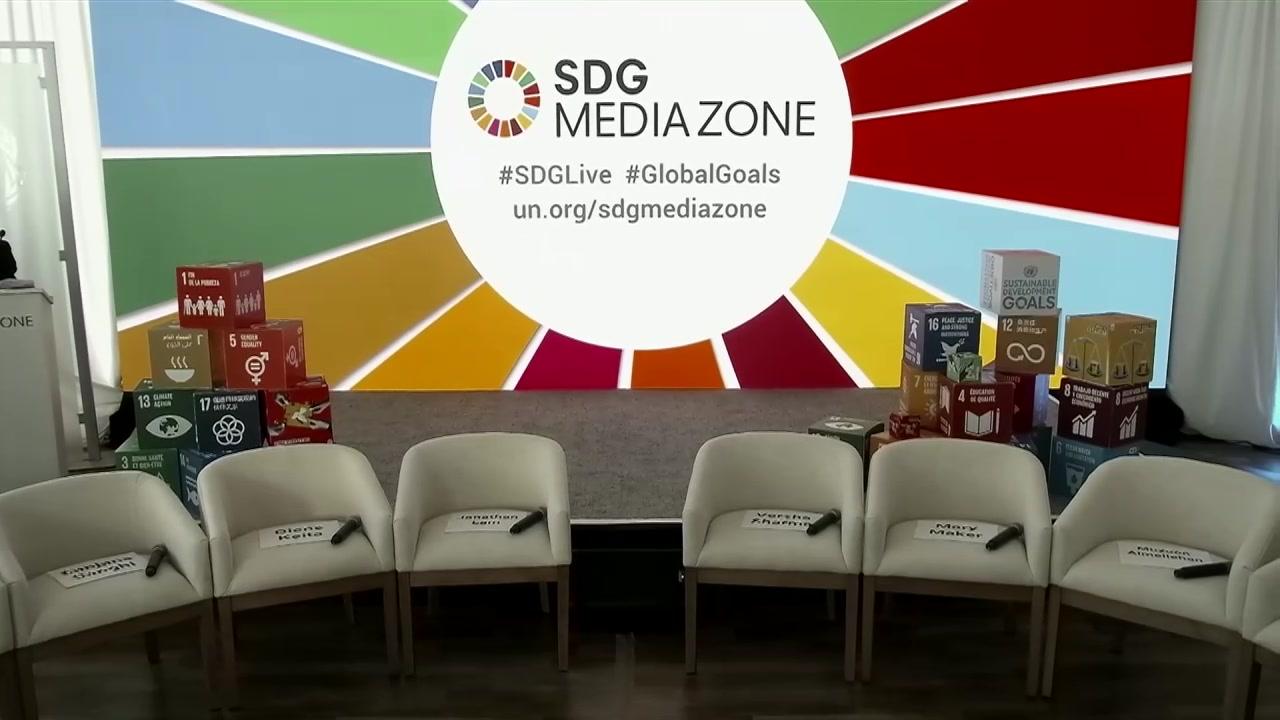
- SDG Media Zone 10th anniversary: Robert Skinner opened Day 1 marking a decade of the platform and thanking the PVBLIC Foundation and Microsoft as sponsors.
- Secretary-General's video message: António Guterres called the SDGs "our rescue plan for a fairer and more sustainable world" while warning that progress is "far off track."
- "One in a Million" documentary: Under-Secretary-General Melissa Fleming screened excerpts from an upcoming FRONTLINE PBS documentary following Isra, a Syrian refugee, over a decade-long journey.
- Terrestrials United campaign premiere: Robert Skinner introduced wearable art by Gorillaz co-creator Jamie Hewlett supporting UN Human Rights' movement against hate. A video featured UN High Commissioner for Human Rights Volker Türk wearing the campaign's t-shirt.