Human Rights for All - From Commitment to Collective Action
UNHQ Side Events • United NationsSeptember 23, 2026
Locunity is an independent informational service and is not an official government page for this commission. All information is sourced from public footage and an analysis of official agendas with the aid of responsible, fact-checked AI. to report an error or omission.
UN Launches Global Human Rights Alliance With Ambitious 2028 Targets
The UN's top human rights official formally launched a new coalition to push back against what he described as a global retreat on human rights — setting concrete goals for the 80th anniversary of the Universal Declaration of Human Rights in 2028, securing a €2.5 million pledge from the Netherlands, and drawing support from more than a dozen governments, major NGOs, and private sector leaders. The event, held on the sidelines of the UN General Assembly, also surfaced urgent fault lines: an escalating US campaign against the International Criminal Court, the absence of AI governance guardrails, and a global inequality crisis that speakers framed as a direct threat to democratic institutions.
- Global Alliance for Human Rights formally launched with targets of 1,000 human rights cities, universal jurisdiction in 120 countries, and 150 climate justice initiatives by December 2028
- Netherlands pledges €2.5 million to back the Alliance's accountability work worldwide
- Human Rights Watch warns ICC faces "existential threat" from US sanctions and announces lawsuit against Trump administration
- Oxfam chief frames rising oligarchy as defining human rights challenge, citing 3,000 billionaires holding $18.3 trillion while 800 million go hungry
- COP30 envoy links climate action to human rights law through new Sumaúma Initiative collecting concrete state commitments
- AI governance gap flagged as OHCHR open letter demands transparency and human rights due diligence from tech industry
From Defense to Offense: The Alliance Takes Shape
Why it matters: The Global Alliance for Human Rights represents an explicit strategic pivot — from defending existing international norms to building a broad-based coalition that goes beyond governments to include civil society, business, academia, and youth. It arrives at a moment when powerful states are openly challenging the institutions that underpin the international human rights system.
Where things stand: UN High Commissioner for Human Rights Volker Türk framed the Alliance as a response to years of institutional erosion. "Many of us who have been working on human rights issues for a very long time share the sentiment that we have been put on the defensive, and we all thought that it is important to be on the offensive," he said. The Alliance, launched in Geneva in June 2026, is designed as an organic, non-bureaucratic platform rather than a new institutional process — connecting governments, NGOs, youth, and the private sector around shared commitments.
Türk laid out specific benchmarks for the 80th anniversary of the Universal Declaration in December 2028: expanding from 120 to 1,000 human rights cities worldwide, growing from five to 100 sports champions supporting human rights, broadening universal jurisdiction from 40 to 120 countries, launching 150 climate justice initiatives, and mobilizing youth groups and philosophers to defend the universality of rights. He also raised alarms about artificial intelligence, warning that "AI has a huge potential to take that away from us, especially when you look at autonomous weapons and the type of drones that are being used at warfare these days."
Netherlands Prime Minister Rob Jetten announced the €2.5 million Dutch contribution and offered a combative framing of the political landscape. "Human rights are not a hobby for a small and privileged group. In fact, human rights affect us all," he said. Jetten was blunt about the forces arrayed against minority protections: "The attacks on queer rights, on women's rights, or other minorities — they're very well organized by some groups that are very well financed, and they go after, for example, trans people. And if they finish that job, they will go after another."
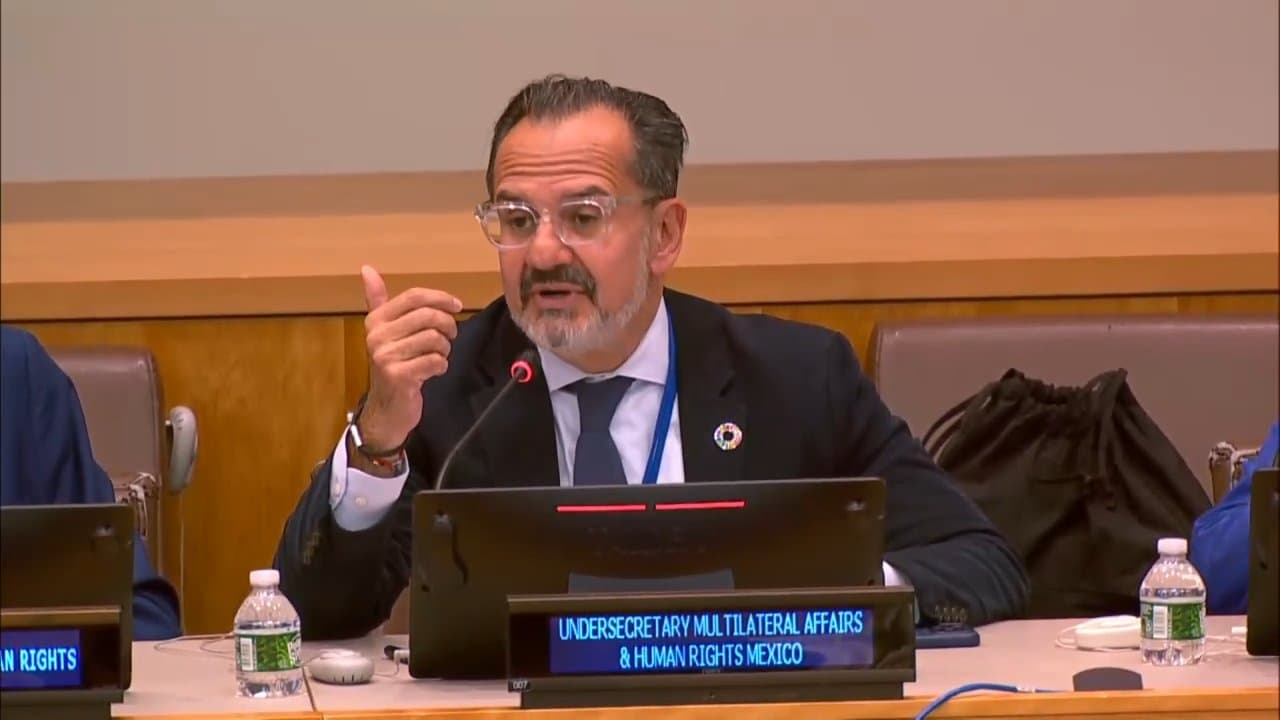
Mexico's Undersecretary for Multilateral Affairs and Human Rights Enrique Javier Ochoa Martinez outlined three pillars for closing the gap between commitments and lived realities: political will, strong institutions with accountability mechanisms, and meaningful participation by affected communities. "Human rights commitments become meaningful only when they are translated into public policies, institutions, and services that improve people's lives," he said, citing Mexico's record of lifting more than 13 million people out of multidimensional poverty since 2018 through minimum wage increases and strengthened labor protections.
Decisions: Statements of support came from Liechtenstein, Montenegro, France, the European Union, Estonia, Finland, Bangladesh, Kazakhstan, and Venezuela, as well as Amnesty International, Human Rights Watch, Human Rights First, and Oxfam International. Philips Global Head of Government and Public Affairs Jan-Willem Sechort represented the private sector, arguing that the traditional separation between government duty to protect and business duty to respect human rights must give way to shared responsibility.
What's next: The Alliance's effectiveness will be measured against the specific 2028 benchmarks Türk outlined. Whether the coalition can grow beyond its initial supporters — particularly among states in the Global South and Global East — will determine whether it becomes a durable force or remains aspirational.
ICC Under Siege: HRW Sues Trump Administration
Why it matters: The International Criminal Court, the primary global institution for prosecuting war crimes and crimes against humanity, is facing what advocates describe as a coordinated campaign by the United States to render it ineffective — testing whether its 125 member states will act collectively to shield it.
Where things stand: Human Rights Watch Executive Director Philippe Bolopion delivered the sharpest warning of the event. "A few weeks ago, the US Secretary of State, Marco Rubio, promised to dismantle the court brick by brick, and he means it," he said. Bolopion announced that Human Rights Watch is suing the Trump administration in US courts to strike down the sanctions regime targeting the ICC and called on the court's member states to come together in its defense.
Human Rights First President and CEO Uzra Zeya reinforced the alarm, describing the US campaign as jeopardizing decades of accountability progress. The Netherlands was referenced as raising the possibility of deploying an EU blocking mechanism to blunt the impact of US sanctions on European entities cooperating with the court.
The other side: No speakers at the event defended the US position, though Venezuela's Vice Minister of Multilateral Affairs used the floor to raise concerns about politicization and selectivity in the application of international human rights standards more broadly — a critique that several Global South governments have historically applied to the ICC itself.
What's next: The HRW lawsuit will proceed through US federal courts. The broader test is whether ICC member states — particularly European governments with significant economic ties to the US — will follow through on collective defense or quietly accommodate the pressure.
Climate Meets Human Rights: COP30's Sumaúma Initiative
Why it matters: As COP30 approaches, the question of whether climate negotiations will meaningfully integrate human rights principles — particularly protections for Indigenous peoples, environmental defenders, and communities facing displacement — is emerging as a central fault line.
Where things stand: COP30 Presidency Special Envoy for Human Rights and a Just Transition Denise Dora introduced the Sumaúma Initiative, named after the Amazonian tree of life. The initiative creates a "pledging tree" that collects concrete examples of states incorporating human rights into climate solutions — building a library of implementation practices rather than producing another set of aspirational declarations.
Dora highlighted Brazil's protection program for environmental defenders, journalists, and lawyers as a model. "If we have protection programs for environmental defenders in different parts of the world, we would probably have less killings, less impunity, much more people feeling confident to protect their own territories," she said. "So this is a climate solution based on a very important human rights principle, which is the protection of life."
She also made a pointed legal argument: states participating in climate negotiations have already ratified human rights conventions that legally bind them to incorporate these commitments — they simply need to be reminded of their existing obligations.
Youth speaker Naranzaya Batsaikan, a climate innovator from Mongolia, reinforced the connection, committing to advance "climate as a human right" — a formulation that, if adopted more broadly, could reshape the legal and political framework for climate litigation and policy.
Oligarchy and the Fight for Human Rights' Soul
The basics: Oxfam International's intervention reframed the human rights conversation from a legalistic exercise to a confrontation with concentrated economic and political power — an argument that several panelists echoed.
Where things stand: Oxfam International Executive Director Amitabh Behar presented stark numbers. "You have 3,000 billionaires who own $18.3 trillion, which is the GDP of China, and on the other hand, you have more than 800 million people actually sleeping hungry," he said. Behar argued that the super-rich are no longer content with wealth alone but are actively buying political power, creating oligarchies that human rights frameworks must confront directly.
He called for a fundamental reorientation. "This is a moment where we must recognize human rights is not just about the legality of it. How do we convert it from a technocratic, legal-centric approach to a people-centric approach?" he said, calling for a "rainbow coalition" that brings together climate justice, gender justice, academics, lawyers, and media. Behar also paid tribute to more than 3,000 humanitarian workers killed in conflict zones over the past three years.
Why it matters: The framing tension between legalistic and populist approaches to human rights advocacy is not merely rhetorical. It reflects a real strategic question about whether the international human rights movement can retain relevance amid deepening inequality — or whether its institutional language alienates the very populations it aims to protect.
AI Governance: Open Letter, but Few Guardrails
Where things stand: High Commissioner Türk's recent OHCHR open letter on artificial intelligence — issued approximately two weeks before the event — called on the tech industry to improve transparency, human rights due diligence, and impact assessments. He specifically flagged autonomous weapons and drones in warfare as threats to human agency that require urgent governance.
Two national programs offered contrasting approaches. Estonia's Undersecretary for Global Affairs Mina-Liina Lind presented the AI Leap program, which brings AI literacy into schools so young people can critically evaluate AI's societal impact. Republic of Korea Deputy Minister of Multilateral and Global Affairs Chang Wook Jin advocated for transparent, human-centered digital governance grounded in international human rights standards, referencing Korea's lead sponsorship of the Human Rights Council resolution on new and emerging digital technologies.
Why it matters: The gap between the pace of AI deployment — particularly in surveillance, warfare, and content moderation — and the development of governance frameworks continues to widen. The OHCHR letter represents the strongest statement yet from the UN human rights system, but without binding mechanisms, implementation remains voluntary.
Minor Items
- Amnesty International Secretary-General Agnès Callamard announced "Constellation 2048," a new initiative to reimagine human rights for future generations, calling on people to be "as brave, as foresighted, as visionary as the 1948 generation."
- Netherlands UN Youth Representative Emma van Nieuwenhuisen committed to bringing young people into decision-making spaces and connecting the youth agenda to climate and digital rights.
- Bangladesh's Minister for Law, Justice and Parliamentary Affairs testified about the country's democratic renewal after the July 2024 revolution, citing approximately 1,400 people shot dead and 30,000 permanently impaired in 20 days, and described new legislation on enforced disappearance and the National Human Rights Commission Act 2026.
- Philips Global Head of Government and Public Affairs Jan-Willem Sechort noted that it takes six times longer for a woman to be diagnosed and treated for cardiovascular disease than a man, arguing the private sector must share responsibility for rights-based outcomes.
- Montenegro Deputy Prime Minister and Minister of Foreign Affairs Ervin Ibrahimović, Liechtenstein Deputy Prime Minister and Minister of Foreign Affairs Sabine Monauni, France Ambassador-at-Large for Human Rights Isabelle Rome, EU Managing Director for Multilateral Relations Martin Bill Herrmann, Kazakhstan Director of Multilateral Cooperation Didar Temenov, and Finland's Vice Minister all delivered statements of support for the Alliance.
- Venezuela's Vice Minister of Multilateral Affairs expressed support while raising concerns about politicization and selectivity in the application of international human rights standards.