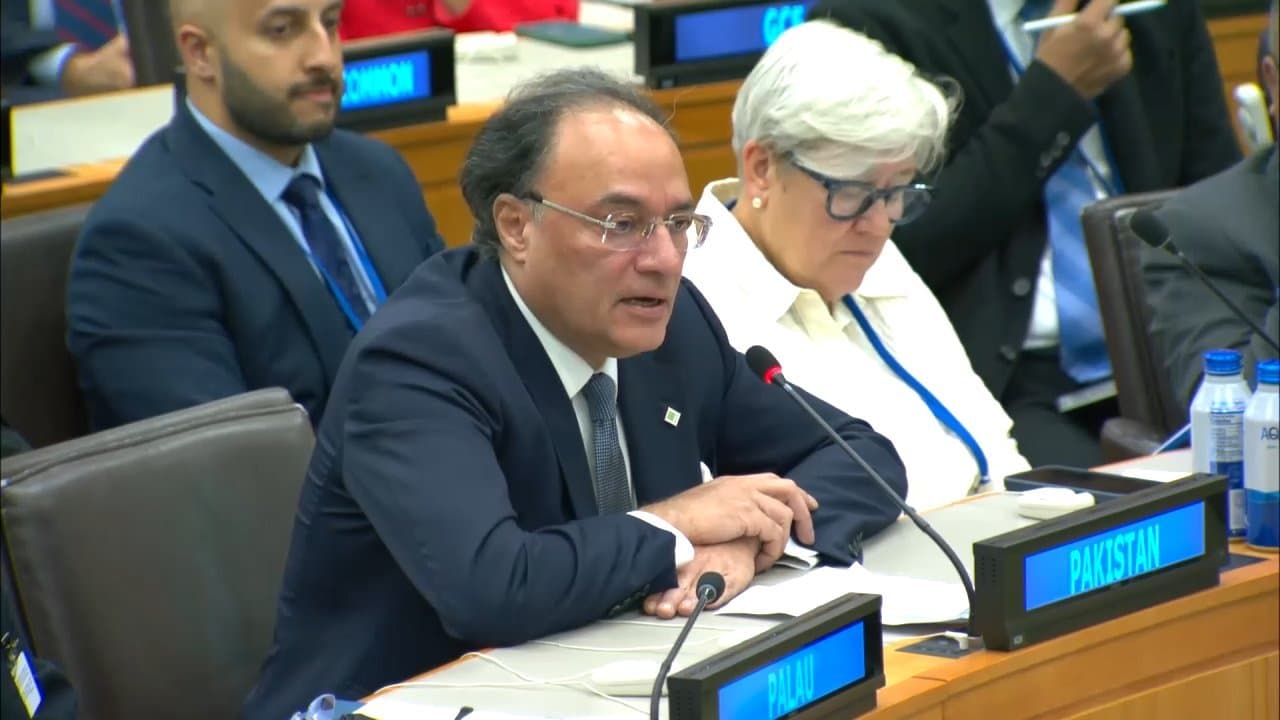
Climate Finance - Solutions Dialogues, Climate Summit 2026
UNHQ Side Events • United NationsSeptember 22, 2026
Locunity is an independent informational service and is not an official government page for this commission. All information is sourced from public footage and an analysis of official agendas with the aid of responsible, fact-checked AI. to report an error or omission.
Climate Finance Leaders Converge on Scaling Risk Pools and Cutting MDB Red Tape
The Climate Finance Solutions Dialogues at the 2026 Climate Summit brought together an extraordinary concentration of MDB chiefs, finance ministers, and climate fund executives — and the consensus was blunt: the architecture built to channel $1.3 trillion a year to developing countries is too slow, too fragmented, and too expensive to match the pace of climate disasters already arriving. From a $6 billion deal strangled by duplicative due diligence to a Loss and Damage Fund facing $2.8 billion in requests with only $250 million on hand, the gap between ambition and delivery dominated the day.
- Africa's risk pool urges volume over subsidies as path to insurance self-sufficiency
- $6B project deal exposes multi-institution due diligence bottleneck, spurring calls for harmonized MDB standards
- Loss and Damage Fund reports 176 requests from 119 countries worth $2.8B — with only $250M available
- Nigeria, Pakistan, and India demand local currency solutions and warn climate finance is being swallowed by exchange rate risk
- COP31 co-presidencies launch the Climate Implementation Bridge and SIDS access-to-finance plan ahead of Antalya
- EIB announces Global Green Bond Initiative of up to €20B for developing country markets
- UK calls for re-rating MDBs to free $600–$800B in deployable capital
Insurance as Fiscal Infrastructure: Africa and the Pacific Make the Case for Scale
Why it matters: Regional risk pools like the African Risk Capacity Group already channel parametric insurance to dozens of governments — but with subsidies declining and climate disasters intensifying, the question is whether these pools can grow fast enough to survive on their own.
Where things stand: David Maslow, CEO of the African Risk Capacity Group, framed the problem not as a shortage of tools but of volume. ARC pools $2 billion in drought, flood, and cyclone risk annually across 23 African governments, yet its mutual insurance model requires far greater scale to be self-sustaining.
"Africa does not lack instruments. We have parametric insurance, contingent credit, catastrophe bonds, pre-arranged humanitarian finance, but what we lack is scale," said Maslow. He added: "Subsidies gets us started. Volume is what helps us to stand on our own, and because ARC is a not-for-profit mutual insurance company, when we perform, the surplus goes back to the member states."
Elizabeth Henderson, Chief Sustainability Officer at Aon, reinforced the point with hard numbers: $2.5 trillion in disaster payouts globally since 2000. She cited Jamaica's catastrophe bond as a model — "a catastrophe bond that Jamaica had purchased that paid out $150 million in losses within 5 weeks directly to Jamaica to help them with the recovery and rebuilding" after Hurricane Melissa. Moody's subsequently upgraded Jamaica's sovereign debt rating, she noted, demonstrating how insurance instruments can improve a country's fiscal standing, not just absorb losses.
Avinash Persaud, Special Advisor on Climate Change at the Inter-American Development Bank, pushed further, calling for pause clauses in all debt instruments, 40- to 50-year lending maturities, and debt-for-resilience swaps — structural changes that would embed climate risk management into the architecture of sovereign finance itself.
Rachel, Chief Sustainability Officer at Convex Insurance and co-chair of the Insurance Development Forum's Risk Modeling Steering Group, pointed to Thailand's $2 billion national catastrophe cover protecting 30 million residential units as proof that private reinsurance markets can absorb more than 90% of sovereign catastrophe risk when the structure is right.
Sarah Jane Ahmed, Managing Director of the Climate Vulnerable Forum, offered a striking statistic: the CVF's 74 member states would be 20% wealthier without climate change. She called for shared market infrastructure, standardized diagnostics, and the V20 100 Banks Program to bring developing-country financial institutions into climate risk management.
What's next: Panelists converged on the idea that insurance must stop being treated as a niche product and start being embedded in how agriculture, health, and infrastructure are financed — a shift that would require governments, MDBs, and private reinsurers to coordinate at a scale none have yet achieved.
The $6 Billion Bottleneck: MDB Reform and the Fight Over Due Diligence
Why it matters: Developing countries have long complained that accessing climate finance takes years of navigating duplicative processes across institutions. At this session, the heads of major climate funds and development banks acknowledged the problem — and offered competing visions of how to fix it.
Where things stand: Mafalda Duarte, Executive Director of the Green Climate Fund, put a price tag on fragmentation. She described a recent $6 billion project finance deal involving multiple MDBs, the private sector, and GCF itself where each institution's separate policies, safeguards, and requirements multiplied the due diligence timeline.
"We have just gone through a process, a very large project finance of $6 billion, with many different institutions, MDBs, private sector, ourselves, and others, and different institutions with different policies, with different requirements, that makes the due diligence process double, multiple times," said Duarte. She praised the Loss and Damage Fund for adopting GCF-accredited entities — a form of mutual recognition that she urged all institutions to replicate.
Mark Bowman, Vice President of the EBRD, acknowledged the challenge and highlighted mutual reliance progress, pointing toward the bank's $150 billion green finance target by 2030. Ambroise Fayol, Vice President of the European Investment Bank, announced the Global Green Bond Initiative — up to €20 billion aimed at creating green bond markets in developing countries — and described a strategic shift from directly financing projects like wind farms to providing counter-guarantees for local banks, a move designed to multiply the EIB's impact through local financial systems.
Small island developing states drove the point home. The delegate from Palau, representing the Alliance of Small Island States, and the delegate from the Marshall Islands both described the disabling complexity of navigating dozens of different fund processes with tiny government staffs. The Marshall Islands delegate called for interoperability, direct budget support, and reformed credit rating methodologies that recognize climate vulnerability rather than penalizing it.
What's next: The convergence between fund heads, MDB vice presidents, and SIDS representatives on harmonized due diligence is notable — but implementation requires governments sitting on MDB boards to actually push for policy changes. Whether COP31 produces binding interoperability commitments or another round of aspirational language will be a key test.
Currency Risk, Bureaucracy, and the $300 Billion Shortfall: Developing Country Finance Ministers Speak
Why it matters: The $300 billion annual climate finance target agreed at COP29 was already seen by many developing countries as inadequate. At this session, finance ministers from Pakistan, Nigeria, and India described the structural barriers that prevent even that insufficient sum from reaching the communities that need it.
Where things stand: Muhammad Aurangzeb, Minister of Finance of Pakistan, drew a sharp distinction between countries that can help themselves and those still seeking external rescue. He described Pakistan's evolution: in 2022, devastating floods sent the government running to Geneva for international pledges. By October 2025, when more severe flooding struck, Pakistan's improved fiscal position allowed it to fund rescue and relief domestically.
"Last year's flood, October '25, was more severe in terms of the provinces and the number of rivers involved, but given because we were in a much better macro situation, the Prime Minister and the Cabinet decided that we are going to use our own resources for rescue, relief, rehabilitation and, to a certain extent, reconstruction," said Aurangzeb. He cited the World Bank's $700 million climate vertical under a 10-year country partnership framework, a $1.2 billion IMF Resilience and Sustainability Facility, and Pakistan's inaugural green Panda Bond — but warned that GCF accreditation bureaucracy remains a major barrier.
Taiwo Oyedele, Minister of Finance and Coordinating Minister of the Economy of Nigeria, raised a structural problem that no amount of fund reform can solve alone: currency risk. "Africa, for example, is perhaps the only continent, clearly one of the only major continents, that has no international reserve currency. So whenever we have to finance anything, we have an added risk in Africa of a currency risk," he said. Nigeria's experience is stark — the naira's depreciation from ₦460 to ₦1,300 per dollar effectively turned foreign loans into instruments with 200% effective interest rates, swallowing any concessional benefit.
Oyedele also pushed back against the framing of climate action as requiring developing countries to sacrifice livelihoods for environmental goals, describing Nigeria's "Green Advantage" strategy as an attempt to balance the two.
Sudhakar Dalila, Vice Minister of External Affairs of India, insisted that climate finance must be "new and additional" — not redirected from existing development budgets. "The $300 billion annual target falls well short of needs," he argued, and called for developed countries to meet their obligations without repackaging existing aid.
Decisions: No formal votes were taken — this was a solutions dialogue — but the alignment among three major developing countries on local currency finance, reformed risk assessments, and "new and additional" commitments signals a negotiating bloc likely to press these demands at COP31.
Three Pillars and a Traffic Light: Mohieddine's Framework for Delivery
Why it matters: With $1.3 trillion needed annually under the Baku-to-Belém roadmap, the gap between climate finance pledges and actual disbursement is the central challenge heading into COP31. Mahmoud Mohieddine, the UN Special Envoy on Financing for Development, offered a three-pillar framework aimed at closing it.
The pillars: (1) country-led investment platforms backed by national budgets — not donor wish lists; (2) coordinated coalitions linked to those country priorities; and (3) affordable capital stacks combining grants, guarantees, local currency finance, and prearranged insurance.
Mohieddine was blunt about the first pillar's prerequisite: "If it is not in the budget, it doesn't exist. If the ministers of finance are not seeing it as a priority with their parliaments, there is something that is really very much missing."
He proposed a traffic-light review mechanism — red, yellow, green — measuring scale, speed, reach, and impact of climate finance flows, referencing GFANZ blended finance work with BII and BCG. And he argued for ending the artificial division between "climate clubs" and "development clubs," a structural split that he said prevents integrated solutions.
COP31 Takes Shape: Türkiye and Australia Launch Implementation Bridge
Why it matters: With COP31 marking the end of the first decade of the Paris Agreement, the co-presidencies used this session to signal their priorities — and the emphasis is on converting a decade of pledges into bankable, country-owned investment pathways.
Ayşen Tuzparazi, representing the COP31 Presidency of Türkiye, described the Climate Implementation Bridge as a co-presidency-led, country-owned initiative that would connect national climate priorities to investment-ready opportunities. The mechanism will use UNDP's Climate Promise as its delivery vehicle, with pilot countries to be announced Sept. 24.
Dr. Sally Box, representing the COP31 Presidency of Australia, announced an Access to Climate Finance for SIDS and LDCs statement and action plan developed through consultations with more than 100 stakeholders. The plan calls on public finance institutions to enhance coordination, reduce fragmentation, and shift toward programmatic approaches. Australia pledged increasing climate finance commitments.
Benoît Farosso, representing France's Ministry of Ecological Transition, emphasized the need to leverage private capital for adaptation, citing a Jordan water project co-funded with private investors. He pushed for full early warning system coverage before scaling loss and damage finance.
"Not an Institutional Conversation — a Human One": The Loss and Damage Fund's Impossible Math
Ibrahima Cheikh Diong, Executive Director of the Fund for Responding to Loss and Damage, reframed the session's technocratic tone with a visceral reminder: "I had a feeling when we talk about climate finance, we make it to be an institutional conversation, not a human conversation. As we speak, because of flood in Nepal, 1,200 people actually passed. And 5,000 that actually are missing."
The fund's numbers tell their own story: 176 funding requests from 119 countries worth $2.8 billion — against only $250 million available. Diong praised GCF's decision to allow the Loss and Damage Fund to use GCF-accredited entities, reducing the accreditation burden, but the 11-to-1 ratio between demand and supply underscores the scale of the financing gap.
Re-Rating the System: The UK's $800 Billion Idea
Rachel Kite, Special Representative on Climate Change for the United Kingdom, offered what may have been the session's most consequential proposal in dollar terms. "If we were to re-rate the MDBs, that would free up $600 to $800 billion of headroom and capital that could be deployed," she said.
Kite cited the Nepal-China border disaster as evidence that the financial system was built for slow-onset crises, not the acute shocks now arriving, and offered the UK's G20 presidency as a vehicle for pushing MDB re-rating forward — a reform that credit rating agencies and MDB shareholders have so far resisted.
Country Ownership and the Bridgetown Push
Pep Baduy, Director of the Bridgetown Initiative and Special Advisor to the Prime Minister of Barbados, challenged what he called the persistent fiction that country ownership is a new idea. "The fact that we continue to speak about country ownership is something that I find mystifying. If that is not taken for granted, then I ask myself, what world have we been living in?" he said.
Daniel Best, President of the Caribbean Development Bank, highlighted a concrete example of what scaled support looks like: Canada's $200 million portfolio credit guarantee to the CDB, signed by Prime Minister Carney, which will enable up to $450 million in additional financing. "The Government of Canada, Prime Minister Carney signed off on a portfolio credit guarantee to the Caribbean Development Bank of $200 million, which will increase our scale of financing by up to $450 million," said Best.
Baron Divavesi-Vapav, Secretary-General of the Pacific Islands Forum, called for full capitalization of the $500 million Pacific Resilience Facility, noting that Pacific nations themselves have contributed 48% of current funding — a pointed reminder that the countries most vulnerable to climate change are already investing in their own survival.
- GFANZ blended finance: Mary Shapiro, Vice Chair of the Glasgow Financial Alliance for Net Zero, discussed GFANZ's work with BII and BCG on blended finance structures to mobilize private capital.
- UNDP Climate Promise: Marcos Neto, Assistant Secretary-General at UNDP, described the Climate Promise as the delivery mechanism for the Climate Implementation Bridge, with pilot countries forthcoming.
- Finance in Common: Rémy Rieu, CEO of Finance in Common, spoke on the role of public development banks in coordinating climate finance delivery.
- BBVA sustainability: Antonio of BBVA discussed the bank's sustainability intelligence and advocacy work in the context of scaling private climate finance.
- Indonesia's position: Indonesia's Deputy Minister of Environment addressed the session on the country's climate finance priorities and access challenges.
- Azerbaijan/Baku follow-through: Yalchin Rafiyev, Deputy Minister of Foreign Affairs of Azerbaijan, spoke on the Baku Finance Goal and the Baku-Belém Roadmap connecting COP29 commitments to COP30 delivery.