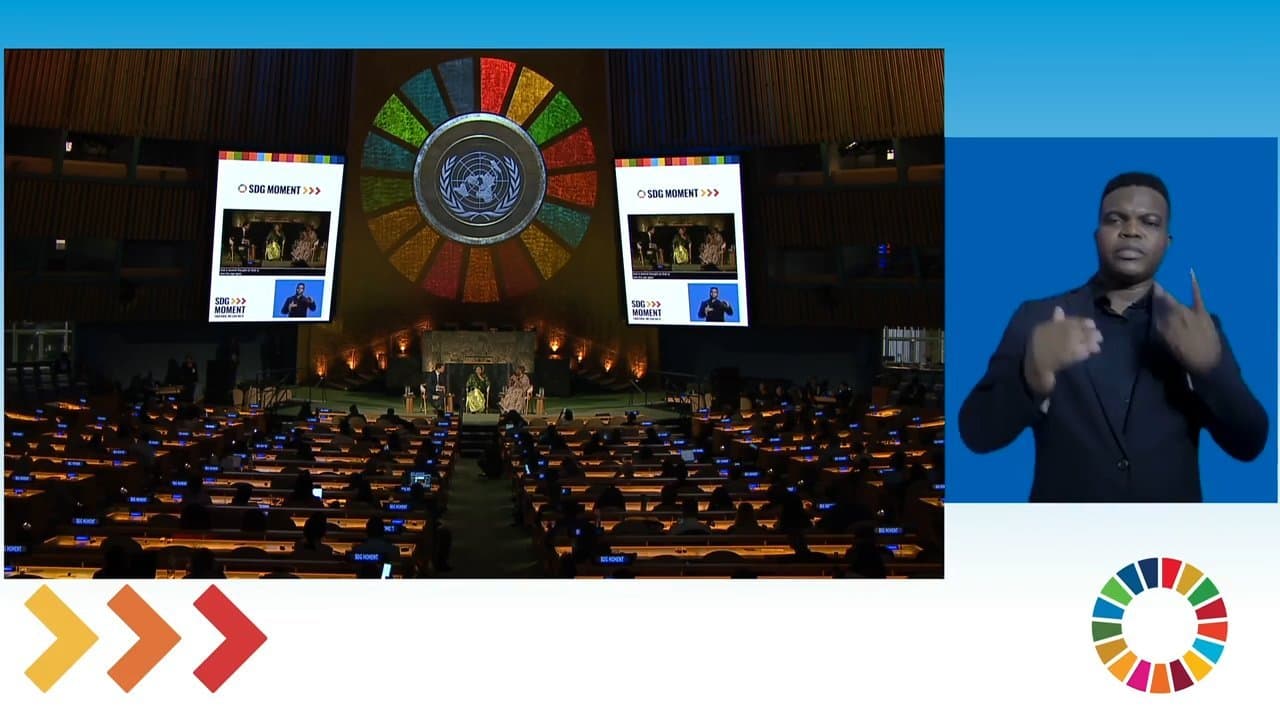
2026 SDG Moment - Together, We Can Do It
UNHQ Side Events • United NationsSeptember 18, 2026
Locunity is an independent informational service and is not an official government page for this commission. All information is sourced from public footage and an analysis of official agendas with the aid of responsible, fact-checked AI. to report an error or omission.
SDG Progress Stalls as Leaders Confront Compounding Global Crises
The United Nations convened its 2026 SDG Moment on Sept. 18 at General Assembly headquarters with a blunt assessment: only 36% of Sustainable Development Goal targets are on track, 15% have regressed below 2015 baselines, and official development assistance fell 23% this year — the sharpest decline ever recorded. With four years left before the 2030 deadline, senior officials, ministers, Nobel laureates and youth leaders used the event to demand debt relief, AI governance, climate finance and a generational transfer of power.
- Only 36% of SDG targets on track; 15% have slipped below 2015 baselines as $8.9 trillion in external debt forces developing nations to pay more on interest than on education
- Secretary-General Guterres calls SDG promises "not being kept," identifies four priority areas for the final stretch: inequality, climate, finance and technology
- Nobel laureate Maria Ressa declares frontier AI "uncontrollable," warns 75% of global compute power sits in the United States and information integrity is collapsing
- Benin issues Africa's first SDG bond and triples domestic revenue in a decade; Bangladesh proposes five-point overhaul of the global financial architecture
- Mission 300 partnership connects 60 million people to electricity at five times the previous pace; Nigeria adding 1 million solar connections per month
- Deputy Secretary-General Amina Mohammed delivers what may be her final SDG address, calling 2030 "a runway, not a countdown"
- Civicus and Women Deliver warn shrinking civic space is directly undermining SDG delivery worldwide
The Scorecard: Real Gains, Systemic Gaps
The basics: The SDGs — 17 goals and 169 targets adopted in 2015 — are the global framework for eliminating poverty, protecting the planet and ensuring prosperity. The 2026 SDG Moment is an annual General Assembly event designed to generate political momentum; the 2027 SDG Summit is now the last major political checkpoint before the 2030 deadline.
Why it matters: The data presented will shape negotiating positions, national budgets and donor commitments across every member state for the next year.
Where things stand: Secretary-General António Guterres opened with a forceful demand for accountability. "Progress was never automatic. It was earned through the determination of people, communities, and countries," he said, before delivering a sharper verdict: "The world continues to spend record sums on war, while development is starved for resources. The promises governments made in adopting the goals are not being kept. It is time to keep them."
Guterres pointed to the gap between military and development spending — $2.7 trillion on weapons annually versus a $4 trillion SDG financing shortfall — and identified four priority areas: fighting inequality, keeping climate promises, financing sustainable development and accelerating progress through data and technology. He called for debt relief, stating plainly: "Debt must serve development, not suffocate it."
President of the General Assembly Khaledur Rahman of Bangladesh reinforced the urgency with granular data. "Only 36% of SDG targets with available trend data are on track or making moderate progress. Nearly half, 49%, are moving too slowly, and 15% have slipped below their 2015 baseline," he said. He noted that 850 million people remain in extreme poverty and 2.1 billion face food insecurity. "For many among us, sustainability is a matter of life and death."
Rahman framed the remaining timeline not as abstract but operational: "We have 4 years to bring them to scale. That's 4 years to get more children into school, more food onto tables, more medicines into hospitals."
There are real gains to point to: nearly 1 billion more people have access to safely managed drinking water since 2015, electricity access has reached 92%, internet connectivity has jumped from 40% to 74%, and child and maternal mortality have continued to decline. But the headline is the gap between ambition and delivery — and the compounding forces making that gap harder to close.
What's next: Under-Secretary-General Lee Jun-hwa of the UN Department of Economic and Social Affairs called for the 2027 SDG Summit to be a "delivery moment, not another reporting cycle." ECOSOC President Ammar Benjama of Algeria proposed a special ECOSOC meeting on external debt — what would be the first dedicated session of its kind and could create political space for debt suspension mechanisms for the most vulnerable nations.
Debt vs. Development: The $4 Trillion Question
Why it matters: The Sevilla Commitment — the new political framework for financing reform — is the backdrop for an intensifying debate over whether the global financial architecture is structurally rigged against developing countries. Panelists argued it is.
Where things stand: Across multiple panels, a consistent picture emerged: developing countries are choosing between servicing debt and investing in their people. Rashid Al Mahmud Titumur, Advisor and Minister to the Prime Minister of Bangladesh, put it starkly: "Of 37 countries, 1.1 billion people receives amount less than their debt servicing." He laid out a five-point reform agenda: vulnerability-anticipating funding mechanisms, governance reform of international financial institutions, debt suspension with predictable finance beyond the 0.7% ODA target, alignment of national development priorities with programmatic rather than project-based financing, and strong graduation pathways for Least Developed Countries.
Zane Dangor, Director General of South Africa's Department of International Relations and Cooperation, described a structural inequity in borrowing: African countries pay more to borrow than developed countries with comparable GDP profiles. "Countries now default on development. They don't default on debt. Countries pay debt first before they deal with development issues, and that's part of the global financial architecture," he said. He identified the proposed Borrowers Club and African Credit Rating Agency as urgent near-term reforms.
The other side — and models that work: Minister of Economy and Finance Aristide Médenou of Benin offered a counternarrative of agency. Benin tripled its domestic revenue over a decade, issued Africa's first SDG bond, and created 25,000 jobs through a new industrial zone. "We have improved access to drinking water from 40% to 80% just in 5 years," he said.
Issa Faye, Director-General of Global Practice and Partnerships at the Islamic Development Bank, described innovative instruments including sukuk issuances exceeding $6 billion and the originate-to-distribute model. He detailed the Mission 300 partnership — the World Bank ($30 billion), the African Development Bank ($10 billion) and the IsDB working together to connect 300 million Africans to electricity.
Ambassador Hector Gomez Hernandez, Spain's Permanent Representative to the United Nations, confirmed Spain is organizing an autumn Seville Forum on Debt, building on the Sevilla Commitment framework.
What's next: Whether the Borrowers Club and African Credit Rating Agency move from concept to operation will be a key indicator of whether financing reform gains traction before the 2027 Summit.
AI Governance: 'The Mother of All Battles'
Why it matters: The UN Scientific Panel on AI's preliminary finding that frontier artificial intelligence is "uncontrollable" raises immediate governance questions for every member state as the technology reshapes economies, elections and information ecosystems.
Where things stand: Maria Ressa, Co-Chair of the Independent International Scientific Panel on Artificial Intelligence and 2021 Nobel Peace Prize laureate, delivered perhaps the most arresting remarks of the day. She mapped technology's trajectory from social media — which she described as attention hacking — through generative AI's capacity for artificial intimacy, to agentic AI, which she characterized as agency theft.
The power asymmetry, she argued, is already locked in: "75% of the world's compute power is in America. It's supposedly America versus China, but it's not, because 15% of the compute power is in China. And the EU, which is protecting all of us, with safety regulations, only has 5%."
Ressa connected AI directly to the SDG agenda: "If we cannot tell the difference between fact and fiction, we cannot do anything. We don't have a shared reality. Journalism will die. Democracy will die. You cannot accomplish the Sustainable Development Goals."
Deputy Secretary-General Amina Mohammed acknowledged that AI did not exist when the SDGs were adopted in 2015 but will shape their delivery. She warned about biased algorithms already screening job applications while acknowledging AI's potential for persons with disabilities.
Enzo Romero, Founder of LAT Bionics, illustrated both the promise and the cost barrier of assistive technology. He described how imported robotic prostheses cost $25,000 — requiring seven years of savings for a daily worker in Peru — while affordable alternatives developed in Latin America can transform lives. "According to UNOPS, for every dollar that you get to invest in assistive technologies, there might be a return into $9 into the family of that person, and that is powerful," he said.
What's next: The Scientific Panel on AI is completing its report; Ressa's characterization of AI as uncontrollable signals a governance gap that will drive debate through the General Assembly session and into the 2027 Summit preparatory process.
Climate Overshoot Meets Energy Access
Why it matters: The framing of energy "transition" versus energy "access" determines whether the world's poorest populations benefit from the clean energy shift or are left behind. The climate trajectory points to 2.8°C of warming — well past the Paris Agreement's 1.5°C target.
Where things stand: Charity Ropati, an Indigenous water engineer from Kongiganak, Alaska, and member of the UN Secretary-General's Youth Advisory Group on Climate Change, grounded the discussion in lived experience. She described how her community relocated homes using ropes, ski-doos and dog sleds in 1967 because of permafrost thaw — with no federal support then or now. She challenged the framing of Indigenous communities as passive victims: "Indigenous peoples have been stewarding land, ecosystems, and waters for generations, and our communities have already been developing these solutions." She cited the Youth Climate Justice Fund's $8 million investment in youth climate movements globally.
Damilola Ogunbiyi, CEO of Sustainable Energy for All, shifted the frame from transition to access. She noted 600 million people still lack electricity and 2.4 billion lack clean cooking. For those populations, she argued, "you can't talk about transition." She cited Nigeria connecting 1 million households to solar per month and Pakistan's rooftop solar boom. She called for local currency finance mechanisms that could reduce borrowing costs from 28-29% to 2-3%.
The Mission 300 initiative has already connected 60 million people to electricity at five times the previous speed — a proof of concept that multilateral development bank cooperation can deliver results at scale.
Deputy Secretary-General Mohammed noted the 1.5°C Paris target is in jeopardy but argued the door is not closed if emissions fall and clean energy finance reaches developing countries.
The Power of the Pen: Youth, Mental Health and Intergenerational Justice
Why it matters: With over 70% of populations in many developing countries under 30 — and leaders decades older — the intergenerational power gap is a structural barrier to SDG implementation, not just a symbolic concern.
Where things stand: Youth was a thread throughout the event. More than 33,000 young people applied for the latest SDG Young Leaders cohort. Malala Yousafzai sent a video message. Young Leaders Suzuka Nakamura and Adeline Pierre spoke from the General Assembly balcony.
But the sharpest exchange came in a fireside conversation between Deputy Secretary-General Amina Mohammed, Monica Geingos — Executive Chairperson of the One Economy Foundation and former First Lady of Namibia — and Assistant Secretary-General for Youth Affairs Felipe Paollier. Mohammed recalled a young person's request: "Thank you for the voice, thank you for the table, can I now have the pen?" She argued that meaningful participation means shaping agendas, not just attending events.
Geingos was more direct: "We must have an older generation of leaders who step back." She urged that achieving the SDGs requires more than political representation for young people: "We'll never achieve SDGs, we'll never solve structural issues in our countries if we only talk about the political representation of young people. We must talk about young people being prepared to go into the public sector and into governments." Geingos described building a bricks-and-mortar integrated youth services center in Namibia using private equity skills — a model later replicated in Angola.
Both speakers raised mental health as a critical and underaddressed concern. Mohammed pointed to the anxiety she sees in young people and the gap between the support systems that existed for previous generations and what is available today: "Can a young person see a future worth building, or would they have to remain in the anxiety and the mental health that has no end to it?"
Mariam Solika, Founder and CEO of The Good News, argued that hope "is not optional — it's a survival mechanism" and called for access, funding and safety rather than abstract optimism.
Crises Compound: UNDP Chief's Warning
UNDP Administrator Alexander De Croo identified a new dynamic threatening SDG progress: the compounding effect of simultaneous crises. "What has changed over the past months is that all those obstacles are now starting to compound," he said, citing geopolitical instability, wars, food insecurity and spiking prices converging in ways not seen when the goals were adopted. He added bluntly: "One thing we don't talk often enough about is conflict is development in reverse."
Civic Space Shrinking
Secretary General Mandeep Tiwana of Civicus and President and CEO Malia Khan of Women Deliver delivered a joint warning that civil society — the engine of SDG accountability and service delivery — is under siege. Tiwana cited physical attacks, arbitrary detention and laws designed to prevent NGOs from accessing resources. Khan broadened the frame: governments, civil society, academia and multilateralism itself are all under attack. She urged that the SDGs be understood as about every person's right to thrive. Both called on governments to recommit to meaningful participation and a safe enabling environment for civic organizations.
Mohammed's Farewell: 'We're Not Done Yet'
Deputy Secretary-General Amina Mohammed — the chief architect of the SDGs — delivered what may be her final SDG Moment address before her term ends in December. She framed the remaining years not as a countdown but as an opportunity: "2030 is close enough to demand urgency and far away enough for us to make a difference, so we're not done yet." She warned that the SDGs were never a checklist but a declaration of values, and called for AI guardrails, intergenerational solidarity and renewed political will.
Her departure creates a leadership transition that will test whether the institutional momentum behind the 2030 Agenda survives a change at the top.
Minor Items
- Opening performance: The Broadway cast of The Lion King performed "Circle of Life" to open the event; Senegalese musician Baaba Maal closed with a call for peace.
- Musical interlude: Grammy winners Ella Brick and N'Dea Owens performed "On the Sunny Side of the Street."
- Theatrical performance: The Waterwell Theatre Company debuted The Future Speaks to Now, a play by Rajiv Joseph imagining a future where SDG promises were kept.
- EU Commission: Executive Vice President Teresa Ribera of the European Commission participated in the Leaders' Dialogue on leading SDG action.
- Panama social protection: Minister of Social Development Beatriz Carles de Arango of Panama contributed to the Leaders' Dialogue on social protection reforms.
- SDG Advocates video: Prime Minister Mia Mottley of Barbados and Prime Minister Pedro Sanchez of Spain, co-chairs of the SDG Advocates, warned in a pre-recorded message that the SDGs are "under attack" and called for doubling down on vulnerability measurement and long-term finance.