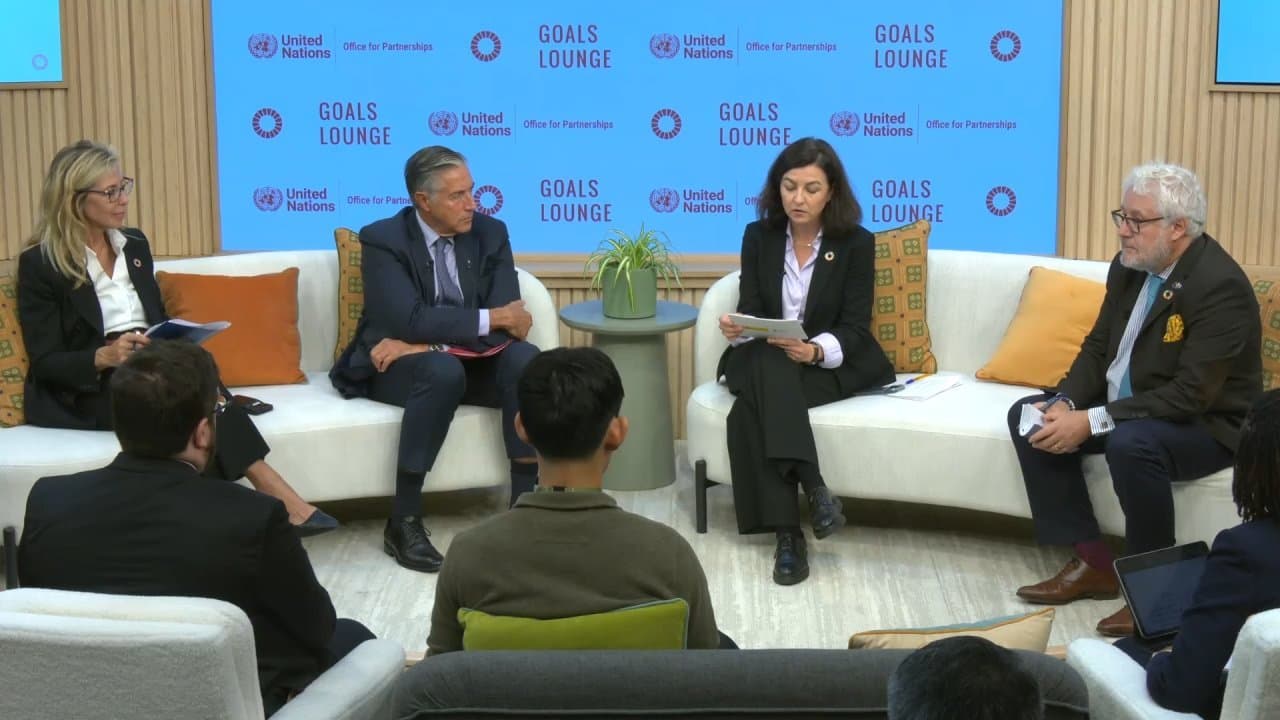
How the UN Is Turning SDG Priorities Into Investable Capital: Partnerships for Economic Transformation | Goals Lounge
UNHQ Side Events • United NationsSeptember 21, 2026
Locunity is an independent informational service and is not an official government page for this commission. All information is sourced from public footage and an analysis of official agendas with the aid of responsible, fact-checked AI. to report an error or omission.
UN Pushes to Elevate SDG Fund as Flagship Financing Instrument
At a high-level side event during the 81st UN General Assembly, the European Union, Spain, and senior UN officials made the case for transforming the Joint SDG Fund into a permanent pillar of the UN's financing architecture — backing the argument with concrete evidence that small catalytic investments are unlocking billions in private capital from Indonesia to Uruguay to Colombia.
- UN proposes redesignating the Joint SDG Fund as the Secretary-General's Fund for Development, placing it alongside CERF and the Peacebuilding Fund as a core institutional pillar
- Spain confirms €120 million pledge fulfilled, endorses the Fund's elevation, and champions gender equality and localization markers
- EU launches Global Green Bond Initiative targeting $20 billion in private capital and pledges €14 million for UN coordination as official development assistance drops 40%
- Uruguay's $7 million green hydrogen investment attracted a $20 million IFC loan — the first in Latin America for the sector — plus capital from Santander, HSBC, and Scotiabank
- Colombia reports 1-to-13 and 1-to-15 returns on blended finance investments in conflict-affected areas
- AI governance tensions surface as panelists weigh data center energy and water demands against development potential
A Bid for Institutional Permanence
The centerpiece announcement at the Goals Lounge event was the UN80 Initiative's recommendation to redesignate the Joint SDG Fund as the Secretary-General's Fund for Development — a move that would give the six-year-old pooled financing mechanism permanent institutional status within the UN system.
Why it matters: The redesignation would place the Fund alongside two established instruments — CERF for humanitarian response and the Peacebuilding Fund for post-conflict settings — completing a three-pillar architecture for UN financing. More practically, it could open the door to assessed contributions from member states rather than voluntary donations, significantly expanding the Fund's capitalization at a moment when traditional aid flows are contracting.
Where things stand: Assistant Secretary-General Oscar Fernandez-Taranco, delivering remarks on behalf of Deputy Secretary-General Amina Mohammed, made the case in blunt financial terms: "Every dollar it has invested has mobilized up to 20 more. Proof that when the UN de-risks, convenes, and leads with courage, markets follow."
The Fund has operated in more than 100 countries since its establishment in 2019, using relatively small initial investments to de-risk projects and attract far larger commitments from international financial institutions, commercial banks, and capital markets. Fernandez-Taranco cited a range of examples: Indonesia's first sovereign SDG bond growing into billions; Uruguay's renewable energy fund engaging seven major banks covering 80% of the country's banking sector; a green financing facility in North Macedonia built with EBRD and six local banks; and $10 million in seed capital for a women-led solar park in Zimbabwe.
"This is the time to increase ambition and support the capitalization of the Joint SDG Fund," Fernandez-Taranco said. "The capital exists. The model works. What we need now is scale."
Head of Secretariat Lisa Kurbiel framed the Fund's role carefully, noting it is not designed to compete with established development banks. "The Joint SDG Fund — the United Nations is not meant to replace the development finance institutions," she said. "We're not trying to edge in on space that is well preserved and well managed by the World Bank and others." The Fund's comparative advantage, she argued, lies in building the feasibility studies, policy environments, and cross-sector partnerships that make investments possible in the first place.
What's next: The redesignation proposal will move through the UN80 process, where it will require broad member-state support. The speed and scale of capitalization will depend on whether governments treat the new designation as a signal to shift from voluntary to assessed contributions.
Spain Steps Up as Anchor Donor
Secretary of State for International Cooperation Eva Granados Galiano positioned Spain unambiguously as the Fund's financial and political anchor.
The basics: Spain is the single largest contributor to the Joint SDG Fund, and Granados Galiano confirmed that the country has fully delivered on the €120 million pledge made by Prime Minister Pedro Sánchez at the last SDG Summit — a multi-year commitment designed to provide the kind of predictable funding that enables long-term program planning rather than one-off project cycles.
"Spain is the largest contributor of the Joint SDG Fund," she said. "Aware of the need of sufficient and predictable funding, we have made multi-year contributions to this key pool fund, and we have fulfilled with €120 million pledge made by our Prime Minister Pedro Sánchez at the last SDG Summit."
Why it matters: Beyond the money, Spain is shaping how the Fund operates. Granados Galiano highlighted two cross-cutting priorities — gender equality and localization — and spotlighted a localization marker co-developed by the Fund and the UN Local 2030 Coalition, which is hosted in Bilbao. The marker is designed to track how investments reach specific communities and territories, and Spain is working to promote its adoption across EU member states.
"Global tools for change will only be successful if they fully include women and girls as agents of change on equal footing, and also if these tools adapt to local needs and priorities and are able to reach in a pertinent manner every community in every territory, leaving no one behind," Granados Galiano said.
Spain explicitly endorsed the Fund's redesignation, calling for "an enhanced, better-funded Joint SDG Fund designed to serve as the backbone for the development pillar until 2030 and beyond."
EU Shifts Strategy as Aid Shrinks 40%
Director for Sustainable Development Policy and Coordination Luc Bagour of the European Commission delivered what amounted to a strategic reorientation: with official development assistance down 40% in three years, the EU is pivoting from traditional aid flows to catalytic market mobilization.
The basics: The EU's Global Gateway strategy operates on two tracks — leveraging public funds through guarantees and innovative instruments to attract private investment, and building enabling environments through regulatory frameworks and ESG standards in partner countries.
"We are moving from a traditional donor-recipient model focused primarily on aid to a relationship in which the European Union and its member states and partner countries collaborate on an equal footing around shared priorities and mutual interests," Bagour said.
Deal math: The headline number is the new Global Green Bond Initiative (GGBI), which targets $20 billion in private capital for sustainable investment in EU partner countries. The EU has already mobilized more than $300 billion since 2021 through Global Gateway and is targeting $400 billion by the end of 2027. Since 2019, the EU has also contributed $60 million directly to the Joint SDG Fund.
Bagour pledged €14 million to the UN Resident Coordinator system for 2026-2027, calling for assessed contributions to ensure sustainable financing for on-the-ground coordination. "Official development assistance that is shrinking — minus 40% over three years — should be used catalytically to mobilize additional public and private funding," he said.
Why it matters: The GGBI represents a significant bet on bond markets as a vehicle for channeling private capital into emerging economies. If it performs at scale, it could fundamentally reshape how development finance reaches countries that have struggled to attract investment on commercial terms. But the model depends on sound regulatory environments and ESG standards in partner countries — conditions that take years to build.
From Seed Capital to Scaled Investment: Three Countries Make the Case
The longest and most detailed segment of the event featured representatives from Jamaica, Uruguay, and Colombia walking through exactly how small UN investments translate into much larger capital flows on the ground.
Jamaica: Digital Education as a Platform Play
Counsellor Cleopatra Parkins of Jamaica's Permanent Mission described how the Fund is financing the digital transformation of the country's education system — not as a standalone project, but as a platform that connects the government, the UN country team, the EU, and the World Bank around shared data infrastructure and institutional capacity.
"Through the Joint SDG Fund, Jamaica is using catalytic financing to advance the digital transformation of our education system," Parkins said. "This involves strengthening the data, digital infrastructure, and institutional capacity needed to support transformation at scale."
For small island developing states with limited fiscal room, Parkins argued, the Fund serves a distinct function: "We need mechanisms like the Joint SDG Fund that can make each development dollar work harder, helping countries build the enabling conditions, partnerships, and investment pipelines that can mobilize financing at much greater scale."
Uruguay: Green Hydrogen Goes Commercial
Counsellor Juan Ignacio Mazzoni of Uruguay's Permanent Mission delivered the most specific deal structure of the day. Uruguay has transformed its energy matrix from oil dependency to 98% renewable electricity — "mainly hydropower, but also wind power," Mazzoni noted — and is now extending that transition into heavy industry through green hydrogen.
The flagship example is the Kairos project: a $7 million Joint SDG Fund investment to develop green hydrogen for decarbonizing forestry logistics, specifically cellulose transport. That initial commitment de-risked the project enough to attract a $20 million loan from the International Finance Corporation — the first IFC investment in green hydrogen anywhere in Latin America — followed by private bank capital from Santander, HSBC, and Scotiabank.
"Thanks to this de-risking of investment thanks to the investment by the Joint SDG Fund, the International Finance Corporation made an investment of $20 million, and this then attracted private investment from banks," Mazzoni said.
Colombia: Portfolio Thinking in Conflict Zones
Deputy Director Mireya of the UN Development Coordination Office, drawing on her experience as a former Resident Coordinator, offered the most sweeping critique of the traditional project model — and the most granular account of what replaces it.
Colombia moved from individual projects to a portfolio of investment facilities spanning inclusive digital transformation (open finance, meaningful connectivity), food systems for small producers, circular economy investments through commercial banks in Bogotá, Medellín, and Cali, and first-loss capital deployment in conflict-affected territories.
"We're still too anchored on this project approach," Mireya said. "We won't generate trillions worth of change on a project-by-project basis, which is nonsense."
The results, she argued, speak for themselves: "We invested and we demonstrated that we could gain 1 to 13, 1 to 15 in our investments — in very conflictual parts of the country where the private sector wasn't necessarily rushing to."
Mireya emphasized that scaling investment requires what she called "territorial readiness" — working with governance structures as they actually exist, including indigenous governance systems in underserved but resource-rich areas. "Unless we bring all this potential to the territorial level, places where sometimes the governance is not even the one we imagine, it's indigenous governance … these are territories often that are very underserved but very highly resourced."
She also described a broader shift in how UN country teams operate: "Those that have understood the potential of the Fund have used it to transform their relationships with different ecosystems. We used to be very inward looking. We would talk mostly to ministers of planning. And I think now the United Nations understands that it needs to join hands with others that know more than we do."
AI Questions Surface Sustainability Trade-Offs
The audience Q&A brought the conversation into newer territory, with questions from Peter Zelman of Caltech and the ECON Program and Radhika Shah, co-president of the Stanford Alliance on Innovation for Global Impact and a member of the Joint SDG Fund Breakthrough Alliance.
Shah pressed panelists directly: "How are the RCs seeing AI's role? Of course, there are a lot of negatives with sustainability, water resources, but as an agent, kind of powerful agent to be leveraged to advance development in some of the remote regions."
Lisa Kurbiel acknowledged the tension head-on. "This includes the role of data centers and the challenges that brings with water and energy consumption, because we know that the tension there between providing for the communities and also for advancing this access to AI is very, very real," she said, referencing Special Envoy Amandeep's work on AI sovereignty and digital advancement policy.
Mireya offered a more cautious view from the field, noting that country teams are currently more focused on ensuring new legislation doesn't leave populations behind than on embracing AI applications at scale.
Zelman, meanwhile, pointed to Sweden's longstanding model for academia-public-private collaboration — in place since 1961 — and proposed adapting "waterfall methods" from the film industry to structure blended finance implementation, arguing that leveraging highly qualified experts in low- and lower-middle-income countries remains the most effective de-risking strategy.
What's next: The AI governance conversation remains early-stage at the UN, but the questions from Silicon Valley and academic stakeholders signal growing pressure to develop frameworks that balance the promise of AI-driven development tools against the very real resource costs — water, energy, data sovereignty — that accompany them.