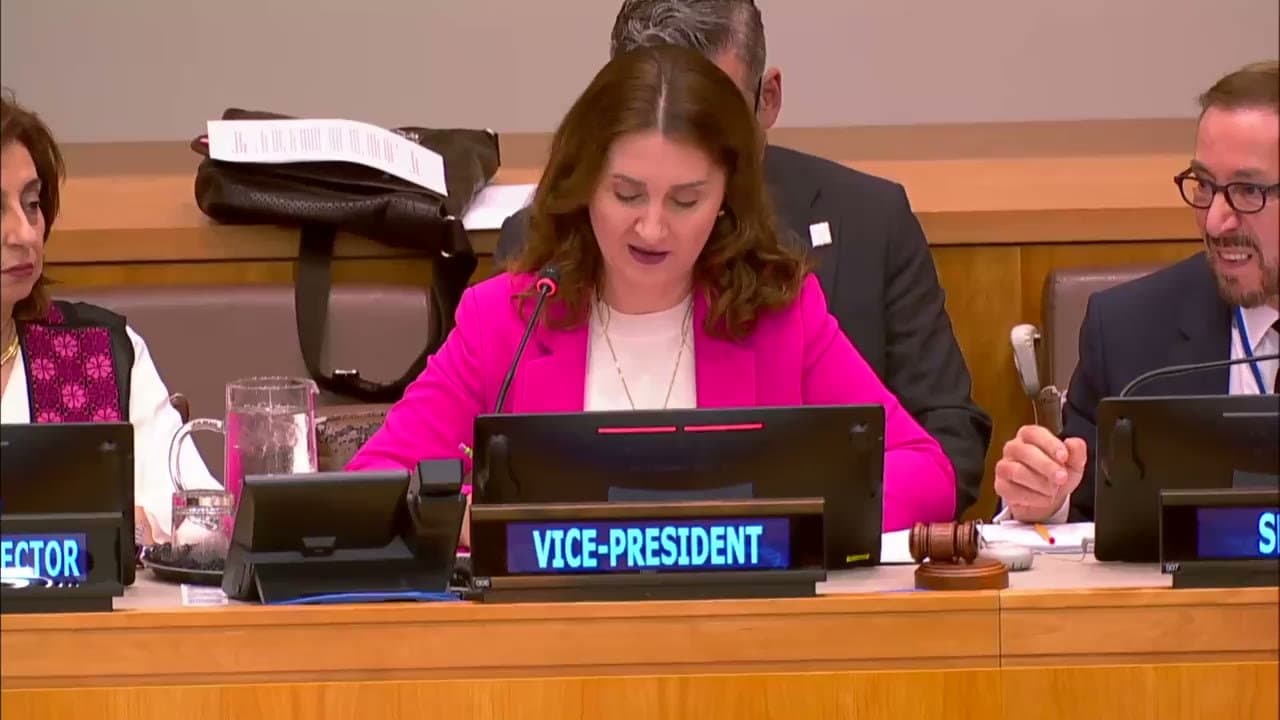
(3rd meeting) UN-Women Executive Board, Second Regular Session 2026
UN-Women Executive Board • United NationsSeptember 10, 2026
Locunity is a independent informational service and is not an official government page for this commission.We use AI-assisted analysis and human editorial review to publish information.
UN Women Board Blocks UNFPA Merger, Advances Five-Part Governance Overhaul
The UN Women Executive Board drew a hard line on the Secretary-General's restructuring ambitions, unanimously declining to recommend a merger with UNFPA while advancing an ambitious five-package governance reform plan that could reshape oversight of five major UN agencies. Three decisions were adopted by consensus at the second regular session's third meeting on Sept. 10, 2026.
- Board declares it is "not in a position" to support a UNFPA–UN Women merger, citing legal opinions that mandate continuity cannot be guaranteed
- Five-package governance reform plan unveiled, including a harmonized delegate's handbook, standing audit/finance subcommittee, and direct oversight reporting lines across UNDP, UNFPA, UNOPS, UNICEF and UN Women
- Coalition of 25+ member states, led by Switzerland, backs reform push and calls for a standing governance agenda item for at least one year
- Flexible, predictable funding framework adopted for UN Women's 2026–2029 Strategic Plan, urging multi-year commitments and compliance with the Funding Compact
- JIU Working Group mandate extended through late 2027, with a joint member state briefing required before the next formal session
- Retiring Board Secretary Jean-Luc Boris honored after 15 years and 46 sessions of service
Board Shuts Door — for Now — on UNFPA–UN Women Merger
The most consequential action of the session came with Decision 2026/18, which effectively blocks the Secretary-General's UNAT initiative from advancing a merger between UNFPA and UN Women without further legal and analytical groundwork.
Why it matters: The decision represents a significant institutional check on the Secretary-General's restructuring agenda, establishing that mandate protection concerns currently outweigh any efficiency arguments for consolidation. It forces additional legal work and transparency before the question can be revisited.
Where things stand: Bastien Hormans, Permanent Mission, Belgium, read the decision, which places several conditions on any future merger discussion. The Board stressed that merger talks must not be considered in isolation from broader UNAT reform — including country team reconfiguration, regional reset, and expertise-on-demand. It also demanded that outstanding legal advice be provided immediately along with unredacted final packages.
The decision cited legal opinions from both UN Women and UNFPA's legal offices, noting "there is no specific legal mechanism available to guarantee the continuity of existing mandates." The Board reaffirmed General Assembly Resolutions 48/162 and 50/227, underscoring that the Board retains authority over structural changes. Decision 2026/18 emphasizes that any reform must fully safeguard UN Women's triple mandate — normative, operational, and coordination — and strengthen country-level delivery.
Decisions: The Board "while remaining committed to engaging constructively with the UNAT initiative, is not in a position to make a recommendation of support on a potential merger between UNFPA and UN Women at this time," while encouraging exploration of alternative options including enhanced governance coordination and improved country-level delivery. Adopted by consensus without objection.
Executive Director Sima Bahous signaled clear institutional alignment in her closing statement: "The decisions adopted at this session also emphasized that you are not in a position to make a recommendation of support on a merger between UNFPA and UN Women at this time, and that you encourage us to explore implementation of alternative options without preempting a possible recommendation on a potential merger. We heard you loud and clear."
What's next: UN Women leadership committed to providing the requested legal and analytical materials and working in full transparency. The February 2027 session agenda includes a UNAT initiative update, ensuring continued scrutiny.
Five Reform Packages Could Reshape Oversight of Five UN Agencies
The Joint Working Group on governance reform delivered its revised report, organizing 31 Joint Inspection Unit recommendations into five concrete work packages that, if fully implemented, would represent the most significant overhaul of Executive Board oversight in years.
The basics: The JIU review (JIU/REP/2023/7) examined governance and oversight across the Executive Boards of UNDP, UNFPA, UNOPS, UNICEF and UN Women. A Joint Working Group co-chaired by Germany and Russia was established to assess 31 recommendations — 10 formal and 21 informal — across six thematic areas.
Why it matters: These reforms could give member states direct technical oversight capacity over UN agency management for the first time, particularly through a proposed standing advisory subcommittee on audit and finance. The work packages also aim to harmonize governance standards that currently vary widely across the five agencies.
Where things stand: Annette Kayser, Co-Chair, JIU Joint Working Group and Delegate, Germany, presented the five packages: (1) a harmonized delegate's handbook consolidating roles, responsibilities, and procedures; (2) a dedicated review of working methods including formal/informal meeting relationships and potential advisory subcommittees; (3) harmonized terms of reference for Executive Board secretariats; (4) updated oversight and advisory committee relationships with direct reporting lines to Executive Boards; and (5) additional matters including performance review of executive heads, orientation and onboarding, and risk management.
Kayser emphasized that the group's guiding principle was incremental improvement: "The Joint Working Group has been guided by the overarching principle of strengthening and optimizing existing mechanisms of the Executive Boards wherever possible, before proposing the creation of new structures."
Nikolai Komarkov, Co-Chair, JIU Joint Working Group and Delegate, Russian Federation, addressed the more sensitive proposals, including performance reviews of executive heads, noting that "the introduction of a formalized review mechanism would require further careful consideration, particularly with regard to the appropriate criteria, methodology, and information sources, in order to ensure an objective and balanced assessment."
A coalition of more than 25 member states, with a joint statement delivered by the Delegate from Switzerland, expressed strong support. The coalition called on member states to hold themselves to the same standards they demand of UN entities: "We rightly ask UN entities to strengthen oversight, transparency and effectiveness. We should hold ourselves to the same standards and verify whether we are fulfilling our responsibilities as effectively as possible and where we can improve."
The coalition specifically endorsed exploring the audit/finance subcommittee and recommended "maintaining a focused standing agenda item on the governance and oversight of the Executive Boards for at least one year."
The other side: Kayser acknowledged that the proposed standing committee remains the most complex element, with legitimate concerns from some delegations. "There are the more complex proposals like the subcommittee or the standing committee where we feel also after having listened to the other boards during the last two weeks, there's a lot of interest in this proposal, but some delegations have also legitimate concerns about capacity and duplication," she said, noting the group plans to invite experts from organizations that already use such committees.
Decisions: Decision 2026/17, read by Marvin Ikondere, Permanent Mission, Uganda, extended the Working Group's mandate through the second regular session 2027. It requires the group to consult with UN Women on complex recommendations and present implementation proposals at the first regular session 2027. Critically, it also mandates a joint briefing for member states before the next session. Adopted by consensus.
What's next: The Working Group expects to present concrete proposals — particularly on the standing advisory committee — at the first regular session in February 2027, following consultations with member states and outside experts.
Funding Decision Pushes for Predictable, Flexible Resources
Decision 2026/16 addressed financing for both the outgoing UN Women Strategic Plan 2022–2025 and the incoming 2026–2029 plan, sending a clear signal on funding quality.
Why it matters: The decision reflects ongoing tension between member states who earmark contributions for specific projects and the institutional need for flexible core funding that allows UN Women to deliver on its triple mandate. Regular (core) resources remain the financial backbone for normative and coordination work that earmarked funds typically do not cover.
Where things stand: The decision, read by Anila Ivazi, Permanent Mission, Albania, recalls the importance of the Funding Compact, recognizes regular resources as essential, and encourages multi-year commitments and early payments. It also emphasizes that regular resources should not subsidize activities financed from non-core resources — a reference to the Joint Cost Recovery Policy. The decision encourages engagement with diverse stakeholders including the private sector and international financial institutions. Adopted by consensus.
Farewell to a 15-Year Institution
The session closed with an emotional farewell to Executive Board Secretary Jean-Luc Boris, who served across 46 sessions since 2011 — a tenure spanning the entirety of UN Women's existence as a consolidated entity.
Executive Director Sima Bahous thanked Boris directly: "We thank you profoundly for 15 years of exceptional service, sound counsel, and devotion to this board."
Permanent Representative Sophie de Schmid, Belgium, highlighted the invisible labor behind Board operations, noting the "countless hours of preparation, coordination, and availability that this takes. And you not only make it possible, you also make it look effortless."
Boris himself reflected on the relationships built over his tenure: "I'm very proud that we have built a relationship with this executive board, with the member states based on trust and openness. And I think everybody would agree that the UN Women Executive Board is one of the best examples of good governance and how it should look like."
Ziad Sheikh was welcomed as Boris's successor. The leadership transition comes during arguably the most complex period in UN Women's governance history, with merger deliberations, reform implementation, and UNAT negotiations all running simultaneously.
Minor Items
- February 2027 agenda approved: The first regular session (Feb. 9–10) will cover audit matters including 2025 financial statements, organizational culture with a Staff Council address and Ombudsperson report, anti-racism and racial discrimination, risk management, JIU review progress, UNAIDS follow-up, and a joint field visit report. The 2027 annual work plan was also endorsed. Both approved without objection.
- No other matters were raised by delegations under the Other Matters agenda item.