Town Council - Sep 08, 2026 - Meeting
Town Council • TruckeeSeptember 8, 2026
Locunity is an independent informational service and is not an official government page for this commission. All information is sourced from public footage and an analysis of official agendas with the aid of responsible, fact-checked AI. to report an error or omission.
Fee Hike Splits Council 3-2 as Housing Costs Take Center Stage
Truckee's Town Council approved its annual fee schedule over pointed dissent, unanimously overhauled downtown parking rules for the first time in two decades, and accepted a new Language Access Plan — all against a backdrop of impassioned public testimony on homelessness, school funding, and the rising cost of building housing in a mountain town.
Council adopts 2.5% fee increase 3-2 after Vice Mayor Henderson and Councilmember Polivy break ranks over housing and short-term rental fees they wanted frozen or capped
Downtown parking gets its first major overhaul since 2005, with priority zone rates jumping from $1.50 to $2.50/hour and a new $910 overnight valet permit for hotel operators
Four residents rally for the Navigation Center ahead of a pivotal joint meeting that will determine the shelter's future
Town adopts its first Language Access Plan, establishing multilingual service protocols for an estimated 25-30% Spanish-speaking population
School funding advocate asks council to endorse Measure P, a parcel tax renewal generating $7 million a year for teachers and programs
The Fee Fight: Cost Recovery vs. Housing Production
The sharpest debate of the night centered on Resolution 2026-45, a routine-sounding update to the town-wide fee schedule that became a proxy war over Truckee's housing crisis.
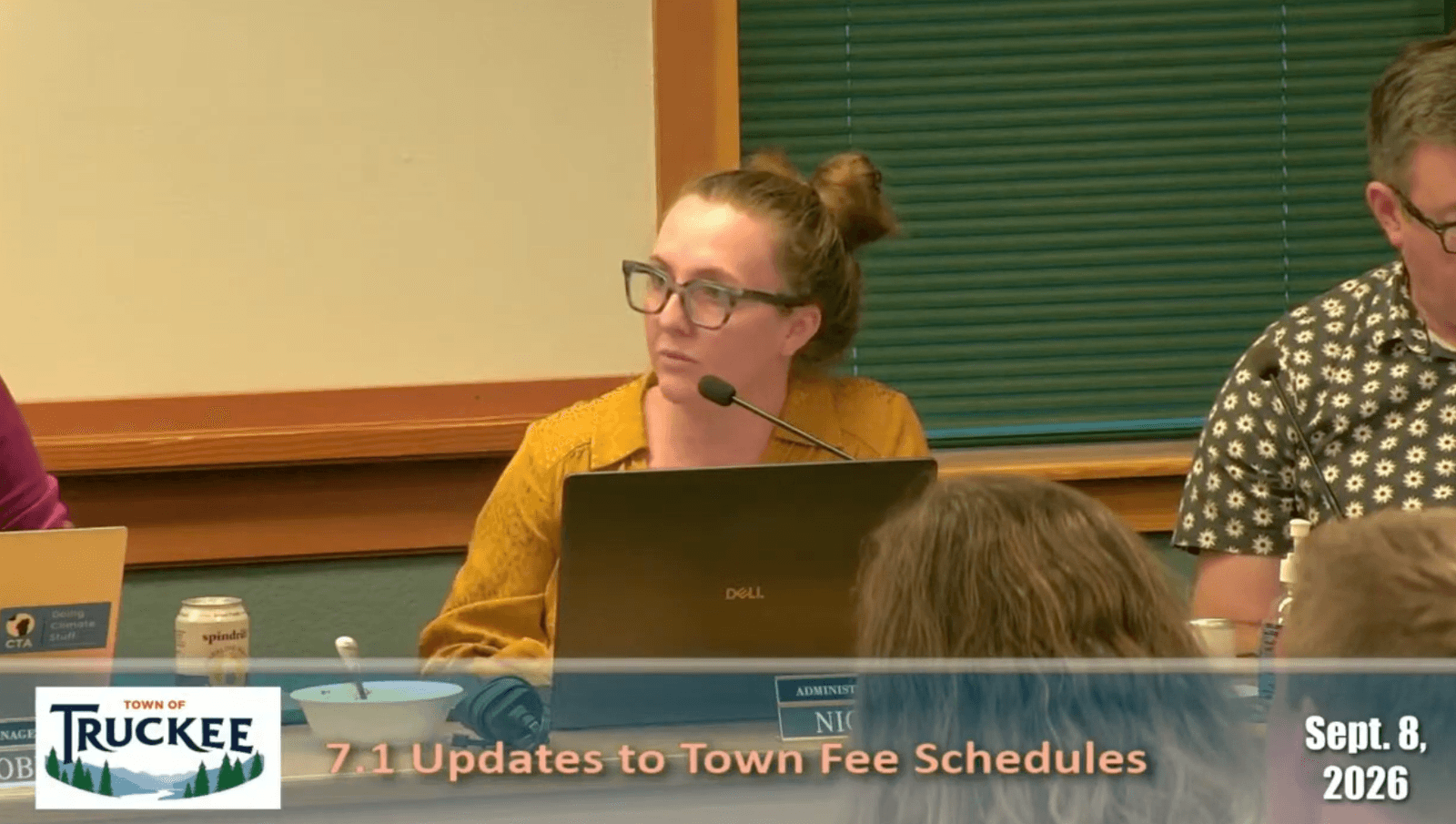
The basics: Senior Accountant Nicole Passaway presented a 2.5% Consumer Price Index adjustment across all town fees — a standard inflationary increase — along with several new fees for body-worn camera records, sidewalk vending citations, ADU refinancing, and damaged waste station replacement. The dial-a-ride transit fare was eliminated.
Why it matters: The vote exposed a growing divide on council over whether the town's cost-recovery model should bend to encourage housing production, setting up the 2027 comprehensive fee study as a major policy showdown.
Where things stand: Vice Mayor Courtney Henderson mounted the most sustained challenge, questioning the origins of the town's 1998 cost-recovery policy and the last comprehensive fee analysis — a 2007 study by Maximus — and arguing that nearly two decades of compounding CPI increases without a fresh cost basis review undercuts the town's housing goals. She proposed holding fees flat for the Truckee Housing Authority Program (THAP), Homegrown Housing, and STR Workforce Housing programs until the 2027 study is complete.
"I don't think we have to choose between fiscal responsibility tonight and getting more housing built. This fee schedule kind of forces that conversation," said Vice Mayor Henderson.
Passaway provided important context on why Truckee relies so heavily on fees, explaining that under California's Prop 13 property tax allocation system, the town receives only about 15 cents of every property tax dollar collected.
Councilmember David Polivy shared Henderson's concern about housing fees but zeroed in on the short-term rental fee, which carries a 15% increase this cycle driven by the litigation fund methodology. He said he could not support the full package without capping the STR increase at 5%.
"I'm still just not comfortable with the whole package if STR fees aren't pulled out," Councilmember Polivy said. "I'm just really honed in on that one fee and just feel like I can't support it."
The other side: Councilmember Jan Zabriskie pushed back firmly, arguing the dollar amounts at stake were too small to meaningfully affect housing production and that carving out exceptions would set a dangerous precedent.
"If I thought it would increase housing to freeze some of the fees, I might be inclined to consider that," Councilmember Zabriskie said, noting the THAP refinance fee amounted to just "$9 a transaction."
Councilmember Lindsay Romack said she trusted staff to evaluate fees annually and preferred to wait for the comprehensive study rather than making piecemeal changes.
Mayor Anna Klovstad supported the full package but pivoted the conversation toward what she called a more powerful tool: deferring fees to certificate of occupancy rather than requiring them upfront.
"Fee deferral is a really powerful opportunity because it's reducing the amount of equity that they have to come up with in order to put a shovel in the ground," Mayor Klovstad said, proposing the council take the conversation to the JPA and partner agencies.
Public commenter Brian Helm, a local developer, brought receipts. On his 12-unit Edmonds project, he detailed that $200,000 in pre-construction fees were assessed — and town fees accounted for only 22% of the total. Water and sewer charges from TDPUD, TTSA, and TSD represented half.
"Town fees of the $200,000 accounted for only 22% of that," Helm said, urging council to convene partner agency electeds to create deed-restricted housing fee credits.
Decisions: Resolution 2026-45 passed 3-2. Mayor Klovstad, Councilmember Zabriskie, and Councilmember Romack voted yes. Vice Mayor Henderson and Councilmember Polivy voted no — Henderson because she wanted housing fees held flat, Polivy because he wanted the STR fee increase capped at 5%.
What's next: Council directed staff to add housing fee discussion and fee deferral exploration to the work plan. The 2027 comprehensive fee study will be the next major battleground over how Truckee balances cost recovery with its stated housing production goals. Mayor Klovstad also proposed convening partner agency electeds to address cumulative development fees across jurisdictions.
Parking Overhaul: First Major Rate Change in 20 Years
The basics: The downtown parking district has operated under rules written in 2005. Resolution 2026-09 consolidates three overlapping resolutions into a single policy, simplifies zone maps into contiguous priority and value areas, raises the priority zone hourly rate from $1.50 to $2.50, holds the value zone at $1.00, and creates a new overnight valet parking permit at $910 per year, capped at 40 permits.
Why it matters: The parking fund has been tapping reserves and faces insolvency without rate adjustments. Priority zones are 90% full and generate 90% of revenue — a textbook sign of underpricing.
Where things stand: Assistant Public Works Director Alfred Knotts presented the overhaul as a baseline reset, with Phase 2 to follow addressing residential parking permits, demand management, and the West River lots. The overnight valet permit specifically unlocks hotel operations in the Rail Yard area.
Councilmember Polivy pressed hardest on what happens next, raising the case of the approved Jaboom Street project — 111 units for residents over age 19 with just 55 parking spaces.
"Jaboom's approved. We don't have to talk about it in isolation anymore," Councilmember Polivy said. "We're going to have 111 people over the age of 19 with 55 parking spaces."
Town Manager Jen assured council that the parking program would become the next highest priority for the transportation team after this baseline update.
Vice Mayor Henderson flagged the community impact: "Several of these changes — eliminating the 2-hour free parking, raising the priority zone rate by a dollar — those things will be really surprising to residents and visitors alike."
Councilmember Romack asked about bike parking, loading zones, and annual parking passes. Vice Mayor Henderson sought details on the overnight valet fee calculation and outreach plans.
Decisions: Resolution 2026-09 passed unanimously, 5-0 (For: Klovstad, Henderson, Polivy, Zabriskie, Romack; Against: none).
What's next: Phase 2 will address residential overnight parking permits, demand management strategies, and West River lot operations — critical issues as new downtown housing and hotel projects begin pulling permits.
Navigation Center Supporters Turn Out Ahead of October Decision
Four members of the public used general comment time to advocate for continuing the Navigation Center, a 24/7 service delivery site for unhoused individuals that has been operating for six months.
Nancy Wallace, a retired healthcare-for-the-homeless administrator from Glenshire with 40 years of experience, urged the town to continue its financial support. Haley, who lives a few hundred feet from the center, said her family has not felt unsafe and that safety concerns raised by opponents involve individuals who are not guests of the center.
Public Defender Bruce Kapsack delivered perhaps the most concrete testimony, reporting a sharp decline in charges related to camping and illegal sleeping since the center opened.
"Those numbers have drastically dropped because there is the navigation center," Public Defender Kapsack said, describing the Truckee Collaborative program that navigates habitual offenders toward services.
Pastor Rebecca Ireland of Church of the Mountains encouraged the council to keep improving the program.
Mayor Klovstad noted that THEC would meet the following day and that a joint meeting with Tahoe Forest Health Systems is scheduled for Oct. 13 to decide the center's future — making tonight's public comment a preview of a community debate that is far from settled.
Language Access Plan Breaks New Ground
IDEA Program Analyst Andrea Fernandez-Landa presented Truckee's first Language Access Plan, a policy establishing how the town evaluates language needs and provides interpretation and translation services for residents with limited English proficiency.
Why it matters: Census data underreports Truckee's Spanish-speaking population. School enrollment data suggests the actual figure is 25-30% of residents — a population that has historically lacked reliable access to emergency, housing, and transit information in their language.
The needs assessment drew on community outreach with TTUSD bilingual services and Sierra Community House promotoras, plus prioritization exercises at la Junta Regional meetings. Emergency services, disaster preparedness, housing, and transportation were identified as the highest-priority areas for translation.
A centralized Laserfiche request form has already processed 46 translation requests since June. The plan also proposes a future full-time bilingual interpreter/translator position modeled on the school district, and a LanguageLine contract is being pursued for on-demand multilingual and ASL services.
Vice Mayor Henderson and Councilmember Zabriskie asked clarifying questions about implementation. Mayor Klovstad praised the plan and noted its alignment with community priorities.
Decisions: Council accepted the plan by consensus without a formal vote.
What's next: A budget request for the full-time bilingual staff position is expected in a future cycle.
Minor Items
Consent calendar approved 5-0, including meeting minutes, a state-of-good-repair project, state ballot measure positions, the Edmonds Lofts disposition and development agreement amendment, and a River Revitalization Steering Committee update.
River revitalization advocacy: Jan from Truckee First urged council during consent public comment to include the Truckee River explicitly in 2027 priorities, rezone catalyst sites to mixed use per the 2040 General Plan, and revisit river setbacks that discourage restoration and redevelopment.
Measure P school parcel tax: Brian Helm asked council to endorse Measure P, a renewal of the existing school parcel tax at $188 per year generating about $7 million annually for teachers, music, art, STEM, and smaller class sizes for 4,200 students. The measure requires a two-thirds vote on Nov. 3. Council agreed to bring formal endorsement to a future agenda.
Yorger Ranch housing: Developer Brian Griggs urged council to support creative infrastructure solutions and a specific plan amendment to unlock nearly 300 housing units at Parcel 4, where $6-8 million in conditions of approval make the project financially infeasible under current rules.
Truckee Chamber of Commerce reported 569 members, 200,000+ job views on the rebranded regional Truckee Jobs Collective platform, and is hiring a shared regional workforce development coordinator with the North Tahoe Chamber and Tahoe Prosperity Center. Restaurant Month launches in October, and candidate forums are scheduled for Oct. 6-8.
Greenhouse gas emissions inventory: The 2024 report showed municipal emissions rose 1% from 2023, falling only 3% below the 2008 baseline — far short of the 40% reduction target by 2030. The vehicle fleet became the largest emission sector at 48%, overtaking buildings and facilities, driven by TART Connect's gasoline consumption and the loss of cold-weather-compatible renewable diesel. Staff committed to returning with TART Connect VMT reduction estimates.
Closed session: Council entered closed session for a public employee performance evaluation under Government Code Section 54957.