
From $100K Homes to Waste-to-Minerals: Summit Showcases Scalable Solutions Seeking Capital
Transformative Impact Summit • United NationsSeptember 26, 2026
Locunity is an independent informational service and is not an official government page for this commission. All information is sourced from public footage and an analysis of official agendas with the aid of responsible, fact-checked AI. to report an error or omission.
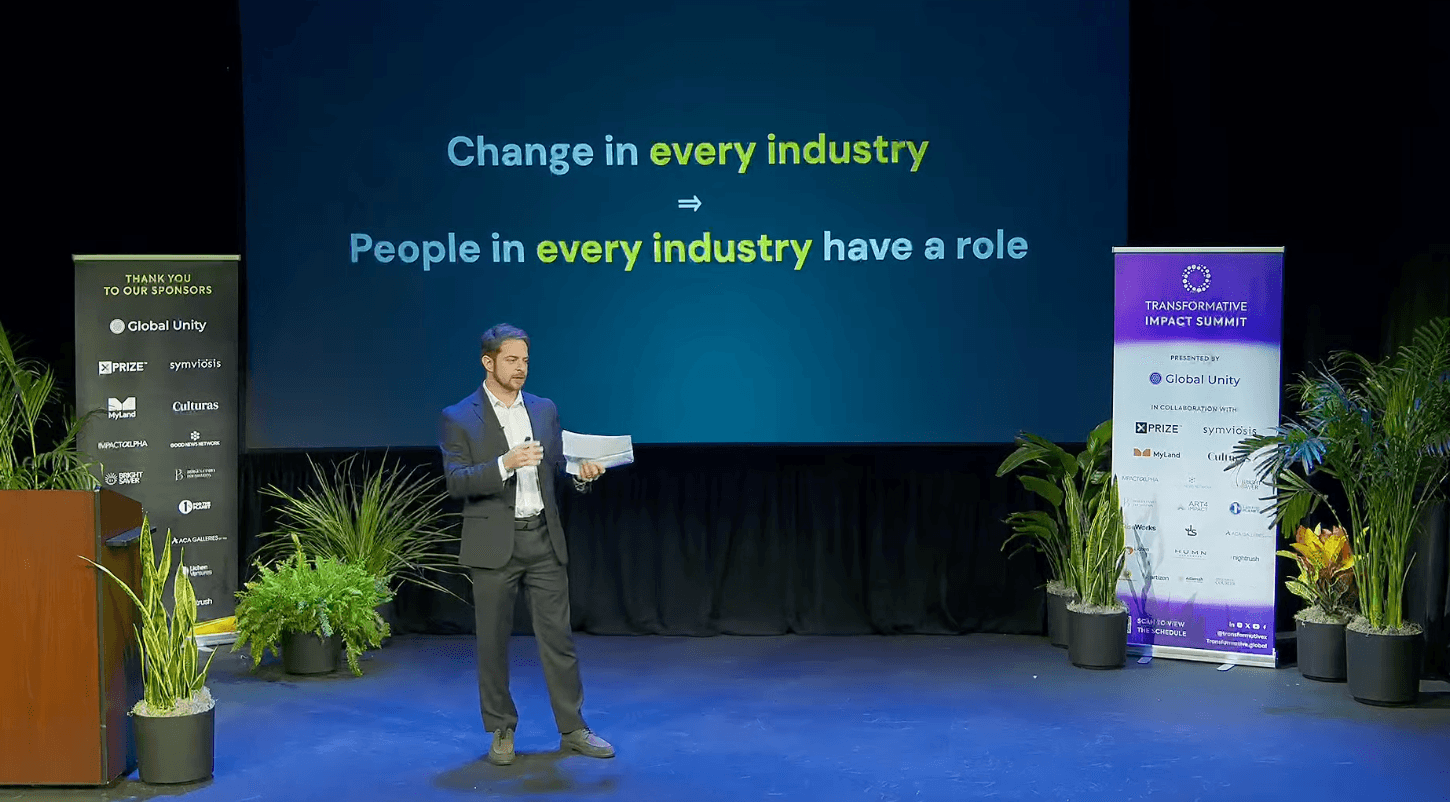
The Transformative Impact Summit brought more than 200 changemakers to New York's Sheen Center to make a case that the world's biggest problems — housing, climate, corporate accountability, wildfire, education — already have working solutions. What they lack is coordination, capital, and the infrastructure to connect them. Across a dozen presentations, founders, investors, and advocates laid out models that compress timelines, slash costs, and challenge the assumption that systems change requires starting from scratch.
- 3D-printed homes built in 10 weeks at under $100K each — Azure Printed Homes reports $62M backlog, plans IPO
- Carbotura locks in 30-year Pennsylvania deal to convert waste into 116 critical minerals, with $655M in community royalties projected
- Shareholder Democracy puts $5B in assets under stewardship through Sierra Club; major brokerages say they'd follow if a competitor moves first
- Dryad Networks wins XPRIZE for detecting and suppressing wildfires autonomously within 10 minutes
- BrightSaver makes plug-in solar legal in 10 states; New York and California bills await governors' signatures
- RESTORE maps 400,000 grassroots restoration projects across 210 million hectares, showing 2% annual vegetation recovery
- Indaba Foundation achieves near-100% literacy among 4.5-year-olds in South African townships via Montessori education
$100K Homes From Recycled Plastic
Why it matters: The U.S. is short 7 million affordable homes at the lowest income levels. Traditional construction in California costs $800,000 to $1 million per unit and takes years. Azure Printed Homes says it can deliver in weeks.
Where things stand: Gene Eidelman, CEO of Azure Printed Homes, described a model that uses 150,000 recycled water bottles per module, 3D-printing housing units in one day versus three months for conventional methods. A 62-unit homeless village in San Luis Obispo, built in partnership with the nonprofit Dignity Moves, was the proof of concept.
"We printed in 10 weeks and it cost under $100,000 a unit. Yeah, we can actually solve homeless crisis," said Eidelman.
The company reports $62 million in backlog, $7 million in revenue, and 35% margins.
A follow-up housing panel reinforced the message that multiple scalable models exist. Carol Tarr, Director for Europe at Relèven, described converting dormant faith properties — churches, convents, rectories — into affordable housing: 3,400 units across 100 projects in North America and Europe, with 90 churches closing in Antwerp alone offering future supply. Jana Hageman, Founder and CEO of T&H Investments, walked through the complexity of stacking five to six capital sources including low-income housing tax credits for 2,000 affordable units, a process that takes four to five years per project. Kevin Rowell, Founder of The Natural Builders, described earthen-floor installations through EarthEnable — 15,000 floors in Rwanda and Uganda — and housing for 12,000 Afghan refugees using natural building techniques across six continents.
What's next: Eidelman indicated Azure is considering an IPO. The gap between Azure's 10-week timeline and Hageman's four-to-five-year tax credit process highlights the regulatory and financing friction that keeps housing innovation from reaching the communities that need it most.
Turning Garbage Into the Biggest Revenue Stream in Town
The basics: Carbotura's technology breaks unsorted municipal solid waste, tires, ash, and sludge down at the atomic level, extracting 116 critical minerals and materials.
Why it matters: Between 200 and 300 U.S. landfills are expected to close within the next five years. For most communities, waste management is a major expense. Carbotura argues it can flip that into a revenue generator.
Where things stand: Tyler Wood, VP of Circularity at Carbotura, presented a 30-year contract in Pennsylvania to process 400 tons per day of municipal solid waste. The deal comes with $481 million in payment guarantees and projects $655 million in royalties flowing back to the community. The technology operates in modular 100-ton-per-day increments, is self-powered by hydrogen it produces, and generates 87,000 gallons of ultra-pure water daily.
Wood noted that regulatory capture by the existing waste industry maintains the status quo, making adoption harder despite the economics. The company has a letter of intent from Texas for statewide deployment.
What's next: If the Pennsylvania contract performs as projected, the model could be replicated across the estimated 3,000-plus U.S. communities facing landfill closures. The statewide Texas LOI would represent a significant scale-up.
Your Proxy Votes Are Working Against You
The basics: When most Americans own stocks through retirement accounts or index funds, their corporate proxy votes — on executive pay, emissions targets, board composition — either go uncast or are automatically delegated to asset management firms like ISS or Glass Lewis.
Why it matters: Gabriel Grant, Founder of Shareholder Democracy, argued this creates a system where people unknowingly vote against their own values.
"We wind up with a world where cancer doctors, patients, and foundations are literally voting to cause cancer all the time," said Grant.
Where things stand: Shareholder Democracy's model lets civil society organizations create voting recommendations that individuals can follow with a single click. A pilot with the Sierra Club quickly achieved $5 billion in assets under stewardship. Northern Trust agreed to facilitate voting through the investment platform Ethic. Grant said Vanguard, State Street, and BlackRock have indicated they would follow if a competitor moves first or a client requests it — a classic first-mover standoff.
What's next: If one major brokerage adopts values-based proxy voting at client request, the competitive pressure could force industry-wide adoption, potentially reshaping how trillions of dollars of retail investment influence corporate behavior.
Smelling Fire Before It Burns
Why it matters: Wildfires emit 6 to 8 billion tons of CO2 annually — equivalent to all global transportation. Current average response time is three hours, by which point small fires become catastrophic. The LA fires caused an estimated $200 billion in damage.
Where things stand: Carsten Brinkschulte, CEO of Dryad Networks, presented a two-part system: SilverNet, a network of 40,000 gas sensors that detect fire in its smoldering phase by "smelling" it within minutes, and SilverGuard, autonomous drones that suppress fires within 10 minutes of ignition. The system is deployed across more than 50 installations in Europe and North America, protecting 130,000 hectares. Two days before the summit, Dryad won an $800,000 XPRIZE Wildfire prize. The Alaska competition required detecting and extinguishing fires autonomously within 10 minutes across 1,000 square kilometers.
The company has generated $2 million in revenue, targets $11 million next year for profitability, and is raising €20 million to productize the drone system for commercial introduction in 2028.
$300 Solar Panels You Plug Into a Wall Outlet
The basics: In Germany, up to 5 million households have installed balcony solar — lightweight panels that plug directly into a standard outlet, no electrician needed. BrightSaver is replicating that model in the United States.
Why it matters: Renters and condo dwellers have been largely locked out of rooftop solar. A $300 panel that pays for itself in two years changes the equation.
Where things stand: Rupert Mayer, Co-Founder of BrightSaver, said the nonprofit has successfully changed plug-in solar laws in 10 states. Bills in New York and California are awaiting governors' signatures. If signed, roughly a third of the U.S. population would gain access. The organization operates on a $29-per-year membership model combining advocacy, activism (endorsed by climate writer Bill McKibben), and commerce. The first container of 1,000 panels is currently in customs at Long Beach.
Donziger's 30-Year Fight Against Chevron
Why it matters: The case against Texaco/Chevron for toxic oil waste dumping in Ecuador's Amazon stands as one of the longest-running corporate accountability battles in history — and a cautionary tale about the reach of corporate legal power.
Where things stand: Steven Donziger, who is affiliated with the Amazon Justice Fund, recounted the arc: 10 years of U.S. litigation, 11 more in Ecuador, and a $10 billion judgment ultimately upheld by both Ecuador's and Canada's Supreme Courts. Chevron's response, Donziger said, included suing him for $60 billion, securing his disbarment without a hearing, and arranging for a corporate law firm to prosecute him for criminal contempt — resulting in 993 days of detention.
"The charge was, I believe, baseless, but aside from that, it was a misdemeanor, which is the lowest-level federal offense, and there had never been a person ever who'd spent even a minute incarcerated on this charge," said Donziger.
The $10 billion judgment remains enforceable but uncollected. The Amazon Justice Fund plans to file enforcement actions in countries where Chevron holds assets.
400,000 Restoration Projects the World Can't See
The basics: RESTORE (restore.eco) is a Google Maps-style platform for conservation and restoration, built in partnership with Google.
Why it matters: Thomas Crowther, Founding Chair of the UN Decade on Ecosystem Restoration, argued that widespread belief in environmental doom — held as fact by 89% of people globally, he said — is itself a barrier to action. The data tells a different story: deforestation rates have been plummeting for 30 years while restoration is rising.
"89% of people on our planet believe that it is a fact that we are doomed to a bleak environmental future. This fact is baked into our understanding of our planet," said Crowther.
Where things stand: RESTORE now hosts 400,000 practitioner-led initiatives across 210 million hectares, led by 2.2 million rural communities. Average sites show 2% annual improvement in vegetation cover, height, and complexity. Crowther called for infrastructure funding to facilitate capital flows directly to rural farmers and land stewards who are driving recovery on the ground.
Philanthropy's Definitional Crisis
Why it matters: As impact investing blurs the line between return-seeking and gift capital, philanthropy risks losing its distinctive power. One-year grant cycles — the sector's dominant model — create enormous waste on both sides of the transaction.
Where things stand: Sarah Howard, Managing Director of the Global Philanthropy Forum, argued the field must shift from funding specific solutions to funding "enabling conditions" — trust, relationships, social capital, and coordination infrastructure.
"How do we invest in the enabling conditions for solutions to emerge, which is a different mindset," said Howard.
She described a scarcity mindset afflicting both funders and implementers, with some funders unable to efficiently process even $10,000 grants while implementers compete against each other rather than coordinating. Her prescription: implementers should organize together and present ecosystem-level funding proposals to funders, and philanthropy should recognize its convening power as perhaps its most valuable and underappreciated asset.
Near-100% Literacy in South Africa's Hardest-Hit Communities
Why it matters: Eighty percent of South Africa's fourth graders cannot read for meaning. Nobel laureate Jim Heckman's research shows that investing in ages zero to six yields the highest returns of any human capital intervention.
Where things stand: Andre Shearer, Chairman of the Indaba Foundation, and Gregory Flipo, Co-Founder and CEO of Indaba Ventures, described a Montessori-based model that trains women in South African townships as educators. The results: near-100% literacy among 4.5-year-olds and Cambridge exam results 15% above global averages — without tests until age 13.
"Why are we spending trillions of dollars on artificial intelligence when we cannot spend a dime on human intelligence?" said Shearer.
The pair is raising $10 million to build an online platform codifying 120 years of Montessori practice, train caregivers globally, and create what they called an "ECD revolution in a box" for governments, with the ultimate goal of establishing the first University of the Child.
Bhutan's Carbon-Negative Experiment
Ujjwal Deep Dahal, CEO of Druk Holding & Investments — Bhutan's sovereign wealth fund — described a nation of 550,000 citizens with 70% forest cover that is already carbon-negative. DHI manages 25 companies contributing 30% of GDP and 40% of government revenue. Bhutan mined Bitcoin starting in 2020 to monetize surplus summer hydropower and has put all citizens on decentralized digital identity.
The centerpiece: the Gelephu Mindfulness City, a 4,000-square-kilometer special administrative region designed as a sandbox for regenerative policy. Alex Cahana, Senior Advisor to DHI, described a Gross Ecosystem Product accounting tool developed with Stanford showing Bhutan's ecosystem value at 3x its GDP, and proposed tokenizing energy so villagers own their megawatt — shifting from debt-based to ownership-based economics.
Work as a Climate Lever
Eugene Kirpichov, Co-Founder and Executive Director of Work on Climate, left Google's AI division and built a 40,000-member community that has moved 3,400 people into climate careers and helped over 1,000 founders launch companies.
"88% of people who are concerned or alarmed about climate think that it is more impactful to sign petitions, to recycle your trash," said Kirpichov, arguing that professional networks are an enormous untapped force for systemic change — from rewriting composting equipment standards to pushing employer benefits for home electrification.
Minor Items
- Summit founder Elliott Bayev opened by framing the gathering as "impact infrastructure," noting that a 3D-printing sponsor at the 2024 event received 60x ROI through connections made at the summit. The event is built on three pillars: Global Unity (community of nearly 1,000 changemakers), Transformative Impact Summit (public showcase), and Transformative Wealth (family office community for systems change).
- Greg Clark, Co-Founder and CEO of RiseWorks, presented on labor and workforce innovation.
- Peter Williams, Managing Director of MyLand, described a soil health technology using native microalgae, reporting 3-6x ROI for farmers and 98% customer retention across 50,000 acres.
- Paul Benhaim, Chairman of the Board of The Hemp Plastic Company, presented on hemp-based material alternatives.
- Simeon Schnapper of JLS Fund and Justin Brody Comet of Lycan Ventures participated in an impact investing discussion.
- Rob Watson, Founder of the LEED Green Building Rating System, was identified among participants.
- Stacey Irving and Shane Cobb-Adams of The Four Cups and Seeding Change, along with Cameron Dubes and John Pinto of All1.eco, presented during an afternoon session.