Federal SNAP Cost Shift Hits Swain as Board Passes on Roadless Rule
Board of County Commissioners • Swain CountyOctober 6, 2026
Locunity is an independent informational service and is not an official government page for this commission. All information is sourced from public footage and an analysis of official agendas with the aid of responsible, fact-checked AI. to report an error or omission.
Swain County is absorbing new federal costs for running food stamps, and the bill arrived after the budget was already set. At their Oct. 6, 2026, work session, commissioners heard the Department of Social Services lay out the math of H.R. 1. They also voted by show of hands to "leave it alone" rather than oppose rescinding the 2001 Roadless Rule, and residents objected in public forum.
- Federal SNAP reimbursement drops from 50% to 25%, while the county's SNAP unit is down to two of five workers
- Commissioners vote to "leave it alone" on the Roadless Rule on the last day to comment; four speakers object
- Data center ordinance drafting begins as lawyers warn outright bans won't survive state law
- Railroad's bid for free county lot parking meets resistance; a resident cites state statute
- $193,765 sheriff's canteen fund targeted for transfer into the general fund
Federal Food Stamp Shift Lands on County Budget
The basics: H.R. 1, the One Big Beautiful Bill Act signed July 4, 2025, changes how costs for running SNAP are shared. SNAP is the food assistance program commonly called food stamps.
Why it matters: Swain must cover new costs it learned about only after adopting its budget. The rules for error penalties are not expected until late December.
Where things stand: Department of Social Services Director Bree Clausen said federal reimbursement for SNAP administration drops from 50% to 25%.
- DSS estimates the county's added administrative cost at $44,153.
- A benefit-error penalty component adds $46,006. That figure is based on a past year and could run higher.
- Penalties are tied to statewide error rates, so Swain's exposure depends partly on other counties.
- Clausen said 70% of errors statewide were agency errors. A new state review tool found 4 errors in 10 sampled cases, and Swain has adopted it.
The staffing picture is worse. DSS has five funded SNAP positions plus a supervisor but is working with two workers and one supervisor, plus Vanguard contractors. Clausen said recent departures went to Macon and Buncombe counties for higher pay and remote work. Hiring takes 2–4 weeks for fingerprinting and about six months of training. "So the majority of the people that work in my agency don't even live in Swain County because they can't afford to live in Swain County," she said.
County Manager Thomas Dills estimated the impact at roughly a penny on the tax rate. He cited $144,000 in extra funding, a figure that differs from the DSS slide totals. "When did they tell us? July 7th, after the budget was submitted and after the budget was complete," Dills said.
The other side: Several commissioners turned the briefing into a debate about fraud. "So if they tell you a lie, they can just coast right on through?" one commissioner asked.
Clausen said DSS must accept applications as submitted. "We cannot discourage anyone to come in and apply for services. That's what we're there for," she said. She added that a program integrity unit investigates fraud.
Other commissioners offered different views. One described being denied help as an able-bodied single father. Another said: "I think with this though, unfortunately, it's not our county's fault."
In public forum, public commenter Garrett Lagan, a mental health and substance use professional, said addiction does not qualify anyone for food stamps. He said disability status requires a Social Security Administration determination. "This change in rule was not about catching fraud," Lagan said.
What's next: New eligibility rules, including work expectations for able-bodied adults, may reduce caseloads. Clausen will return with fraud case numbers rather than speculate.
Board Declines to Defend the Roadless Rule
The basics: The 2001 Roadless Area Conservation Rule protects inventoried roadless areas in national forests. A federal rescission has been proposed.
Where things stand: Dills noted it was the last day to weigh in. He brought back a resolution opposing rescission that a "Ms. Smith" had presented at a prior meeting, where it was tabled.
One commissioner argued that opening the forest to timber means jobs and money. The commissioner added that old logging roads are reclaimed and benefit wildlife, and that unharvested timber will rot. "My ideal is I think maybe we ought to leave it alone," the commissioner said.
A motion to "leave it alone" passed by show of hands with little discussion. No tally was announced, and no resolution was adopted.
The other side: Four speakers pushed back in public forum.
- Public commenter Sam Evans, a former Wesser Creek resident, said: "I'm disappointed to hear y'all's vote earlier, especially without a whole lot of discussion." He said the Cheoah Bald roadless area has shrunk from 23,000 acres to about 7,000. He argued national forests could quintuple timber harvests without entering roadless areas, and noted the Cheoah Bald salamander lives only there.
- A statement from Fred Crawford, read aloud, put the Cheoah Bald and Wesser Bald roadless areas at about 6,895 acres, roughly 2% of the county. It cited tourism, hunting and fishing as economic drivers. It listed support for the rule from Trout Unlimited, Backcountry Hunters and Anglers, the Theodore Roosevelt Conservation Partnership, REI, Patagonia, the Conservation Alliance and Gov. Stein.
- Public commenter Lori Heinzman of Needmore traced the rule to unmaintained roads sending sediment into streams, which harms hellbenders and spotfin chub. "If the Forest Service cannot repair their own roads, then let's stop building more," she said. She said 99% of 625 earlier commenters favored keeping the rule. She asked the county to clarify whether "leave it alone" means keeping the rule as is.
- Lagan tied rescission to selling public land to wealthy buyers.
Decisions and stakeholder impacts: Swain will not formally weigh in to defend the protections. That leaves hunting, fishing and outdoor-recreation interests, and residents near the two balds, without a county voice. Timber interests got the outcome the motion's sponsor favored.
Data Center Rules Take Shape as Bans Falter
Why it matters: Lawyers warn that outright bans likely violate North Carolina's prohibition on downzoning, which limits reducing what landowners are allowed to build. Swain's protections therefore depend on a defensible ordinance finished before the moratorium expires.
Where things stand: Moratorium committee representative Sylvia Baker said the committee is using Cherokee County's draft high-impact land use ordinance as its template. The committee wants stronger language holding facilities liable for community damage. Reports underway include:
- Noise, light, air and vibration pollution, due by the end of November
- Jobs and tourism impacts
- A Swain-specific biodiversity study, now in second draft
Neighboring governments are also acting:
- Bryson City's moratorium took effect Sept. 9.
- Jackson County has a 12-month moratorium.
- Cherokee County's ordinance is not expected before its commissioners until December.
- Clay County and the Eastern Band of Cherokee have outright bans.
Southern Environmental Law Center research found only Macon and Haywood counties have broad restrictive ordinances. On outright bans, Baker said, "the attorneys at the Southern Environmental Law Center don't think it'll hold up."
Dills agreed a ban amounts to a bluff. "What we're looking for right now from y'all is some guidance about how we can effectively make it so difficult that nobody wants to do it," he said.
Decisions and stakeholder impacts: Commissioners appointed Carl Dubstadt to the seat vacated by Dakota Bone, on the committee's unanimous recommendation. The vote was by show of hands, and no tally was announced. Baker said Dubstadt "has an extensive career in hands-on data center management," and he leads the pollution report. She also criticized commissioners' attendance at committee meetings. One commissioner agreed to attend the next morning's meeting.
What's next: A public comment session on extending the moratorium is set for 5 p.m. before the Oct. 20 regular meeting.
Railroad Parking Request Hits a Wall
The Great Smoky Mountains Railroad, through Kim Albrighton, asked to use the county's federal building lot after hours and on weekends in October and on Polar Express nights. The railroad offered cones, signage and litter pickup. Dills laid out three options: deny the request, approve it as written, or keep the lot as open public parking.
Where things stand: Commissioners raised conflicts with pavilion events and floated charging the railroad $1,000 a day. "We've worked with them. We bought them an engine. We built them a turntable. What else do we need to do?" one commissioner asked.
Another commissioner recalled residents being unable to pay taxes last year because the lot was full. That commissioner cited a 10% tourism drop and favored allowing railroad use only outside business hours. Dills said with "99% assurance" that the county can bar a business from using its lot, and he will research further.
The other side: Public commenter Josh Williamson said he was the resident who raised the issue, noting county employees returned late from lunch because they couldn't park. He cited North Carolina General Statute 160A-301, which he said allows only local governments to charge for parking on public lots. "What the train is currently doing is not only discouraged by the locals, but it's illegal," Williamson said.
What's next: No decision was made. Dills is researching legality and options.
Sheriff's Canteen Fund Comes Under Scrutiny
Commissioner David Loftis said the Sheriff's Department controls $193,765.61 in canteen funds that it can spend at its discretion. "I believe we need to bring that money back into the general fund of the county," Loftis said. He suggested the money could fix the jail's heating and air conditioning.
The other side: Dills said canteen money is regulated for a specific purpose: "It's like inmate welfare and security." He noted litigation over misuse in other places. He recommended a dedicated line item that preserves that purpose, with spending routed through the finance office and purchase orders.
Loftis also proposed raising the threshold for purchases that require a purchase order from $300 to $500 to cut paperwork, while still keeping receipts. Another commissioner suggested setting limits department by department. Loftis raised concerns about county credit card charges. He said he is leaving the board and handed the issue to colleagues: "I wish one of you fellas that was going to be here longer would look into it and push it, but it ain't going to be me."
What's next: Dills will check the legal requirements and place the canteen fund on the regular session agenda for discussion and a possible vote. He will consult the finance office on the purchase order threshold.
Minor Items
- Duke Energy line: Commissioners agreed by consensus that Dills will draft a letter opposing the Needmore/Almond substation route, for all five commissioners to sign and send to the NC Utilities Commission. Duke has not yet answered five route questions raised by resident John Close.
- Library delays: Phase 2 of the Marian Black Library renovation starts Oct. 26, with no programming until a late-April reopening. A $1 million congressional grant was secured Sept. 25, leaving about $300,000 still needed for the $7.2M project.
- EMS transport policy: Williamson said Swain EMS cited a policy against transporting patients beyond Mission Hospital after 10 p.m. when his daughter had a perforated appendix. A commissioner said he would look into it.
- Broadband board: Julie Thorne was appointed to a broadband board vacancy by show of hands; the result was not formally announced.
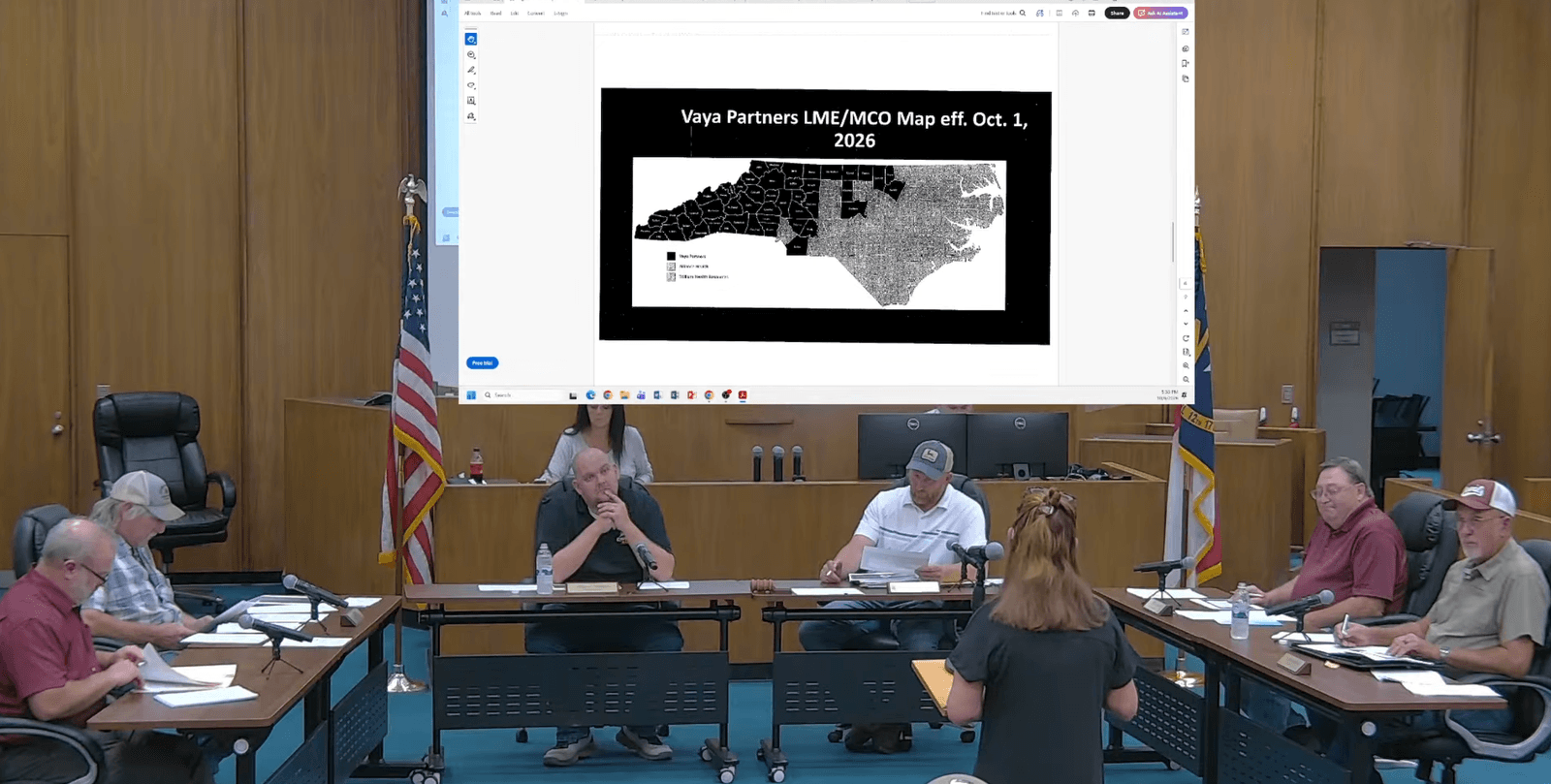
- Via Partners merger: Community Relations Regional Director Shelley Foreman said Via Health and Partners Health merged into a 47-county public agency that manages Medicaid behavioral health services. She said members should keep their providers and care managers.
Looking Ahead
- Data center moratorium: Public comment on the extension is set for 5 p.m. before the Oct. 20 meeting.
- Airport property: A 5:30 p.m. public comment session on the purchase will be announced at least 10 days in advance, pending one remaining item from the Local Government Commission.
- Duke letter: Dills aims to have the draft ready by Friday close of business.
- Fontana Regional Library: Dills warned that Macon County's planned exit could dissolve the regional library system. He wants to ask Macon's leadership about its commitment, possibly after its new board is seated in December.