Global Leaders Debate Multilateralism's Survival as U.S. Nuclear Threats Go Unanswered
Sustainable Development Solutions Network (SDSN) • United NationsSeptember 24, 2026
Locunity is an independent informational service and is not an official government page for this commission. All information is sourced from public footage and an analysis of official agendas with the aid of responsible, fact-checked AI. to report an error or omission.
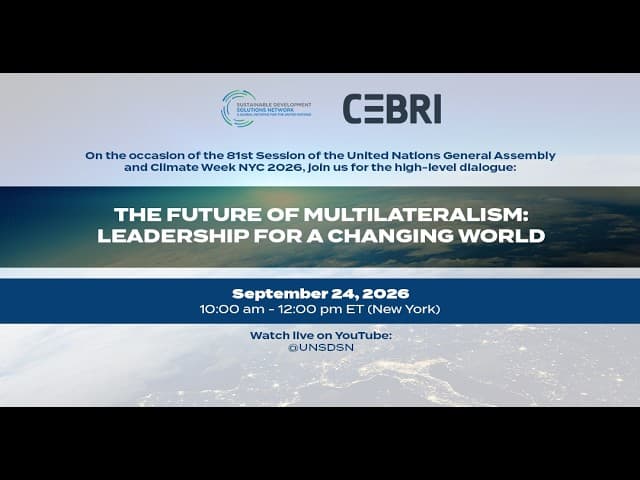
The Sustainable Development Solutions Network and Brazil's CEBRI convened diplomats, former heads of state, and Nobel laureates for a roundtable that laid bare the fractures in the international order — from a U.S. president threatening nuclear annihilation at the UN podium to small island nations warning their votes can still be bought for $50,000. The dialogue mapped a world where multilateral institutions are wounded but, as participants concluded, "not dead yet."
- Jeffrey Sachs calls Trump a "dark triad" psychopath with 1,600 deployed nuclear weapons and no institutional check from Congress or the international community
- Paraty Dialogues propose "coalitions of the responsible" organized by purpose, not ideology, to bypass Security Council paralysis
- Serbia reveals 60%+ public support for BRICS versus under 50% for EU accession, exposing the gravitational pull of alternative organizations
- Barbados defends incrementalism but warns small-state agency is fragile without domestic stability and development bank reform
- Debate sharpens between incremental UN reform and a comprehensive Charter review under Article 109 ahead of new Secretary-General
- Ambassador Corrêa do Lago charges the West is "more anti-China than anti-Trump" and is destroying the system it built
The Time of Monsters: Sachs Sounds the Alarm on U.S. Unilateralism
SDSN President Jeffrey Sachs delivered the dialogue's most searing assessment, invoking the Italian philosopher Gramsci to frame the current geopolitical moment.
Why it matters: Sachs argued that the near-total silence from every institutional safeguard — Congress, European capitals, the UN General Assembly — after a sitting U.S. president threatened nuclear annihilation signals a breakdown comparable to the years between the world wars, but with far more destructive weapons.
Where things stand: Sachs identified three facts he called stunning. First, President Trump threatened to annihilate Iran from the UN General Assembly podium. Second, no member of Congress invoked Article I, Section 8 — the constitutional provision granting Congress the power to declare war. Third, no European leader and no UN member state walked out or objected.
"Donald Trump is a monster. That's not a cliché. It's not a quip. He is a monster. He's a psychopath," said SDSN President Jeffrey Sachs, describing Trump as a "dark triad personality" in command of 1,600 actively deployed nuclear weapons.
"Nobody walked out. Nobody said a word. No European leader has called Trump out for this, as far as I know," Sachs added.
Sachs characterized the United States as a power that retains enormous capacity for destruction — particularly through financial sanctions — but diminishing capacity for constructive leadership. "It has a unique capacity to ruin your country's economy overnight. That's its last remaining power," he said. "It has very little positive to offer, but it can destroy your economy overnight by creating a financial crisis."
The other side: Sachs tempered his warning with notes of cautious optimism. He cited Trump's 32% approval rating and argued the multipolar reality — where the U.S. cannot militarily defeat China, Russia, or even Iran conventionally — provides structural checks on unilateral action. He also pointed to overwhelming global public support for the United Nations in Pew surveys.
Trita Parsi amplified the critique, targeting Canadian Prime Minister Mark Carney for what Parsi called a repetition of the very double standard Carney himself had diagnosed. "Instead of acting on what he said he would do at Davos, he downplayed the comment. He repeated exactly the sin that he thankfully admitted had been committed by so many for so long," Parsi said.
Parsi expressed broader disappointment in European states, with one exception. "I have very little faith in European states at this moment to be able to play the role that they played in 1945, with the exception of a few. Spain, I would say, is one of them," he said.
Former Argentine President Fernández offered a structural counterpoint, arguing the right-wing wave sweeping Latin America and beyond is cyclical rather than permanent — driven by global commodity price trends and Chinese economic growth patterns. He suggested incumbents are punished when growth slows, regardless of ideology, and that Trump's declining popularity would follow the same trajectory.
Not Dead Yet: Paraty Dialogues Chart a Path Through Coalitions of the Responsible
CEBRI President José Pío Borges and Brazilian Ambassador to London Antonio Patriota reported on the Paraty Dialogues, a CEBRI-organized forum held at a UNESCO heritage site in Brazil that gathered more than 20 diplomats, intellectuals, and Nobel laureates.
Why it matters: The dialogues produced a framework that offers an alternative to the paralysis of formal Security Council reform — flexible, purpose-driven coalitions that can operate alongside, not against, existing institutions.
Where things stand: Three takeaways emerged. First, the concept of intergenerational responsibility — borrowed from climate discourse but applied to international institutions. Second, the idea of "coalitions of the responsible" organized along three axes: special purpose, similar state, and regional groupings. These coalitions need not be ideologically aligned, only "like-purposed." Third, these parallel efforts complement rather than compete with formal institutional reform.
"The institutions are in crisis, but it should not be confused with a collapse. And we should work to reform and save these institutions from the state that they are today," said CEBRI President José Pío Borges.
Ambassador Patriota drew a critical distinction between like-minded and like-purposed cooperation. He cited several emerging examples: the Tropical Forest Forever initiative launched at COP30 in Belém, the Partnership for Multilateralism letter signed by Brazil's Lula, Canada's Carney, Portugal's Costa, and Kenya's president, and the Barcelona mobilization of progressive governments.
Patriota also introduced the concept of "cooperative multipolarity" — multipolarity governed by shared rules and international law rather than hostile competition. "You could have multipolarity of confrontation, breakdown into different hostile groups," he said. "Or we could join forces to build a more cooperative multipolarity."
He distinguished between the rigidity of multilateral negotiation, which requires consensus, and the flexibility of implementation. "Implementation can proceed at different speeds and different levels of ambition and bring together countries that have common interests," Ambassador Patriota said. "There's a freedom in implementation that you would not have in negotiation."
Borges also flagged a special-purpose issue that BRICS could address: the outsized role of the dollar in global finance, noting the U.S. represents 12% of international trade but controls more than 70% of financial transactions.
Serbia, BRICS, and the Shifting Gravity of Global Alignment
Where things stand: The roundtable surfaced concrete evidence that alternative organizations are reshaping diplomatic alignment for small and medium powers.
Vuk Jeremić, former Serbian foreign minister and SDSN Leadership Council member, reported that Serbia faces intense European pressure for its engagement with China-led bodies, including WICO (for AI governance) and the International Organization for Mediation. But public opinion in Serbia tells a different story.
"The support for Serbia to join BRICS in the public opinion is over 60%, and to join the European Union is less than 50%," Jeremić said.
Jeremić described Trump not as the root cause of the crisis but as an accelerator. "I personally do not believe that Mr. Trump is the cause of our current crisis. He's perhaps a very visible symptom and a truly significant accelerator," he said, tracing the erosion of multilateral norms back through previous U.S. administrations.
He called for making alternative organizations "mainstream and kosher" rather than treating engagement with BRICS or Chinese-led bodies as a diplomatic transgression.
Ambassador Corrêa do Lago sharpened this point, arguing the West is undermining its own creation. "The West is incredibly more anti-China than anti-Trump. And this is something that is very hard to understand because Trump is a much bigger threat to the West than China is," he said. He pointed to EU failures with Turkey and Russia as evidence, and identified evangelical movements as a destabilizing force.
Ambassador Patriota closed the geopolitical discussion by noting that in comparative terms, China is "actually adhering more to international law than some other superpowers."
Incrementalism vs. Charter Overhaul: The Reform Debate the Next Secretary-General Will Inherit
The sharpest internal disagreement of the dialogue emerged over whether the UN can be reformed from within or requires a comprehensive overhaul.
Why it matters: With a new UN Secretary-General expected to take office and the 2030 development agenda approaching, the choice between these approaches will shape the institution's relevance for a generation.
The incrementalist case: Pat Bardwell, from the Barbados Prime Minister's Office and a lead on the Bridgetown Initiative, defended gradual reform using Barbados's own experience as proof of concept. "Resilience is a marathon and political cycles are a sprint," she said. "But transformation may be the ambition, but we shouldn't give up on incrementalism as a way of getting there in parallel."
But Bardwell delivered an equally powerful warning about the fragility of small-state agency. She noted that diplomatic visibility often depends on individual leaders — like the Barbados prime minister — and doesn't transfer across administrations or to similar states. She recalled a time when minimal investment could buy a vote outright: "A few decades ago, for a $50,000, $100,000 fish processing plant, we would vote one way or the other. Agency only works when we can stand on our own feet."
Bardwell called for aggregating the voices of dozens of small states into critical mass for UN reform and urged structural reform of the multilateral development bank system, where small states lack adequate representation.
The case for comprehensive reform: Sofía pushed back directly, arguing incrementalism cannot fix a fundamentally broken structure. "Incremental, one resolution and another resolution is like putting eggs on a basket that is broken," she said, calling for activating Article 109 of the UN Charter — the provision for a review conference — to pursue genuine institutional renewal.
Ambassador Patriota staked out a middle position, advocating incremental, cumulative change — including proposals achievable via General Assembly resolution, such as a new Climate Council — while keeping the Article 109 review conference "on the horizon."
Virginia brought data to the question of the incoming Secretary-General, arguing the next leader needs a "loud win" early in her tenure — perhaps by addressing conflicts not involving permanent Security Council members, such as Sudan — to build credibility and momentum.
Jeremić expressed hope for a Latin American woman candidate but cautioned that strong candidates from other regions may emerge. Patriota argued candidates should be judged by their commitment to international law without double standards.
Sachs closed the session with a pointed call: if South Africa is excluded from the G20 summit in the United States on what he described as racist grounds, "I dearly hope that the rest of the G20 would refuse to come."
Science, Cities, and the Case for Bottom-Up Multilateralism
Several speakers argued that the reform debate is too focused on institutions and too distant from the people multilateralism is supposed to serve.
Lee, Special Envoy for the Congo Basin Science Panel and SDSN science panels representative, argued that science provides a natural foundation for multilateral cooperation. "Science is just naturally multilateral. All of the scientists from developing nations, developed nations are working together on these issues," he said, highlighting atmospheric rivers flowing from the Congo Basin to Egypt and from the Amazon to southern South America as examples of transboundary interdependence that demand cooperative governance.
A CEBRI researcher presented fieldwork from five Latin American cities involving more than 1,000 interviews across 80 institutions. The findings were clear: people support international cooperation only when it delivers tangible results in their daily lives, and they reject development blueprints imposed from outside, demanding sovereignty and autonomy in their own development paths. She questioned whether the 2030 development agenda would survive.
Mahmoud Mohieldin reinforced this bottom-up vision, arguing that villagers with electricity and internet access "don't need anybody to dictate to them what they should be doing" and advocating for regional bodies like ASEAN as complements to formal reform frameworks.
Remy called for including mayors and local authorities in UN high-level dialogues, and Andrea raised the concept of "emocracies" — governments based on emotional manipulation through social media and AI — as a threat that institutions must confront with practical solutions.
- Paraty Dialogues: Organized by CEBRI at a UNESCO heritage site in Brazil with 20+ participants; an article titled "Not Dead Yet" by a colleague of Professor Avieiro was cited as capturing the forum's overall conclusion.
- Tropical Forest Forever initiative: Launched at COP30 in Belém; highlighted as an example of special-purpose coalition building.
- Partnership for Multilateralism (P4M): Joint letter by Brazil, Canada, Portugal, and Kenya flagged as a model for like-purposed cooperation.
- Mohieldin advocated for ASEAN and regional bodies as complements to the P4M framework and bottom-up priority identification.