
Spruce Pine Council Splits Over Flock Cameras as Final Vote Goes Unclear
Town Council • Spruce PineNovember 9, 2026
Locunity is an independent informational service and is not an official government page for this commission. All information is sourced from public footage and an analysis of official agendas with the aid of responsible, fact-checked AI. to report an error or omission.
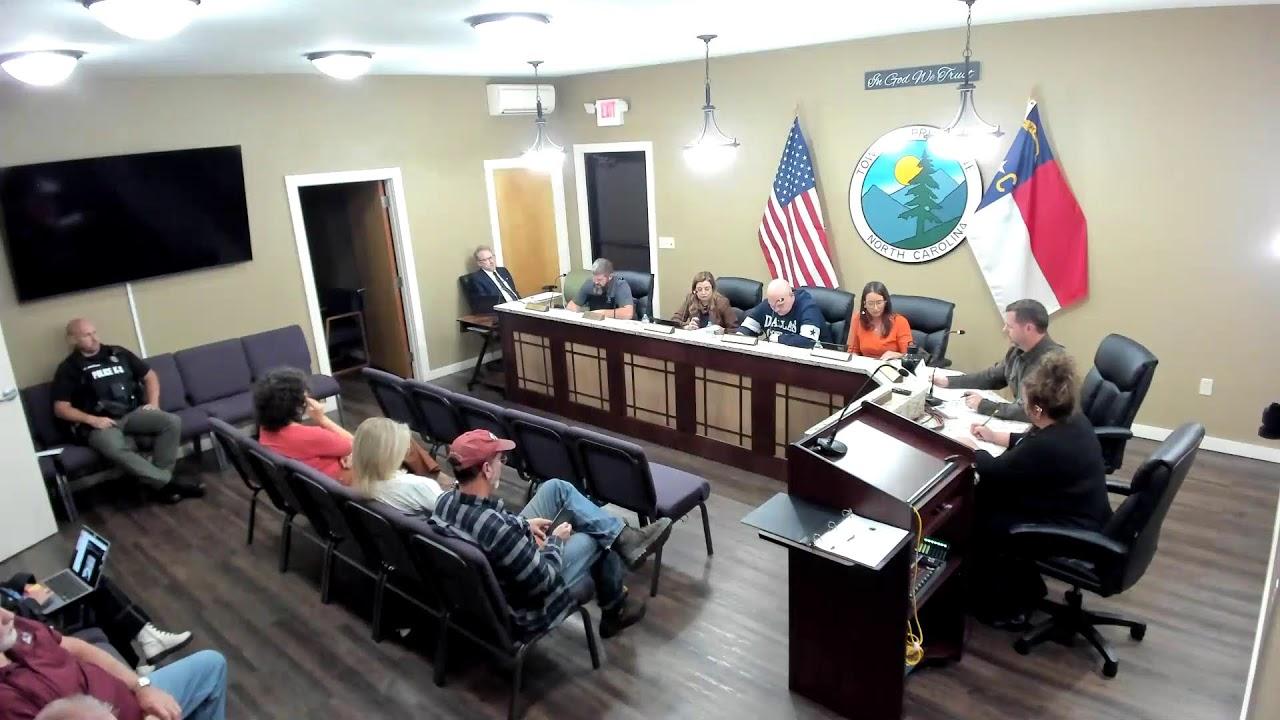
Spruce Pine's Town Council spent most of its Nov. 9, 2026, meeting on whether to put license plate reader cameras at two town sites, weighing privacy fears against stories of missing people found. After a failed removal motion and a muddled postponement vote, members moved to let the town manager sign the Flock contract and keep negotiating, but no result was ever declared from the dais.
- Flock license plate camera contract reaches a voice vote; outcome not declared
- Residents split 2-1 against the cameras during public comment
- Revised police policy promises monthly audits and bans use tied to protected characteristics
- Contract runs 36 months and currently has no termination without cause
- Project Woodpile closing targeted by Jan. 31, 2027; downtown gains 14 to 15 parking spaces
Cameras, Policy and a Privacy Fight
The basics: Flock Safety sells automated license plate readers (ALPRs). These fixed cameras photograph passing plates and log them in a searchable database that police can query.
Why it matters: The town would host fixed plate readers for up to three years. The open questions are who audits the data, how long it is kept and whether Spruce Pine can exit the deal.
Where things stand: One physical camera is already installed, but "none is active or programmed," said Town Manager Daniel Stines. Work stopped when the final price exceeded the manager's spending authority. That is why the contract is now before the council for ratification.
The proposal covers two pole-mounted locations: one in front of Town Hall and one on Oak Avenue near the park. One camera reads in both directions.
Staff presented a revised police policy with several limits:
- Access is restricted to authorized users.
- Use based on protected characteristics or expressive activity is prohibited.
- Officer queries are audited every month.
A police official said "there's no facial recognition" in the system. Each entry requires a case number and supervisor approval, and every search is logged.
Retention remains muddled. Stines said Flock purges data every seven days, but the policy text cites 90 days. Mayor Beth Holmes separately asked about seven-day versus 30-day retention.
The other side: All three public commenters spoke on Flock.
- Leah Charles, a public commenter, opened bluntly: "I am adamantly opposed to this." She cited documented abuses, lawsuits, canceled contracts, misread plates and hacking. She also pressed for answers on retention, camera locations, data sharing, auditing and local control.
- A second resident rejected the argument that people are "already tracked." The resident cited U.S. Forest Service access and the absence of outside audits showing that data is actually deleted. "They are data aggregators," the commenter said.
- Jeff Harding, a business owner and taxpayer, backed the cameras. He cited four people found in Mitchell County, including a teen located in Ohio. "If you have the proper policy and the proper procedure in place, then Flock is a great thing to have," Harding said.
The dais shared the skepticism about oversight. "I think there needs to be a lot of thought given to regulation on the back end if this actually is to be a technology that we use," said a Councilmember who pushed for third-party auditing.
Mayor Holmes said she was more comfortable with the revised policy, but added: "I also have some extreme concerns about technology surpassing policy."
Decisions and stakeholder impacts: On contract terms, Stines said the agreement currently lacks termination without cause. The town has requested a 30-day exit clause on a proposed 36-month term.
- Police would gain a fixed investigative tool at two high-traffic points.
- Privacy-minded residents are relying on internal audits, not the outside verification they asked for.
- Families of missing people, the group Harding cited, are the clearest beneficiaries.
From Delay to Delegation, With No Declared Result
Why it matters: The procedural fight decides whether Spruce Pine commits before Flock answers eight pages of requested contract changes.
Where things stand: The council moved through four steps:
- Removal motion: A motion to pull the item failed for lack of a second. Mayor Holmes noted the full council was not present.
- Postponement motion: The mayor seconded a motion to postpone to the next meeting, saying she wanted the vendor's response first. Another member objected that the delay repeated what happened at the last meeting.
- Postponement vote: The voice vote result was unclear, and a tie was mentioned. Stines cautioned that Flock may grant none of the requested changes.
- Authorization motion: Mayor Holmes then proposed approving the contract while routing revisions through the town attorney. The motion authorized the manager to enter the contract and negotiate changes recommended by legal counsel. On the voice vote, "aye" was heard on both the call for ayes and the call for opposed. The result and tally were not stated.
Town Attorney Chad Donahue advised that the license agreement is a separate document requiring its own approval. That agreement lets the vendor mount cameras on town property, and it carried none of the requested revisions. It also went to a voice vote, and again "aye" was heard on both calls with no declared result. No vote counts were recorded for any of these motions.
What's next: Residents should check the approved minutes to learn whether the authorization and license agreement passed. Watch for Flock's response on the 30-day termination clause and the conflict between 90-day and seven-day retention.
Woodpile Timeline, Downtown Parking, FEMA Work
Where things stand: In his project updates, the town manager reported progress on several fronts.
- Project Woodpile: Phase 1 is lined up. The examination period ends Dec. 31, with closing within 30 days after, or by Jan. 31, 2027. The Development Finance Initiative and a DEQ intake are set for post-closing studies and grants.
- Locust Street: The caboose has been moved. Parking is being restriped from 45-degree to 90-degree spaces, for a projected net gain of 14 to 15 spaces.
- FEMA recovery: Negotiations on funding amounts continue across 66 projects. The 226 water line awaits review by the U.S. Economic Development Administration (EDA), and Wilderness Street is finished.
- Public Works: Grading on the facility is expected around Dec. 1.
What's next: New requests for qualifications (RFQs) are coming. Christmas decorating, a parade and a tree lighting are planned.
Minor Items
- Minutes: The council approved the Oct. 26 minutes by voice vote, with no opposition heard.
- Veterans Day: A proclamation recognizing Nov. 11, 2026, as Veterans Day passed by voice vote.
- Transportation appointment: Mayor Pro Tem Rocky Buchanan, who was absent, was renamed the town's designee to the Rural Transportation Advisory Committee.
- Council training: Members tentatively set a special called meeting with Donahue for Monday, Feb. 1, at 4:30 p.m. Topics include legislative changes, zoning amendments, open meetings and council roles. "Things are potentially going to change rapidly at the North Carolina General Assembly," Donahue said.
- Closing comments: Members praised the caboose move and sent well wishes to a former mayor.
Looking Ahead
The Flock question likely returns in some form: as confirmation of an approved deal, as a renegotiated contract, or as an item at the next meeting. Residents tracking surveillance policy should watch for the official minutes and any revised retention language.