
Council Keeps Flock Cameras Rolling 4-1 Despite Vendor Distrust
City Council • South San FranciscoNovember 11, 2026
Locunity is an independent informational service and is not an official government page for this commission. All information is sourced from public footage and an analysis of official agendas with the aid of responsible, fact-checked AI. to report an error or omission.
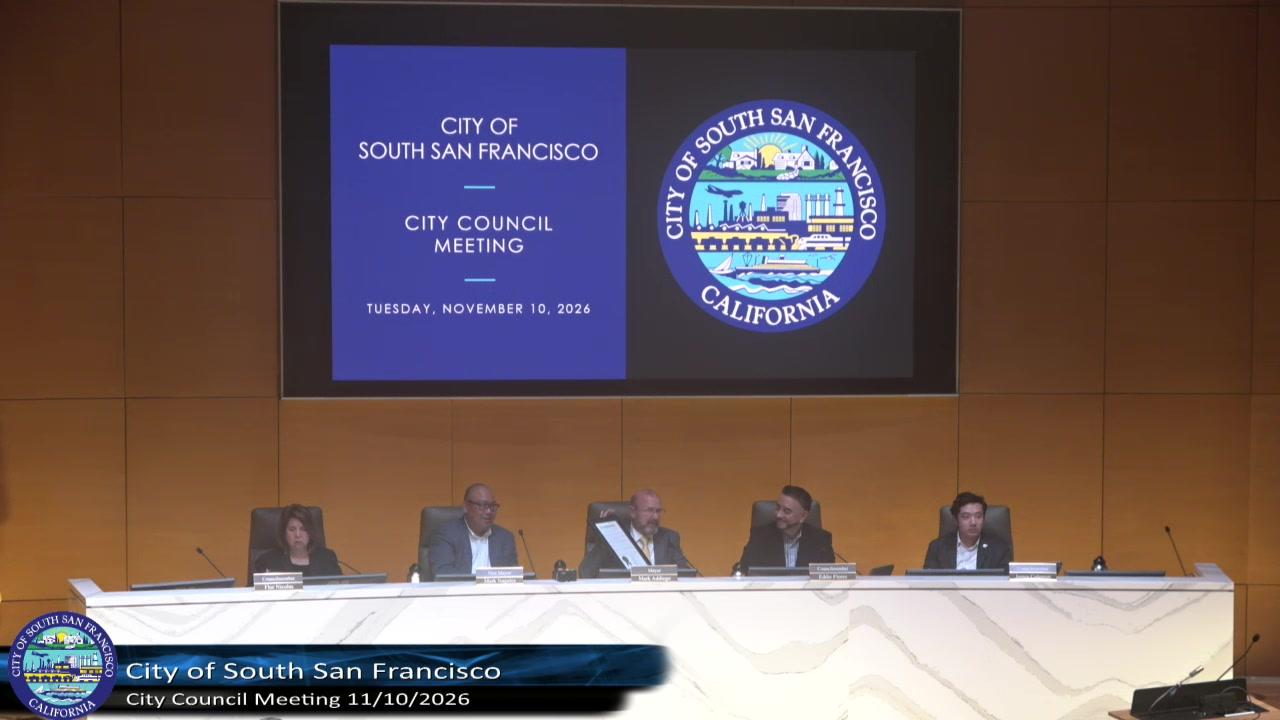
South San Francisco's City Council voted 4-1 on Nov. 10, 2026, to extend its license plate camera contract with Flock Safety. Members said staff's analysis left them with a hard choice between paying $120,000 to keep 40 cameras running and paying $20,000 to turn them all off. The same night, the council approved a $610,000 child care expansion pilot and the city's first contract with the Chamber of Commerce, while public commenters demanded resignations over unproven election-law allegations.
- Flock ALPR extension passes 4-1: $120,000 for one year, with Coleman dissenting
- $610,000 child care pilot approved 5-0, including $500,000 in impact-fee grants
- First city-chamber contract approved 5-0 at $50,000 with an extension option
- Prohousing re-application draws four yes votes as the state consolidates housing funds
- Commenters allege Elections Code violations by two council members and demand resignations
Flock Deal: A Choice Members Called Forced
The basics: Automated license plate readers (ALPR) are fixed cameras that capture vehicle plates. The council authorized the city's Flock program in November 2022.
Why it matters: The vote keeps a surveillance network running. It also adds new data protections, and members said openly that they distrust the vendor.
Where things stand: In August 2026, staff found two conflicting Flock agreements. One expired Sept. 8, 2026, and the other expires Aug. 19, 2027. Staff determined the later agreement governs. Under it, ending the contract now would cost $20,000 and turn off all 40 cameras. Instead, staff proposed a one-year, $120,000 extension, paid from vacancy savings in the police budget, while the city runs a request for proposals (RFP) for a new vendor. Staff said even an expedited RFP could take up to six months, and that Flock could switch off the cameras if the council delayed.
Captain Anthony Pinell of the South San Francisco Police Department said the new terms:
- Prohibit AI and machine-learning use of city data
- Double Flock's liability cap to 24 months of fees ($240,000)
- Bar disclosure to third parties
- Require breach notice within 72 hours
- Allow termination if Flock violates the law, or breaches and fails to fix the problem within 30 days
"The contract specifically talks about the city's ownership of the data," said Pinell. Responding to Councilmember Eddie Flores, staff said Flock owns the cameras and software, while the city owns the data. Vice Mayor Mark Nagales asked whether a missed breach notice could end the contract. The City Attorney said it would be an incurable material breach.
The other side: Councilmember James Coleman pointed to West Hollywood, which has a $200,000 liquidated-damages clause for each unauthorized disclosure. Liquidated damages are penalty amounts set in advance in a contract. City Attorney Sky Woodruff said that model leaves a city owing the balance of the contract, and that Flock rejected stronger termination language. "The model that we've selected is if there's a breach, we can terminate. We owe them nothing on the rest of the contract," said Woodruff.
Mayor Mark Addiego summed up the city's weak bargaining position: "In this case, it seems like the technology has the upper hand, very definitely." Nagales cited a local shooting: "We experienced gun violence. And it was because of the cameras and our great police department that we were able to arrest that individual."
Coleman objected to the vendor's conduct: "Just allow Flock to thrash us about." After Councilmember Buenaflor Nicolas said "But public safety is paramount," Coleman replied, "Tell that to the immigrant community where 5 of them got picked up this morning and 20 of them in the past 2 weeks in San Mateo County."
Decisions and stakeholder impacts: Nicolas moved the item and Nagales seconded. The vote was For: 4 (Addiego, Nagales, Nicolas, Flores); Against: 1 (Coleman); Absent: 0. Police keep their investigative tool, and the city gains new contract protections. Residents worried about immigration enforcement and data sharing got assurances on paper, not a different vendor. One e-comment was submitted on the item; its content was not read aloud.
What's next: Staff will run the RFP for the next ALPR vendor during the extension.
Child Care Pilot Puts Impact Fees to Work
Why it matters: Developer impact fees will now pay directly for new licensed child care capacity. The city faces a projected shortage of 2,138 spaces by 2040, according to a 2020 nexus study, and 2,059 spaces by 2032, according to a 2022 county assessment.
Where things stand: South San Francisco has collected a child care impact fee since 2001. It adopted a Child Care Master Plan in 2022 and is building the Westborough preschool, which will have about 40 spaces. Budget Amendment 27.023 appropriates $610,000:
- $100,000 for the Child Care Coordinating Council of San Mateo County (4Cs) to design and run the program
- $10,000 in contingency
- $500,000 in grants
"This program would offer a pool of $500,000 in grant funding to licensed childcare providers in South San Francisco," said Angela Duldulao, Deputy Director of Parks and Recreation. The grants will pay for capital improvements. 4Cs ranked first among five RFP responses.
Christine Padilla, Director, Build Up San Mateo County at 4Cs, described the program's approach:
- Multilingual outreach
- Equity-weighted scoring
- Technical assistance
- Site visits
Nagales asked how small, mom-and-pop providers would be prioritized. Staff said eligibility rules and grant amounts will be set over the next two months, and noted the RFP floated a $200,000 maximum grant.
The other side: No member opposed the program. One hurdle surfaced: prevailing-wage rules for projects funded by impact fees could raise costs for small providers.
Decisions and stakeholder impacts: Flores pressed for broad outreach and lower barriers to apply. "One request that I would like to put forward in the final phase, the reporting and the program evaluation, is if we could also put together a survey of those that did participate," he said. He asked that the survey also reach providers who drop out. Nicolas tied child care to gender equity and to preventing displacement. Licensed providers and working families stand to gain the most. Nicolas moved the item and Nagales seconded. The vote was For: 5; Against: 0.
What's next: Staff and 4Cs will set eligibility criteria and allocations over the next two months.
Chamber Gets Its First City Contract
Why it matters: The city's economic development division has two staff members. This contract extends their reach through the South San Francisco Chamber of Commerce, which was founded in 1913. "This is the first time the City Council's considered this type of contract agreement between the city and the chamber," said Ernesto Lucero, Economic Development Manager.
Where things stand: The council chose between two one-year scopes. The chamber picks the specific services in each.
- Scope A, $25,000: partnership, cross-promotion and outreach, plus two of three services: legacy-business focus groups, business walks or an Off the Grid event
- Scope B, $50,000: adds two of three larger events: a senior services fair, a Genentech Goes to Town-style event with a new large employer, or a downtown wine walk
Coleman asked why Scope B costs twice as much. Staff and Mary Prem, CEO, South San Francisco Chamber of Commerce, said it involves larger events. "I want to say we take public funding very seriously and are ready to show what this investment can accomplish," said Prem.
The other side: Addiego worried that a one-year term was too short: "I don't want to set her up for failure." He also urged events beyond downtown. Flores wanted surveys, a pilot mindset and a check on business interest in an entertainment-zone policy like Redwood City's. "But my main thing, what I want to underscore is the technical assistance that I want to be able to provide," he said. Nagales backed the $50,000 scope and downtown activations.
Decisions and stakeholder impacts: Coleman moved Scope B with a staff-proposed amendment. It lets the city manager extend the contract six months at no added cost. The vote was For: 5; Against: 0. Small and legacy businesses gain outreach, welcome packets and events.
What's next: The chamber reports progress to the council in the contract's ninth month.
Prohousing Status Up for Renewal
Why it matters: The state's Prohousing Designation Program awards bonus points on competitive housing grants. Those points matter more as the state consolidates its housing funding sources.
Where things stand: South San Francisco was designated in 2023. It is one of two San Mateo County cities with the status. The designation must be renewed every three to four years, and the city's renewal is due January 2027. According to Management Analyst Pierce Abrahamson, the designation brought the city an $890,000 incentive grant in 2024.
Staff expect a higher score this round because of increased affordable housing funding near transit at 500 and 522 Linden. The status also helped the city's application to the state's Affordable Housing and Sustainable Communities (AHSC) program for 1051 Mission Road, with Related as partner. Awards are expected in December.
"Including being pro-housing designated, our applications in South City will now approach what it would be like to be in a high resource area," said Nell Selander, Director of Economic & Community Development.
The other side: Coleman asked about Proposition 1 and future regional bond funds. Staff said most state programs award prohousing bonus points. Addiego asked whether smaller cities can compete with larger jurisdictions. Later in the meeting, Coleman urged engaging Sacramento lobbyists so any regional housing bond benefits smaller cities.
Decisions and stakeholder impacts: Nagales moved the item and Nicolas seconded. Four yes votes were recorded: Addiego, Nagales, Nicolas and Coleman. Flores's response was not recorded, and no result was formally announced. Four votes are a majority of the five-member council.
What's next: A 30-day public comment period on the application runs through Dec. 7.
Allegations Cloud the Dais
Where things stand: Two public commenters alleged that Flores and Coleman violated California Elections Code 18205. These are allegations only. No findings were presented, and neither named member responded at the meeting.
Sam Kakuti, a public commenter, alleged that Flores promised a candidate a commission seat to stay out of the District 3 race and that Coleman was complicit. He demanded both resign. Corey David, a public commenter, alleged a felony violation and said oversight agencies had been notified. He warned that future council decisions involving the two members would be viewed as suspect.
The other side: Nicolas said she had received many emails about the matter. She noted that a city council lacks criminal investigative powers and said the case has reportedly been sent to the appropriate agencies. "We must allow the legal process to run its course to ensure justice and due process," she said.
Minor Items
- Consent calendar passed 5-0: The council approved these items in a single vote:
- A $1.8M bond-interest appropriation for the Orange Memorial Park Aquatic Center
- A $100,000 increase to the Michael Baker International housing consulting contract, to $250,000
- A $25,000 Genentech gift for the library's Summer Learning Challenge
- Up to $41,327 in federal after-school snack funds
- Other routine items
- Transportation grants: The council authorized Caltrans and San Mateo County Transportation Authority grant applications. Flores reported close to $4.4M in regional funding. Public commenter John Baker praised the new Hickey Boulevard bike lanes and called the Hickey/Junipero Serra intersection dangerous.
- El Niño prep: Assistant City Manager Rich Lee highlighted:
- A sandbag station at 550 North Canal Street, with up to 10 bags per visit
- SMC Alert sign-up
- 119 volunteers in the Community Emergency Response Team (CERT) program
Cynthia Markopoulos reported that an 86-year-old resident was told to fill her own sandbags. The city said it would follow up.
- Proclamations: The council honored La Tapatia's 50th anniversary, Ruby Bridges Walk to School Day and Native American Heritage Month.
- LAZ review: Nagales asked LAZ to give the council a progress report. The request drew the required three-member support.
Looking Ahead
- Nov. 18: The Ruby Bridges walk gathers at City Hall.
- Dec. 7: Public comment on the prohousing application closes.
- Closed session: The council discussed lease terms at 238 Grand Avenue with Solo Soccer Shop and labor terms for the City Clerk position. No outcome was reported.