
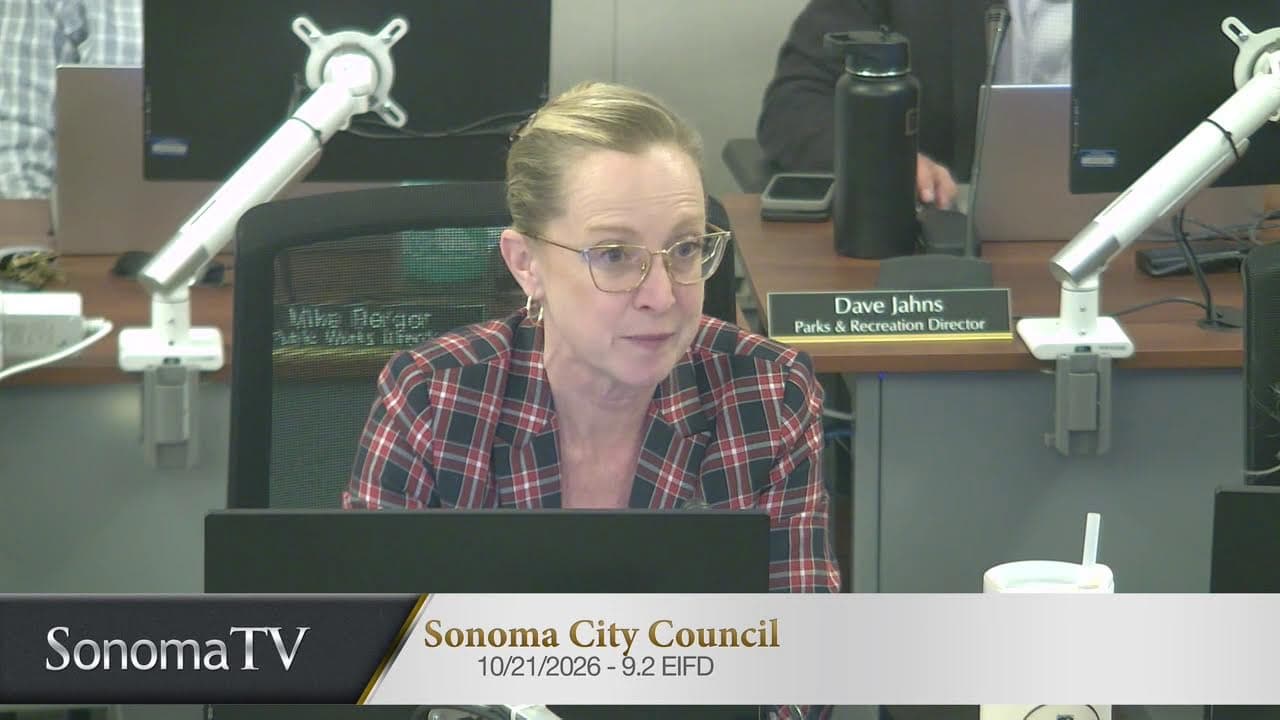
Sonoma Council Opens Formal Talks With County on Infrastructure Financing District
City Council • SonomaOctober 20, 2026
Locunity is an independent informational service and is not an official government page for this commission. All information is sourced from public footage and an analysis of official agendas with the aid of responsible, fact-checked AI. to report an error or omission.
Sonoma took its first formal step Oct. 20, 2026, toward a county-matched financing tool that would set aside future property tax growth for infrastructure and affordable housing. The council voted 5-0 to authorize negotiations with Sonoma County, but it did not form a district or commit any money. The council also adopted an urgency ordinance to keep the Sebastiani Theatre project's approval from expiring Nov. 30.
- 5-0 vote directs staff to negotiate with Sonoma County on an Enhanced Infrastructure Financing District (EIFD). No district was formed and no funds were committed.
- Consultant models up to about $95M in present value, depending on boundaries and the size of the county's match.
- Redevelopment debt runs through 2036, so EIFD spending is unlikely before then.
- Urgency ordinance extends project approvals to five years, passing 5-0 to protect the Sebastiani Theatre project.
A Long Game for Infrastructure Money
The basics: An EIFD is a form of tax-increment financing. It sets aside a share of future growth in property tax revenue for specific projects. It does not raise tax rates. A district can last up to 45 years and is governed by a new public financing authority made up of city, county and public members.
Why it matters: Sonoma's revenue options are limited. A county match could roughly double what the city puts in. The tradeoff is that whatever share of tax growth the city pledges would no longer be available to its general fund.
Where things stand: City Manager Cristine Alilovich said the request was narrow. "So we are not recommending an actual formation of the EIFD or any formal or monetary commitment on the city's part at this point," she said.
Joe Diegas, a consultant with Cosmont, presented a county-funded feasibility study. He compared an EIFD to a retirement account with an employer match. "None of what we're talking about this evening is about adding taxes or increasing taxes," Diegas said.
The study modeled two approaches:
- Focused parcels (scenario D): about $1.7M over five years and $5.8M over 10 years.
- Citywide boundaries: $1.4M to $6.3M over five years and $4.8M to $17.5M over 10 years.
Focused boundaries produce less money but protect more of the general fund. The study put the present-value benefit at $6M for the city's general fund and $11M for the county's.
Eligible uses include:
- Infrastructure with a useful life of 15 years or more
- Affordable housing
- Facilities of nonprofits or small businesses
Diegas said simply forming a district also improves the city's scores on state grant applications. He said alternatives such as Climate Resilience Districts and CRIAs offer less flexibility.
Council scrutiny: Councilmember John Gurney asked about a 23% county share shown in one slide. "Is there a formula in the legislation that comes up with that 23% figure, or is that a negotiated figure?" he asked. "It absolutely is a negotiated point," Diegas replied. He said the figure was chosen to produce a dollar-for-dollar match. Gurney also raised conflict of interest. Diegas said the firm would make written disclosures and pick a side.
The biggest constraint is old debt. Former redevelopment agency bonds are paid first, and EIFD revenue cannot be used until they are retired. Final payments come due in 2033 and 2036. Alilovich said spending or bonding is unlikely within 10 years.
The other side: Mayor Ron Wellander pressed on whether the tool fits a small town. "We have no industry," he said, noting Sonoma's limited growth. He also asked about the redevelopment debt: "How are we currently saving for that, or how we anticipate paying for it if this thing goes away?" Alilovich said "the details and nuances of that is very deep in the finance world." She deferred the question to a future administrative services director.
Diegas offered a candid off-ramp. If the council finds the district can't be defended locally, he said, "I say just pull the plug."
Councilmember Patricia Farrar-Rivas made the case for upside. "So there's a compounding effect as you're doing this," she said of infrastructure investment. Alilovich framed the benefit as matching funds for critical infrastructure and affordable housing.
Public voices: Betsy Chavez read a statement from Supervisor Rebecca Hermosillo: "I support the city taking this next step to explore and enhance infrastructure financing district partnership with the county." The statement noted that details would return to both boards.
Julian Mackey, a public commenter, urged action while the county is receptive. "It's worth moving forward with enthusiasm," he said. He also asked whether the city would keep decision-making control. Staff and the consultant said the authority would carry out plans, but the council and the Board of Supervisors must each approve the financing plan.
A member of the Sonoma League for Historic Preservation set a firm condition. "I just don't want any more property tax to fund an increase in the city's budget for this," he said. He added interest in using the funds to preserve historic buildings.
Decisions and stakeholder impacts: Vice Mayor Sandra Lowe backed engagement while saying she would watch the percentages. "I see absolutely no reason to stop the conversation at this point," she said. Gurney said the Finance Committee found the idea worth pursuing. Councilmember Jack Ding asked about administration and timeline.
The motion passed (For: 5 — Wellander, Lowe, Gurney, Farrar-Rivas, Ding; Against: 0; Absent: 0). The county gains a negotiating partner. Affordable housing and infrastructure advocates gain a potential long-term funding source. The general fund's future flexibility is the main thing at stake.
What's next: Staff will negotiate contributions and terms with the county. The next formal step would be a resolution of intention, followed by nine to 15 months of hearings that include a public protest opportunity. Formation is targeted for the third quarter of 2027. The topic is expected to come up at the council's January/February goal-setting workshop.
Five-Year Window Saves Sebastiani Theatre Approval
Why it matters: The Sebastiani Theatre Restoration and Expansion approval expires Nov. 30, 2026. Without immediate action, the project would have had to restart the entitlement process.
Where things stand: Under current rules, approvals expire after two years. The Planning Commission can grant one one-year extension, for three years total. Community Development Director Jennifer M. Gates said larger projects face outside factors, such as sale closings and weather.
The new rules make three changes to Sections 16.04.150 and 19.56.040 of the municipal code:
- They clarify what applicants must show to qualify for an extension.
- The city planner or community development director may approve up to two one-year extensions, with notice to neighbors.
- The original approving body may grant one more year, for five years total.
A standard ordinance takes two readings plus 30 days, which would arrive too late for the theater. "Staff is requesting that City Council approve the ordinance as an urgency ordinance," Gates said. Urgency ordinances require a four-fifths vote. Gates said extensions are granted one year at a time, so updated codes can be applied at each renewal. "We're not giving away all 3 years of an extension," she said.
The other side: No one spoke against the change. Mackey supported it, arguing that the good-faith requirement preserves the council's leverage: "the city still maintains control." The extensions were found exempt from CEQA, California's environmental review law. Earlier in the meeting, the preservation league had separately pushed for broader environmental review.
Decisions and stakeholder impacts: Both votes passed (For: 5 — Wellander, Lowe, Gurney, Farrar-Rivas, Ding; Against: 0; Absent: 0). The council first adopted the urgency ordinance, then introduced the regular ordinance. Developers with entitled projects gain time and avoid re-entitlement costs. Neighbors will receive notice of staff-level extensions.
What's next: The regular ordinance returns for second reading Nov. 4. It would take effect Dec. 4, 2026.
- Appointments: The council appointed Pete Hennig to the Sonoma Valley Community Advisory Commission, Jenna Trujillo as youth commissioner on the Cultural and Fine Arts Commission, and Vincenzo Mansfield to the Traffic Safety Committee, each by a 5-0 vote. Historic Preservation and groundwater advisory seats remain open.
- Consent calendar: Approved 5-0.
- Preservation push: Elizabeth Scrandall of the Sonoma League for Historic Preservation sought full environmental review for projects, including in the Historic Overlay District. "We also strongly encourage everyone to vote no on Proposition 45, which circumvents CEQA regulations and guidelines," she said.
- Highway 121 roundabout: A councilmember relayed neighbors' concerns that a planned Caltrans roundabout at Highway 121 and 8th Street East would affect Berndale crossings.
- Recognition: The mayor dedicated the meeting to Shawna Davis, a cheesemaker and chef who fed people in need. The council also proclaimed October 2026 Community Planning Month.
Looking ahead: Planning commissioners and the City Council will hold a joint meeting Oct. 27 at 6 p.m. on the housing ordinance feasibility study. The Traffic Safety Committee will hear updates Nov. 2 on the city's first raised crosswalk, at Junipero Serra Drive, and on the 3rd Street West traffic circle redesign. A tabletop emergency exercise follows Nov. 3. A sandbag station is open at Depot Park, and an emergency preparedness update is expected in November.