
Sonoma Leaders Signal Cutting Inclusionary Rule From 25% to 15%
City Council • SonomaOctober 28, 2026
Locunity is an independent informational service and is not an official government page for this commission. All information is sourced from public footage and an analysis of official agendas with the aid of responsible, fact-checked AI. to report an error or omission.
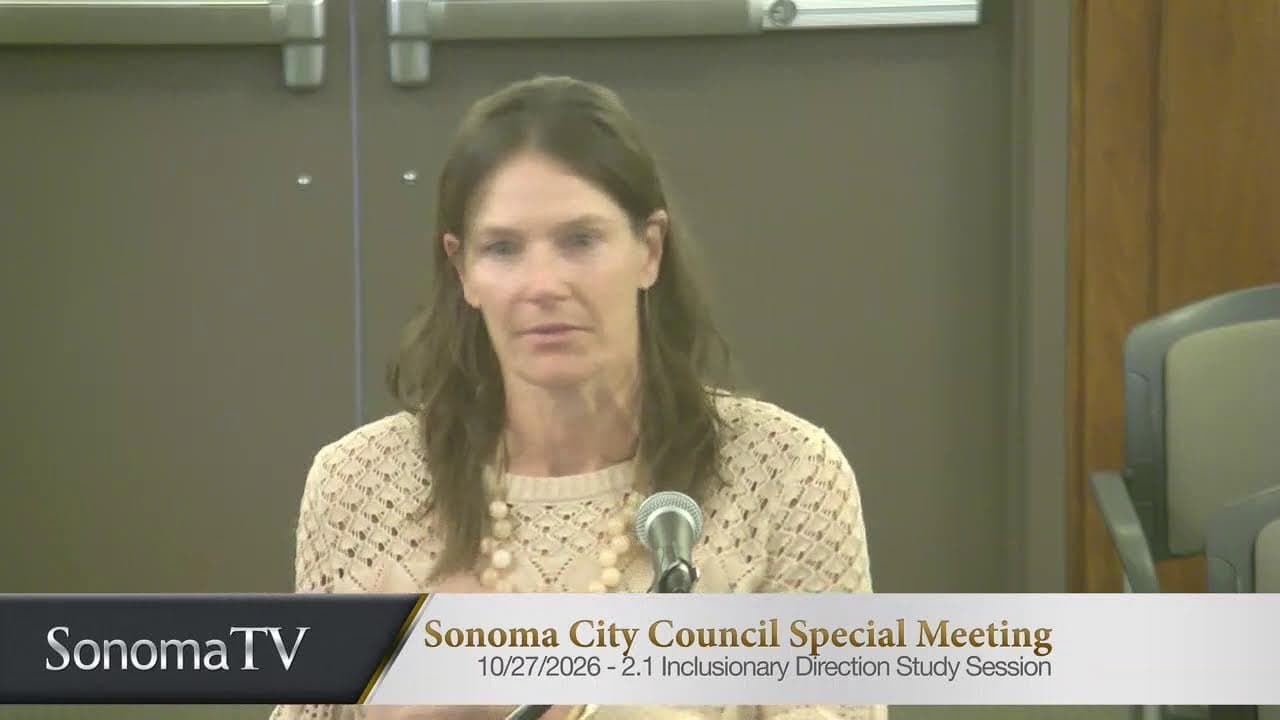
Sonoma's 25% affordable housing mandate, higher than the 10% to 20% range in neighboring cities, is on track to shrink. In a joint special session on Oct. 27, 2026, the City Council and Planning Commission used informal straw polls to steer staff toward about 15% for for-sale homes and 10% low-income for rentals. No formal vote was taken. The direction rests on a consultant study showing the current rule strains nearly every type of housing the city needs.
- 25% to about 15%: Broad informal support for cutting the for-sale on-site requirement, with a lower rate for attached condominiums
- $500 a month short: Consultants say rents must rise that much before apartments become financially feasible
- 10% low-income rentals: A thumbs-up straw poll backed the lighter requirement, though every rental scenario is still unworkable
- 30% cap on the 850-square-foot small-unit exemption heads to staff for modeling
- Tiered in-lieu fees were favored, but the mayor wants build-or-pay to stay a hard choice
- No rules changed yet: A draft ordinance goes to the Planning Commission, then the Council
Study Finds 25% Rule Strains Nearly Everything
The basics: Inclusionary zoning requires market-rate developers to set aside a share of new homes at below-market prices. Sonoma currently requires 25% on-site, charges a $25-per-square-foot in-lieu fee for projects of 1 to 4 units, and exempts units under 850 square feet.
Why it matters: The city's Housing Element requires Sonoma to check that the policy isn't blocking development. The study is also the city's evidence if the state housing department questions its rental requirement.
Where things stand: Kaiser Marston and Associates tested four prototypes: single-family detached, small lot or duplex, condominium and apartment. Under current rules, single-family homes were challenged, small lots and condos were marginal, and apartments were significantly challenged. The consultants set the developer profit threshold at 10% for single-family and small-lot projects and 12% for condos.
"The 25% is higher than the other jurisdictions, which are in the 10 to 20% range depending on the income levels," said Harriet, Consultant, Kaiser Marston and Associates.
The rental gap is steep. "It's about $500 a month before feasibility can be achieved," Harriet said.
Vice Mayor Sandra Lowe asked whether neighboring cities' rates had been in place for years or had recently changed after officials saw their effects.
Jennifer Gates, Community Development Director, said the city's remaining regional housing need is "82 very low, 45 low, 25 moderate, and 102 above moderate units by 2031."
The other side: Three public commenters spoke, and all pushed the panel to judge the policy by units actually built rather than by the headline percentage. Caitlin Cornwall of the Sonoma Valley Collaborative urged requirements that maximize total below-market units over time. She asked what metric the city uses to decide whether the policy inhibits development and how density bonus units are counted. Julian Mackey, a Sonoma resident, said 25% inhibits below-market units. He proposed 15% to 20%, tiering by square footage, a larger exemption and built-in periodic adjustments. A third commenter called the $25-per-square-foot fee excessive given rising costs and asked how fee revenue would be used and what income assumptions the study relied on.
For-Sale Homes: Heading Toward 15%
Why it matters: Staff say most projects now proposed in Sonoma are small-lot detached homes or duplexes, so the for-sale rate largely determines what gets built.
Where things stand: Commissioners argued the current rule isn't delivering. "At 25%, we're not achieving affordable housing anyway," said Commissioner Willers, Planning Commission. He added that the report points to a lower figure: "For single-family houses, it's essentially 15%."
Members discussed mixing income tiers, including moderate, middle and low, and debated how to define condominiums versus townhouses before setting a separate condo rate. A consultant suggested using the small-unit exemption instead of creating a distinct condo percentage. Members also asked staff to consider other incentives.
The density bonus factor: State density bonus law is triggered when a project includes 10% low-income, 10% moderate-income or 5% very low-income units. Qualifying projects receive unlimited waivers and one to three incentives, and waivers of height, setbacks and parking fall outside local control. Staff said the city's percentage should at least match those thresholds, since projects will use the bonus regardless. Willers noted the trade-off between height and ground coverage.
"One of the things I believe several of us would like to protect is the town character," said Ron Wellander, Mayor. Gates responded that most projects stay around three stories.
The other side: Commissioner Gorman-Jenkins, Planning Commission, wanted to go lower at first. "I would actually rather go to 10%, but I would like to have it be a 3-year window," she said. Her proposal would start at 10% for three years and then move to 15%.
Decisions and stakeholder impacts: In a voice straw poll around the room, several members supported lowering to about 15%, with a lower rate for attached condominiums. No count was taken. Small-lot and duplex builders stand to gain most. Fewer affordable units per project would be the trade-off, unless the lower rate unlocks more projects overall.
Rentals: A Lower Bar for Stalled Apartments
Why it matters: Staff say no rental project pencils today, so the requirement is being tuned to state density bonus triggers rather than to expected yield.
Where things stand: Gates said apartments are challenged under every option, even with no inclusionary requirement at all, and pointed to stalled projects such as Montaldo. "Nothing's marginal, nothing's feasible. Everything is challenged," she said. Staff recommended either 5% very low-income or 10% low-income.
The other side: "No for-profit developer is going to create rental housing," said Donna, a panel member, arguing that only affordable housing developers will build rentals. Gates replied that those developers pursue tax credits and are not guided by the city's standard.
Decisions and stakeholder impacts: Mayor Wellander called for a show of thumbs on 10% low-income. Support was evident, but no formal tally was recorded. The lighter rule mainly signals openness to market-rate apartment builders. Most rental production is still likely to depend on density bonus deals and tax-credit financing.
Exemption Cap, Fee Tiers Take Shape
Where things stand: Staff recommended modifying the 850-square-foot exemption, which can currently let projects avoid affordable units entirely. Willers proposed a percentage cap, and the group discussed limiting exempt units to 30% of a project. Gates said for-sale developers ignore the 850 threshold, so she proposed about 1,200 square feet for condominiums while keeping 850 for rentals. Gorman-Jenkins asked why a project of 100% small units shouldn't be allowed. Gates said developers are no longer building them. The mayor requested thumbs up or down on the package, but the result was not stated.
In-lieu fees: Staff proposed tiered fees for small projects, possibly modeled on the county's schedule, and allowing larger developments to pay a fee instead of building. The mayor and others said paying should not become the easy default. "I am really interested to make it a very difficult decision for a developer to either build it or pay the fee," Mayor Wellander said. Willers suggested letting developers defer other city fees, with interest.
Decisions and stakeholder impacts: Fee revenue feeds the Affordable Housing Trust Fund, which the city needs for planned affordable housing overlay zones. Pricing fees too low would drain on-site units. Pricing them too high would stall small infill builders. Staff will return with numbers.
What's next: Staff will finalize the feasibility study and draft an ordinance. The draft goes first to the Planning Commission, then to the City Council. The current 25% rule stays in effect until the Council adopts a new ordinance.
Minor Items
- Councilmember Ding and two planning commissioners were absent from the joint session.
- Gates said feasibility is typically reviewed every 3 to 5 years, echoing calls for periodic revisits.
Looking ahead: Watch for the draft ordinance at the Planning Commission. Key questions include whether the condo definition, the 1,200-square-foot threshold and the in-lieu fee schedule will be enough to unlock projects, and whether the city can answer commenters' call for a clear metric of success.