
Sonoma Council Launches First Affordable Housing Fund Round at $2M
City Council • SonomaOctober 20, 2026
Locunity is an independent informational service and is not an official government page for this commission. All information is sourced from public footage and an analysis of official agendas with the aid of responsible, fact-checked AI. to report an error or omission.
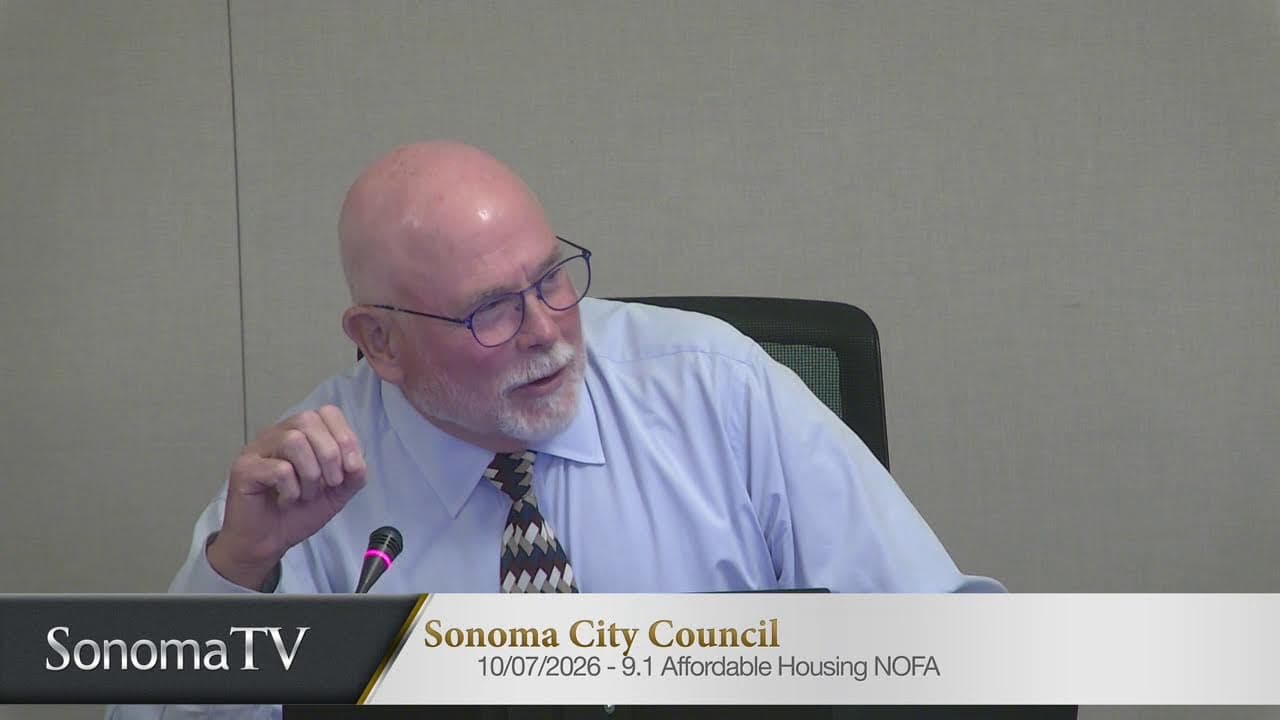
Sonoma is opening its Affordable Housing Trust Fund to developers for the first time, and the City Council decided the opening offer should be bigger than staff proposed. On a 5-0 vote, the council authorized a Notice of Funding Availability (NOFA) for up to $2 million, up from staff's $1.25 million recommendation. Members also introduced a rewritten sign ordinance designed to speed approvals for businesses.
- First affordable housing NOFA approved 5-0, with the ceiling raised to $2M from $1.25M
- Perpetual affordability added as the council keeps flexibility on loans, ownership and rental
- Housing nonprofits push for a bigger pot and ownership options, and a mobile-home resident raises displacement fears
- Sign ordinance rewrite introduced 5-0, shifting most approvals to staff
Council Goes Bigger on First Housing Fund Round
The basics: A NOFA is a competitive call for project proposals. This one offers gap financing, the final dollars needed to close a project's funding stack, to developments serving households at or below 80% of area median income (AMI).
Why it matters: Under its housing element, Sonoma still needs 254 units permitted through 2031, including 152 for lower-income households. The trust fund holds $2.8 million, which is modest compared with projects likely to cost $30 million to $50 million.
Where things stand: Community Development Director Jennifer M. Gates proposed up to $1.25 million. Under her proposal, both nonprofit and for-profit developers could apply, subject to:
- At least a 4:1 leverage minimum
- A $250,000 minimum award
- Affordability terms of 55 years for rentals and 45 years for ownership
Staff asked the council three questions: one award or several, ownership or rental, and what type of loan.
Councilmembers pressed for local-resident priority. Gates said the law allows a preference but not a restriction. "We cannot under the law limit to only allow those to live in those units, but we can prioritize with application process," said Gates. She also cautioned that more than 100 units have affordability restrictions expiring by 2031. That is an argument for holding some money back to preserve them.
Mayor Ron Wellander asked whether prevailing wage would apply. "The Labor Code requires that if public funds are used whole or in part," said the City Attorney.
The other side: Public commenters argued staff's number was too small.
- Julian Mackey, Executive Director of Sonoma Valley Commons, urged an increase to $2.5 million and flexibility on affordability terms. He said viable projects are 40 units or more.
- Caitlin Garfield, Housing Director of the Housing Land Trust, thanked the council for including ownership units.
- Logan Harvey, a public commenter, suggested growing the fund through added transient occupancy tax. He said middle-income households also struggle with housing costs.
- Regina, a Tri-Parks resident, worried new affordable housing could let park owners evict residents. The City Attorney said the council will award projects and proposals will be visible. The mayor noted her concern for the record.
Council reshapes the offer: Councilmember Patricia Farrar-Rivas pushed for longer affordability terms. "I would like to see up to perpetuity," she said, adding that "a loan for 55 years is basically a grant." Vice Mayor Sandra Lowe asked "how can we have sustainable increased funding for the long term." "I am not opposed to increasing the dollar award amount up to $2 million," said Councilmember John Gurney, who then made the motion. The mayor agreed and called this the first of potentially several rounds.
Decisions and stakeholder impacts: The council approved up to $2 million for new construction, acquisition, rehabilitation or preservation, with perpetuity added. It also found the action exempt from the California Environmental Quality Act (CEQA). Ownership and rental projects both remain eligible, and loan type stays negotiable. About $0.8 million stays in reserve.
The vote was For: 5 (Mayor Wellander, Vice Mayor Lowe, Councilmembers Gurney, Jack Ding and Farrar-Rivas), Against: 0, Absent: 0.
Here is who is affected:
- Nonprofit builders such as Sonoma Valley Commons and the Housing Land Trust gain a local funding source.
- Construction workers benefit from the prevailing wage requirement.
- Tri-Parks residents will be watching which sites compete.
What's next: The City Manager or a designee will publish the NOFA in consultation with the City Attorney. Awards will return to the council for approval.
Sign Rules Get a Ground-Up Rewrite
Why it matters: The rewrite aims to cut red tape for businesses. It moves compliant signs to staff-level approval and replaces subjective review with objective design standards.
Where things stand: Associate Planner Jacob Dunn traced the project from 2022 consultant work through study sessions to Planning Commission approval in September. "Staff recommends introducing this ordinance to repeal Title 18 completely and other associated sections related to Title 18 and adopting a new Chapter 19.47 for signs," said Dunn.
The ordinance includes:
- Administrative approvals for compliant signs
- A voluntary sign program allowing more total sign area
- Expanded definitions and revised measurement rules
- Updated prohibitions on displays such as feather banners and roof signs
Councilmembers asked about incidental signs and why the Plaza did not get tighter limits than the 100-square-foot aggregate allowed in commercial zones. "I'm glad that we didn't make 2 separate zones for the signs," said Vice Mayor Lowe.
On enforcement, Mayor Wellander said, "I know that historically this town enforces their ordinance and laws by complaint only." Staff said no change is planned. Dunn added that he will create an application checklist to accompany the ordinance. The mayor urged that sign applications not burden the building department.
Decisions and stakeholder impacts: Vice Mayor Lowe moved and Councilmember Farrar-Rivas seconded. Councilmember Gurney conditioned his yes on the vote being for introduction only. The vote was For: 5, Against: 0, Absent: 0. Business owners gain clearer rules and faster approvals. Preservation-minded residents get one citywide standard instead of a stricter Plaza zone.
What's next: The ordinance was introduced, not adopted. A second reading is expected at a future meeting.
Minor Items
- Consent calendar passes 5-0: A Parks and Recreation Director salary adjustment, costing under $20,000 this fiscal year, will be absorbed through citywide salary savings. Councilmember Ding had asked, "My question is how we can cover this kind of increase."
- Plaza beautification: The Valley of the Moon Garden Club is funding replanting near Carnegie Hall, rose garden improvements and irrigation upgrades with a $75,000 private grant.
- Preservation advocacy: Mike Menefee, Vice President of the Sonoma League for Historic Preservation, opposed county CEQA exemptions and urged a no vote on Proposition 45.
- Regional and legal updates:
- Councilmember Farrar-Rivas reported $20 million in public geothermal exploration funding through Sonoma Clean Power.
- Vice Mayor Lowe said the League of Cities opposes Proposition 43.
- New state law AB 1821 gives the city 10 business days, rather than 10 calendar days, to respond to public records requests.
- Proclamations: The council recognized Domestic Violence Awareness Month, honoring the YWCA's 50th anniversary, and Oct. 18-24 as United Against Hate Week.
Looking Ahead
The city's draft historic context statement is open for public comment and heads next to the Historic Preservation Commission. Staff also reminded residents that hot, dry fire weather persists.