
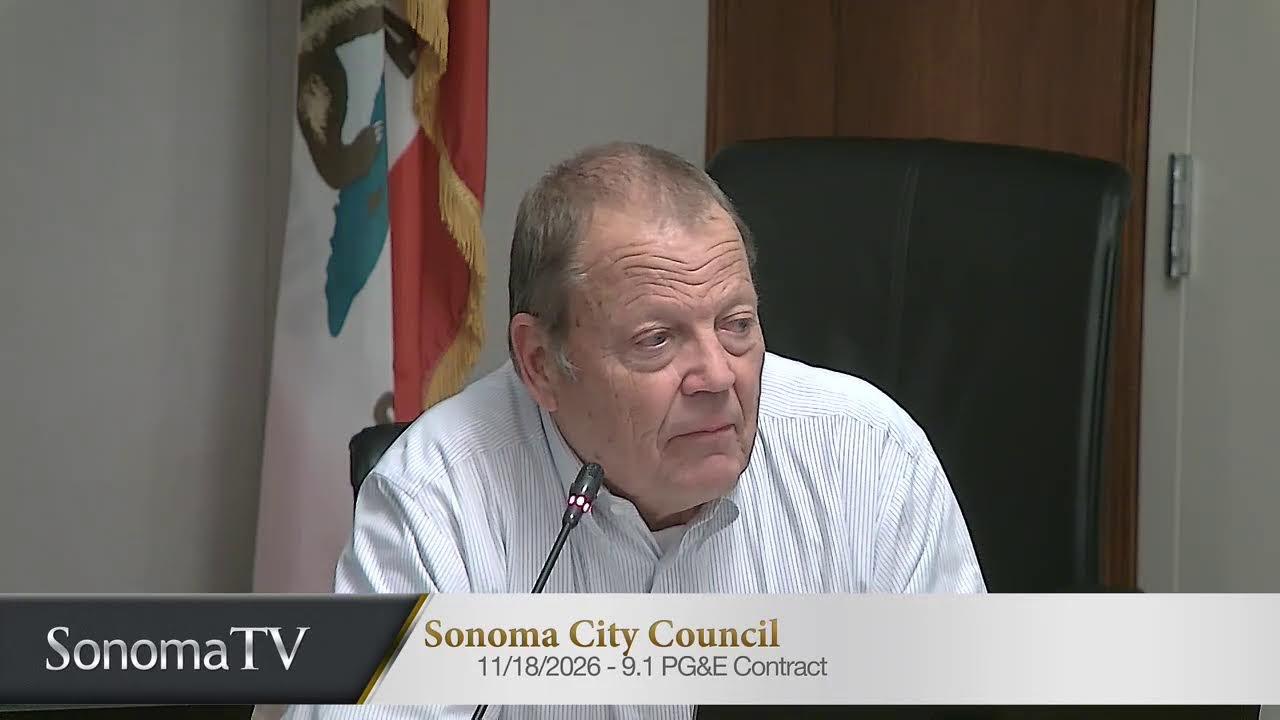
Sonoma Adopts State-Model Policy Limiting Immigration Agents' Access
City Council • SonomaNovember 20, 2026
Locunity is an independent informational service and is not an official government page for this commission. All information is sourced from public footage and an analysis of official agendas with the aid of responsible, fact-checked AI. to report an error or omission.
Sonoma's City Council voted 5-0 to adopt a state-model policy that keeps federal immigration authorities out of nonpublic city spaces unless they have a judicial warrant. The city meets a Jan. 1, 2027 state deadline, but advocates and council members said the work isn't finished. The same meeting produced a unanimous vote on a $60,303 PG&E contract to power electric bus and fleet charging, plus a lengthy briefing on readiness for a possible El Niño winter.
- SB 580 immigration-interaction policy adopted 5-0, with advocates pressing for more training and protection of public spaces
- $60,303.14 PG&E contract approved 5-0 for Corporation Yard EV charging; city must still find about $73,000
- Storm drain inspection of 39,000 feet turned up collapsed lines as the city prepares for a possibly wetter winter
- Wet-weather sheltering for unhoused residents is still being worked out
Sonoma Sets Rules for Immigration Agents at City Hall
Why it matters: Every local government in California must adopt the Attorney General's model policy, or a substantially similar one, before 2027. The policy now governs how every city employee responds when federal immigration authorities show up.
The basics: SB 580 directed the state Attorney General to write model policies on local interactions with immigration authorities. City Attorney David Ruderman said the law "requires all state and local governments to adopt those policies or substantially similar policies and implement them by January 1st, 2027."
Where things stand: The policy designates public and nonpublic areas of city facilities. It routes requests from immigration authorities to the city attorney and city manager, requires staff to document interactions, minimizes data collection and bars releasing records without legal review.
Ruderman said the policy does not authorize anyone to obstruct a valid judicial warrant. It also does not change policing, which Sonoma contracts to the Sonoma County Sheriff's Office. Police Chief Brandon Cutting told the council the provisions "are in alignment with Sheriff's Office policy."
Council questions covered video footage and administrative warrants, immigration agents staging on city property, support for children of detained parents, and whether the rules apply to council members. On footage, Ruderman said "most of our video footage is not going to be something that is accessible absent a valid judicial warrant or court order."
Councilmember Jack Ding framed the policy as more than an immigration matter, citing children's well-being. "This is a public safety issue," said Ding.
The other side: No speaker opposed the policy. Public commenters supported it but said it falls short.
Public commenter David Iker urged passage. He warned that citizens could be profiled along with immigrants and asked the city to study further steps, including protecting sensitive public places such as schools and churches.
Pamela Harder of the Sanctuary Coalition asked the city to follow Petaluma's approach: a three-month rollout with staff training. She objected to letting U.S. Immigration and Customs Enforcement use public space and said immigrants are living in fear. Harder also said the county sheriff may still turn over people held for misdemeanors to ICE. She welcomed the state-recommended steps but said the city can do more.
Council members emphasized countywide consistency and consulting immigrant communities as next steps.
Decisions and stakeholder impacts: Ding moved to adopt the resolution and direct the city manager to implement it with the city attorney, including administrative procedures, employee training and coordination with contracted service providers. The motion passed 5-0 (For: Mayor Ron Wellander, Vice Mayor Sandra Lowe, Councilmembers Jack Ding, John Gurney and Patricia Farrar-Rivas; Against: 0; Absent: 0).
City employees gain clear protocols and new documentation duties. Immigrant residents gain defined limits on federal access to nonpublic city spaces. Because policing runs through the Sheriff's Office, the county's practices still shape much of what residents experience on the ground. The council reordered the agenda at the start of the meeting so this item came first, while interpretation was available to the public.
What's next: City Manager Cristine Alilovich said that "prior to January 1st, obviously, the implementation will be to identify responsible staff, assess the facilities and procedures." Advocates are watching whether training and countywide coordination follow.
A $60,303 Down Payment on Fleet Electrification
Why it matters: State clean-fleet rules are pushing cities toward electric vehicles. "There are state regulations that require us to move our fleet equipment to EV charging over the next year to 5 years," said Alilovich.
The basics: Capital project BF2 is a joint effort with Sonoma County Transit. It adds EV charging for transit buses at the city's Corporation Yard and builds capacity for future city fleet needs. The PG&E contract covers supply-side electrical upgrades.
Where things stand: The full project costs $573,879. "Sonoma County Transit has secured $400,000 in grant funding for this project," said the Public Works Director, Mike Berger. That grant is scheduled for the county Board of Supervisors on Dec. 8, and a letter of commitment from the transit agency is in the council packet.
The city's share is $173,879. "Currently we have $100,000 of carryforward in our budget for this project," said Berger. The remaining roughly $73,000 must come from the general fund, long-term building maintenance funds or reserves. Staff said the direct-current charger and a gate drive much of the cost.
PG&E needs the agreement approved by Dec. 17, and the roughly $60,000 is paid up front. Ding pressed on the exposure if the grant falls through. "That is gone. That is not refundable, right?" asked Ding. Staff confirmed the payment is nonrefundable.
The other side: Mayor Ron Wellander asked whether the project is needed now. "So in terms of what we currently have, we have the capabilities to continue independent of this project?" he asked.
"That's correct. However, if we increase the size of our electric fleet and put a street sweeper in, that'll stress our capacity," Berger replied.
Council members also discussed deferring the item to the Dec. 7 meeting.
Decisions and stakeholder impacts: The council approved the contract, not to exceed $60,303.14, by a 5-0 vote (For: Wellander, Lowe, Ding, Gurney, Farrar-Rivas; Against: 0; Absent: 0). Ding seconded. Sonoma County Transit gains bus charging capacity. The city locks in electrical capacity for future fleet purchases but carries a nonrefundable cost while the county grant vote is pending.
What's next: The Board of Supervisors takes up the $400,000 grant Dec. 8. Staff still must identify where the city's remaining $73,000 will come from.
Storm Drains, Creeks and a Proclamation on Standby
Why it matters: Forecasters expect a wetter-than-average winter. The city has a local emergency proclamation ready but has not finalized wet-weather shelter plans for unhoused residents.
Where things stand: Sarah, the city's Senior Management Analyst and Public Information Officer, reviewed the El Niño outlooks. She described compounding risks from atmospheric rivers, sea level rise and high tides. She also tempered expectations: "El Niño doesn't automatically mean a wet winter in Sonoma."
Public Works completed a cleaning and inspection contract covering about 39,000 feet of storm drain, roughly one-sixth of the system. Crews found collapsed lines and junction structures that need repair, and staff plans to report back to the council. Public Works also coordinated work on Nathanson and Fryer creeks with the Sonoma County Water Agency and Sonoma Ecology Center, and upgraded truck radios.
Parks staff described tree and drainage work and contingency plans for plaza lighting. Fire, police and county emergency management officials outlined rescue assets, drones, alerts and sandbag sites.
On emergency powers, the analyst said a local emergency proclamation is drafted. "We do have one prepared so it could be considered quickly if conditions warrant that," she said.
Decisions and stakeholder impacts: The council took no action. Residents were urged to prepare and sign up for alerts. Unhoused residents remain the clearest gap, since sheltering arrangements are still in development.
What's next: Staff noted a recent tabletop exercise and a community partner meeting set for Dec. 9. The storm drain repair report is still to come.
Minor Items
- Permit extensions: The consent calendar passed 5-0. It included the second reading of Item 7.3, giving applicants up to five years to commence construction. Public commenter David Iker asked to change "complete" to "commence" in one example. City Attorney David Ruderman suggested adding the word at the next zoning amendment instead.
- Sonoma Clean Power: At her last Sonoma Clean Power meeting, Councilmember Patricia Farrar-Rivas joined votes approving a $287,000 Brown and Caldwell biogas study at the Laguna plant and joining a California Geothermal Coalition. The board also extended its $4M Business One-Stop Shop building loan to interest-only for 12 months. Councilmember John Gurney takes the seat.
- AI and public records: Ruderman flagged a new state law that excludes AI from the definition of a "person" under the Public Records Act and Brown Act. He said the law may be largely performative, and staff will study its verification provisions.
- Tri-Park hearing: Lynn Murray DeVincent of the Tri-Park Committee thanked the city for moving the Dec. 7 closure-and-conversion hearing earlier, holding it at the larger Veterans Hall and recording it on video.
- Historic preservation: Elizabeth Scrandall of the Sonoma League for Historic Preservation said the group accepts thoughtful infill. She urged environmental impact reports and full California Environmental Quality Act review in the Historic Overlay District.
Looking ahead: The Tri-Park closure-and-conversion hearing is Dec. 7 at Veterans Hall. The county vote on the $400,000 transit grant is Dec. 8, the storm partner meeting is Dec. 9, and the PG&E agreement deadline is Dec. 17. The SB 580 policy must be fully implemented by Jan. 1, 2027.