
Small Business Commission - Aug 24, 2026 - Meeting
Small Business Commission • San FranciscoAugust 24, 2026
Locunity is a independent informational service and is not an official government page for this commission.We use AI-assisted analysis and human editorial review to publish information.
Grant Program Overhaul Sparks Dissent as Budget Crunch Hits Legacy Businesses
San Francisco's Small Business Commission tackled the growing tension between shrinking city budgets and rising demand from legacy businesses, restructuring its landlord stabilization grant program in a contested 3-1 vote that drew a procedural challenge. The commission also endorsed a 10-year tax credit to rescue neighborhood hardware stores from an unintended Prop M tax hike and welcomed five new businesses to the Legacy Business Registry.
- Legacy business grant rules overhauled in 3-1 vote, capping landlord grants at five years as program funding drops from $1M to $437K — but a former program manager says the vote may not be legal
- 10-year tax credit endorsed for neighborhood hardware stores after owners testify Prop M doubled their tax bills and one iconic store closed after 88 years
- Five neighborhood institutions join the Legacy Business Registry, including a 55-year-old Russian bookstore, a judo dojo founded in a Japanese internment camp, and a five-and-dime that now trains the community on naloxone
- 15 new alcohol licenses coming in September for downtown and underserved neighborhoods, plus a new mobile food cart permit program nearing citywide launch
Budget Cuts Force Hard Choices on Legacy Business Grants
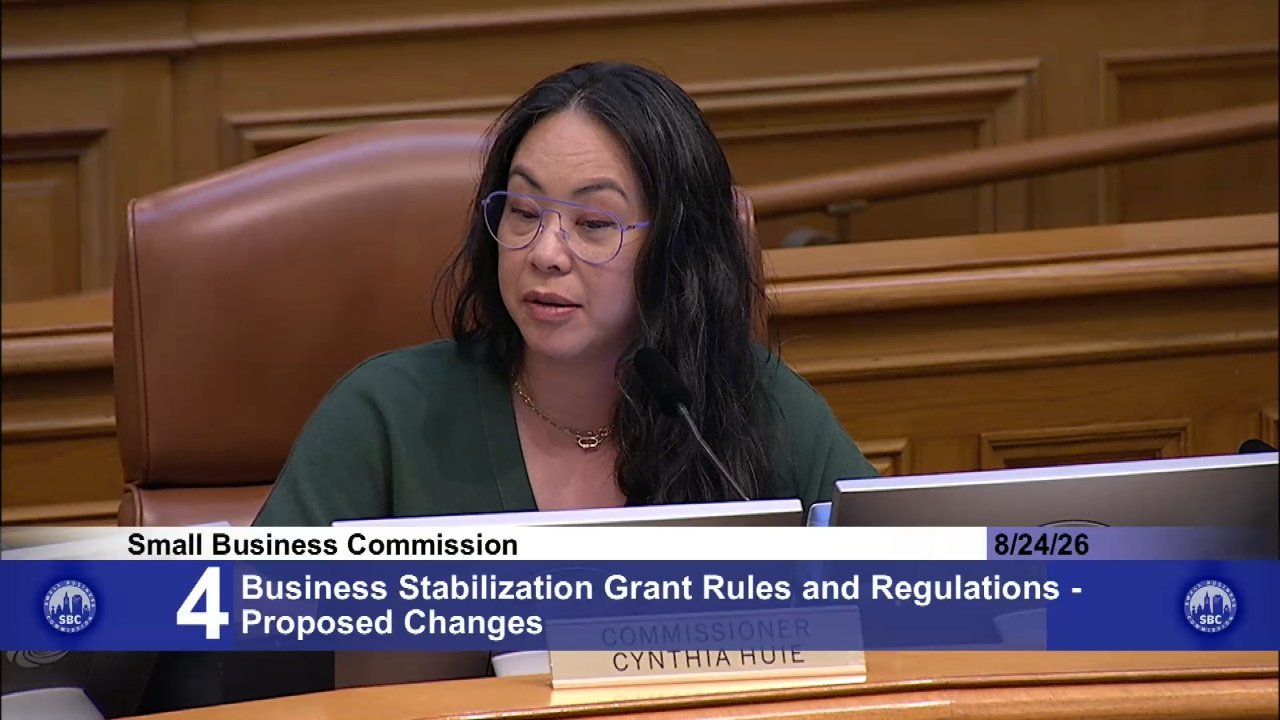
The commission approved sweeping changes to its Business Stabilization Grant program — the financial backbone of San Francisco's effort to keep legacy businesses in their neighborhoods — but the 3-1 vote exposed fault lines over how to stretch a dramatically smaller budget and whether the commission followed its own rules.
The basics: The stabilization grant, created under Prop J, pays landlords who offer 10-year leases to legacy business tenants. It is the only program of its kind in the country.
Why it matters: The program's budget was slashed from roughly $1 million to approximately $437,000 this fiscal year, with carry-forward funds bringing the total to about $700,000. Around 50 landlords currently receive grants, while a growing queue of eligible applicants is being turned away.
Where things stand: Director Ting, Office of Small Business, laid out the math driving the overhaul: "Over the past couple of years there have been significant reductions to this funding. So to the point where for this fiscal year we're down to about $437,000 roughly." She noted that "San Francisco actually does have the most robust legacy business program in the country. We do not know of any other jurisdiction that offers a rent or business stabilization grant program the way that we do."
The proposed rule changes include capping grant eligibility at five consecutive years instead of the full lease term, requiring landlords to apply within one year of executing a long-term lease, consolidating grants for businesses occupying two contiguous spaces into a single grant, requiring 10 hours of technical assistance for tenants, and removing the appeals process.
Commissioner William Ortiz-Cartagena pushed for an additional amendment excluding formula retail tenants from the program, arguing that chain businesses shouldn't consume scarce resources meant for independents. "It's a real limited resource and I would just hate for an actual formula retail to get this one," he said. "Even one business that gets bumped because of a formula retail." The commission adopted the amendment.
The other side: Richard Carrillo, former Legacy Business Program Manager at OEWD — whose position was eliminated earlier this year — delivered pointed public comment opposing every major change. He argued the commission lacked authority to hear the item as an action item due to insufficient public notice under the administrative code. On the substance, he said the five-year cap undermines the program's core purpose: "The five-year grant limit defeats the purpose of the grant, which is to incentivize long-term leases of 10-plus years. This change will make the grant ineffective." He also called the removal of the appeals process a "red flag" and questioned whether consolidating grants for contiguous spaces works when different LLCs own the parcels.
Commissioner Ron Benitez acknowledged the constraints, saying he appreciated "that the city's really working hard and really trying their best to continue to give these small businesses or the new ones that are planning for this fund what they can with the constraints that we have."
Decisions: Commissioner Fisher moved to approve the draft changes with the formula retail exclusion amendment. The vote passed 3-1 (For: President Cynthia Huie, Commissioner Benitez, Commissioner Fisher; Against: Vice President Ortiz-Cartagena; Absent: Commissioner Cornet, Commissioner Zouzounis).
The 3-1 margin itself became the story's coda. Carrillo returned during commissioner discussion to argue the administrative code requires four affirmative votes for any approval: "The affirmative vote of a majority of the members says four votes shall be required for the approval of any matter." Clerk Kerry Birnbach acknowledged uncertainty but declared the motion passed.
What's next: The procedural challenge may force the commission to revisit the item. If the administrative code does require four affirmative votes regardless of absences, the rule changes could be void — leaving the program in limbo as the waitlist grows.
Hardware Store Tax Credit: Fixing Prop M's Collateral Damage
The commission unanimously endorsed a 10-year gross receipts tax credit for small hardware retailers, responding to testimony that a 2024 voter-approved tax reform measure is threatening the survival of neighborhood stores that have served San Francisco for generations.
The basics: BOS File 260792, introduced by Supervisor Mandelman, would retroactively create a gross receipts tax credit beginning Jan. 1, 2026, through 2035 for hardware stores where more than 50% of receipts come from hardware products and total receipts fall under $50 million.
Why it matters: Prop M, passed by voters in 2024 to reform the city's business tax structure, had the unintended effect of dramatically increasing tax burdens on small hardware stores. Grace Huang, legislative aide to Supervisor Mandelman, told the commission that "even before Prop M passed, our office had begun to hear concern from neighborhood hardware stores that, contrary to the intent of Prop M, they were in a category of small business that might see their tax burden increase if the measure passed." She cited Papenhausen Hardware's closure in December 2024 after 88 years as a cautionary case.
Owners Describe Razor-Thin Survival
Terry Aston Bennett, fifth-generation co-owner of Cliff's Variety, testified that Prop M doubled their gross receipts tax. "What most of you don't know, as hardware store owners, we often go weeks at a time without paying ourselves, that we run on very, very fine margins," she said. She described 12% inflation from tariffs compounding the tax hit, and recalled how hardware stores served as essential lifelines during the 1989 earthquake and the COVID pandemic.
Rick Karp, owner of Cole Hardware and a third-generation legacy business operator, testified his taxes doubled to approximately $20,000 per year. Combined with roughly $80,000 in Healthy SF costs, about $100,000 annually goes to the city. He noted that grocery stores, restaurants, and large retailers with lobbyists secured carve-outs from Prop M, but hardware stores did not.
President Huie voiced strong support, saying "hardware stores, I think, are very much needed resource in our communities and I think any way that we can support them in making sure that we have them in our neighborhood corridors is really important."
Vice President Ortiz-Cartagena recalled how Cole Hardware provided laundry carts so elders could carry food boxes at the Mission Food Hub during the pandemic: "Rick, when it was the pandemic, when the LTF started, the Mission Food Hub, we had all these boxes supplying people in the heart of the pandemic. And I remember our elders, they needed carts, like the laundry carts to carry the boxes. And you hooked it up."
Decisions: The commission voted 4-0 to endorse the ordinance (For: President Huie, Commissioner Benitez, Commissioner Fisher, Vice President Ortiz-Cartagena; Absent: Commissioner Cornet, Commissioner Zouzounis). The legislation now heads to the full Board of Supervisors.
Five Neighborhood Icons Join the Legacy Business Registry
The commission unanimously approved legacy business status for five San Francisco institutions, each with a story that reads like a chapter in the city's immigrant and neighborhood history.
Why it matters: Legacy status unlocks rent stabilization grants and city recognition that help long-standing businesses negotiate longer leases and resist displacement in an increasingly expensive city. All five had already received positive recommendations from the Historic Preservation Commission.
The approved businesses span the city:
- Ambrosia Bakery (1988, Ingleside) — a Vietnamese-American bakery whose owner, Kee Chuan, told the commission his decades of work had a singular purpose: to leave a legacy to his three children.
- Standard Five and Dime Ace Hardware (1939, Presidio Heights) — one of the last five-and-dime stores in the country, now also a community naloxone training hub after the owners lost their son to fentanyl. Jeff Leopold, the third-generation owner, shared his family's immigrant story — his father arrived after World War II with nothing and worked his way from unpaid stock boy to owner.
- Globus Books (1971, Inner Richmond) — the only remaining West Coast bookstore specializing in Russian, Belarusian, and Ukrainian books. Manager Anastasia Mutungi said: "Globus has been here for 55 years because of the people, often immigrants, who cared about this place and believed that independent bookstores still matter." Angeline Yu, speaking on behalf of Supervisor Connie Chan, called the store irreplaceable and a cultural touchstone connected to the Russian American historic context statement.
- Casa Guadalupe Supermarket (1990, Mission District) — a Peruvian-immigrant-founded Latin American grocery.
- San Francisco Judo Institute (1954, Sunset) — founded by a Japanese American who learned judo in an internment camp. The institute has produced Olympic athletes. Alix Caba, a 10-year board member and San Francisco firefighter who grew up at the club since age 5, spoke about continuing the legacy of training youth citywide.
President Huie marveled at the businesses' attentiveness to their communities: "I'm just in awe of how you can anticipate your neighbor's needs so acutely. And it really comes to that many years of experience of talking to people and knowing who is in your community."
Vice President Ortiz-Cartagena called the legacy businesses a source of pride: "The 5 and 10 store — I've never been inside. But your story, of San Francisco generational small business, makes me proud because that's what San Francisco is."
Decisions: Approved 4-0 (For: President Huie, Commissioner Benitez, Commissioner Fisher, Vice President Ortiz-Cartagena; Absent: Commissioner Cornet, Commissioner Zouzounis).
Minor Items
- June 22 meeting minutes approved 4-0.
- 15 new Type 87 alcohol licenses — 10 for the downtown hospitality zone and 5 for neighborhood census tracts in Bayview, Excelsior, Ocean Avenue, Sunset/Noriega-Judah-Taraval, and Portola/Visitacion Valley — will be released in September, with a lottery if demand exceeds supply.
- Barrier removal grant reopened, offering up to $10,000 in reimbursement for ADA accessibility upgrades, funded by $4 per business registration (~$300,000–$350,000 annually). Vice President Ortiz-Cartagena praised the grant's ripple effects: "That grant has been like the best pound for pound. It's not only the money you get, but businesses get this knowledge — in my community now they're aware of ADA stuff and they organically help the next business."
- Compact mobile food operation permits are nearing citywide launch, allowing carts both outdoors and inside existing retail spaces. Director Ting noted: "It's not just for outdoor, it can also be a cart inside. So for example, we've heard of people who want to have a coffee cart inside a clothing store or even bookstore."
- Nitrous oxide sales prohibition legislation is pending at the Board of Supervisors, with exceptions for medical, research, manufacturing, and food purposes.
- Divisadero corridor fires in June temporarily closed KFICO and The Mill, though The Mill's owner leveraged locations in other neighborhoods to continue operations. A new French restaurant, Esmé, opened in the former Ragazza space.
- City Maid Quilts celebrated a grand opening, activating a storefront vacant for 20 years through an OEWD grant in Visitacion Valley, which will also host its first night market on Leland Street.
- Chinatown Night Market mahjong nights on Waverly are drawing 35-plus tables and intergenerational crowds, though multiple simultaneous construction projects — including a library, DPH center, and the demolished Portsmouth Square–Hilton bridge — are creating challenges for the neighborhood.