
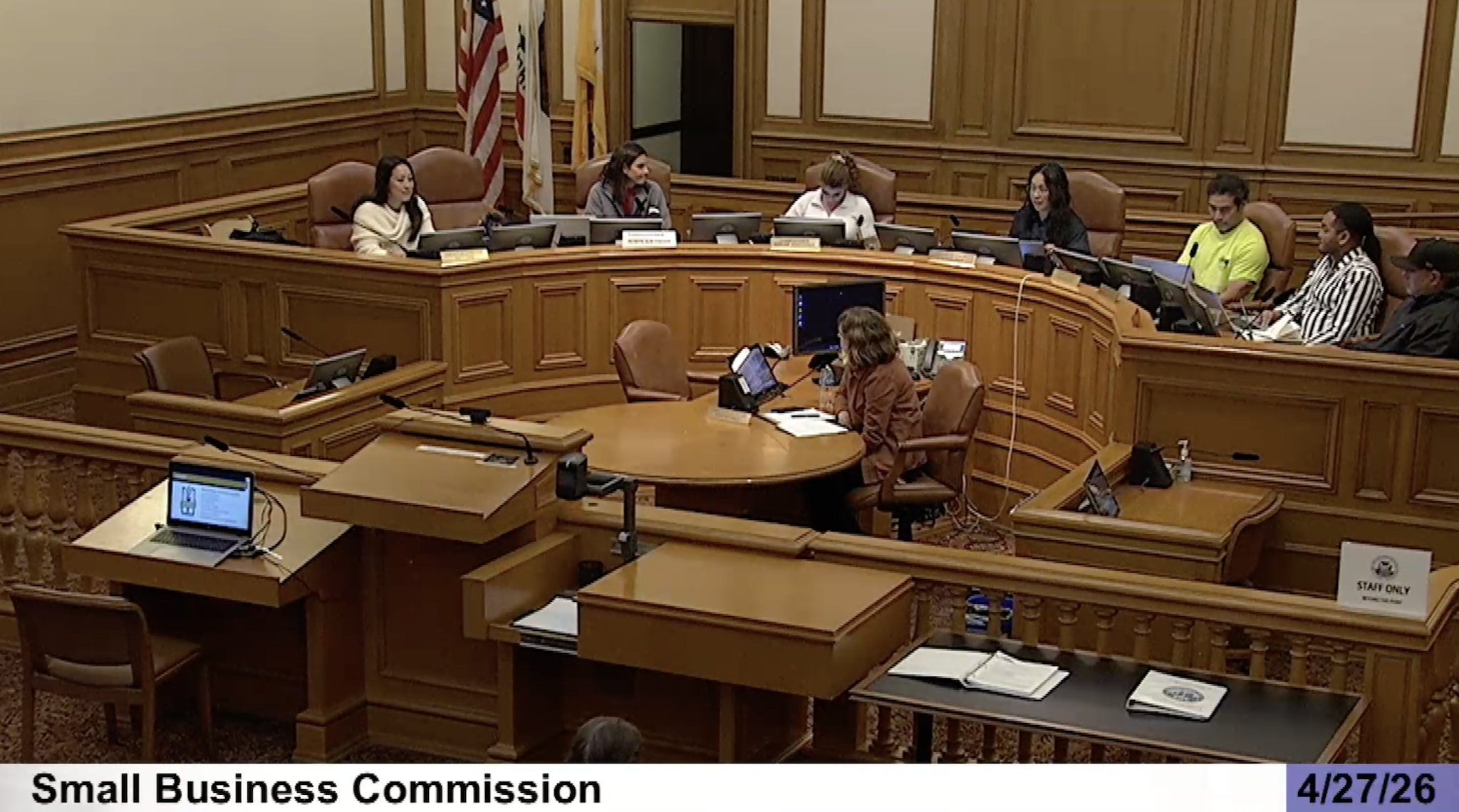
Small Business Commission - Apr 27, 2026 - Meeting
Small Business Commission • San FranciscoApril 27, 2026
Locunity is a independent informational service and is not an official government page for this commission.We use AI-assisted analysis and human editorial review to publish information.
Commission Rejects Outdoor Smoking Ban, Backs Cannabis Cafes and Battery Safety
San Francisco's Small Business Commission drew a sharp line on April 27: public health mandates that land on small businesses without mitigation will not get this body's support. Commissioners unanimously killed an outdoor bar smoking ban, then pivoted to endorse cannabis cafes 5-1 and a battery safety law 6-0 — but only after demanding the city pair enforcement with equity programs.
Outdoor bar smoking ban rejected 6-0 as commissioners cite business burden, sidewalk spillover, and lack of local data
Cannabis cafe permits advance 5-1, opening food, beverage, and live entertainment at consumption lounges
Uncertified lithium-ion battery sales ban backed 6-0 with call for rebate programs so low-income riders aren't priced out
Street closure permits streamlined unanimously, eliminating mandatory hearings for 80–90% of small events
Nine businesses join Legacy Business Registry, from a 1948 dive bar to the world's longest-running LGBTQ film festival
Commissioner Zouzounis warns federal food-stamp enforcement surge is threatening corner stores in Districts 5 and 6
Smoking Ban Goes Up in Smoke: 6-0 Rejection
The basics: File 260361, introduced by Supervisor Myrna Melgar, would have prohibited smoking on outdoor patios of bars and taverns and repealed outdated indoor smoking exemptions. Jen Lowe, legislative aide to Melgar, told commissioners the measure was "cleanup and catchup," noting San Francisco is among the last Bay Area cities without the restriction.
Why it matters: Roughly 50 bars and taverns with outdoor smoking areas would have been affected. Health advocates called it an overdue worker-protection measure; business owners and nightlife workers said it would push smokers onto sidewalks, creating new problems while punishing establishments still recovering from the pandemic.
Where things stand: Lowe offered a delayed enactment of up to nine months and state-funded signage, but those concessions failed to move the commission. The debate lasted over an hour — the longest of the night — and every commissioner found reason to oppose the ban.
Commissioner Miriam Zouzounis delivered the most pointed critique, connecting the proposal to prior tobacco regulation she said devastated small retailers:
"We have since all the tobacco bans seen small actual storefronts that are black markets and street black market activities increase. Whereas before we had a 96% compliance rate in selling to youth."
She also called out an unaudited fee retailers already pay, noting that the city hasn't audited the cigarette litter abatement fee in almost two decades.
Commissioner Dimitri Thierry Cornet framed the issue as one of business owner choice, arguing some establishments have smoking areas baked into their business models. He warned San Francisco's entertainment sector comeback could be undermined:
"San Francisco, we're making a comeback and we're making a very strong comeback. What's coming back very strong for us is entertainment."
Vice President William Ortiz-Cartagena pointed to the vacancy risk:
"That's 50 anchor businesses and neighborhoods. Those are 50 potential vacancies."
Commissioner Robin Sue Fisher, in her first meeting, urged a data-first approach:
"It seems to me that the prudent thing to do would be to wait until the other results are in. We're not doing something experimental here."
President Cynthia Huie questioned punitive approaches altogether:
"We kind of keep going back to the stick, like where we keep thinking about, okay, well in order to get this behavior to change, we need to find the right punishment. To me, that is not the way that I think about behavior change."
She suggested grant-funded cessation programs as an alternative and raised concerns about simply moving smoking from back patios to sidewalks.
The other side: Public health advocates pushed back forcefully. Dr. John Maa, a surgeon at Chinese Hospital, urged support based on career experience with smoking-related surgical complications, noting the ordinance closes a loophole most Bay Area cities eliminated years ago. Liz Williams of American Nonsmokers' Rights Foundation argued bar workers are among the only employees still breathing secondhand smoke on the job and said over 120 California communities have adopted similar laws that are working. Liz Hendricks of the American Cancer Society Cancer Action Network cited a 2005 study showing smoke-free laws actually increased restaurant and bar revenues in California.
On the opposition side, Stephen Torres, a nightlife worker and former entertainment commissioner, warned that workers would bear the enforcement burden through steep fines and risk of closure. John Ojinaga, owner of Azúcar Lounge and board member of the Leather and LGBTQ Cultural District, cautioned the ban would threaten LGBTQ cultural traditions in SOMA and increase sidewalk congestion under residential windows.
Decisions: Cornet moved to not approve the ordinance; Zouzounis seconded. The vote was 6-0 to reject. (For: Benitez, Cornet, Fisher, Huie, Ortiz-Cartagena, Zouzounis; Against: none; Absent: none.)
What's next: The commission's unanimous rejection sends a strong advisory signal to the Board of Supervisors, though the board can still move the legislation forward. Commissioners made clear they want San Francisco-specific complaint data and paired mitigation programs before any future version returns.
Cannabis Cafes Get the Green Light, With One Dissent
The basics: File 260281, from Supervisor Rafael Mandelman, would create a cannabis cafe permit enabled by state Assembly Bill 1775. Cannabis retailers could serve food, sell non-alcoholic beverages, and host ticketed entertainment. The ordinance expands allowable consumption space beyond the current one-third limit, establishes a phased rollout beginning with existing retailers, maintains a 600-foot buffer from schools with a narrow exemption, and caps permits at four per owner.
Why it matters: With only 11 consumption lounges citywide and legal cannabis squeezed by layered taxes and illicit competition, the cafe model offers a new revenue pathway that could determine whether equity operators survive.
Where things stand: Sophie Marie, Legislative Aide from Mandelman's office explained the industry's structural disadvantage:
"Cannabis businesses cannot have access to traditional banking services or loans, credit, insurance and more, which makes day to day operations a lot more costly."
She noted existing retailers have waited years for this opportunity, sharing that they expect many businesses in the first year given they have been waiting 10 years for the permit system.
Ben Van Houten from the Office of Economic and Workforce Development confirmed that ventilation requirements already match emergency room negative-pressure standards and would continue to apply. Ray Law from the Office of Cannabis described three consumption permit types and confirmed the permit backlog has been cleared.
The SF Cannabis Alliance and Brownie Mary Democratic Club support the legislation but prefer a five-year phased rollout over the proposed one year, fearing oversaturation. President Cynthia Huie questioned whether the one-year runway was sufficient given build-out costs — $275,000 for ventilation alone for one equity applicant — and worried about large corporations entering the market.
The other side: Liz Hendricks of the American Cancer Society Cancer Action Network argued cannabis cafes would undermine decades of smoke-free workplace protections, noting pregnant workers would face impossible choices between health and employment. Liz Williams of Americans for Nonsmokers' Rights Foundation cited a UCSF study showing ventilation systems reduced air pollution by only 12% in a San Francisco cannabis lounge.
Decisions: Cornet moved to support; Zouzounis seconded. The vote was 5-1. (For: Benitez, Cornet, Fisher, Ortiz-Cartagena, Zouzounis; Against: Huie; Absent: none.) Fisher initially hesitated but voted yes.
What's next: The legislation moves to the Board of Supervisors. The phased rollout timeline — one year versus five — remains a key point of negotiation with industry stakeholders.
Battery Ban Passes, but Equity Concerns Come First
The basics: File 260359, from Supervisor Bilal Mahmoud, would ban the sale and delivery of lithium-ion batteries that lack UL or European EN safety certification — targeting the cheap, uncertified products behind a surge of deadly fires. Samantha Logan, Legislative Director from Mahmoud's office cited a fire at 50 Golden Gate Ave. that displaced 130 residents and noted 123 battery fire incidents in District 5 over two years, with property losses jumping from $270,000 in 2024 to nearly $3 million in 2025. The legislation was drafted alongside the SF Fire Department and modeled on New York City's approach.
Why it matters: Uncertified batteries are overwhelmingly cheaper — roughly one-third the cost of certified alternatives. The people who depend on them are increasingly low-income workers, delivery riders, and SRO residents, not the tech demographic that originally adopted e-bikes.
Where things stand: Commissioner Miriam Zouzounis named the tension directly:
"I think in this case this falls for me as another anti-poor legislation because we're dealing with a tech product innovation that was introduced into San Francisco for a certain demographic of folks. But those are not the demographic of folks using these modes of transport anymore."
She questioned why the ban arrived without concurrent mitigation like charging stations.
Commissioner Robin Sue Fisher supported the ban as an e-bike rider and parent and proposed a trade-in concept:
"I think that there should be thought about a refurbished market for batteries that can be safely rebuilt and restored and have that be considered as an alternative."
Commissioner Dimitri Thierry Cornet pushed for action:
"We want to put forward safety, but we kind of got to put our money where our mouth is."
He proposed instant reimbursement through bike shops.
Decisions: Tang helped craft the final motion language. Fisher moved to support the ban with a recommendation to explore programs to mitigate inequities for communities that cannot afford certified batteries; Cornet seconded. The vote was 6-0. (For: Benitez, Cornet, Fisher, Huie, Ortiz-Cartagena, Zouzounis; Against: none; Absent: none.)
What's next: The legislation heads to the Board of Supervisors. Whether the city creates an accompanying rebate or trade-in program will determine whether the ban's safety benefits reach the communities most at risk without pricing them out.
Red Tape Cut for Block Parties and Small Events
Why it matters: Small businesses producing neighborhood events since the pandemic have struggled with permitting delays. File 260294, backed by Mayor Daniel Lurie and co-sponsored by multiple supervisors, would let SFMTA administratively approve street closures contained within three blocks that keep intersections open and don't require Muni rerouting — eliminating the mandatory ISCOTT hearing for an estimated 80–90% of applications.
Ben Van Houten from the Office of Economic and Workforce Development described the shift:
"Since the pandemic, we've seen just an incredible level of ownership over creating new events from our small businesses around San Francisco, which has been really exciting to see."
All departments — fire, police, and others — would still review events; only the public hearing requirement changes. Director of Office of Small Business Katy Tang added that the reform would benefit small businesses doing grand openings, which previously required an ISCOTT hearing even for one parking space.
Decisions: Ortiz-Cartagena moved to support; Benitez seconded. The vote was 6-0. (For: Benitez, Cornet, Fisher, Huie, Ortiz-Cartagena, Zouzounis; Against: none; Absent: none.)
Nine Businesses Join the Legacy Registry
The commission unanimously approved nine businesses for the Legacy Business Registry, all of which met the program's three criteria and received positive recommendations from the Historic Preservation Commission. The new additions span neighborhoods and decades: Billiard Palisade (1980, Excelsior), Carlos Osejo Taxes and Bookkeeping (1980, Excelsior), Frameline (1976, LGBTQ film nonprofit), Horseshoe Tavern (c. 1951, Marina), Los Planos de Renderos (1989, Excelsior), Only in San Francisco (1979, Pier 39), Philosophers Club (c. 1948, West Portal), Silver Cloud (1979, Marina), and Would You Believe (1986, Inner Richmond).
Business owners and supporters packed the public comment period. Justin Fritsch, co-owner of Philosophers Club, described the nearly 80-year-old tavern as a "third place" for community gathering. Megan Weaver, co-owner of Horseshoe Tavern, called the bar a community living room honoring her late father's legacy. Vice President William Ortiz-Cartagena gave personal testimonials about nearly every business on the list:
"Every part is a part of my history of my San Francisco experience."
Legacy status qualifies businesses for rent stabilization grants and historic preservation protections. The vote was 6-0. (For: Benitez, Cornet, Fisher, Huie, Ortiz-Cartagena, Zouzounis; Against: none; Absent: none.)
Minor Items
New Commissioner Robin Sue Fisher was welcomed to the commission. Fisher is the founder of Smitten Ice Cream, which she started as a street vendor in the Mission roughly 20 years ago. Former Commissioner Rachel Herbert was recognized for her service.
Small Business Week launches the following week with a B2B-focused vendor pop-up at City Hall on Tuesday (11 a.m.–3 p.m.), an opening night ceremony Monday at 6 p.m., library workshops, and a "Small Business Boogie" in West Portal on Wednesday evening.
Commissioner Zouzounis flagged a surge in federal USDA enforcement of EBT (CalFresh) licenses in Districts 5 and 6, warning that businesses with clean records are receiving irrevocable violations: "A lot of food stamps licensed businesses are now getting irrevocable violations that have never had any problems before. And so the city has in fact created a compounded food access issue." She said the enforcement coincides with the city's business curfew policy in the same neighborhoods, and that the Human Services Agency only supports businesses with on-premise/hot-food CalFresh — leaving corner store retailers without city assistance.
Commissioner Zouzounis also announced an Arab American Heritage Month reception and acknowledged Armenian, Greek, and Assyrian Genocide Remembrance Month.