
Jail Mental Health Team Half-Staffed as Oversight Board Probes Night Releases
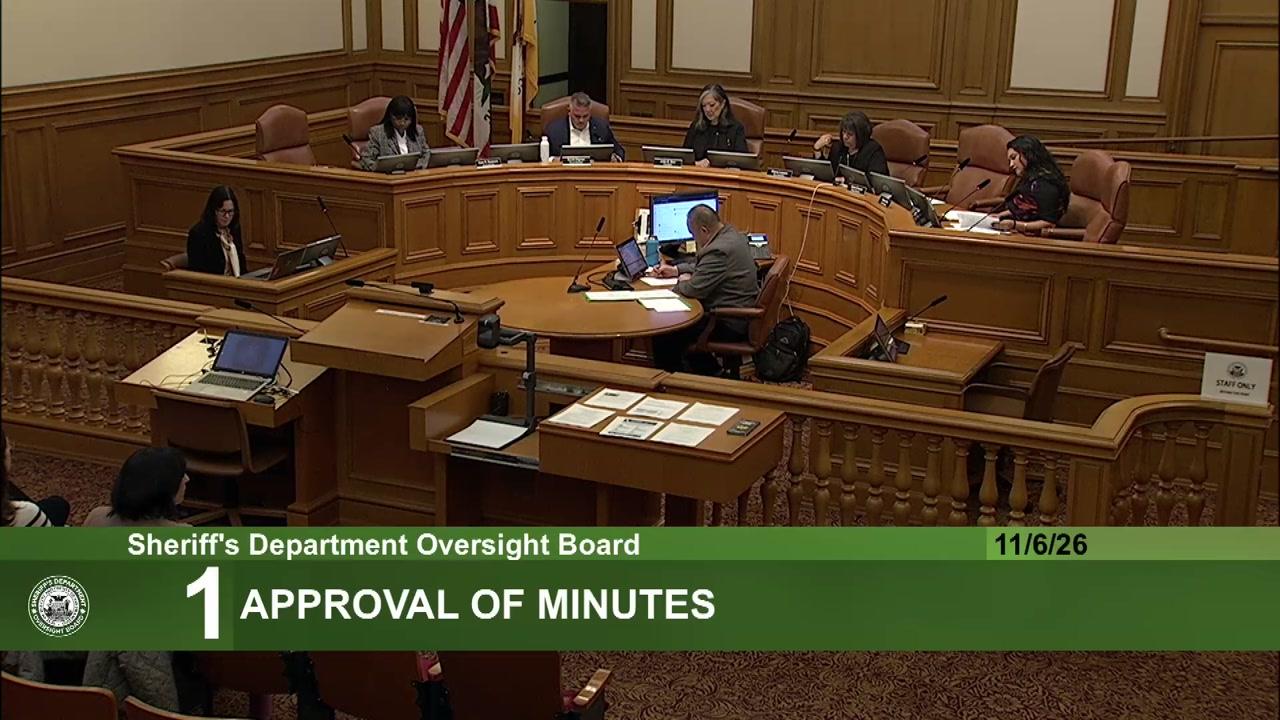
Sheriff's Department Oversight Board • San FranciscoNovember 6, 2026
Locunity is an independent informational service and is not an official government page for this commission. All information is sourced from public footage and an analysis of official agendas with the aid of responsible, fact-checked AI. to report an error or omission.
San Francisco's jail mental health team follows more than a third of the people in custody, and it is working with about half its usual clinicians. In a two-hour session on Nov. 6, 2026, the Sheriff's Department Oversight Board heard from Jail Health Services leaders, pressed them on staffing, language access and late-night releases, and learned that its long-stalled Inspector General search can finally restart.
- Jail behavioral health clinicians down about 50%, with clinic hours cut from 8 p.m. to 6:30 p.m.
- About 26% of releases occur between 11 p.m. and 6 a.m., a public commenter said, after clinicians go home
- Pretrial services shift to Adult Probation as the nonprofit that ran them closes
- Inspector General hiring resumes after the Mayor's Office confirmed funding; target is around June 30
- Board approves Q3 2026 report and October minutes, 6-0 on each vote
Jail Mental Health Team Runs at Half Strength
The basics: Jail Health Services is a division of the San Francisco Department of Public Health that runs medical and mental health care inside the county jails. A "5150" is California's involuntary psychiatric hold.
Why it matters: The behavioral health team follows about 38% of jail residents. Its capacity shapes how quickly people in crisis are seen and what care they leave with.
Where things stand: Dr. Tyler Maines, Director of Jail Health Services, described eight teams, 180 staff and a $60M budget. They serve about 1,100 people in custody daily and handle 17,000 bookings a year. Monthly, the team conducts about 334 mental health assessments and 21 5150 holds; people on 5150 holds go to Unit 7L at SF General.
"Jail is temporary for everyone," said Maines.
The staffing picture was stark. "We're down about 50% of the clinicians we normally have," said Adrian, Acting Deputy Director for Behavioral Health Services. Adrian said staffing forced the team to cut its hours from 8 p.m. to 6:30 p.m. Maines said three clinicians are being hired, but city hiring is slow: "it takes sometimes up to a year later until we're filling that position."
Board Member Carla Cuevas asked whether the cause was "recruitment, retention, budget issues?" Maines answered: "All of the above."
Dr. Lauren Roth, the head psychiatrist in the jail with the UCSF Department of Psychiatry, said psychiatry has three full-time psychiatrists, and two new positions are being hired through UCSF. She said custody staffing also shapes care: "Short staffing on the part of the sheriff's department can lead to the necessity of healthcare providers like us doing visits at the cell door without privacy."
Language gaps: Cuevas pressed on whether the team uses certified healthcare interpreters. Maines said the team relies on certified bilingual DPH staff and LanguageLine, a phone interpretation service, and uses "Not outside agencies." Adrian said Spanish-speaking clinicians serve most Spanish-speaking clients. Cantonese is the second-highest language need, and the team has no Cantonese-speaking clinician. Maines said tablets and telehealth are being explored after Board President Julie D. Soo suggested video monitors.
The other side: Board Member Estela Nataly Ortiz framed the shortage as bigger than one division: "It seems that that's a systemic pattern in a lot of the departments." Board Vice President Diane Lozano asked what the board could do. "I think we in government sometimes get so busy keeping our jobs that we forget to do our jobs," she said.
Decisions and stakeholder impacts: The item was informational, and the board took no vote. Maines asked the board to advocate on budgeting and hiring. Ortiz offered to connect the team with family networks and to push for DPH funding. Board Member Gale R. Rosboro asked about interns, and Adrian said interns do not solve the shortage.
What's next: Maines said he wants "a jail health dashboard that shows some of these key metrics you all are talking about," and hopes to present it next year.
Night Releases and Handoffs Expose Reentry Gaps
Why it matters: About half of people leave jail within two days, Maines said. Many leave without a "warm handoff," a direct, in-person connection to a community care provider.
Where things stand: Nikki Tabak, Deputy Director of Care Coordination, said discharge planning is hampered by unclear roles and late notice of releases. Maines said community providers, including the SF General methadone clinic, come into the jail. He also confirmed that the nonprofit running Pretrial Services is closing and its functions are moving to Adult Probation. "And that nonprofit is closing, but the services are still needed and essential," he said.
On outcomes, Maines said "about 25% of people who start medication in jail are linking to a provider in the community within 30 days." That rate is 50% for methadone. He also cited a SAMHSA-funded program called Juno, where "we had a 60% success rate of patients who were started on medication in jail continued for 6 months after treatment." Soo proposed uniform data templates and anonymous tracking of groups of released people.
The other side: Two public commenters argued the system misses people.
Joanna Hernandez, who said her son has been held for 10 years, said the board meets at times families cannot attend. She urged more clinician-led groups and partnerships with culturally competent providers such as Instituto Familiar de la Raza and Bayview organizations. She also questioned long waitlists when the team has seven staff. "My son was separated in segregation for a year and a half, and mental health services did not check on him," she said.
Margaret Keane cited BSCC data from 2021-2025 showing about 26% of releases happened between 11 p.m. and 6 a.m., after the 6:30 p.m. cutoff for clinicians. "A large percentage of inmates are released after hours," she said. Keane also noted that about 30% of the jail population has been booked 10 or more times, and urged programs aimed at that group.
Decisions and stakeholder impacts: The mismatch between release times and clinic hours lands hardest on people leaving jail at night, many of whom face addiction or psychiatric needs. It also affects the neighborhoods where they are released. Soo asked Chief of Staff Kelvin Wu of the Sheriff's Office to pursue the release-service questions with his department.
What's next: Later in the meeting, Cuevas asked, "How can we act on the public comment about the inmates being released after hours," and requested information on releases and the women's jail for future agendas.
Inspector General Search Restarts With Budget in Hand
Why it matters: The Sheriff's Inspector General is meant to be the board's frontline channel for complaints and claims against the department. The search had stalled.
Where things stand: "We do have the budget for an inspector general," Soo reported, after the Mayor's Office confirmed funding. Talks will resume with Berkeley Consulting and city HR. More than 30 people applied earlier, and the posting could reopen for a month. Board members must complete unbiased interview training and file Form 700 and Sunshine disclosures before taking part.
"I'm hoping before the next fiscal year, again, before or around June 30th, we will have a new Inspector General," Soo said.
Soo also raised charter language on excluding former law enforcement from the role and noted the department's high claim settlements. Ortiz said she had lobbied Chief of Public Safety Stephen Betts on the hire.
The other side: Ortiz asked how sexual harassment and PREA cases are handled now. PREA is the federal Prison Rape Elimination Act. Soo said serious cases go to the Department of Police Accountability: "those are serious enough where it would go under DPA." She also cautioned that building a full Inspector General office could take up to five years.
Decisions and stakeholder impacts: No vote was taken. A filled position would give the board independent investigative capacity. That matters to people in custody, their families and deputies alike.
What's next: Consultants and HR will vet applicants, with a goal of a hire around June 30.
Minor Items
- Minutes: The October 2, 2026 minutes passed (For: 6, Against: 0, Absent: 1). Voting yes were Cuevas, Dignan, Lozano, Ortiz, Rosboro and Soo. Palmer was absent.
- Q3 report: On Lozano's motion, the board approved its 2026 Q3 report for the Sheriff and Board of Supervisors under Charter Section 4.137 (For: 6, Against: 0, Absent: 1: Palmer). The report's contents were not discussed.
- Academy graduates: Wu said "on October 23rd, we celebrate the largest academy graduation with 34 people," with two more classes planned for January and February 2027.
- In memoriam: The board honored retired SFPD Deputy Chief Ann Mannix and her daughter, Katie. Soo urged annual mental health checkups for people in high-stress jobs to reduce stigma.
- Bail notices: Soo, who disclosed she is an enforcement attorney at the California Department of Insurance, cited Assembly Bill 1927. She said "the jails cannot favor a particular bail agency" and that jail notices should list license and Department of Insurance details.
Looking Ahead
Sheriff Miyamoto and Undersheriff Catherine Johnson are slated to brief the board in December. Members also requested several future items:
- A Five Keys presentation (Lozano)
- Community engagement options, including community meetings (Ortiz)
- Women's jail conditions and after-hours releases (Cuevas)
- Language access and transgender protections
- The RESET Center annual report, which Soo flagged for its cost: "it was $2,000 per seat for 23 hours and 59 minutes."