Board of Directors - Jul 13, 2026 - Meeting
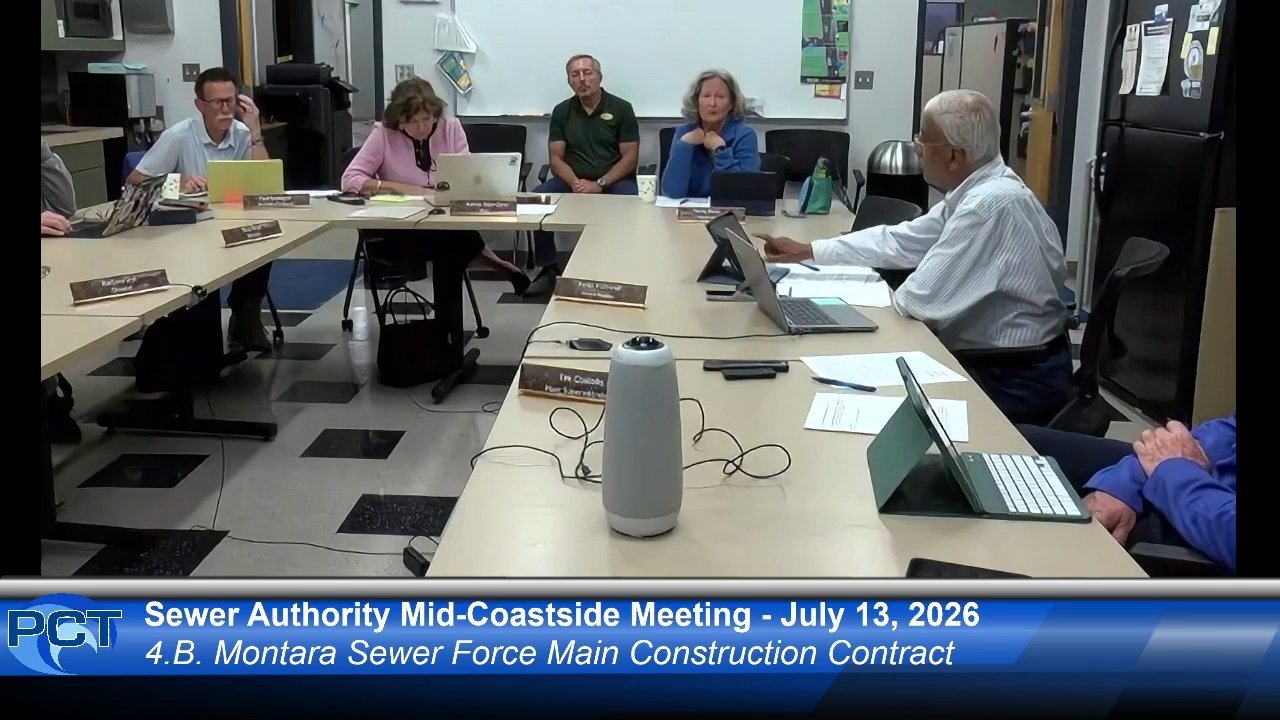
Board of Directors • Sewer Authority Mid-CoastsideJuly 13, 2026
Locunity is a independent informational service and is not an official government page for this commission.We use AI-assisted analysis and human editorial review to publish information.
Board Pumps Brakes on $16M Sewer Force Main, Demands Review
SAM's board deferred its biggest infrastructure decision in years — a $16.6M sewer force main replacement under a federal consent decree — after directors demanded to see the actual contract, get a peer review, and consult the member agencies footing the bill. The same meeting also marked a quieter milestone: a fifth consecutive national award for financial reporting excellence, capping a turnaround from an era when the agency was three audits behind.
$16M+ sewer force main contract deferred to August 10 as board demands peer review, full contract, and member agency input
Fifth consecutive Government Finance Officers Association (GFOA) financial excellence award celebrates dramatic turnaround from 2019 audit crisis
Community group wins transparency commitments — SAM will create a miscellaneous spending subcategory and public project dashboard
4% cost-of-living raises approved unanimously for unrepresented and Local 39 employees
$16M Sewer Force Main: Too Big to Rush
The basics: SAM must replace roughly two miles of 40-year-old sewer force main along Highway 1 in Montara under a consent decree from the Ecological Rights Foundation (ERF), with a current deadline of June 30, 2027. Staff recommended the board authorize General Manager Kishen Prathivadi to sign a Phase 2 progressive design-build contract with McGuire and Hester at a guaranteed maximum price (GMP) of $13,228,000 for construction — plus roughly $2M for engineering, inspection, testing, and outreach, bringing the total to $16.6M under the recommended option, which includes requesting a one-year extension from ERF to June 2028.
Why it matters: This is potentially SAM's largest capital expenditure since its treatment plant expansion. The cost has ballooned from an initial $10M capital improvement plan estimate, and every month of delay adds roughly $50,000 in pipe price escalation alone. Three member agencies — Half Moon Bay, Granada Community Services District, and Montara Water and Sanitary District — will divide the bill, with Half Moon Bay responsible for more than 60% of the cost. For ratepayers, the project could mean assessments of $1,200 to $1,600 per household.
Cost Drivers Stacking Up
SRT Consultants Project Engineer Rachél Lather walked the board through the escalation: pipe prices have jumped from roughly $500,000 to $1.2M. Caltrans now requires all abandoned pipe and trenches under its right-of-way to be backfilled with controlled low-strength material (CLSM), adding approximately $1.5M that wasn't in earlier estimates. And if the board tries to hit the original June 2027 consent decree deadline, an El Niño contingency adds $4M to cover the risk of weather-related delays during winter construction.
"We recommend that the board accept the guaranteed maximum price and approve signing of the contract with McGuire and Hester for 13,228,000, contingent on obtaining a time extension from ERF to June 30, 2028," said Rachél Lather, SRT project engineer.
The recommended option (Option 2) would request the time extension, avoiding the $4M El Niño contingency and allowing construction to proceed through a second dry season.
Board Hits Pause
Multiple directors balked — not at the project itself, but at the pace of the ask.
Vice Chair Nancy Marsh led the push for more scrutiny. "I don't think we've had enough time with this to make a decision tonight. This is probably the biggest expenditure since the plant expansion at SAM. And I think we need to, as the fiduciary representatives of the ratepayers, do some good rigorous due diligence," she said.
Board Member Barbara Dye flagged the exclusions in the proposal. "What concerns me the most is all the exclusions because they could add up to a lot of additional money. Millions and millions of dollars of additional money. I just don't think it's quite figured out to the point yet that we want to commit funds to it," she said.
Board Member Deborah Ruddock zeroed in on the one-year warranty: "I think the warranty is insufficient for a start. It's one year warranty on this very expensive project." She also argued that individual agency boards — particularly Half Moon Bay's — should hear from staff and weigh in before SAM commits, given that her city is on the hook for the majority of the cost.
Board Member Paul Nagengast questioned the guaranteed maximum price itself. "I'm much more comfortable with a peer review on this whole process. How do I know the price is what it is without some numbers to compare?" he said. He also expressed skepticism about Caltrans delivering permits on time.
Montara Pushes for Speed
Board Member Scott Boyd, representing Montara — the community directly served by the aging pipe — pushed back against further delay. "The crux of the biscuit here is it's coming and are we all setting aside the funds to do it?" Boyd argued that SAM's engineers should be trusted to manage the project without duplicative review by each member agency.
Chair Kathryn Slater-Carter echoed the urgency, noting cost increases are cumulative. "If we had started this project when we had initialized it, we wouldn't have the extra million bucks or 2 million bucks that Caltrans is requiring. These things are cumulative," she said — but ultimately sided with the consensus for more information.
Smart Money Move?
Marsh also floated a potential upside to the delay: "One of the things I thought was an advantage if we leverage the El Niño — to push the timeline out a bit on the actual construction — is it allows us to split the cost over two fiscal years and two fiscal years of revenue."
Legal Counsel Jeremy Jungreis confirmed the contract was legally adequate but noted his review hadn't covered deal points like warranties or cost-effectiveness. "He wasn't looking for deal points and whether there might be a way to do it more cost effectively or maybe some risk shifting, like the warranty brought up by Director Ruddock," Jeremy told the board.
Rachél Lather defended the design-build approach, explaining that contingencies in the risk register are transparent and unused contingencies aren't billed. "In design-build, we're negotiating what the risks are and we're making it a contingency. So if it's not used because you don't encounter that risk, you don't pay for it," she said.
Decisions: No formal vote. The board reached consensus to: (1) distribute all 65% design plans, itemized costs, and the draft contract to member agencies by Aug. 5; (2) arrange a meeting between member agency general managers and the SRT/McGuire and Hester team; and (3) target the Aug. 10 board meeting for a decision, keeping all three options on the table — the full GMP, the GMP with an ERF time extension, and going out to traditional bid.
What's next: Materials due to member agencies by Aug. 5. Board decision targeted for the Aug. 10 meeting. The board also recessed into closed session regarding the ERF consent decree litigation (Ecological Rights Foundation v. SAM), with no reportable action.
Five Straight: SAM's Finance Turnaround Earns National Recognition
Why it matters: In 2019, SAM had three outstanding audits, 32 audit adjustments in a single year, and a 615-day lag between fiscal year-end and audit opinion. That era is over.
General Manager Kishen Prathivadi presented the agency's fifth consecutive GFOA Certificate of Achievement for Excellence in Financial Reporting — the gold standard for government financial transparency. "2019, we had three audits outstanding, while now we have zero audits outstanding. In fact, the auditors say they miss us because we come only once a year," Kishen told the board.
The turnaround began in January 2020 when a new finance team — including Peter Marina and George Kelly — was assembled. By 2026, audits are current, opinions arrive within 161 days, and the backlog is zero.
Vice Chair Nancy Marsh praised the team's responsiveness while drawing a careful distinction: "Those have never been about our access to information. George and Peter and Callie are uber responsive. Answer every question, provide any data you want. The accounting has been perfect for five years."
Public commenter Greg Diegas offered context, noting that AC Transit — a far larger transit agency — only just completed its 2025 financial statements, underscoring that SAM's timely clean financials should not be taken for granted.
Community Group Wins Budget Transparency Commitments
Kevin Sniecinski, co-founder of Code Allies, reported to the board on a community meeting attended by roughly 30 residents who identified budget transparency as a top concern.
"Community members have been operating from a place of thinking that SAM makes major shifts of funds without board input or oversight. This is disconcerting because all of the project funds come from taxpayer dollars," Sniecinski said.
Two concrete outcomes emerged from a follow-up meeting between Sniecinski, another community member, Prathivadi, and Chair Slater-Carter: (1) SAM will create a distinct budget subcategory for miscellaneous expenditures — gift cards, flowers, jackets, food — capped at $10,000 per year, to be formalized during the mid-year budget review; and (2) SAM will add a dedicated website section showing all current and on-hold capital projects with assigned budgets and explanations of fund transfers.
Kishen Prathivadi confirmed both are doable. "Our project details are already available on the website in monthly reports and as quarterly reports. But we'll make it more clearly visible. We'll create a separate space for it which shows the status of projects, what's going on and how much budget is left," he said.
Minor Items
Consent agenda approved 6-0: Minutes of June 22, 2026, and disbursements for July 13, 2026.
4% COLA for unrepresented employee approved 6-0: The raise aligns SAM's sole unrepresented employee, the finance officer, with the Local 39 MOU cost-of-living increase, effective July 1, 2026.
Bi-weekly salary schedule formalized 6-0: A ministerial action required for CalPERS regularization with no substantive change from existing Local 39 MOU terms.
Board Member Ruddock noted the U.S. Army Corps of Engineers may be finding a federal interest in a SAM project, though no formal notice has been received.
Closed session held on pending litigation (Ecological Rights Foundation v. SAM, Case 3.18-CV-04413); no reportable action.