
Sewer Authority Accepts Clean Audit, but Thin Cash and Pensions Loom
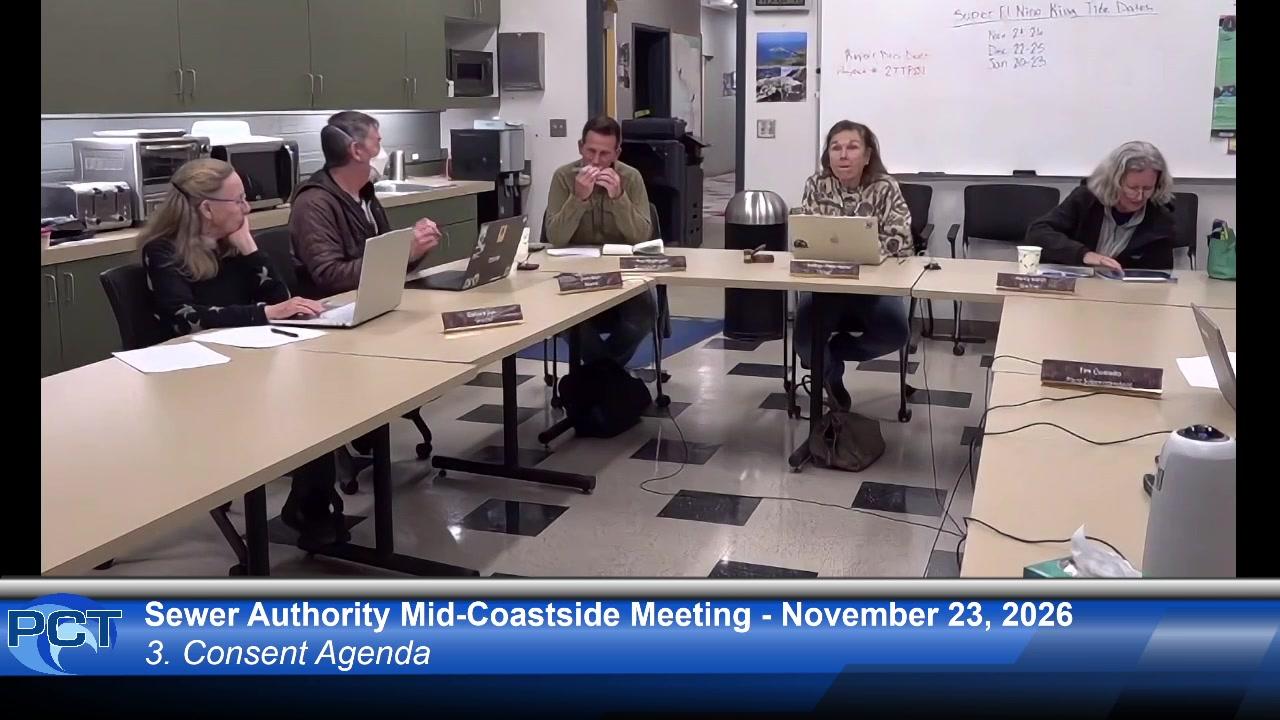
Board of Directors • Sewer Authority Mid-CoastsideNovember 23, 2026
Locunity is an independent informational service and is not an official government page for this commission. All information is sourced from public footage and an analysis of official agendas with the aid of responsible, fact-checked AI. to report an error or omission.
The Sewer Authority Mid-Coastside (SAM) got a clean bill of financial health on Nov. 23, 2026, but its board spent most of the meeting on what the audit didn't fix: just over $2.2M in cash and a negative unrestricted net position. Directors accepted the audit 6-0 and sent pension and retiree health liabilities to the Finance Committee in January. Meanwhile, a public commenter warned of a much larger long-term bill for aging infrastructure.
- Clean audit accepted 6-0, with net position up about $1M and cash down to just over $2.2M
- Pension and retiree health liabilities head to January Finance Committee after Director Deborah Ruddock pressed staff
- Public commenter estimates $212M–$310M to replace SAM's aging assets
- New flood barriers held in first storm, and the permanent electrical fix is expected late January or February
Clean Audit, Thin Cushion
The basics: The Annual Comprehensive Financial Report (ACFR) is SAM's audited annual financial statement. An "unmodified opinion" is the cleanest result an auditor can give. Unrestricted net position is roughly what an agency would have left over if it settled all its obligations.
Where things stand: Auditor Jared Solomonson, partner at Nigro & Nigro, delivered the headline finding for the fiscal year ending June 30, 2026.
"We issued an unmodified opinion on the annual financial statements," said Solomonson. He reported no material issues.
- Revenue: nearly $11.2M, up $467,000, driven mainly by a $645,000 increase in capital assessments.
- Spending and growth: Operating expenses were about $10.2M. Net position rose about $1M, and capital additions totaled about $4.1M.
- Cash: Cash and investments fell about $371,000, to just over $2.2M.
- Liabilities: The net pension liability fell about $480,000, and the net OPEB liability fell about $80,000. OPEB refers to retiree health and other post-employment benefits.
Staff said the Finance Committee had reviewed the report the week before and made no changes. The ACFR will now go to the Government Finance Officers Association (GFOA) to establish eligibility for its reporting award.
Director Barbara Dye and Vice Chair Nancy Marsh praised finance staff, citing the report's demographics and rate pages. "There were only three journal entry adjustments," said Marsh.
Why it matters: The year-over-year declines in liabilities look good on paper. Staff, however, cautioned that the underlying problem is structural.
"I'm concerned about the negative unrestricted net position," said Director Deborah Ruddock.
General Manager Kishen Prathivadi said the unfunded liability keeps growing and needs to be addressed. Consultant Peter Medina explained that the liability balance swings with market performance. He identified the root cause as SAM's own thin reserves.
"If we had a larger cash balance, larger cash reserve held at SAM, that negative unrestricted fund balance would be positive," said Medina.
The funding math: Current efforts to set money aside are modest:
- SAM budgeted $20,000 for OPEB this year.
- About $33,000 already sits in a PARS trust account, a fund for prefunding retiree benefits, with another $26,000 budgeted.
- Medina said staff are studying options for prefunding pension costs after attending CalPERS seminars.
Decisions and stakeholder impacts: Director Scott Boyd moved to accept the audit, and Secretary/Treasurer Paul Nagengast seconded. The vote was For: 6 (Dye, Boyd, Nagengast, Board Chair Kathryn Slater-Carter, Marsh, Ruddock), Against: 0, Absent: 0.
SAM is funded by its member agencies: Half Moon Bay, the Montara Water & Sanitary District and the Granada Community Services District. Any decision to build reserves or prefund liabilities will flow back to those agencies and ultimately to ratepayers. That includes the fiscal 2027-28 budget and rate cycle.
What's next: "I think this is something we should put in our agenda for next year early in January," said Board Chair Kathryn Slater-Carter. She suggested a January or February board discussion.
"I suggest that we take it up in the Finance Committee meeting first," said Prathivadi, proposing a January committee review.
A $212M–$310M Question From the Public
Where things stand: Public commenter Greg Diegas used figures from the ACFR to argue that SAM and its member agencies face a far bigger long-term bill than its balance sheet suggests.
His math started with three numbers from the report:
- About $66M in original asset cost
- $44.6M in accumulated depreciation
- Roughly 12 years of remaining useful life
He then applied U.S. Army Corps of Engineers construction-cost trends. That produced an estimated replacement cost of $212M to $310M.
"Anywhere between $18 million and $26 million a year in replenishment is a lot of money," said Diegas. He urged the board to review the analysis.
The other side: Diegas acknowledged his estimate was not based on a detailed asset inventory. He also said it was not a comment on the accuracy of the financial statements. The board did not respond directly.
Why it matters: If the estimate is even roughly accurate, the annual replacement need would exceed SAM's entire roughly $11M budget. It would also dwarf its $2.2M in cash. That raises the stakes for January's reserve discussion and for capital planning across all three member agencies.
Flood Barriers Pass First Storm Test
Where things stand: Newly installed Garrison flood barriers held during the season's first storm. Peak flow reached 6 to 7 million gallons per day (MGD).
Staff showed photos of barriers surrounding mechanical building 1 and other flood-prone areas. The barriers needed sandbags to hold up against wind. Plant Superintendent Tim Costello said setup took a couple of hours and the barriers will likely stay in place for months.
Why it matters: Directors said some residents believed the plant was unprotected. They asked staff to update the website and to amplify the news through Coastside Buzz. Prathivadi agreed.
Directors also raised two community notes. Dye flagged an RV dumping incident in El Granada. Boyd relayed public praise for crews working in the rain.
The electrical fix: The plant is still recovering from an October bus duct failure. A bus duct is the enclosed conductor system that distributes power through the facility. The recovery so far:
- PG&E has restored power, and the rental generator has been returned.
- The purchase order went to Eaton Corporation on an expedited basis the day after the prior board meeting.
- Delivery is expected in four to six weeks, likely about six, putting installation in late January or February.
The insurer is processing an advance payment. "They should be mailing the advance payment of $500,000 very soon," said Prathivadi.
What's next: The plant's electrical vulnerability ends only when the permanent bus duct is installed.
- Q1 financial report accepted 6-0 (Boyd/Dye); Marsh said over-budget lines reflect annual insurance and membership payments: "It's really as expected."
- Nov. 9 minutes corrected and approved 5-0-1 after Marsh flagged copy-paste errors in the adjournment dates; Ruddock abstained because she missed that meeting.
- Disbursements and the October revenue/expense report approved 6-0 on consent, including costs tied to the electrical failure.
- Ruddock participated by Zoom while ill with what she called a basic cold; legal counsel cited the just-cause provisions of SB 707 and Government Code 54953.8.3.
- Board recessed to closed session, beginning with real property negotiations over Force Main at Montara easements and licenses; no outcomes were reported.
Looking ahead: Pension, OPEB and reserve strategy go to SAM's Finance Committee in January, setting up decisions that will shape the fiscal 2027-28 budget and member-agency rates.