
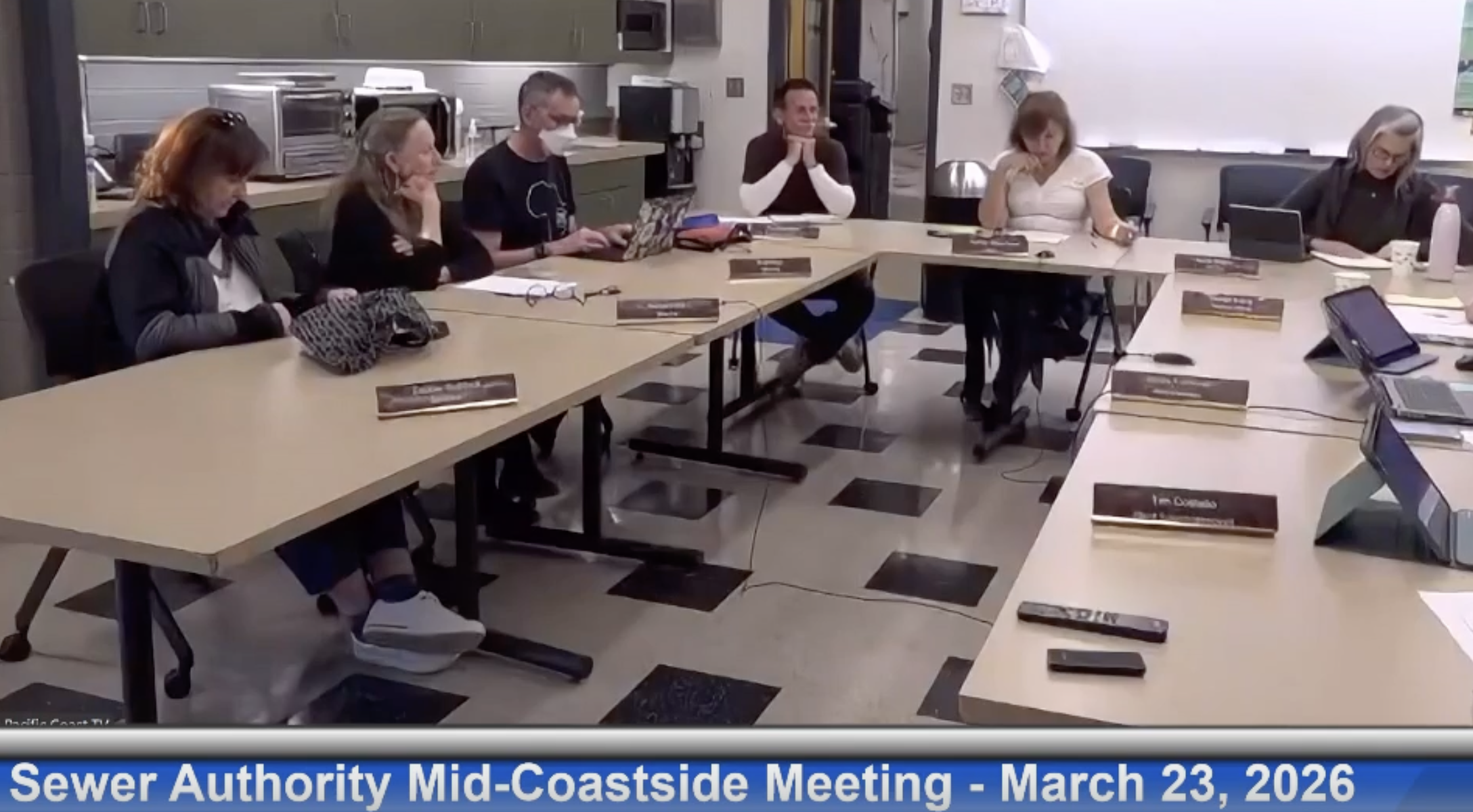
Board of Directors - Mar 23, 2026 - Meeting

Board of Directors - Mar 23, 2026 - Meeting

Board of DirectorsSewer Authority Mid-CoastsideMarch 23, 2026

Sources:

Locunity is a independent informational service and is not an official government page for this commission.We use AI-assisted analysis and human editorial review to publish information.

Force Main Costs Surge Past $13M as SAM Board Navigates Budget, Solar and PFAS Risks

Sewer Authority Mid-Coastside's (SAM) board got a dose of fiscal reality Monday night: the Montara Force Main refurbishment is now projected at $13–14 million — roughly $3–4 million more than planned — and member agencies will be asked to cover the gap. In brighter news, a creative rooftop redesign of the agency's solar project cleared a major permitting hurdle, and the board unanimously accepted a Q2 financial report showing spending trending back toward budget.

  • Force main project balloons to $13–14M, up from $10M; guaranteed maximum price due in May or June, with mid-year budget adjustments looming for all three member agencies

  • Solar panels move to rooftops, sidestepping environmental review; vendor confirms the project still pencils out financially

  • Q2 financial report accepted 6-0; expenditures $348K above mid-year benchmark but trending down as front-loaded costs are absorbed

  • Board warns staff to drop "over budget" language to prevent AI-powered news tools from mischaracterizing SAM's finances

  • PFAS Superfund listing flagged as major emerging liability for wastewater agencies statewide


Force Main Costs Could Hit $14M, Triggering Member Agency Assessments

Why it matters: SAM's largest active infrastructure project is running significantly over its original estimate, and the three member agencies — Granada Community Services District, Half Moon Bay, and Montara Water & Sanitary District — will each be assessed proportionally by wastewater flow to cover the shortfall.

Where things stand: During the General Manager's report, Board Member Scott Boyd flagged the gap between the $5 million remaining project budget and the $6.5 million estimated completion cost listed in the capital projects tracking document. General Manager Kishen Prathivadi explained that the $6.5 million figure reflects only the current fiscal year portion; the full project was originally pegged at $10–10.5 million in the adopted five-year capital improvement plan.

But the real number is higher, and is not expeted to cost $13-14 overall.

The contract is structured as a progressive design-build. The contractor will deliver a guaranteed maximum price in May or June, at which point the board can either accept and proceed or rebid the construction portion separately. Any shortfall will require a mid-year budget adjustment assessed to the three member agencies proportionally by wastewater flow.

Boyd pressed on how costs would be divided. Staff confirmed the standard proportional-flow formula would apply.

On the ground, potholing work is progressing on schedule. The contractor has completed roughly 40–45 potholes in two weeks, using the Granada Community Services District area near the harbor for staging. Crews have finished the Moss Beach residential area and are heading south along Highway 1, with approximately 34 more potholes expected this week. No surprises have surfaced. The work is on track for completion by April 9, after which there will be a gap before construction begins.

What's next: The guaranteed maximum price is expected in May or June, setting up a pivotal board decision on whether to proceed or rebid.


Solar Panels Head to Rooftops, Bypassing Environmental Review

Why it matters: By relocating all panels from ground-mounted arrays to building rooftops, SAM could need only a standard building permit — issuable in roughly one week — instead of navigating a lengthy environmental and regulatory review process. That could accelerate clean energy savings significantly.

Where things stand: After environmental concerns blocked ground-mounted panels outside the plant fence, vendor Coldwell Energy developed a rooftop-only alternative. General Manager Kishen Prathivadi reported the vendor confirmed the revised design is financially viable:

"The vendor went back and checked on it and it is viable. They've told me that it can still pencil out with having all the panels on the buildings instead of anything on the ground."

Discussions with Half Moon Bay's planning director confirmed that rooftop-only installation would require only a building permit.

The complication: SAM's treatment plant sits on land owned by the city of Half Moon Bay, and the power purchase agreement requires a 25-year term. The city manager has expressed a preference for a short-term easement extension rather than a long-term one, citing an upcoming Army Corps of Engineers study that may recommend changes to the property's use for coastal protection infrastructure.

Board members discussed the Army Corps project's scope — including a federal interest determination, a potential $500,000 second phase for detailed planning, possible infrastructure relocation, and Pillar Point Harbor area restoration involving rechanneling the Kehoe watercourse. Chair Kathryn Slater-Carter cautioned that the Army Corps' timelines and local cost-sharing requirements could limit practical outcomes.

"My experience in observing the Army Corps is they make glacial time look pretty quick, and the costs for the sponsoring agency could be a real limitation on what happens," said Slater-Carter.

Board Member Paul Nagengast commended staff for engaging Half Moon Bay's planning department early.

What's next: A public hearing on the power purchase agreement is scheduled for April 13, with potential board action on April 30.


Board Accepts Q2 Financial Report — and a Warning About AI

Why it matters: The Q2 report confirms SAM's day-to-day finances are on track, but the discussion surfaced a novel governance concern: how AI-powered news tools could distort routine budget language into damaging headlines.

Where things stand: Finance Officer George Evans presented the Q2 report for fiscal year 2025–2026, which the Finance Committee reviewed and recommended on March 19. The report showed overall expenditures $348,000 above the mid-year budget benchmark — driven primarily by annual costs like insurance that are paid up front early in the fiscal year. But the trajectory is positive.

"Overall we're at 348,000 over budget, which is down from August. It's actually been trending down," said Evans.

Personnel costs are approximately 2% under budget, while non-personnel spending is about 6% over, largely due to the timing of annual payments. Collections are solid:

"The bottom line on collections is that we're within 2% of expectations," Evans reported.

The reporting format itself drew praise. Starting in Q1, staff revised the format to be less bulky while matching the audit structure, giving the board 12 consistent views per year.

"Our reporting now is in the same format as the audit, so it makes it a little easier for all of us to carry those changes forward and to understand them," Evans explained.

The AI Language Problem

Board Member Paul Nagengast raised a pointed concern about the phrase "over budget" appearing in financial documents.

"When you use the term over budget in this day and age of AI, somebody's going to take it and they're going to say, oh, SAM is over budget. I think we should be very careful our choice of words," he warned. "I just caution in the future that because I know some news media is going to be using AI and AI just grabs words."

Another meeting participant sharpened the point, referencing a specific tool already in use:

"And then you have Posty at Coastside News which is AI just reviewing the meeting record and not necessarily doing a very good job."

The board agreed that future reports should use language like "within expectations" and include clear definitions and assumptions up front to provide context for any reader — human or automated — processing the documents. Staff and the finance officer will refine presentation language and the capital project tracking format at the next Finance Committee meeting.

Decisions: The board accepted the Q2 financial report unanimously by roll call vote, 6-0. (For: Ruddock, Dye, Boyd, Nagengast, Slater-Carter, and an alternate voting for absent Marsh; Against: 0; Absent: Marsh.)


PFAS Superfund Listing Looms Over Wastewater Agencies

Why it matters: The Biden administration listed Perfluorooctanoic acid (PFOA) and Perfluorooctanesulfonic acid (PFOS) — two of the most common per- and polyfluoroalkyl substances (PFAS) chemicals, aka man-made "forever chemicals" — as hazardous substances under the federal Superfund law before leaving office, and the Trump administration has not rescinded the designation. Because PFAS is ubiquitous and bioaccumulates in the human body, it enters every wastewater stream, creating potentially enormous cleanup liability for agencies like SAM that handle it as part of routine operations.

Where things stand: California agencies are actively pursuing federal liability protections, including clarification of the Clean Water Act's permit shield provision and protection for PFAS in biosolids sent to landfills. SAM's attorney also flagged SB 601, a two-year bill aimed at closing gaps in the Clean Water Act created by recent Supreme Court decisions, noting that "the recent decision by the Trump administration to memorialize in regulation some of those recent decisions may be a catalyst for SB 601 moving forward." The California Association of Sanitation Agencies (CASA), is engaged on the bill.

The legislative update also covered tribal equity legislation that would strengthen AB 52 consultation requirements and create Public Records Act exemptions for sacred site information, and SB 1153, which would provide liability relief to water and wastewater agencies whose infrastructure is destroyed in catastrophic wildfires.

What's next: No board action was required; staff and counsel will continue monitoring all four legislative areas.


Minor Items

  • Consent agenda approved unanimously by voice vote, including minutes from March 9, disbursements for March 23, and the monthly revenue and expense report through Feb. 28, 2026.