
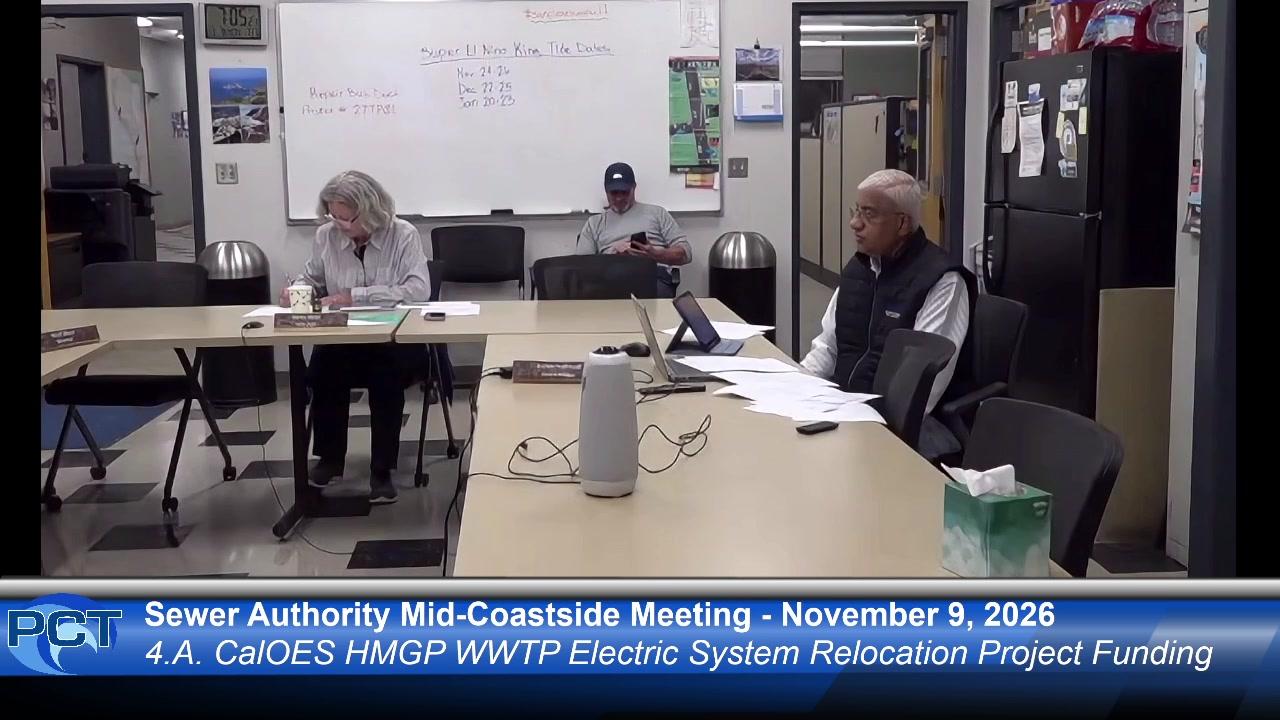
SAM Board Chases $6.8M Flood-Protection Grant Despite Budget Squeeze
Board of Directors • Sewer Authority Mid-CoastsideNovember 9, 2026
Locunity is an independent informational service and is not an official government page for this commission. All information is sourced from public footage and an analysis of official agendas with the aid of responsible, fact-checked AI. to report an error or omission.
The Sewer Authority Mid-Coastside's treatment plant nearly flooded on Jan. 1, 2023, and its electrical gear is still sitting in harm's way. On Nov. 9, 2026, the board voted 6-0 to seek more federal and state money to relocate that system, even as directors worried about how member agencies will pay their share. The same meeting dealt with an emergency already underway: a failed bus duct, a $202,693 PG&E bill and weeks of rented generators.
- Grant bid advances 6-0 as electrical relocation estimate climbs to about $6.8M
- About $1.7M local share left uncommitted, pending approval by each member agency
- Board ratifies $202,693 PG&E emergency connection, about six times a prior comparable job
- Expedited Eaton bus duct replacement approved: 6-7 weeks for roughly $10,000 more
Flood Fears Meet a Crowded Capital Plan
The board authorized staff to apply for added Cal OES/FEMA Hazard Mitigation Grant Program (HMGP) funding for Phase 2 of the plant's electric system relocation. This was the longest debate of the meeting, running nearly an hour.
The basics: SAM is a joint powers authority (JPA) and cannot apply to HMGP directly, so the Montara Water & Sanitary District (MWSD) applies on its behalf. FEMA split the project into two phases: design, which Stantec has completed to 100%, and construction.
Why it matters: FEMA would cover 75% of the cost. SAM's 25% share, about $1.7 million, would be divided among the member agencies, which are already carrying the force main, the bus duct repair and other multimillion-dollar costs.
Where things stand: "How did the cost double?" asked Director Paul Nagengast, the board's secretary/treasurer. Staff answered that "the original estimate of the project was around close to $3 million, while now the revised estimated project cost is coming about $6.8 million." Cal OES has reportedly earmarked the extra funds, pending FEMA approval.
Directors questioned the April 2028 completion date and whether FEMA would grant extensions. They also raised the risk of PG&E costs and noted that contractor bids are not bound by estimates.
Supporters of the grant pressed for speed. "So we've got $5 million on the table and the Fed's ready to go," said Director Scott Boyd. Director Johnson, serving as an alternate for Director Brock, warned that El Niño storms will increase competition for grant money: "So get our foot in the door, get this money going, and get this project going."
Board Chair Kathryn Slater-Carter asked for a full "no project" risk and liability analysis, but she also wanted SAM in the FEMA queue quickly. "I'm not a risk taker when it comes to free money," she said.
The other side: "I'm in favor of doing it. My issue is the timing," said Director Barbara Dye. Vice Chair Nancy Marsh favored seeking a one-year schedule extension into the 2028-29 budget. Staff warned that signaling a delay could cost the project its "shovel-ready" scoring.
SAM's legal counsel said leaving a known hazard unaddressed could create liability: "the point is you've got a risk, and so you got to figure a way to address it." Greg, a public commenter, noted that the packet contained no alternatives analysis and asked, "is there really such a thing as an alternative of not moving the electrical building?"
As interim steps, staff said the plant's berm will be raised for under $50,000. Directors also flagged a nearby SFPUC reservoir as a separate flood risk.
Decisions and stakeholder impacts: Dye moved the item and Boyd seconded. It passed by roll call (For: 6 — Slater-Carter, Marsh, Dye, Boyd, Nagengast, Johnson; Against: 0).
The vote does not commit any money. "According to the JPA, we can't approve that on behalf of the member agencies," Marsh said of the 25% share. The real budget fight therefore moves to MWSD, Granada Community Services District and Half Moon Bay, and ultimately to their ratepayers.
What's next: Directors asked for an updated five-year capital improvement plan (CIP) and a project plan. Staff said Stantec will present the 100% design.
PG&E's $202,693 Bill, Paid Under Protest
The emergency began when the plant's bus duct, a large enclosed conductor that carries power through the plant, failed on Oct. 9. SAM has run on rented generators with around-the-clock staffing since then. PG&E took about three weeks to respond and quoted $202,693 for a temporary connection. Roughly four years ago, a comparable job cost about $32,000.
Where things stand: "I went ahead and signed the agreement under protest because it's an emergency," said Kishan, SAM staff. Staff contacted legislators and filed a ticket with the California Public Utilities Commission (CPUC). PG&E crews were due Thursday, Nov. 12.
Insurance is softening the hit. Staff reported that the insurer has "approved $500,000 as advance payment," though a $100,000 deductible remains.
The other side: Directors wanted to see PG&E's math. "Is there a way we can get detailed invoices or how, you know, their cost breakdowns?" asked Nagengast. Directors also asked for historical invoices. Counsel outlined two routes: a CPUC refund process and Public Records Act requests. He cautioned that pursuing them brings diminishing returns.
Decisions and stakeholder impacts: Dye moved to ratify the procurement, and the motion passed by roll call (For: 6, Against: 0). The board left the refund effort with staff. A utility monopoly's emergency pricing now rests on regulatory complaints rather than negotiation, and that dynamic matters to every agency that depends on PG&E.
What's next: The CPUC holds a public forum on Nov. 16.
Fast-Track Fix for the Bus Duct
The board chose speed. Supplier Eaton offered two options: an expedited replacement in 6-7 weeks for about $470,000, or a standard replacement in 32 weeks for about $458,000. Staff also priced a new manufacturer and a cable-and-conduit approach at about $750,000 to $1 million.
Where things stand: Staff recommended an expedited in-kind replacement. The plan adds heat tracing to fight moisture, plus an enclosure concept that still needs vetting by PG&E and Eaton. Insurance would cover the cost, less the $100,000 deductible.
The other side: Public commenter Greg recalled the earlier failure and the duct's weep holes. He asked how an enclosure would prevent moisture from building up and said he wants to see drawings. Staff replied that only a contractor concept exists so far.
Decisions and stakeholder impacts: Boyd moved the staff recommendation, option 1A, and Marsh seconded. It passed by roll call (For: 6, Against: 0). Paying about $10,000 more ends reliance on generators roughly six months sooner. However, the moisture-driven failure risk remains until the electrical room is relocated, which ties this fix back to the grant debate.
- Consent agenda: Oct. 14 minutes, Nov. 9 disbursements and the revenue and expense report approved 6-0 by roll call.
- Interim repair costs: Project 27TP01 has cost $144,000 through Nov. 6, and diesel use runs about 400 gallons a day.
- Remote attendance: Counsel said Nagengast could join by Zoom under SB 707's family-emergency provision without a board vote.
- Reports: The general manager's report was taken as written, and counsel skipped his report.
Looking ahead: After open session, the board recessed to closed session on items 9A–9C. Watch for Stantec's 100% design presentation, the updated five-year CIP and each member agency's decision on its share of the roughly $1.7 million match.