
Board of Directors - Aug 24, 2026 - Meeting

Board of Directors - Aug 24, 2026 - Meeting

Board of DirectorsSewer Authority Mid-CoastsideAugust 24, 2026

Sources:

Locunity is a independent informational service and is not an official government page for this commission.We use AI-assisted analysis and human editorial review to publish information.

SAM Board Approves $8.5M Budget Increase for Sewer Force Main

The Sewer Authority Mid-Coastside board unanimously backed a major mid-year budget adjustment to fund its biggest infrastructure project in years, then heard a sobering legal warning: a new federal court ruling on PFAS could saddle wastewater agencies with open-ended cleanup liability for chemicals they can't control.

  • $8.5 million mid-year budget increase approved for sewer force main design-build project, with construction targeted through June 2028
  • Federal appeals court upholds EPA's PFAS hazardous substance designation, raising potential Superfund liability for wastewater agencies as "passive receivers"
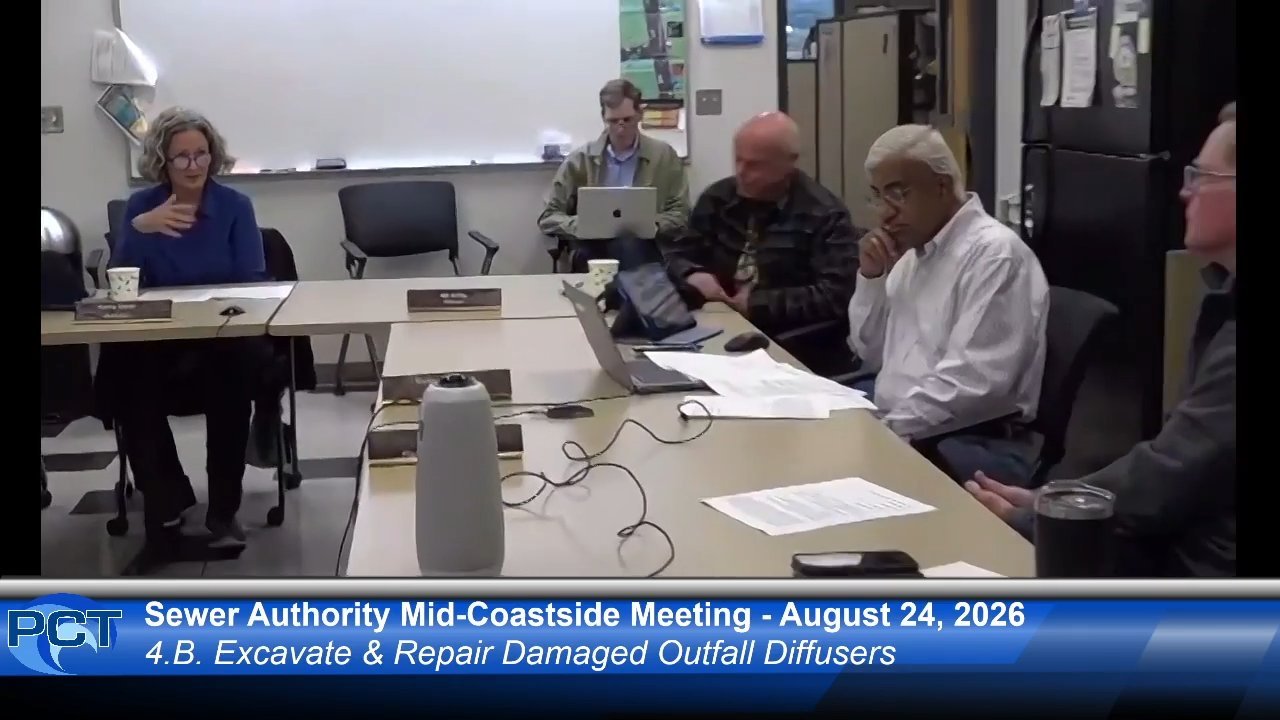
  • Annual underwater outfall inspection authorized, with dive team set to replace four clogged diffusers at 40-foot ocean depth
  • New monthly capital project reporting debuts in board financial packet for improved transparency

$8.5M Budget Boost Unlocks Force Main Construction

Why it matters: The sewer force main connecting Spain and Montara is SAM's signature infrastructure investment, and the budget adjustment — backed by all three member agencies before it even reached the board — clears the financial path for construction through mid-2028.

Where things stand: The board unanimously adopted Resolution 042-2026, increasing the fiscal year 2026-27 mid-year budget by approximately $8.5 million after the progressive design-build team of McGuire and Hester (with design consultant BKF) delivered its guaranteed maximum price at 60% design completion. The board had previously selected the lower-cost Option 2.

The general manager explained that the original budget lacked a reliable estimate: "An increase of about 8 and a half million was researched after receiving the guaranteed maximum price. This was discussed in the last board meeting and was passed on to the member agencies."

All three member agencies — Granada Community Services District, the City of Half Moon Bay, and Montara Water & Sanitary District — had already approved corresponding resolutions. The general manager said written confirmations were in hand from each agency, though only GCSD's signed resolution was included in the board packet.

Transparency on Employee Spending: The resolution also formalized line-item breakdowns within the existing administration budget — $10,000 for employee bonuses, awards, and gift cards; $2,500 for SAM-branded clothing; and $3,200 for food and snacks during emergency operations — without any dollar increase. Staff said the detail was added in response to public questions about how administrative funds are spent.

Board Member Barbara Dye praised the change: "I think it's good to have a cap. I think that's a good change and well done." She also emphasized the value of SAM's coast-side workforce: "My point is that we are lucky to have local staff."

The general manager noted that staff respond to calls within one hour, including weekends, by pre-positioning vehicles at lift stations to avoid coastside traffic congestion.

What's next: The design-build contract is on the verge of execution. The general manager reported that red lines had been received from the contractor, with a meeting scheduled the following morning to finalize signing. Construction is targeted for completion by June 30, 2028.

Decisions: Passed 5-0 (For: Director Deborah Ruddock, Director Barbara Dye, Director Scott Boyd, Vice Chair Nancy Marsh, Director Softkey as alternate; Absent: Director Paul Nagengast).


Federal PFAS Ruling Puts Wastewater Agencies on Notice

The basics: PFAS — per- and polyfluoroalkyl substances, often called "forever chemicals" — are synthetic compounds found in consumer products, industrial processes, and, critically, in human bodies. Because they pass through people and into wastewater, agencies like SAM receive PFAS in their influent without any ability to prevent it.

Why it matters: A D.C. Circuit Court ruling last week upheld the EPA's designation of PFOA and PFOS as hazardous substances under CERCLA — the federal Superfund law — potentially exposing wastewater agencies to open-ended cleanup liability for chemicals they never manufactured or chose to handle.

Where things stand: General Counsel Jeremy briefed the board on the ruling's implications. He warned that the court's language went further than simply validating the Biden-era rulemaking: "The D.C. Circuit in a fairly comprehensive manner rejected the challenges with language suggesting that not only was the initial rulemaking by EPA valid, but that they do have broad authority to these kinds of designations in the future."

The core problem for agencies like SAM is the "passive receiver" dilemma — wastewater systems cannot control what enters their pipes. Jeremy noted that "most agencies do not have in their existing NPDES permits specific discharge standards for PFAS. And if they did, a lot of them couldn't meet it anyway."

He underscored what makes PFAS fundamentally different from conventional pollutants: "PFOA and PFOS doesn't hang out in a plume, like most contaminants do. It's everywhere. It's in the air, it's in our bodies, it's everywhere. And so how do you remediate that?"

Legislative Track: The California Association of Sanitation Agencies (CASA) asked Jeremy to review proposed legislative language that would limit liability for passive receivers. He said the effort has support across party lines but its passage remains uncertain. Biosolids and sludge disposal is a particular vulnerability, since nearly all biosolids contain detectable levels of PFOA and PFOS.

What's next: If federal legislation protecting passive receivers fails, Jeremy indicated SAM would need to carefully review its operations to minimize CERCLA exposure — a signal that biosolids management practices could be on the table for significant changes.


Dive Team Authorized for Underwater Outfall Repair

Why it matters: SAM's ocean outfall is the final point where treated wastewater is discharged into the Pacific. Keeping the duckbill diffusers clear and functional is essential for environmental compliance and preventing discharge violations.

Where things stand: The board authorized a purchase order to Global Diving and Salvage for the annual outfall inspection and diffuser repair. Operations staff member Tim described the challenge in vivid detail: the diffusers sit at roughly 40 feet of depth, range from 2 to 6 feet in length and about 8 inches in diameter, and are buried under 4 to 5 feet of sand and heavy rock that continuously falls back in during excavation. Four diffusers were previously flagged as clogged with no flow, and five additional units will be evaluated during this cycle.

Scheduling with the specialized dive team is a key constraint — sea conditions including swells, wind chop, and even algal blooms (which reduced visibility during last year's work) all affect the window for operations.

One participant praised the team's work: "It really takes a top notch team to do this kind of work. And these are the ones we've been working with for a while."

Decisions: Passed 5-0. Motion by Director Dye, seconded by Director Ruddock (Absent: Director Nagengast).


Minor Items

  • Consent agenda approved (5-0): Minutes from the Aug. 10 regular meeting, disbursements for Aug. 24, and the monthly revenue and expense report through July 31.
  • General Manager's Report: July described as a routine operations month with no notable issues flagged.
  • Finance committee reporting upgrade: Vice Chair Nancy Marsh highlighted that active CIP projects and non-CIP capitalized expenditures are now tracked monthly in the board's financial packet, crediting staff members George and Peter for efficient implementation.
  • Closed session: The board adjourned to closed session on cybersecurity. No reportable action.
  • Attendance note: Director Paul Nagengast was absent. Director Softkey attended as alternate for Chair Kathryn Slater-Carter, with Vice Chair Nancy Marsh presiding.