
Board of Directors - May 11, 2026 - Meeting
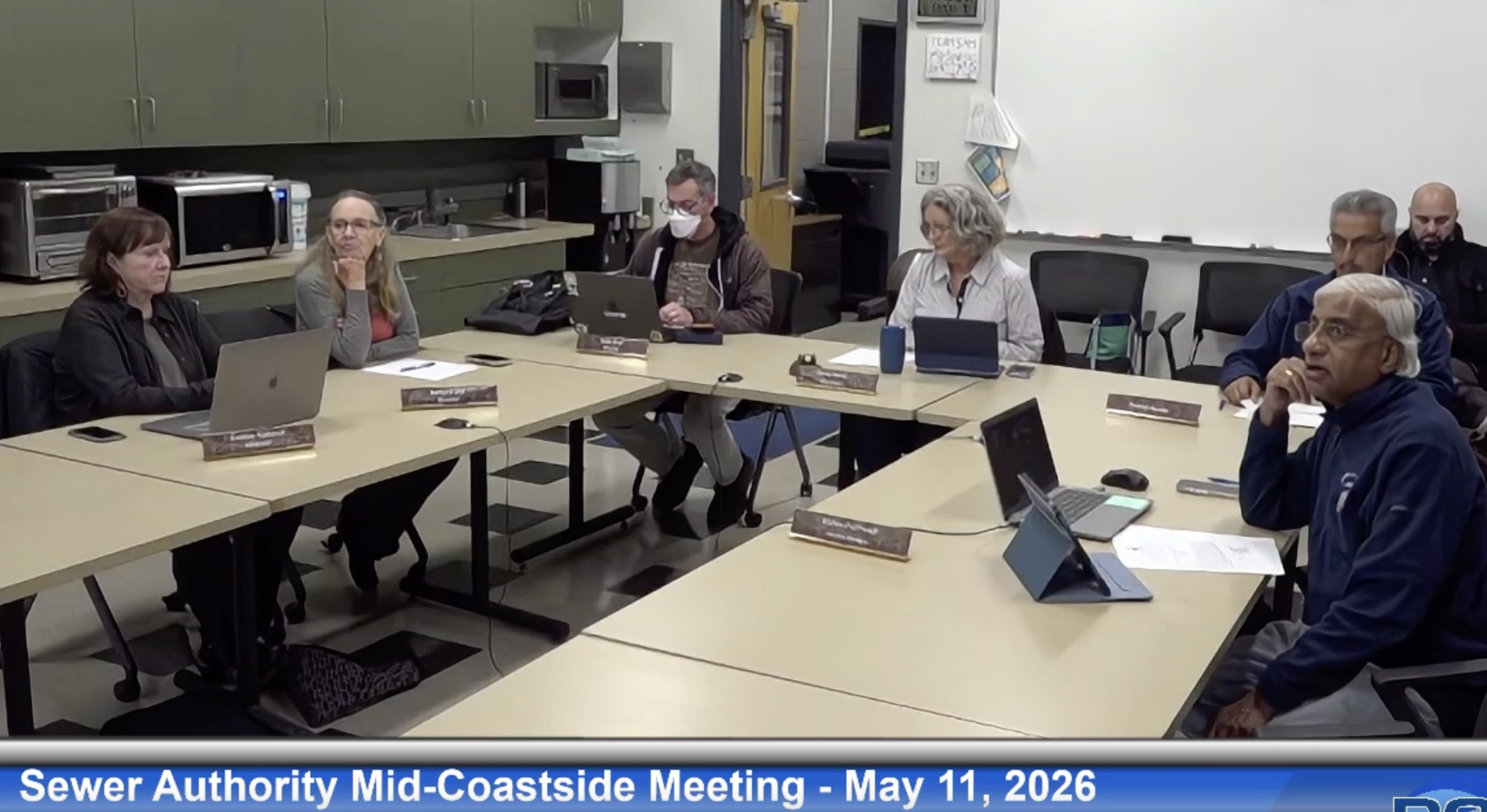
Board of Directors • Sewer Authority Mid-CoastsideMay 11, 2026
Locunity is a independent informational service and is not an official government page for this commission.We use AI-assisted analysis and human editorial review to publish information.
Easement Standoff Threatens Solar Deal as SAM Board Draws Line With Half Moon Bay
The Sewer Authority Mid-Coastside (SAM) board drew a hard line against linking a promising watercourse restoration project to the renewal of an expired plant easement — a dispute that now jeopardizes a solar energy contract with an imminent vendor deadline. Meanwhile, the board heard encouraging water quality data showing rare improvement at some coastal monitoring sites, and learned that an Army Corps kickoff meeting to protect the aging plant from coastal hazards is days away.
SAM board unanimously rejects structuring Half Moon Bay's land proposal as a quid pro quo for renewing the expired plant easement
Solar PPA public hearing pushed to May 20 as Caldwell Energy's patience wears thin
First Flush report finds three sites met E. coli standards — a rare bright spot — but fecal bacteria still exceed thresholds at most coastal discharge points
Army Corps "new start" kickoff meeting expected within 10 days to assess federal interest in protecting the wastewater plant
Federally funded electrical building upgrade at risk if easement impasse drags on
Easement Impasse: Board Backs Watercourse Restoration but Refuses the Trade
Half Moon Bay came to the SAM board with a new pitch: grant the city an approximately 4.5-acre easement on SAM's Langstrap parcel to restore the Kehoe watercourse, capture stormwater flooding the sewer plant, and potentially relocate a sewer pipe. In return, the city would extend SAM's expired easement on the plant site — the same easement that has been blocking a 25-year solar power purchase agreement and a federally funded electrical building upgrade.
The board said yes to the project concept and no to the deal structure.
Why it matters: The original easement on SAM's treatment plant site expired in 2022. Without a renewal, the solar vendor — Caldwell Energy — has no binding assurance that Half Moon Bay, as landowner, won't require removal of equipment. The same uncertainty clouds a federally funded electrical building project already underway. Both are stuck.
Where things stand: Vice Chair Nancy Marsh, who chaired most of the meeting while Chair Kathryn Slater-Carter participated remotely, led the opposition to any framework that trades the original easement renewal for a new land deal.
"I think protecting the initial credit structure of the JPA for us is non-negotiable," said Marsh.
She argued the member agencies' original contributions to the joint powers authority should not be re-valued every time a new project comes along.
Director Barbara Dye was more blunt.
"It sort of feels like this easement agreement — Half Moon Bay wants to get something for extending it when extending it is in the best interest of the sewer authority," she said.
Director Deborah Ruddock, representing Half Moon Bay, pushed back, calling it a straightforward negotiation between government entities.
"I think you know what a negotiation is. You get something, I get something. You give something, I give something," said Ruddock.
She described the Kehoe project's multiple components: realigning the watercourse away from homes, replacing a culvert, and connecting to the CAL transmitter site to redirect water away from both residences and SAM's plant.
The other side: Director Scott Boyd, representing Montara Water & Sanitary District, proposed a middle path — simultaneous action on both items without explicitly linking their monetary value.
"If we agreed to just do them jointly, perhaps we — I offer that for consideration. I would like to see this get done," said Boyd.
Legal Counsel Jeremy Jungreis offered a technical mechanism: structure the agreements so neither proceeds without the other, avoiding any recitation of exchange value. But he also warned the board about the risks of full separation:
"If they're totally separate, then we potentially could have an issue where someone could say, well, why is SAM giving this to the city for a lease without consideration? This is a gift of public funds."
Slater-Carter, joining remotely, praised the restoration concept but insisted on proper documentation. She also raised a pointed question about the federally funded electrical building:
"We've gotten some federal money for it. We don't know what would happen if the land deal goes bad. Do we have to give that money back?"
Decisions: No formal vote was taken. The board gave clear direction: extend the existing easement simply; bring back the Langstrap proposal with adequate detail as a separate matter; both could move on parallel tracks. Marsh summed up:
"They could be at the same time. They can both take the time they're supposed to."
Half Moon Bay City Manager Matthew Chidester indicated the city's next available council date is June 2 due to member travel and conflict-of-interest constraints.
What's next: Staff will return with a revised framework separating the two actions. The question is whether the parallel tracks can converge quickly enough to save the solar deal.
Solar PPA Hearing Continued to May 20 as Vendor Deadline Looms
The board unanimously continued the public hearing on SAM's proposed solar power purchase agreement (PPA) with Caldwell Energy, buying two more weeks but little more.
Why it matters: The PPA would lock in long-term energy savings for the wastewater plant, but Caldwell Energy requires a 25-year guarantee of site access from Half Moon Bay — the same permission bottleneck created by the expired easement.
Where things stand: Staff reported that a draft PPA agreement has been exchanged with Caldwell Energy, with both SAM's and Half Moon Bay's legal counsel providing redlines. A meeting with the vendor to finalize terms was planned for the following week. Legal Counsel Jeremy Jungreis explained that without a binding commitment from the landowner, the vendor has no assurance Half Moon Bay won't require removal of solar equipment.
The board discussed whether simple "permission" — short of a full easement agreement — might satisfy the vendor's requirements.
Decisions: Board Member Scott Boyd moved to continue the hearing to an adjourned regular meeting on May 20, seconded by Chair Kathryn Slater-Carter. The motion passed by roll call, 5-0, with Board Member Paul Nagengast absent. Jungreis noted that if the May 20 date doesn't work, there is enough time to re-notice for the regular June 8 meeting — but the vendor's patience is not unlimited.
What's next: The adjourned regular meeting on May 20 is the next critical date. If Half Moon Bay cannot grant the necessary permission before the vendor walks, SAM may lose the PPA entirely.
Rare Good News in Coastal Water Data, but Bacteria and Metals Persist
Clifton Herman of the San Mateo Resource Conservation District presented the 2025 First Flush community science water quality monitoring results — an annual snapshot of the worst-case scenario for coastal water quality during the first major rain event of the wet season.
The basics: The program tests 16 coastal sites from Pacifica to Half Moon Bay for fecal indicator bacteria (E. coli and enterococci), nutrients, metals, and suspended solids. Testing occurs during the first significant storm, when pollutant loading is at its peak.
Why it matters: This data identifies which coastal discharge points pose ongoing risks to human and ecological health, guiding stormwater investment priorities for SAM and its member agencies.
Where things stand: The results offered a rare positive signal alongside persistent concerns.
"In 2025 we had three sites that were within recommended levels for E. coli, which did include Montara Creek, which is good to see," said Herman. "I will say that it's honestly relatively uncommon that we have so many sites that are within those recommended health thresholds."
But all 16 sites exceeded enterococci objectives. Copper exceeded thresholds at four sites. West Point Ditch and Vassar Outfall were flagged as persistent "frequent flyer" sites for metals, including elevated zinc levels. Five sites exceeded orthophosphate thresholds, though Herman attributed this partly to a low detection limit. Only one site — Surfers South Outfall — exceeded suspended solids limits, which staff attributed to upstream conditions rather than the sand replenishment project. All sites were within safe limits for lead and nitrate.
On the question of bacterial sources, Herman noted that prior harbor district studies found no "smoking gun" for human-source contamination.
"Even if every liveaboard boat dumped their entire tank all at the same time, it wouldn't add up to the amount that was seen over time. It really is everybody contributing," he said.
Director Barbara Dye praised the program and offered a practical takeaway:
"If the community has a message from this, one thing is, for those issues, pick up the poop."
She also advocated for using creek names rather than technical labels like "ditch" or "outfall" to build community connection to local watersheds, and asked about the possibility of sampling Deer Creek, which the harbor district is tracking for sediment management. The program costs approximately $42,330 annually under an existing contract.
Minor Items
April 27 minutes continued to the next regular meeting for revisions. Vice Chair Marsh pulled the minutes from the consent agenda, requesting they more accurately reflect the board's position that the INI study discussed at the April 27 meeting should not be linked to the easement renewal — noting that "members of the board did not agree that additional consideration was warranted for the extension of the easement agreement."
May 11 disbursements approved by voice vote (For: 4, Against: 0, Absent: 2 — Chair Slater-Carter and Board Member Nagengast).
General Manager's report deferred to the next meeting, per normal practice for the second meeting of the month.
Army Corps update: Board Member Ruddock reported that a kickoff meeting with Army Corps of Engineers staff — including a wastewater treatment plant specialist — is expected within 10 days as part of the agency's "new start" project to assess federal interest in protecting SAM's coastal plant. Coastal geomorphologist Dave Revell of Integral Consulting will participate. SAM's federal lobbyist, One Shoreline, is already pursuing implementation funding. Board Member Boyd highlighted the caliber of experts involved: "Being on the sewer authority board is not always seen as the most glamorous thing, but we get to meet the most interesting experts."