
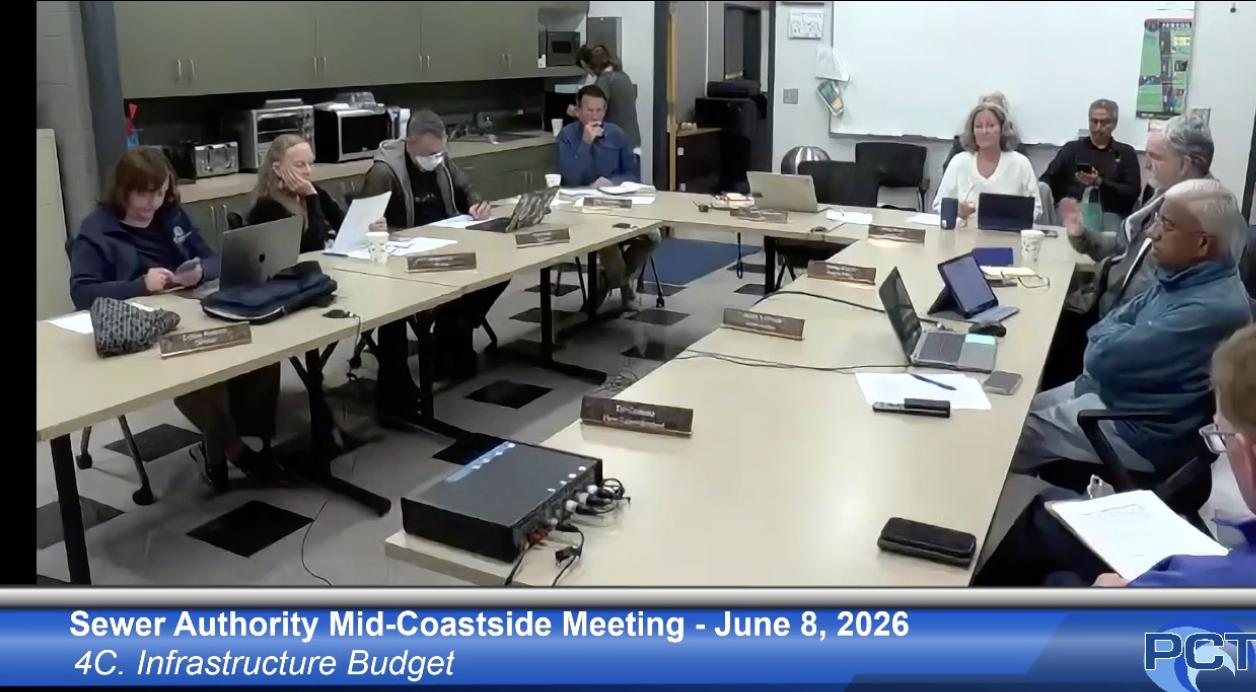
Board of Directors - Jun 08, 2026 - Meeting
Board of Directors • Sewer Authority Mid-CoastsideJune 8, 2026
Locunity is a independent informational service and is not an official government page for this commission.We use AI-assisted analysis and human editorial review to publish information.
SAM Adopts $12.5M in Budgets, Confronts $2M in Infrastructure Overruns
The Sewer Authority Mid-Coastside board moved swiftly through two fiscal year budgets totaling more than $12.5 million on June 8, but the real story was what those numbers don't yet include: a major force main project whose price tag is still unknown and rising, a treatment plant sitting on a lapsed easement, and a growing consensus that decades of tight budgeting have cost the agency millions in delayed repairs.
Board adopts $11.55M general budget, acknowledging it will need a mid-year amendment once the Montara force main price arrives
$2M+ in Capital Improvement Program (CIP) overruns across six plant upgrades since 2021 laid bare in detailed presentation
Directors reject linking SAM's lapsed treatment plant easement to the Landstra property deal; Half Moon Bay signals willingness to grant standalone perpetual easement
Board backs expanding Landstra parcel easement from 4.5 to all 9.8 acres for flood control and habitat restoration
Solar PPA public hearing opened and immediately continued to June 15 as deal complexities mount
Public commenters warn that county planners may recalculate mid-coast development permit caps, potentially surging new sewer connections
The Budget Gap No One Can Ignore Yet
The board unanimously adopted Resolution 03-2026, setting the SAM general budget at $11.55 million for FY26-27 — a $1.48 million increase over the prior year — while openly acknowledging the number is a placeholder.
Why it matters: Infrastructure spending rose 70% in the new budget, driven largely by the Montara sewer force main project. But the guaranteed maximum price from contractor McGuire and Hester has not yet been received. When it arrives, the budget will almost certainly need a mid-year amendment adding potentially millions more.
Where things stand: Cost allocations are based on 2025 calendar year flow: Half Moon Bay at 61.18%, Granada Community Services District at 18.21%, and Montara Water and Sanitary District at 20.6%. The reserve policy requirement of $2.32 million is met with a $465,000 surplus as of May 31.
General Manager Kishen Prathivadi told the board he plans to seek authorization at the June 22 meeting to lock in pipe orders before prices climb further. "The pipe cost, which is about almost a million dollars, has been increasing over the past few months by about 20%. And plus it's got a long delivery time, about 90 days," he said.
Director Barbara Dye was blunt about the budget's limitations: "This budget does not have enough funding in it for the year it covers to allow us to construct that project. There's not enough money in there for that project."
Vice Chair Nancy Marsh noted the board retains the option to reject the GMP entirely and go to competitive bid, urging the contractor not to assume the project is theirs. The board discussed the history of mid-year budget adjustments and the practice of not front-loading full-year costs until actual construction billing begins, which staff said would not happen until November or December.
Decisions: Resolution 03-2026 passed 6-0 by roll call (For: Slater-Carter, Marsh, Dye, Ruddock, Boyd, Nagengast).
What's next: The GM plans to present an estimated price range at the June 22 meeting, with the full GMP expected by June 30. The board should expect a mid-year budget amendment once construction costs are finalized.
$2M+ in Overruns: Anatomy of an Aging System
At Director Scott Boyd's request, General Manager Kishen Prathivadi delivered a granular accounting of capital improvement project spending since 2021.
The basics: Six major plant upgrades consistently came in well over budget: the aeration basin diffuser project (budgeted $416,000, spent $691,000), bar screen drives ($216,000 budgeted, $740,000 spent), influent pumps ($468,000 budgeted, $650,000 spent), primary clarifier upgrade ($225,000 budgeted, $412,000 spent), secondary clarifier ($420,000 budgeted, $789,000 spent), and water pumps ($250,000 budgeted, $530,000 spent).
Why it matters: The overages — totaling more than $2 million — were not the product of poor planning so much as the reality of working with decades-old infrastructure. Equipment ordered in 2021-22 didn't arrive for a year. When crews pulled out old equipment, they found corroded conduits, outdated wiring, and code compliance issues that expanded project scope on the spot.
Where things stand: Vice Chair Marsh praised the quality of staff tracking and transparency, but pointed to a deeper structural problem. She said the Finance Committee had approved using cash flow from prior years rather than seeking mid-year increases — essentially absorbing the overages through existing reserves. She also revealed that non-CIP incidental infrastructure costs ran about $1 million this year but had never had a dedicated budget line until now.
"I wouldn't want to petition the position. But in the position of budgeting so tight that he has to keep coming back asking for incremental more. I'd rather see a fat budget and come in under budget," Vice Chair Marsh said.
Director Boyd pushed for deeper project management lessons: "I'd also like to know when we started trying to do it and having a bit of a timeline about when did we become aware of it, when did we prioritize it, when did it come to the board the first time? Because delays have really cost us a lot, millions, millions of dollars."
The other side: Director Dye advocated for building contingency funding directly into future project budgets. Director Ruddock suggested adding cost escalators. Chair Kathryn Slater-Carter proposed benchmarking SAM's practices against other JPA sewer districts: "I would like to have what we do maybe reviewed by a special district JPA sewer that's getting pretty specific budget analysts to see how other agencies have dealt with this."
A public commenter offered a creative suggestion: a "dumpster fires" forum modeled after practices used by biologists, where staff and the board could openly analyze projects that went sideways without finger-pointing.
What's next: No formal action was required on this informational item. The board requested future reports include project timelines from initial awareness to completion, contingency budgets, and cost escalator provisions.
Easement Tangle: Board Demands SAM's Plant Deal Stand Alone
The board delivered clear feedback on draft amendments to restate the lapsed 1982 easement between SAM and the City of Half Moon Bay for the wastewater treatment plant site: do not link it to the Landstra property agreement.
The basics: SAM's treatment plant sits on land owned by the City of Half Moon Bay under an easement that has expired, leaving the authority in legal limbo for grants, contractor access, and the pending solar power purchase agreement.
Why it matters: Legal Counsel laid out the stakes plainly: "Having SAM in this weird kind of limbo, it's just really problematic on multiple fronts. It brings up issues with having people on site, it brings up issues with contracting, it brings up issues with grants."
Where things stand: The draft agreements linked the SAM site easement and the Landstra property agreement through interrelation clauses requiring both to pass or neither to take effect. Vice Chair Marsh objected sharply to the linkage, arguing that the original JPA consideration already covered the easement and that prior member agency contributions — the Walker tank and Burnham Strip — set a precedent for no-additional-consideration transactions.
"As long as they're related. I feel very strongly about this principle. I would not vote for either," Vice Chair Marsh said, adding she would vote yes on both agreements if delinked.
The other side: Director Boyd acknowledged the legal drafting was artful: "It requires joint timing, but it doesn't actually describe transfer of value, which I think was a very important legal concern that you raised last time. And I think this does an artful dance around that." He supported both agreements moving forward together in timing — but without the formal interrelation clause.
Director Ruddock revealed a key piece of information: at Half Moon Bay's prep meeting, the city's position was to "just give SAM a perpetual easement over the SAM plant without much in the way of conditions." The linkage, she said, was not at the city's request.
Decisions: The board consensus was to delink the two agreements, remove paragraph 7 (the interrelation clause), and bring revised drafts to a future meeting. Half Moon Bay's city attorney had only received the drafts the night before and was still reviewing.
What's next: Revised, delinked agreements will return at a future board meeting. Resolution of the easement is a prerequisite for the solar PPA to move forward.
Full Parcel, Full Vision: Landstra Expansion for Flood Control
The board coalesced around a significantly more ambitious scope for the Landstra property easement, directing staff to expand coverage from the proposed 4.5 acres to the full 9.8-acre parcel along the Kehoe watercourse.
Why it matters: With the treatment plant located in a flood zone and increasingly intense storms anticipated, the expanded easement could provide critical stormwater detention capacity while enabling habitat restoration along the watercourse — goals that cannot be achieved on a narrow strip.
Where things stand: Neighbor Jim Benjamin provided extensive technical testimony, raising four concerns: whether a "drainage easement" is the right instrument when detention and retention are needed; the easement should cover all 9.8 acres as the neighborhood proposed in 2015; discrepancies exist in metes and bounds descriptions across a 1908 map, a 2005 survey never filed with the county, and a 2008 SAM survey; and the proposed sewer line relocation must account for erosion, endangered species habitat, and wetlands.
Director Ruddock strongly backed the expansion: "I like the idea of an easement over the entire parcel because I think it's going to have to be a winding channel because the idea was to collect the water that comes from the east side of the highway, get it away from the houses, have it meander." She emphasized a proper restoration needs its own floodplain and cannot be confined to a narrow corridor.
Director Boyd agreed, suggesting the easement should cover the full parcel with the specific scope refined after engineering studies, biological assessments, and hydrological analysis. Vice Chair Marsh concurred that the wider area provides needed flexibility. Chair Slater-Carter floated the idea of selling or trading the Landstra parcel to Half Moon Bay — "Why don't we just sell it to Half Moon Bay?" — but other directors did not support complicating the current process.
What's next: Revised drafts reflecting the expanded scope will return at a future meeting. Half Moon Bay's engineering staff will need to review the expanded proposal.
Solar PPA Punted to June 15
The board opened the public hearing on the Power Purchase Agreement with vendor JUA Caldwell and immediately continued it to June 15 after General Manager Kishen Prathivadi said staff was not yet ready to proceed. The vote to continue was 6-0 by roll call.
The PPA faces two unresolved obstacles. First, the lapsed easement means the solar vendor cannot get assurance from the property owner — the City of Half Moon Bay — that they won't be evicted from the site. Second, Vice Chair Marsh flagged a practical concern: roughly a third of the proposed solar panels are slated for a carport along the parking lot fence, where 30-plus-foot trees on the southern exposure would shade the panels for most of the day, potentially wiping out projected savings.
Public commenter Gregg Dieguez questioned whether SAM should pursue the PPA at all, suggesting the authority might benefit from waiting for better solar technology.
Mid-Coast Permit Cap Stirs Alarm
Two public commenters alerted the board to a potentially significant development outside SAM's jurisdiction but squarely within its service area.
Cid Young reported that on May 27, both the Mid-Coast Community Council and the Planning Commission discussed modifying how the 40-unit annual development permit cap is calculated under the Local Coastal Program. The Planning Commission is considering banking unused permits back to 2013, which could allow a surge of new development — and new sewer connections. She noted confusion among Planning Commission members who believe SAM is responsible for stormwater catchment improvements, which is incorrect.
Young also warned that large projects like Cypress Point (71 units) receive special affordable housing allocations exceeding the 40-unit cap, while individual homeowners are frozen out of permits until 2028. She flagged potential upzoning of CUSD parcels in El Granada.
Gregg Dieguez called the permit recalculation effort "outrageous" and said he had forwarded concerns to the Mid-Coast Community Council.
Minor Items
Collection services budget adopted: Resolution 02-2026 passed 6-0 for the $960,662 contract collection services budget, covering four staff who maintain 17 lift stations and perform sewer line cleaning across Half Moon Bay ($331,000, 34.5%), GCSD ($273,000, 28.5%), and MWSD ($355,000, 37%). MWSD's share decreased slightly after Seal Cove areas were removed from SAM's responsibility.
Consent agenda approved: Minutes, disbursements, monthly revenue/expense report, and Q3 FY25-26 quarterly financial report passed in two votes to accommodate Director Paul Nagengast's abstention on May 11 minutes (he was absent from that meeting). New reporting formats now separate CIP from non-CIP capital expenditures, with a dedicated $417,000 budget line for incidental infrastructure.