
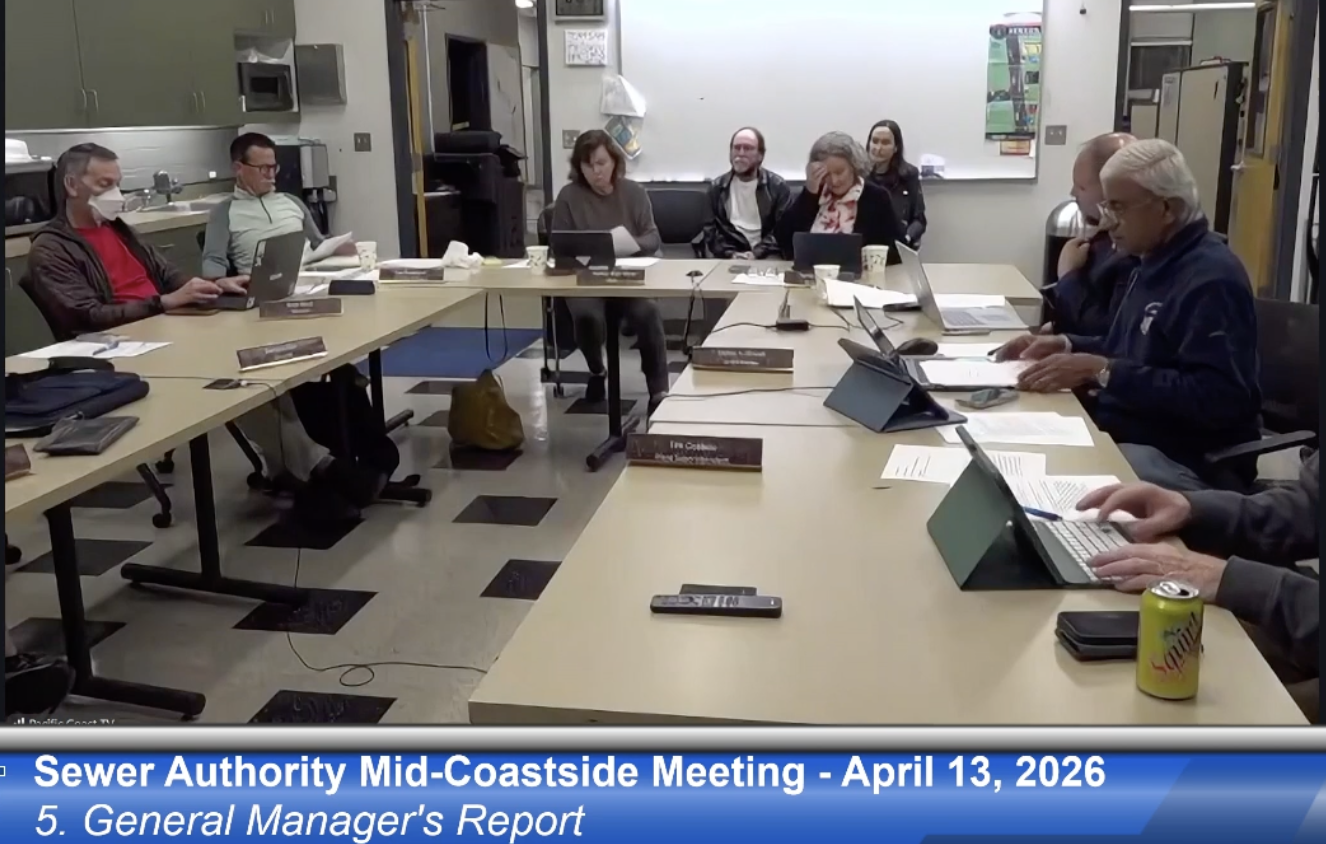
Board of Directors - Apr 13, 2026 - Meeting

Board of Directors - Apr 13, 2026 - Meeting

Board of DirectorsSewer Authority Mid-CoastsideApril 13, 2026

Sources:

Locunity is a independent informational service and is not an official government page for this commission.We use AI-assisted analysis and human editorial review to publish information.

SAM Board Fast-Tracks Solar Deal Under Federal Deadline

The Sewer Authority Mid-Coastside board opened a public hearing on a proposal to install solar panels and battery storage at its wastewater treatment plant — then ran headlong into a tangle of unresolved land rights, incomplete environmental review, and a July 4 IRS deadline that could make or break nearly $3 million in projected energy savings. In a separate flash point, a longtime resident challenged the coastside's fragmented sewer governance, demanding three districts merge into one.

  • Board unanimously authorizes GM to negotiate a 25-year solar power purchase agreement with Coldwell Energy, racing a July 4, 2026 federal deadline

  • Industry neighbor supports solar but warns of battery noise, fire risk, and tree-shading problems

  • Resident challenges $2.9 million in litigation costs across three separate sewer districts, demands consolidation

  • Chair reports state lawmakers eyeing special district revenues for high-speed rail and other spending


Clock Is Ticking on SAM's Solar Bet

The basics: Coldwell Energy is proposing to install rooftop solar, three carport solar structures, and a lithium iron phosphate (LFP) battery system at SAM's wastewater treatment plant — all within the existing facility fence line. Under a 25-year power purchase agreement, SAM would pay no upfront capital and lock in a fixed 3% annual price escalator. The system would cover roughly 25% of the plant's electricity needs, saving an estimated $20,000 per year and just under $3 million over the contract's life.

Why it matters: Under 2025 IRS rule changes, physical work on the project must begin by July 4, 2026, or the federal investment tax credit that makes the economics work drops from 50% to as low as 20%, fundamentally altering the deal's viability. That gives the board roughly 11 weeks to finalize negotiations, complete environmental review, and resolve a land-rights puzzle.

Where things stand: The project has already gone through three design iterations. An original ground-mounted layout outside the plant fence was scrapped over environmental concerns. A hybrid ground-mount/rooftop plan was then narrowed to rooftop and carport structures only after the Half Moon Bay planning department flagged permitting delays for ground-mounted panels.

Consultant Rebecca Wetzstein of Allie Bridge Solutions presented the financial terms: "It's 25 years with a fixed 3% annual escalator. There's no upfront capital for SAM and over 25 years, just under $3 million of savings compared to not doing the project and paying the utility."

But the deal has real obstacles. General Counsel Jeremy Jungreis identified the most fundamental one: SAM owns the buildings at the plant but not the land beneath them — the city of Half Moon Bay does. A 25-year agreement with a real estate component requires a structure the city has not yet agreed to. "SAM doesn't currently have the authority. They own the structures, they don't own the land. That's the city. So some structure has to be agreed to and right now we don't have that," he said. Counsel also told the board he cannot approve the project until CEQA review is complete, though he believes a categorical exemption under Class 1 and Class 3 may be appropriate.

The Public Pushback

Two members of the public raised substantive concerns during the hearing. Tristan Glenwright, a solar and battery industry veteran of 15-plus years who is one of the plant's nearest neighbors, said he supports the solar component but cautioned the board on the battery. He warned that air-cooled lithium iron phosphate (LFP) batteries generate significant fan noise warranting a noise study, that LFP cells can still experience thermal runaway from manufacturing defects, and that tree growth will shade carport panels over time, reducing production.

"I would just caution you from rushing into something too quickly. I don't think the facts that were presented here about the deadlines are quite correct. There's also ability still to spend 5% in my understanding before July 4th and safe harbor the project," Glenwright said, raising the possibility that a less aggressive timeline might still preserve federal incentives.

Gregg Dieguez, who also submitted a written letter, questioned whether the savings justify the rush. He asked whether waiting three years for potentially better incentives or a self-investment structure could yield greater returns and raised concerns about insurance carrier solvency over a 25-year term.

Board Members Weigh In

Board Member Scott Boyd acknowledged the gaps in the current proposal but signaled support for moving forward. "I'm concerned about the battery siting. But I do think there are some other things where we just don't have a design in front of us. So it's a little hard to speak to some of the concerns that have been raised," he said. Boyd also flagged a practical maintenance issue: trees growing into the carport solar areas could create $10,000 to $20,000 bills down the road.

Jordan Potter-Comstock of Coldwell Energy responded to tariff and compliance concerns, confirming the project meets both FIAC and domestic content requirements. "What we have proposed currently is not only FIAC compliant, but it is also domestic content compliant. We have the documentation from the manufacturers as far as the materials being used to meet the domestic content requirements as attributed by the IRS," he said. On the battery, Comstock said Coldwell chose LFP specifically for sensitive sites: "These batteries are used at critical infrastructure facilities because of the fire risk. It's very minimal. They're all UL9540A certified."

Decisions

Vice Chair Nancy Marsh made the motion to authorize the general manager to negotiate the PPA, pursue CEQA exemptions on an expedited timeline, reimburse Coldwell up to $10,000 for CEQA preparation if the deal falls through, and continue the public hearing to April 27. The board approved unanimously (For: 6, Against: 0).

Chair Kathryn Slater-Carter added a directive: staff must respond in writing to public comment letters from James Benjamin and Greg Dieguez, address concerns raised by Tristan Glenwright, and determine whether the land ownership issue will add costs. "I would like a written response to both letters that we received and the concerns raised by Tristan. I want to know whether the land ownership issue will add costs because of this project," she said.

What's next: The public hearing continues April 27, when the board expects to see a proposed PPA, CEQA documentation, and answers to the outstanding land-rights, noise, and cost questions.


Resident Demands One Sewer District, Not Three

During oral communications, 50-year Half Moon Bay resident Chad Hooker read a published opinion piece calling for the consolidation of the three separate coastside sewer entities — Half Moon Bay, Granada Community Services District, and Montara Water & Sanitary District — into a single unified district. He cited more than $2.9 million spent on inter-district litigation, duplicative boards, staff, legal teams, and accounting operations, and pointed to grand jury and LAFCO reports recommending merger.

Chair Kathryn Slater-Carter pushed back on a key premise, correcting that Half Moon Bay sued the other two districts — not the other way around — and that Granada and Montara are not seeking attorney's fees. The exchange underscored the political sensitivity of consolidation talk on a coast where the three entities share a treatment plant but not a governance structure.


Minor Items

  • March 23, 2026 meeting minutes approved (For: 5, Against: 0, Abstain: 1 — Vice Chair Nancy Marsh abstained because she was absent from the March 23 meeting).

  • April 13, 2026 disbursements approved unanimously (For: 6, Against: 0).

  • General Manager Kishen Prathivadi deferred his report to the second meeting of the month.

  • General Counsel Jeremy Jungreis previewed the May 28 CASA law symposium in San Francisco, featuring Rob Bilott, the attorney who led PFAS litigation against DuPont and 3M and was depicted in the film Dark Waters. He also flagged conflicting Court of Appeals rulings on Prop 218 tiered rates — "You've got the Dreher case which seems to allow tiered rates and more flexibility and deference to agencies" versus the Patz and Cozy cases from San Diego that are "much less deferential" — creating legal uncertainty for agencies setting water and sewer rates. Counsel also noted growing acceptance of recycled water reuse, including Southern California's Brewery X brewing beer from highly treated wastewater.

  • Chair Slater-Carter reported from a California Special Districts Association legislative visit that the state is in poor fiscal shape and eyeing special district revenues. She flagged a pending high-speed rail funding bill that would create redevelopment-style tax capture districts around Caltrain stations, potentially siphoning tax revenue from schools, cities, and special districts. A separate rumored bill would require the Local Agency Investment Fund (LAIF) to spend 5% of income on community development, reducing interest earnings for districts that rely on LAIF for budget stability.

SAM Board Fast-Tracks Solar Deal Under Federal Deadline | Board of Directors | Locunity