Board of Directors - Sep 14, 2026 - Meeting
Board of Directors • Sewer Authority Mid-CoastsideSeptember 14, 2026
Locunity is a independent informational service and is not an official government page for this commission.We use AI-assisted analysis and human editorial review to publish information.
SAM Approves $1.5M in Contracts to Launch Montara Force Main Construction
The Sewer Authority Mid-Coastside cleared the final contractual hurdles to begin its major Montara sewer force main replacement, unanimously approving three construction subcontracts in quick succession — then pivoted to a sobering briefing on what emergency officials are calling the worst storm season since the 1950s.
$1.5M in force main subcontracts approved unanimously for environmental monitoring, construction inspection, and materials testing as SAM enters Phase 2
$75K public outreach contract delayed after three directors question the price tag and demand itemized costs
Staff unveils facility-by-facility El Niño storm checklist, including Baker tank rentals, trash pump deployments, and smart cover spare parts for a season forecasters say could break records
Pilarcitos Reservoir dam flagged as a risk — built in 1866 and rated in poor condition, with board members calling for further discussion
Tribal rights legislation could affect future SAM projects on state lands if the governor signs the California Native American Indian Freedom Act
Force Main Contracts Clear the Board
Why it matters: SAM's Montara force main replacement is the district's largest capital project in years, critical to preventing sewage spills along the Mid-Coastside. With progressive design complete under contractor McGuire and Hester, the board needed to lock in subcontractors for environmental compliance, quality control, and testing before a construction kickoff meeting scheduled for the Friday after this meeting.
Where things stand: The board approved three contracts totaling over $1.5 million in about 20 minutes, with substantive but ultimately supportive questioning from directors.
The largest contract — $793,082.79 to Marina Construction Management for full-time construction inspection — drew attention because MCM was the only firm to submit a proposal despite 13 firms attending the mandatory pre-proposal meeting. Two other firms cited work backlogs. General Manager Kishen Prathivadi noted that MCM's principal had direct, hands-on experience with SAM's previous Granada Force Main project from a prior employer, and references were highly positive. Director Paul Nagengast asked about welding inspection; staff confirmed certified welding inspectors would be on-site as required by code.
The $585,983 contract with BKF Engineers for environmental and cultural monitoring was sole-sourced — an unusual move that Nagengast pressed on. "I want to make sure because of the type of contract this is, it's not illegal," he said, asking whether the arrangement complied with procurement rules.
General Counsel Jeremy Jungreis confirmed the approach was proper:
"We have in our procurement policy the ability, particularly for service contracts that involve the unique application of skills, familiarity with a particular area."
Prathivadi explained that BKF handled all permitting during Phase 1 and has established relationships with every regulatory agency involved. Approaching another consultant proved impractical — they would have had to start from scratch at non-competitive prices. On a bright note, the CDFW permit arrived Sept. 8, ahead of schedule.
"We've got the CDFW permit and no further action is required. So that's improvement," Prathivadi said.
Only the U.S. Army Corps of Engineers permit remains outstanding, expected by Oct. 25.
Nagengast also noted the BKF cost appeared roughly $140,000 above earlier estimates. Staff explained the earlier figure was a rough guaranteed-maximum-price-stage estimate, not a firm number.
The third contract — $150,875 to BAG Engineers for soil and materials testing — was the most straightforward. Four firms responded to the RFP, and BAG came in as the lowest responsive bidder with a local track record dating to the early 2000s. Nagengast endorsed the firm from personal experience.
Vice Chair Nancy Marsh found the environmental scope unexpectedly fascinating:
"The cultural and paleo — and the archaeological and what you do if you find human remains. So this could be a very exciting project."
Decisions: All three contracts passed 6-0 by roll call vote (For: 6, Against: 0, Absent: 0).
$75K Outreach Contract Hits a Wall
Why it matters: The board's refusal to rubber-stamp a $75,000 contract with Costanoa Strategic Consulting for public communications during construction signals tighter scrutiny of consulting costs — even on a project where directors broadly agree community outreach is important.
Where things stand: Director Paul Nagengast requested itemized cost details before voting, and two other directors piled on.
"That strikes me as very high — that's almost like three-quarters of our communications person in the city full time," Nagengast said. "I need to see detailed data."
Vice Chair Nancy Marsh questioned whether door hangers and print mailings were even necessary:
"The signs were fine. I don't think we need that. I'd like to see more detail that adds up to it because it seems like a lot to me."
The other side: Chair Kathryn Slater-Carter pushed back, drawing on the harbor district's experience with contentious neighbors.
"It's very useful to have someone to tone down the natural responses of the board members and the general managers into a more diplomatic phrasing," she said.
What's next: Staff committed to bringing a detailed line-item breakdown to the next meeting. The item was continued without a vote.
Bracing for a Historic El Niño
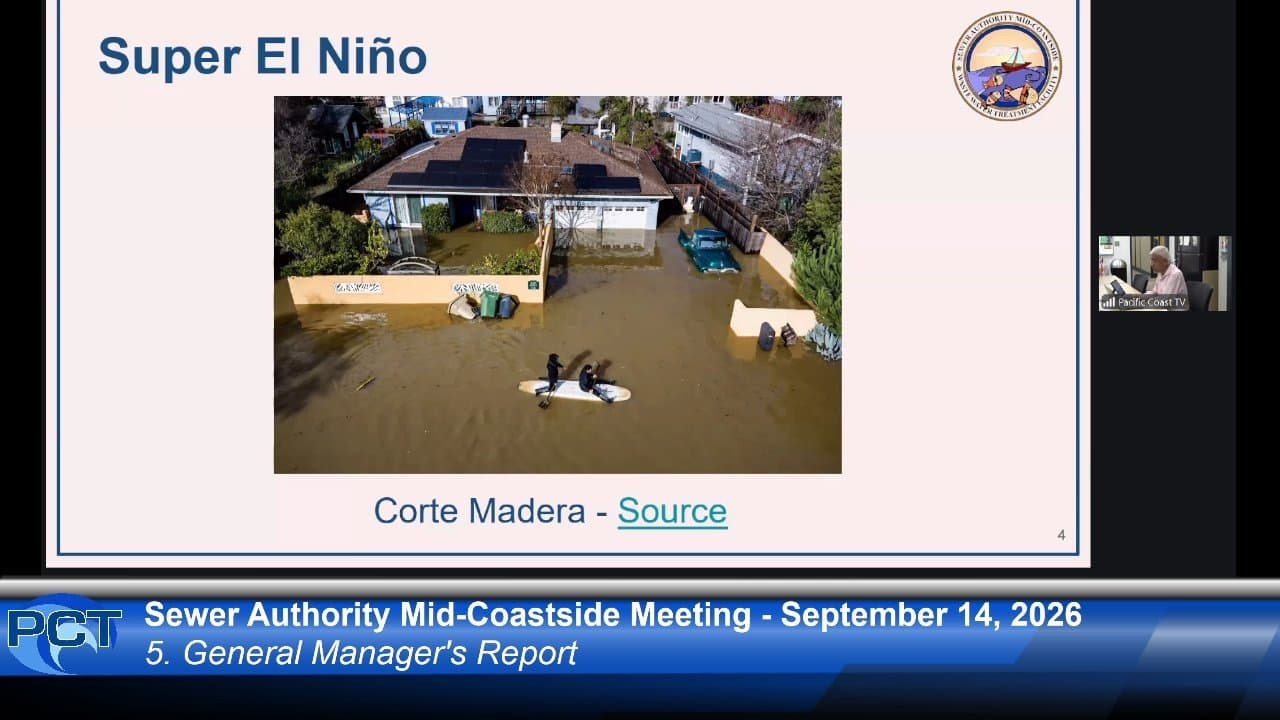
Why it matters: County emergency officials have characterized the coming wet weather season (Oct. 1 through March 31) as potentially the worst since record-keeping began in the early 1950s. For a sewer authority serving the Mid-Coastside, that means elevated risk of sewage spills, equipment flooding, and infrastructure failure across every pump station and the treatment plant itself.
Where things stand: General Manager Kishen Prathivadi walked the board through a facility-by-facility storm readiness checklist, following the path of sewer flow from headworks to outfall and then covering external pump stations and the collections system.
At the treatment plant, staff have replaced bar screens (with manual bypass available), brought five of six new influent pumps online, cleaned grit chambers on a quarterly schedule, begun primary clarifier inspections, repaired gates between old aeration basins to allow independent equalization storage, installed new IO cabinets at higher elevation to guard against flooding, started up newly installed effluent pumps on Sept. 3, brought two new boilers online, and repaired a long-dormant expansion tank. A dissolved oxygen sensor replacement in Aeration Basin 3 was scheduled for the following week.
For external pump stations, the plan includes renting four Baker tanks (80,000 gallons total) at the Montara Pump Station for the entire wet season, upgrading pumps at Portola Pump Station with surge protector bladder spares ordered from Southern California, and deploying a rented 6-inch trash pump at Princeton Pump Station by early October. Collections crews have been performing monthly air release valve maintenance, and SAM coordinated with member agencies Half Moon Bay and Montara to ensure spare parts for smart cover sensors are on hand, given weeks-long lead times.
"We will be proactive in doing sandbagging at vulnerable locations — increased on-call assignments ahead of big storms," Prathivadi said.
The Bigger Threat Picture
Chair Kathryn Slater-Carter reported from a San Mateo County Special District Association meeting that emergency officials painted a dire picture.
"Apparently they started keeping records in the early '50s on those storm events, and this is the worst they have ever seen," she said, referencing a 1998 USGS report by Ken Lajoy on the 1982–83 El Niño.
She added that sea levels are "expected to be 12 inches or so higher in elevation" due to pressure, thermal expansion, and wind — with three king tides forecast.
Director Barbara Dye raised a separate concern: the condition of Pilarcitos Reservoir dam, built in 1866.
"According to this report, it is extremely dangerous for downstream effects and it is in poor condition," she said, citing a state analysis she had found that day.
Director Deborah Ruddock noted the board had received potential inundation maps several years ago showing dam-collapse scenarios.
Ruddock also reported that the City of Half Moon Bay is purchasing canvas flood barriers for the Oak Creek Park and Safeway areas. Staff discussed whether similar barriers could protect SAM's electrical building.
Director Paul Nagengast emphasized the inter-agency dimension:
"I'm talking with our own city staff. They coordinate with SAM staff and there's also county and Caltrans — a lot of resources to try and help each other out."
Slater-Carter closed the discussion on a positive note:
"I think the sewer system part — at least the SAM part — is going to be ready for what comes up."
What's next: Staff offered to conduct a site walk with Dye to assess equipment near Francis Beach and Pilarcitos Creek. No formal action was taken; the item was informational.
Minor Items
Consent agenda approved (For: 5, Against: 0, Abstain: 1) — including minutes of Aug. 24, 2026, disbursements for Sept. 14, 2026, and the quarterly financial report for Q4 FY 2025–26. Director Nagengast abstained from the minutes portion, as he was not present at the Aug. 24 meeting.
New staff introduction: General Manager Prathivadi introduced new accounting technician Liz Eden, describing her as an accounting professional with more than 15 years of experience in accounts receivable, payable, payroll, and financial reconciliation.
Legislative watch: General Counsel Jungreis briefed the board on Assembly Bill Ramos, the California Native American Indian Freedom Act of 2026, which has passed the legislature and awaits the governor's signature. The bill would prohibit governmental agencies — including SAM — from "substantially burdening a California Indian or Native American tribe's exercise of religious or spiritual practices on state lands, except as necessary to protect public safety." It includes a private right of action beginning Jan. 1, 2028. Counsel noted the bill was significantly narrowed during the legislative process and primarily affects state lands, an undefined term that could encompass Caltrans right-of-way. A carve-out preserves the State Water Resources Control Board's permitting authority. No board action was taken.