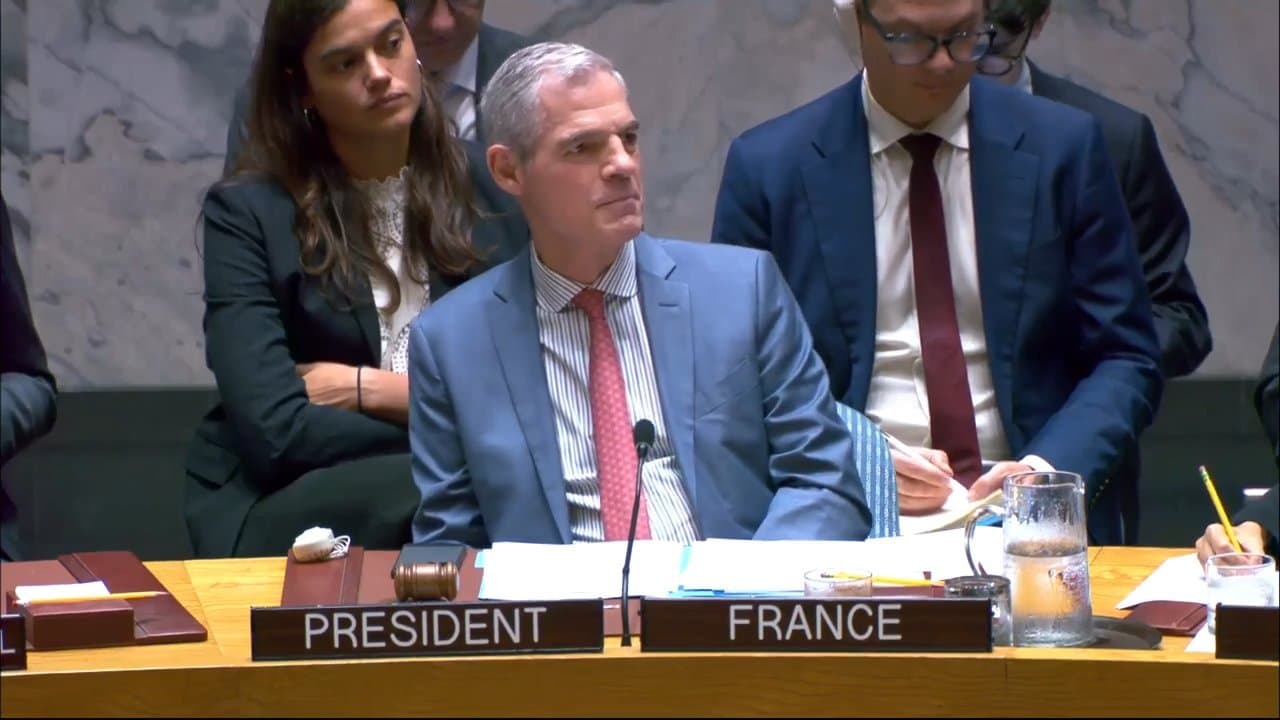
United Nations peacekeeping operations - Security Council, 10226th meeting
Security Council • United NationsSeptember 18, 2026
Locunity is a independent informational service and is not an official government page for this commission.We use AI-assisted analysis and human editorial review to publish information.
Security Council Debates Sweeping Peacekeeping Reset as U.S. Declares 'Lost Confidence'
The United Nations Security Council convened its most consequential debate on peacekeeping in a generation, with Secretary-General António Guterres urging members to deploy blue helmets only where a genuine peace exists to keep — and the United States responding that the current model is a "flawed instrument" delivering too little for its $5.1 billion price tag. The open session, chaired by France during its September 2026 Council presidency, drew more than 20 delegations into a sharp contest over whether peacekeeping needs targeted reform or fundamental contraction.
- Guterres proposes five-priority peacekeeping reset — missions deploy only after a peace agreement or robust ceasefire, backed by political compacts between the Council, host states, and the Secretariat
- United States declares it has "lost confidence" that peacekeeping delivers results proportionate to its costs, demands mission terminations and cost efficiencies
- Resolution 2823 adopted unanimously with a record 153 co-sponsors, strengthening accountability for attacks on UN peacekeepers
- African Union presses for action on Resolution 2719 financing nearly three years after adoption, with up to 25% of funding still unresolved
- Developing nations push back against austerity framing, warning that efficiency "cannot become a justification for hollowing out missions"
- Indonesia and the Netherlands to co-host the next UN Peacekeeping Ministerial in Jakarta toward end of 2027
Guterres Draws a Line: No Peace, No Peacekeepers
Secretary-General António Guterres delivered what amounted to a doctrinal manifesto, anchored in his landmark review of UN peace operations (S/2026/600). The core proposition: peacekeeping is a political instrument, not a substitute for political solutions — and the Council should stop treating it as one.
Why it matters: The review proposes the most significant restructuring of peacekeeping since the 2000 Brahimi Report, arriving at a moment when no new mission has been established since 2014, budgets have been cut 10%, and peacekeepers face drones, IEDs, and cyber threats that didn't exist a generation ago.
Where things stand: Guterres laid out five priorities. First, put peacemaking first. "Peacekeeping operations should be deployed only when a peace agreement, or at least a robust ceasefire, is in place," said Secretary-General António Guterres. "Peacekeepers can do a lot to preserve the peace, but we cannot keep peace where there is no peace to keep."
Second, forge a new partnership model — "a political mechanism such as a compact between this Council, the Secretariat, and the host state, with each of us committing to what the others need," he said. Third, mandate for the world as it is: measurable objectives, protection of civilians built in from the outset, and exit strategies planned from day one. Fourth, empower operations by breaking rigid budget constraints, funding predictably, countering drone threats, and ensuring women's full participation. Fifth, work as a network with regional organizations, especially the African Union under Resolution 2719.
On accountability, Guterres was blunt: "Resolution 2823, which this Council adopted unanimously, must now be implemented. No impunity. No exceptions."
What's next: The debate produced no formal outcome document. Instead, it functioned as a public staking of negotiating positions ahead of the third-year review of Resolution 2719, due by December 2026, and the Jakarta Peacekeeping Ministerial planned for late 2027.
U.S. Challenges the Model; Developing Nations Push Back
The sharpest fault line of the session ran between the United States — demanding contraction and accountability — and a coalition of troop-contributing and host nations insisting that efficiency cannot be code for abandonment.
The U.S. position: The delegate from the United States delivered the most critical intervention of the session. "We have lost confidence that peacekeeping, as we currently design and resource it, delivers results proportionate to its costs and footprint," the delegate said. The U.S. characterized missions as having "grown too big and too broad" and called them "flawed instruments in need of fundamental reform."
The U.S. demanded "unvarnished" Secretariat assessments, integrated mission planning, termination of underperforming missions, and tangible transition plans — criticizing a recent Secretariat report on UNMISS as lacking concrete detail. "We asked for tangible plans, not prose about process," the delegate said.
The other side: Multiple delegations rejected the implication that budget discipline should drive mandate design. Pakistan's delegate argued the sequencing must run in the opposite direction: "Define the political objective, design the mandate, identify the capabilities required, and finally resource it accordingly. We must not start with a financial ceiling and then shrink the mission to fit it." Pakistan also warned: "In resetting peacekeeping, we should be careful not to dismantle the very strengths we may need again tomorrow."
Panama's Minister of Foreign Affairs Javier Martínez-Acha Vásquez set the conceptual frame early in the debate, arguing that "the success of a peace operation is measured not by how long a mission remains in place, but by how long peace can endure after the mission has withdrawn." He introduced a notable rhetorical pivot: "For decades now, we have spoken of exit strategies. Well, the time has come to also speak of entry strategies." On technology, he drew a careful line: "Artificial intelligence can help us anticipate risks; it cannot replace political intelligence."
Somalia's delegate and Indonesia's delegate both warned against hollow efficiency. Indonesia emphasized that "the push for cost efficiency must never justify any arbitrary cost-cutting that compromises adequate resources or personal safety."
Russia's delegate took a different tack, calling for stripping non-security functions — human rights monitoring, climate change, women in local government — from peacekeeping mandates entirely, and rejecting Secretariat-led reforms that bypass member-state consensus.
Decisions: No vote was taken. The debate exposed a deep structural disagreement that will shape every mandate renewal in the coming months: whether the primary problem is bloated missions or under-resourced ones.
Host Nations Demand a Seat at the Table — on Their Terms
The debate's most emotionally charged moments came from nations that have lived with peacekeeping missions on their soil, each insisting that consent cannot be a one-time formality.
Why it matters: The tension between host-state sovereignty and mission effectiveness is at the center of current crises, including MONUSCO in the Democratic Republic of the Congo and UNIFIL in Lebanon, where restrictions on peacekeepers have endangered mandate delivery.
Where things stand: The delegate from the Democratic Republic of the Congo — host to one of the oldest and largest UN missions — cautioned that streamlining should not mean giving up. The DRC called host-state consent "a conversation, not a ceremony" and demanded that transitions be "responsible, concerted, and above all, reversible" when ground conditions change, specifically emphasizing MONUSCO's access to M23-controlled areas as essential.
Lebanon's delegate offered a different model, describing UNIFIL's 48-year presence since 1978. "Its purpose is not to prevent conflict, nor can it on its own guarantee the absence of violence. Its role is to contain escalation as far as possible. Without it, the situation would have been far more serious," the delegate said. Lebanon called for maintaining a temporary international presence until the Lebanese Armed Forces can fully deploy and demanded no impunity for crimes committed against UNIFIL soldiers.
Pakistan stressed that host-state consent must translate into practical cooperation, including freedom of movement for peacekeepers. Denmark went further, calling restrictions on freedom of movement "unacceptable."
Liberia's delegate offered the session's most vivid historical narrative, tracing four decades of international engagement: "In 1990, ECOMOG intervened to stop our war. In 1993, UNOMIL observed our fragile peace. In 2003, UNMIL kept the peace. By 2018, Liberia carried it alone. Four instruments, one country, one continuum." Liberia proposed mandatory joint transition compacts with measurable benchmarks negotiated at least two years before drawdown.
Resolution 2719: Still a Framework Without Its Financing
Nearly three years after the Security Council adopted Resolution 2719 to provide predictable funding for African Union-led peace support operations, the money question remains unanswered — and the African Union used this session to press the point publicly.
The basics: Resolution 2719 envisions up to 75% of AU-led operations covered by UN assessed contributions, but the remaining 25% gap has never been resolved.
Why it matters: Africa hosts the majority of UN peacekeeping missions and contributes the majority of peacekeeping troops. If the Council cannot fund AU-led operations, the entire "work as a network" pillar of the Secretary-General's review collapses.
Where things stand: The African Union's delegate relayed the Luanda Assembly's directive, noting that "3 weeks ago in Luanda, Angola, the Assembly of the African Union, in its 21st Extraordinary Session on Conflict Prevention, adopted a decision urging this Council to implement Resolution 2719." The AU also linked the review to Security Council representation, calling for "a more representative Security Council, beginning with redress of the historical injustice against Africa."
Liberia's delegate was blunter: "Resolution 2719 remains a framework still waiting on its financing, up to 75% of AU-led operations covered by assessed contributions and 25% still unresolved nearly 3 years after its adoption." The delegate characterized budget cuts without strategic direction as "retreat, not reform."
France, holding the Council presidency, called implementation of Resolution 2719 "a priority whenever circumstances are conducive." Portugal, Austria, and China all voiced support for deeper UN-AU cooperation, with Austria describing the resolution as "an important step towards predictable, sustainable, and flexible financing."
What's next: The AU urged Council members to "reflect the recommendations addressed to this Council in your 3rd-year review of Resolution 2719 by December this year."
Resolution 2823: Rare Unanimity on Peacekeeper Protection
One area of genuine consensus: the unanimously adopted Resolution 2823, co-led by Denmark and Pakistan — described as the "Council's peacekeeping duo" — and co-sponsored by a record 153 member states.
Why it matters: Attacks on peacekeepers have escalated as conflicts become more technologically sophisticated. India noted 184 Indian peacekeepers have made "the supreme sacrifice"; Pakistan cited 183 of its own. The breadth of co-sponsorship signals rare multilateral agreement in a fractured Council.
Colombia's delegate underscored a broader accountability theme, arguing that membership of the Council "entails an enormous degree of responsibility which must itself also be subject to review and accountability." Panama framed the stakes memorably: "Protecting civilians is a mandate; protecting those who protect them must also be one."
India's delegate highlighted its cumulative record — "nearly 300,000 troops across more than 50 missions, the largest troop contributor to date" — and announced India's 2028-29 Council candidacy with peacekeeping as a priority.
Minor Items
- Technology modernization: Multiple delegations called for peacekeepers to access drones, counter-drone systems, and AI-enabled early-warning tools. The UK's Parliamentary Under-Secretary of State Chris Elmore expressed concern about host-state restrictions on essential equipment and called for access to technologies needed for safe operations. Latvia's delegate emphasized the need for a "change in mindset rather than administrative" action. Liberia proposed a standing peace operations technology and readiness framework funded as a budget line item.
- Germany suggested sequenced mandates — starting modest and widening as conditions allow — as an alternative to overloaded initial deployments.
- China proposed leveraging green energy and unmanned intelligent technologies for peacekeeping operations while emphasizing host-country sovereignty and the Global Governance Initiative.
- Greece delivered an extended statement touching on multiple reform themes, including the importance of cooperation with regional organizations.
- Indonesia and the Netherlands announced they will co-host the next UN Peacekeeping Ministerial in Jakarta toward the end of 2027, the next major multilateral venue for translating this debate into commitments.