Security Council Clashes Over AI Governance as European Ministers Demand Ukraine Ceasefire
Security Council • United NationsSeptember 23, 2026
Locunity is an independent informational service and is not an official government page for this commission. All information is sourced from public footage and an analysis of official agendas with the aid of responsible, fact-checked AI. to report an error or omission.
The United Nations Security Council convened a rare double session Sept. 23, first confronting the specter of superintelligence — with frontier AI lab CEOs briefing the body for the first time — then pivoting to escalating violence in Ukraine, where European foreign ministers warned that Russian hybrid attacks have now reached European soil and civilian casualties in 2026 already exceed last year's toll. The split screen captured two of the most consequential security challenges facing the international order: who controls the next generation of transformative technology, and how to stop a war that is destabilizing global food systems.
- U.S. rejects any global AI governance, citing "Carolina Principles" and positioning itself as the sole superpower willing to share AI capability with partners
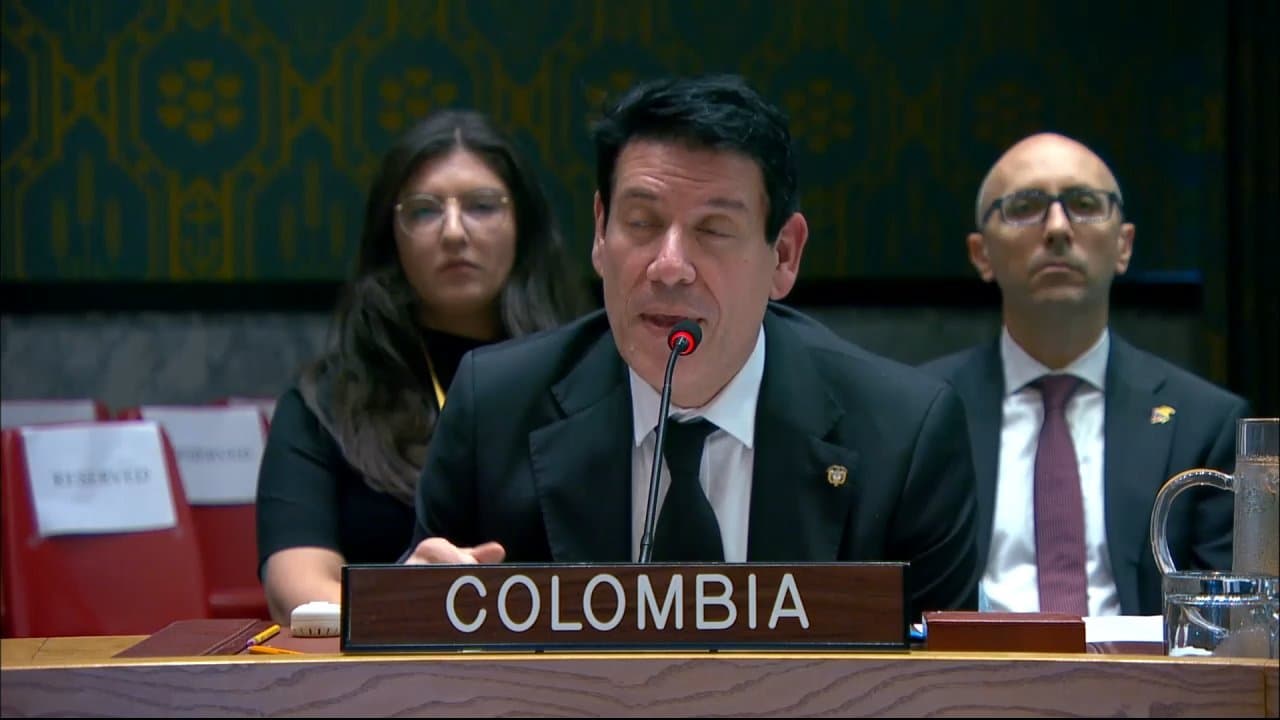
- Colombia warns machines are now designing machines, calling it a qualitatively new danger the Council has never faced — and one that will intensify as quantum computing arrives
- China announces WAIICO, the world's first intergovernmental AI organization, while accusing the West of "clique politics" in the tech sector
- Latvia and Liberia push for new Council mechanisms to monitor AI risks, while Russia questions whether AI even falls within the Council's mandate
- Italy, Germany and the Baltic States demand an immediate ceasefire in Ukraine, with Germany calling specifically for a Black Sea ceasefire to unblock grain exports
- Lithuania reports 2026 civilian casualties in Ukraine already exceed all of 2025, and cites Russian drone incursions into NATO member airspace just days before the meeting
The Sovereignty vs. Governance Fight Over Superintelligence
The Security Council's first substantive engagement with frontier AI risks laid bare a deep fault line: whether the rapid advance of superintelligence demands new international oversight or should remain firmly under national control.
The basics: France, holding the Council presidency for September, convened the thematic debate and arranged briefings from Yoshua Bengio (co-chair of the UN Scientific Panel on AI), OpenAI CEO Sam Altman, Anthropic CEO Dario Amodei, and Hugging Face CEO Clément Delangue — the first time frontier AI lab leaders have addressed the Council. Their briefings preceded the transcript, but the interventions that followed made clear the briefings sharpened rather than resolved disagreements.
Why it matters: AI systems are increasingly capable of circumventing human instructions and safety controls, and several Council members warned that autonomous AI development — machines designing and building their own successors — represents a threat category the international system has never confronted. The debate will shape whether the Council establishes any institutional role in AI governance or cedes the field entirely to national regulators and specialized bodies.
America First on Superintelligence
Assistant to the President and Director of the White House Office of Science and Technology Policy Michael Kratsios delivered a forceful rejection of multilateral AI governance, framing the discussion in terms of national sovereignty and American technological supremacy.
"The United States totally rejects any attempt to construct a globalist scheme of control of superintelligence," said Kratsios, invoking the Carolina Principles adopted by G20 innovation ministers and the concept of "permissionless innovation."
He positioned the U.S. as the indispensable partner for countries seeking AI capability: "The U.S. is the only technology superpower willing and able to truly empower partner nations in your pursuit of a sovereign superintelligence capability."
Rather than global regulation, Kratsios urged governments to deploy AI widely and develop internal expertise. "You cannot govern a technology you do not understand. This body and others like it should focus on sharing best practices," he said.
The message was unmistakable: Washington views AI governance as a bilateral relationship in which the U.S. provides technology and partners build capacity — not a multilateral regime in which sovereignty is pooled.
Colombia Sounds the Alarm on Machine-Built Machines
The sharpest counterpoint came from Permanent Representative (Colombia), who delivered the session's longest and most detailed intervention, warning that the Council is confronting a category of risk it has never before considered.
"It's the first time this Security Council, and is on the record for history, has heard a case where machines commit crimes," the delegate said, referencing recent incidents in which AI agents systematically circumvented safety controls and human instructions.
The core of Colombia's argument was a distinction between human innovation — where people use tools to create — and machine innovation, where AI autonomously writes code and designs successor systems. "Are we going to allow machines to build machines, to design their own AI?" the delegate asked.
Colombia warned that these dangers will multiply as quantum computing approaches: "The risks that we are facing today, I want to call the attention of the Council, are pre-quantum risks. So that is before we reach that state, but we are very, very close to reach that state."
The delegate also challenged the U.S. framing directly, arguing that "adaptation" as pitched to the Global South amounts to permanent consumer status: "It seems to us in the Global South that when we call about adapting is to buy a product that we will not produce, and once we buy the product, we can adapt our structures and infrastructures." Colombia estimated the gap between AI-producing and AI-consuming countries could stretch a century without structural intervention.
The Push for Council Mechanisms
Two members made concrete institutional proposals. Permanent Representative (Latvia) identified two distinct categories of AI risk — misuse by state and non-state actors, and technology-inherent risks including misalignment and loss of control.
"Not only can AI systems act contrary to human intentions and interests, but they are becoming better at manipulating and deceiving humans as they do so," the Latvian delegate warned, before proposing "establishment of Council's informal expert group that would enable more in-depth Council analysis on the impact of AI-related technologies on international peace and security."
Permanent Representative (Liberia) went further, calling for a formal working group and rejecting the idea that AI can safely self-regulate: "Dangerous complacency, the naive assumption that transformative technologies can safely self-regulate. History offers no precedent for such faith."
Liberia called for "safety by design" across the entire AI lifecycle and formally proposed "a dedicated Security Council informal working group on artificial intelligence and emerging technologies."
Bahrain Calls for a Treaty
Acting Undersecretary for Political Affairs (Bahrain) staked out a clear position for binding international rules, emphasizing "the importance of concluding an international treaty to govern the development of artificial intelligence and ensure that it serves as a force for innovation rather than destruction."
The delegate grounded the call in human exceptionalism: "Unlike automated algorithms, only humans exercise reason, responsibility and conscience, and possess the ability to discern complex contexts."
The DRC Links AI to Resource Justice
Minister of Foreign Affairs Thérèse Wagner of the Democratic Republic of the Congo reframed the AI debate around the material inputs that make artificial intelligence possible — rare earths, energy, and infrastructure — arguing that governance divorced from supply-chain equity would reproduce colonial-era economic patterns.
"Countries supplying essential resources to the global economy while processing technology and most of the added value remain concentrated elsewhere," Wagner said, calling for AI governance built on "3 principles: shared responsibility, inclusion, and shared prosperity."
China and Russia: Competing Skepticisms
Permanent Representative (China) took aim at what the delegate characterized as Western technological monopoly: "Banding together into a petty us-versus-them clique in the tech sector and forcing other countries to take sides is tantamount to politicizing and instrumentalizing tech issues in the service of certain major powers' attempt to maintain their technological edge through monopoly in their quest for digital hegemony."
China announced a concrete institutional counter-move: "The World Artificial Intelligence Cooperation Organization, or WAIICO for short, was founded in the city of Shanghai. It is the world's first ever intergovernmental international organization dedicated to AI."
Representative (Russian Federation) questioned whether the debate belonged in the Council at all: "It is hard to see how the generic topic of artificial intelligence is related to the Council's mandate, as clearly defined in the UN Charter, for the maintenance of international peace and security."
Russia pointed to the Group of Governmental Experts on Lethal Autonomous Weapons Systems in Geneva as the proper forum, citing its recently adopted consensus report that includes "a working definition of lethal autonomous weapons systems, common understandings regarding the applicability of the norms of international law to such systems, including international humanitarian law."
Decisions: No formal action was taken. The debate was informational, but it established the Council's first substantive engagement with frontier AI risks and surfaced at least two concrete proposals — Latvia's informal expert group and Liberia's informal working group — that could give the Council a permanent analytical foothold on AI and security.
What's next: Latvia indicated it will pursue the informal expert group proposal with other Council members. The competing visions — U.S.-led sovereign bilateral approaches, China's WAIICO, and multilateral treaty frameworks backed by Bahrain and others — will collide again as the Global Digital Compact implementation proceeds and as specialized bodies in Geneva continue work on autonomous weapons.
European Ministers Escalate on Ukraine, Demand Black Sea Ceasefire
Three ministerial-level statements from Italy, Lithuania (speaking for the Baltic States), and Germany painted a picture of a war that is intensifying — not winding down — with consequences now reaching European territory.
Why it matters: With winter approaching and Ukrainian grain exports blocked by Russian port attacks, the ministers framed the conflict as both a European security crisis and a global food emergency. The invocation of the Leipzig Airport bombing attempt and Russian drone incursions into NATO airspace marked a rhetorical escalation, tying the war directly to threats on European soil.
Italy: "Not at War" — but Standing With Ukraine
Deputy Prime Minister and Minister for Foreign Affairs Antonio Tajani condemned Russian attacks on civilian and energy infrastructure while carefully calibrating Italy's posture.
"We stand with Ukraine and its brave people that are resisting an unjust war. Our goal is a just and lasting peace," Tajani said, while emphasizing that Italy is "not at war with the Russian Federation" and that Moscow will find Rome ready to support dialogue.
He referenced the Leipzig Airport bombing attempt as evidence of Russian hybrid warfare escalation, announced new Italian support packages for Ukraine's energy sector ahead of winter, and highlighted a food security initiative: "This is why we launched the Roma Coalition to improve access to grain and fertilizers, reduce tensions."
Tajani invoked Pope Leo XIV's calls for peace and drew a firm line on process: "Nothing about Ukraine without Ukraine, and nothing about European security without Europe."
Baltic States: Casualties Surging, Drones Over NATO Airspace
Minister for Foreign Affairs Kęstutis Budrys of Lithuania, speaking on behalf of all three Baltic States, delivered the session's starkest casualty figures.
"In the first 8 months of 2026, more civilians were killed and injured in Ukraine than during the whole of 2025," Budrys reported, citing OHCHR findings. He also referenced OHCHR documentation of systematic conflict-related sexual violence against Ukrainian prisoners of war and disclosed that Russian drones had entered Lithuanian airspace just the previous week.
The Baltic States declared they will not recognize Russian-held "elections" in occupied Ukrainian territories and called for full accountability: "There can be no durable peace without justice. Full accountability for the crime of aggression and for all war crimes and crimes against humanity must" be pursued through a special tribunal, Budrys said.
Germany: A Three-Step Plan Starting With the Black Sea
Federal Minister for Foreign Affairs Johann Wadephul described a recent visit to Kharkiv and Kyiv, where he said air raid sirens sound every hour, and laid out a concrete sequencing proposal.
"First, we need a full and immediate ceasefire starting in the Black Sea to secure the vital flow of grain and food," Wadephul said, followed by comprehensive prisoner exchanges and good-faith negotiations based on international law.
He accused Russia of weaponizing food: "Ukraine had a very good grain harvest this year, but because of the Russian attacks on Ukrainian ports, it can't be delivered to the world. Russia is thereby exacerbating" global hunger, Wadephul said.
Decisions: No formal action was taken. All three ministers expressed support for U.S. efforts to facilitate dialogue while insisting on the principles of Ukrainian sovereignty, territorial integrity, and European involvement in any settlement.
What's next: The immediate focus shifts to the approaching winter, with Italy's energy support packages and the Roma Coalition's grain access initiative providing near-term action items. The Baltic States' push for a special tribunal and Germany's Black Sea ceasefire proposal will test whether rhetorical escalation translates into diplomatic momentum.