
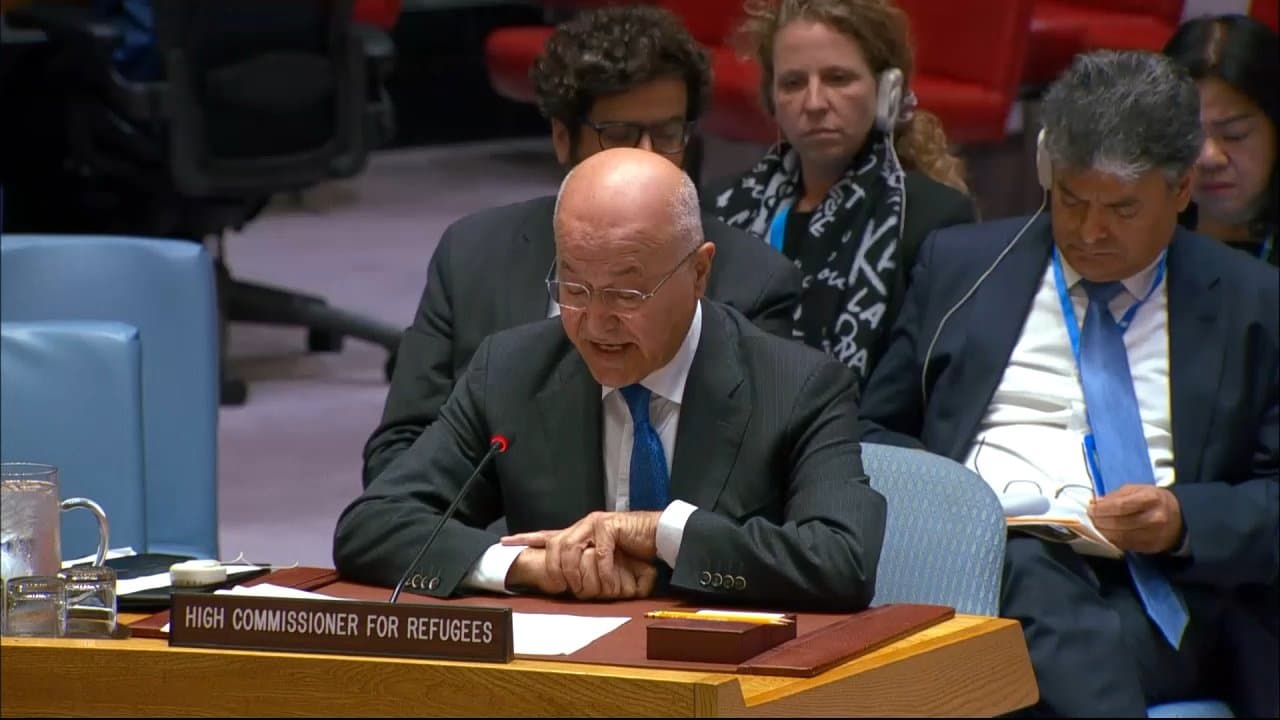
New UNHCR Chief Unveils Bold Plan to Halve Protracted Refugee Displacement by 2035
Security Council • United NationsSeptember 25, 2026
Locunity is an independent informational service and is not an official government page for this commission. All information is sourced from public footage and an analysis of official agendas with the aid of responsible, fact-checked AI. to report an error or omission.
United Nations High Commissioner for Refugees Barham Salih delivered his first briefing to the Security Council with a stark message: 117 million people are forcibly displaced worldwide, solutions are not keeping pace with need, and the international community must shift from managing displacement to ending it. In a sweeping session that touched every major crisis on the globe — from Sudan to Syria, the DRC to Yemen — 15 delegations laid bare sharp divides over burden-sharing, asylum reform, and accountability, even as they voiced near-unanimous support for the new chief's ambitious "50 by 35" framework.
- UNHCR chief sets "50 by 35" target to halve the number of refugees in protracted displacement who remain dependent on humanitarian aid by 2035
- Sudan declared the world's largest displacement crisis, with over 14 million forced to flee; delegations demand a humanitarian truce the Council has yet to deliver
- 3.8 million Syrians have returned home since December 2024, marking one of the largest voluntary repatriation movements in UNHCR history
- UNHCR budget crisis deepens: financing needs hit $8.5 billion while actual resources fall to roughly $3.2 billion — less than half of recent years
- DRC accuses Rwanda of settling nationals in emptied Congolese villages, calling it a "ticking time bomb" before the Council
- United States calls for asylum system reform, reporting $1.4 billion in FY 2025 contributions while urging UNHCR to crack down on economic migrants
- UNHCR declares Level 1 emergency for Yemen, Djibouti, and Somalia as new escalation displaces tens of thousands
A New Vision for a Broken System
High Commissioner Barham Salih used his inaugural Council appearance to reframe the global refugee mandate around a measurable outcome: cutting in half, by 2035, the number of refugees stuck in long-term displacement and reliant on humanitarian assistance.
Why it matters: The "50 by 35" vision represents a philosophical shift for the agency — from indefinite care to concrete reduction targets — and puts both donor and host countries on notice that perpetual camp life is no longer an acceptable norm.
Where things stand: Salih told the Council that displacement has nearly doubled in a decade, from 65 million in 2015 to 117 million today, driven by conflicts that multiply and become protracted while political solutions remain elusive. "Keeping people alive year after year while they remain unable to rebuild their lives cannot be our end," said High Commissioner Barham Salih. He urged that refugees and returnees be included in national development plans, that development financing reach host communities and countries of return, and that solutions be embedded in recovery and peacebuilding from the outset.
"Ultimately, the most durable solution to forced displacement is peace, and you around this table carry a unique responsibility to help make peace possible," he told the 15-member body.
Decisions: No resolution or formal action was taken. The briefing served as an informational session, with delegations delivering national statements. The United Kingdom, Denmark, and the United States were among those endorsing the "50 by 35" framework, though several stressed it must be paired with structural asylum reform.
What's next: The framework is now on the Council's radar ahead of the next Global Refugee Forum, creating a benchmark against which future displacement figures and UNHCR funding will be measured.
Sudan: The World's Largest Displacement Crisis Without a Ceasefire
Nearly every delegation identified Sudan as the most urgent humanitarian emergency on the planet, yet the Council remains unable to compel a ceasefire.
Why it matters: With over 14 million people forced to flee — both internally and across borders into Chad, Kenya, Ethiopia, and Egypt — Sudan represents a test case for whether the Security Council can convert unanimous concern into enforceable peace.
Where things stand: High Commissioner Salih reported visiting Sudanese refugees across the region in his first month and was unequivocal: "There is no military solution to the conflict in Sudan. There needs to be a humanitarian truce and to really start a serious dialogue, including with civilians, to pave the way for a durable peace."
The Delegate (Latvia) reported that in the first eight months of 2026, more civilians were killed and injured in Ukraine than during all of 2025 — but Latvia also underscored Sudan's severity, noting nearly one-third of the population has left home. The Delegate (United States) advocated for a humanitarian truce and protection of civilians. Permanent Representative Jérôme Bonnafont, representing France as Council president, called for broadening sanctions and the arms embargo.
The other side: Despite broad rhetorical alignment, no delegation introduced draft resolution language during this session, underscoring the gap between expressed urgency and binding action.
Syria's 3.8 Million Returns — and the Risk of Losing the Moment
Why it matters: Syria's returns since December 2024 represent one of the largest voluntary repatriation movements in UNHCR history. But without international investment in recovery, returnees risk being displaced again — a pattern the Council has been urged to break.
Where things stand: "Since December 2024, some 3.8 million Syrians displaced abroad or within the country have returned to their homes. Their determination to rebuild is unmistakable," said High Commissioner Salih. He urged international engagement and investment, framing Syria as a rare opportunity where displacement trends are reversing. The Delegate (Denmark) reinforced the point, noting the past year "also saw some of the largest returns in UNHCR's history. Nearly 15 million people went home, including in Syria and in the DRC."
Salih offered a pointed philosophical frame for the challenge ahead: "Return is an event. A solution is what comes after."
Yemen Escalation Triggers UNHCR Emergency Declaration
The High Commissioner announced that UNHCR has declared a Level 1 emergency for Yemen, Djibouti, and Somalia in response to the latest escalation of hostilities, enabling rapid mobilization of resources and staff for cash assistance, shelter, and protection. Tens of thousands have already been displaced.
Why it matters: The Delegate (Denmark) described the broader consequences in stark terms: "The conflict in the Gulf has displaced millions inside Iran and across the region. The subsequent Iranian closure of the Strait of Hormuz triggered an energy crisis and severed the main artery for Gulf fertilizer exports, with dangerous knock-on effects."
The Delegate (United Kingdom) called for de-escalation in Yemen and recommitment to a UN-led political process. High Commissioner Salih called for the immediate release of all UN personnel detained by Houthi de facto authorities.
DRC Accuses Rwanda of Population Replacement
The Delegate (Democratic Republic of the Congo) delivered the session's most incendiary charge, accusing Rwanda and the M23 of ongoing military offensives and a deliberate campaign to depopulate Congolese villages and replace residents with Rwandan nationals.
Why it matters: Security Council Resolution 2773 condemned Rwanda-backed M23 offensives, but the DRC's allegations — if substantiated — would represent a new dimension of the conflict: not just displacement but territorial population replacement, deepening one of Africa's longest-running crises.
Where things stand: "Rwanda is promoting the displacement of populations and the settlement of Rwandans in Congolese villages, which are now empty as people have fled. This is a ticking time bomb which we must absolutely address before it goes off," the Delegate (Democratic Republic of the Congo) told the Council.
High Commissioner Salih cited the Washington Peace Accord and Doha Declaration and reported chairing a tripartite ministerial meeting on voluntary repatriation. He noted that generations in the DRC have lived through cycles of conflict and displacement, with no durable end in sight.
The Funding Collapse: $8.5 Billion in Need, $3.2 Billion in Hand
A recurring theme across delegations was the widening gap between what UNHCR needs and what it receives — a gap that translates directly into fewer shelters, less protection, and reduced services for millions.
Why it matters: When the agency's budget drops by nearly half, the consequences are not abstract. As Foreign Minister Javier Martinez Acha Vasquez of Panama put it: "For 2026, UNHCR has estimated financing needs of $8.5 billion. And when resources wane, we're not just talking about a budget line. We're talking about less protection, fewer shelters, less assistance."
Where things stand: The Delegate (Greece) noted the budget dropped from $6 billion to approximately $3.2 billion and commended UNHCR for continuing operations despite the shortfall. The Delegate (China) stated that low- and middle-income countries host 70% of refugees. Foreign Minister Martinez Acha Vasquez noted 75% of refugees are hosted by countries near their origins, many of them developing nations. Additional Foreign Secretary Nabil Munir of Pakistan called for grants rather than loans for host countries. The Delegate (Denmark) highlighted its role as a leading donor providing unearmarked funding.
The Delegate (Somalia) demanded adequate, predictable, and flexible funding for UN agencies including UNRWA.
The other side: The Delegate (United States) reported contributing more than $1.4 billion in FY 2025 to UNHCR, UNICEF, and IOM — but coupled that figure with a pointed demand: "UNHCR's most urgent priority should be to advance changes that halt the abuse of asylum mechanisms by economic migrants, perhaps the most powerful driver of mass migration."
Asylum Reform, Geopolitics, and the Future of Displacement
Beyond the crisis-by-crisis accounting, several delegations used the session to stake out broader positions on the refugee system itself.
Russia offered a combative counter-narrative, framing Ukrainian displacement as the result of a 2014 coup and criticizing European treatment of Ukrainian refugees. The Delegate (Russian Federation) accused Western nations of using Ukrainian men as instruments of war: "Because these men are just an instrument the West is using to wage war on Russia. Their rights, their future, much like the future of Ukraine, is of no interest to European colonizers."
Russia also cited International Organization for Migration data showing that despite a 39% drop in migrants arriving in Europe this year, deaths in Mediterranean crossings continue to rise.
Colombia offered a forward-looking warning. The Delegate (Colombia) noted that global refugee numbers now exceed World War II levels — "we have crossed the number of refugees in World War II. There are more than 40 million people in this condition today" — and predicted the emergence of a new category: "We will find in these reports a section of technology, of technological refugees. This is a very likely thing that we will start observing in the years to come." Colombia also highlighted drug trafficking and organized crime as system-breaking drivers of displacement, with more than 2.5 million Venezuelan refugees in Colombia alone.
Liberia offered the session's most personal testimony, speaking as a nation rebuilt from its own refugee experience. "Liberia speaks as a nation of former refugees and with the unmistakable clarity of lived experience," said the Delegate (Liberia). "Three decades ago, our families were scattered across West Africa. Our children grew up in exile. Today, we sit in this chamber as living proof of a fundamental truth: displacement does not have to be a permanent address."
Other Crisis Updates
Multiple speakers addressed additional protracted displacement situations:
-
Rohingya: High Commissioner Salih noted over 1.2 million stateless Rohingya refugees remain in Bangladesh more than nine years after mass displacement, with an entire generation growing up in exile. The Delegate (Latvia) noted these camps constitute the world's largest refugee settlement.
-
Western Sahara: The High Commissioner called the status quo "untenable, unsustainable, and genuinely, truly inhumane" after more than 50 years and said UNHCR is working with the Special Envoy and interested parties.
-
Afghanistan: Nearly 8 million Afghans are expected to return by end of year, many in adverse circumstances.
-
Sahel: The High Commissioner described the region as at a critical juncture, with over 4 million forcibly displaced across Mali, Burkina Faso, and neighboring countries.
-
Palestinian refugees: The Delegate (Somalia) rejected any forced transfer of Palestinians from their land and reaffirmed the right of return under international law, calling for an immediate and permanent ceasefire in Gaza.
-
75th anniversary of the 1951 Refugee Convention: Multiple speakers reaffirmed commitment to the principle of non-refoulement while acknowledging the convention's mechanisms are under severe strain from displacement levels its drafters never anticipated. President Bonnafont noted displacement nearly doubled in a decade, from 65 million in 2015 to 117 million in 2025, and highlighted France's support for refugee inclusion through the "Avec Elles" initiative.
-
Children: Foreign Minister Martinez Acha Vasquez highlighted that 39% of refugees are children: "Boys and girls that should be learning how to read, and instead they're learning how to survive."