Glasgow Researchers Tackle Pollution, PFAS, Food Poverty and Oil at UN Science Summit
Science Summit • United NationsSeptember 23, 2026
Locunity is an independent informational service and is not an official government page for this commission. All information is sourced from public footage and an analysis of official agendas with the aid of responsible, fact-checked AI. to report an error or omission.
Four PhD researchers from the University of Glasgow brought environmental and social sustainability research to the United Nations Science Summit, connecting Scotland's rivers and the UK's food system to global crises spanning chemical contamination, climate change, and regulatory failure.
- Researcher maps 360,000+ registered chemicals threatening Scotland's River Nith ecosystem across four seasons and 10 monitoring sites
- Study warns UK flood events may spread PFAS "forever chemicals" far beyond known pollution sites — and current policy doesn't account for it
- UK wastes 9.5 million tonnes of food annually while 7 million people live in food poverty; researcher questions whether 2030 SDG target is achievable
- Comparative study finds oil pollution persists in both the UK North Sea and Nigeria's Niger Delta due to enforcement failures, not lack of regulation
Chemical Cocktail: Mapping Pollution and Climate Risks Along Scotland's River Nith
Why it matters: More than 360,000 chemicals have been registered globally and introduced into natural environments, creating threats that extend far beyond any single country's borders. A new research framework aims to combine pollution monitoring with climate data — an approach that could reshape how Scotland manages its river basins.
Where things stand: Mamoon Sadiq, PhD student at the University of Glasgow's Blow Research Group and faculty member at Bangladesh Agricultural University, presented the most detailed research of the session. His integrated ecological risk assessment of the River Nith in southern Scotland targets both legacy contaminants — heavy metals like lead, cadmium, and mercury, plus polyaromatic hydrocarbons — and emerging pollutants including PFAS, microplastics, pesticides, and pharmaceuticals.
The study will sample 10 monitoring sites from upstream to downstream across all four seasons, organized around three objectives: identifying pollutant prevalence and hotspots, analyzing climate interactions such as temperature fluctuations, flooding patterns, and salinity intrusion, and engaging communities who depend on the river.
"More than 360,000 chemicals have been already registered and they have been introduced to nature. And obviously it becomes our headache not just to my country, but all over the world, posing threats to the ecosystems and to the public health as well," said Sadiq.
He connected the work to his background in Bangladesh, a country he described as heavily dependent on agriculture and fisheries — and one that uses enormous quantities of chemicals. "I'm a faculty member at Bangladesh Agricultural University in Bangladesh. It's an agricultural-based country, and there's huge activities of agriculture and fisheries in our country. So I'm from that of a country that actually uses loads of chemicals," he said.
Sadiq also pointed to the urgency of integrating climate data, referencing recent extreme weather events. "I can remind you the recent flash floods in Nepal where you definitely saw more than 5,000 people died with a very sudden flash flood in Nepal just two weeks ago," he said.
His key argument: pollution and climate change cannot be treated as separate problems. "Pollution and climate change cannot be managed separately at all, and comprehensive integrated assessment is obviously obligatory to protect the riverine ecosystems," Sadiq said.
The research is funded by Commonwealth Scholarships and directly addresses SDG Goal 6 (clean water and sanitation), SDG Goal 13 (climate action), and SDG Goal 14 (life below water).
What's next: Sadiq will begin seasonal sampling of the River Nith's 10 monitoring sites and stakeholder engagement with communities along the waterway.
Forever Chemicals on the Move: How UK Floods May Spread PFAS Contamination
The basics: PFAS — per- and polyfluoroalkyl substances — are synthetic chemicals found in non-stick cookware, food packaging, textiles, cosmetics, firefighting foam, and batteries. The extremely strong carbon-fluorine bond makes them nearly impossible to break down, earning the name "forever chemicals."
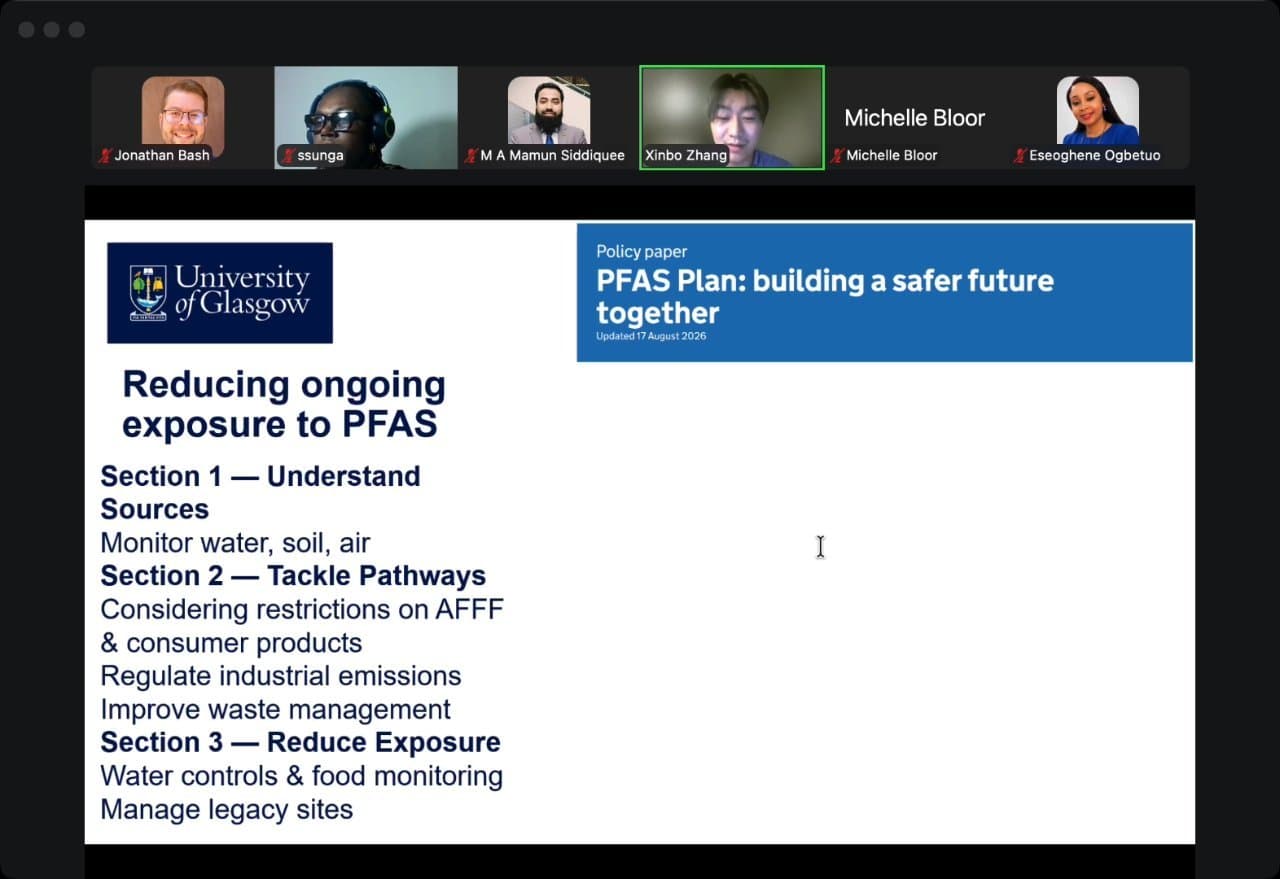
Why it matters: The UK published a PFAS management plan in 2026 with three pillars: monitoring sources, restricting pathways like firefighting foam and industrial emissions, and lowering exposure through improved drinking water controls. But the plan does not account for a critical variable — flooding.
Where things stand: Zimbo Zhang, PhD student at the University of Glasgow, presented research examining how flood events influence PFAS transport through waterways. Flooding increases runoff and river flow, disturbs contaminated sediments through remobilization, and can carry PFAS far downstream of known pollution sites.
"One key feature of PFAS is very strong bond between carbon and fluorine. Because of this, PFAS are very stable and very difficult to break down," Zhang explained. He noted that shorter-chain PFAS move more easily with water while longer-chain varieties bind to sediment — meaning different flood dynamics release different types of contamination.
The health stakes are significant. "PFAS have also been detected in human blood, and they can also be transferred from mother to baby. They can be found in both breast milk and umbilical cord blood," Zhang said, describing how PFAS accumulate in the liver and kidneys.
Zhang identified three critical knowledge gaps: the influence of flood events on PFAS transport remains insufficiently understood, environmental risk during extreme events remains uncertain, and current policy frameworks rarely consider flood-driven PFAS transport.
He also flagged a stark data disparity. "We can see England have a lot of PFAS data points, but we can see Scotland just have a little bit of PFAS data points," Zhang said, suggesting geospatial deep learning may help predict contamination patterns in areas without monitoring infrastructure.
What's next: Zhang is conducting a systematic literature review using the PRISMA methodology across PFAS, hydrological transport, and policy literature. If his research confirms that flood-driven PFAS transport is significant, it could force revisions to the UK's regulatory framework.
The Food System Paradox: 9.5 Million Tonnes Wasted, 7 Million Going Hungry
Why it matters: The United Kingdom wastes over 9.5 million tonnes of food annually at a cost of £19 billion to the economy — while more than 7 million people live in food poverty. Between 2019 and 2023, households living in poverty increased by over 2.5 million, with children disproportionately affected alongside Black ethnic minorities and communities in the northeast and northwest of England.
Where things stand: Rita Smyths, PhD student in the BLORE Research Group at the University of Glasgow, framed her research around this central contradiction.
"Annually the United Kingdom wastes over 9.5 million tonnes of food, which is costing the economy over £19 billion. We want to meet the Sustainable Goals 12.3 of halving food waste. I'm wondering if this could be reached by the slated 2030 as planned," Smyths said.
She identified the key drivers of food poverty: low income and financial insecurity, rising costs of living including inflation on energy and food prices, high housing costs and household debt, insufficient social security and welfare systems, and supply chain pressures. Barriers to seeking help include stigma and dignity concerns, perceptions that redistributed food is inadequate, and unstable surplus food logistics. The consequences cascade into poor nutrition, mental health impacts, reduced well-being, and increased chronic disease rates.
Smyths' methodology includes a literature review, a questionnaire survey of approximately 1,000 UK households, expert workshops with NGOs and food industry groups, focus groups, and use of the Food Insecurity Experience Scale.
What's next: The research aims to produce a "No More Food Waste" roadmap strategy for the UK with evidence-based policy recommendations, directly targeting whether SDG 12.3 — halving food waste by 2030 — can realistically be achieved.
Same Companies, Same Failures: Oil Pollution Enforcement Gaps in UK and Nigeria
Why it matters: The same multinational oil companies operate in both the UK North Sea and Nigeria's Niger Delta. Neither country has successfully translated regulation into measurable environmental recovery — despite available remediation technologies.
Where things stand: Esogene Yvette Uwetu, PhD research student in the School of Social and Environmental Sustainability at the University of Glasgow, presented a comparative analysis of pollution control in both regions. The UK faces decommissioning liabilities as abandoned infrastructure pollutes the North Sea marine ecosystem. Nigeria's Niger Delta suffers from gas flaring, mangrove loss, and direct water and air contamination. Both regions experience elevated cancer rates, respiratory diseases, and neonatal and infant mortalities.
"The problem is not a lack of regulation, it's an uneven translation of regulation into measurable recovery and environmental health and ecosystem restoration," Uwetu said.
She noted that remediation technologies exist — phytoremediation, bioremediation, and advanced chemical technologies — but they remain largely theoretical. "Despite these scientific solutions, we are still having these problems still bedeviling this region," she said.
Uwetu proposed a forward-looking alternative: repurposing decommissioned infrastructure for clean energy. "For the North Sea, UK North Sea, they can actually be decommissioned and used for hydrogen production, offshore wind production, carbon capture storage. And for Nigeria, these pollution patterns can actually be decommissioned and used for LPG production and as well as capture of the gas flare for electricity," she said.
UK regulatory bodies include OPRED and the North Sea Transition Authority, while Nigeria operates through NOSDRA, NUPROC, and the Petroleum Industrial Act. Uwetu's presentation was still in progress when the session recording ended.
- Session context: All four researchers are part of interrelated research groups at the University of Glasgow's School of Social and Environmental Sustainability, with research supervised or co-supervised by Professor Michelle Blow. Dr. Chidinma chaired the session.
- Funding: Sadiq's research is supported by Commonwealth Scholarships.