
After Measure X Defeat, Sausalito Weighs Marinship Path as Council Advances ADUs
City Council • SausalitoNovember 17, 2026
Locunity is an independent informational service and is not an official government page for this commission. All information is sourced from public footage and an analysis of official agendas with the aid of responsible, fact-checked AI. to report an error or omission.
Sausalito’s first council meeting after voters rejected Measure X opened with roughly 43 minutes of public comment. Speakers on both sides asked for unity but pressed very different priorities for the Marinship waterfront. With Mayor Steven Woodside departing early, Vice Mayor Melissa Blaustein led the council through state-mandated ADU rules, downtown wayfinding signs, holiday free parking and a $312,000 downtown business district budget.
- Measure X aftermath dominates public comment: Speakers called for common ground, an accessory retail fix and a new traffic study.
- Wayfinding sign permit approved, with sign locations shifted and design left to the Downtown Sausalito Association and architect Michael Rex.
- ADU ordinance advances to Dec. 1 second reading. Fire-access limits were deferred over state enforcement risk.
- $312,000 downtown district budget approved, a 2.5-fold jump in spending.
- Four free holiday parking weekends moved as a demand-pricing test. The vote result was not announced clearly.
Marinship After Measure X: Truce Talk, Old Divides
Why it matters: Measure X failed with about 58% of voters opposed. Every council move on Marinship zoning will now be judged on whether it respects that result.
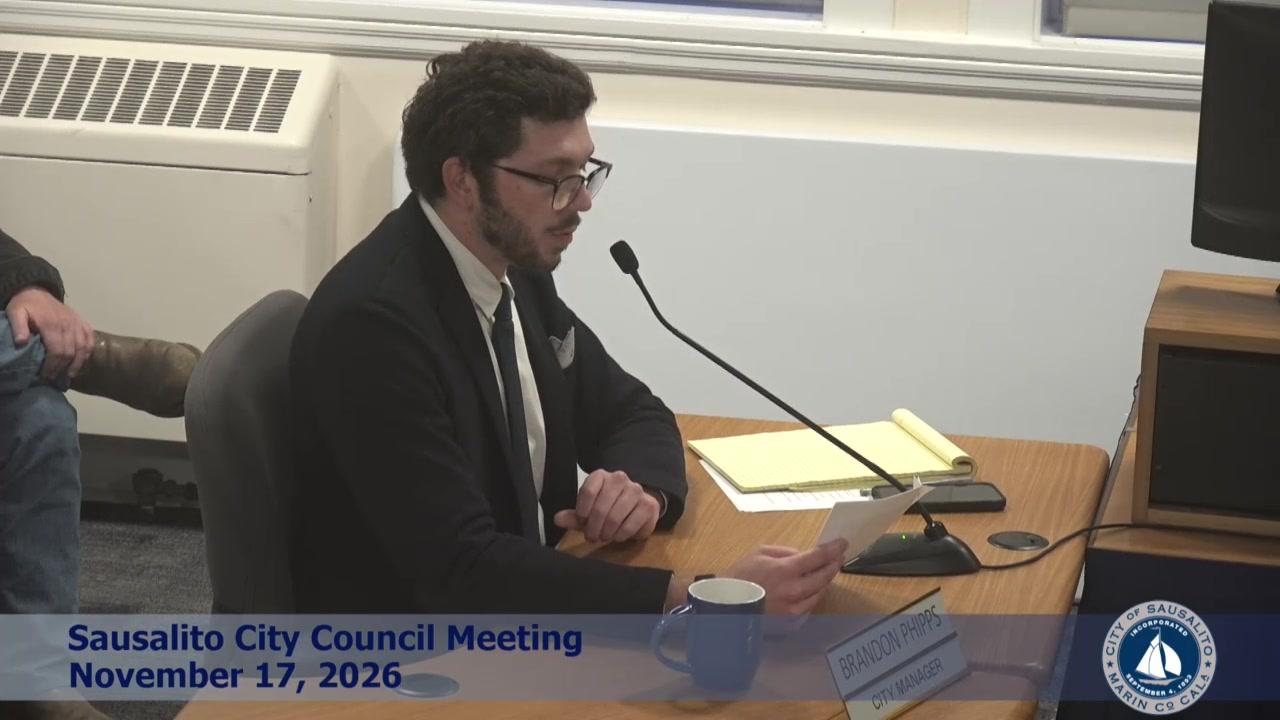
Where things stand: Interim City Manager Brandon Phipps said the next step is evaluating whether to merge the Marinship Specific Plan into Chapter 10.26 of the municipal code. “Measure X did not pass, and the city has a plan to move forward,” said Phipps.
Former backers struck a conciliatory tone. “We need to work together to find practical, long-term solutions to protect our waterfront, our businesses, and our community,” said Jim Madden, speaking for the Sausalito Sustainable Waterfront Association. Curtis Havel, harbormaster at Clipper Yacht Harbor and a founding member of that group, accepted the result. He urged a waterfront-wide vision that includes a right-to-industry ordinance and sea level adaptation.
The other side: Measure X opponents arrived with demands of their own. Sophia Collier of Save Our Sausalito asked the council to affirm a 15% accessory retail right for Marinship businesses, direct a code fix and commission a comprehensive traffic study. “The general plan, as we’ve often heard, is the constitution of the city,” said Collier.
Other speakers were sharper. “Will this council adhere to the voice of the people?” asked Sandra Bushmaker, a public commenter. She objected to emails she saw as workarounds to the vote. A commenter identified as John demanded traffic, sea level and flooding data before any planning: “No committees, no 15-year-old studies, no architects, no compromised planning commissioners.” Alice Merrill, a public commenter, asked the council not to rush and to talk with both sides rather than decide behind the scenes. Other speakers asked the measure’s authors to step aside, called for an end to labeling residents, and raised ethics questions about officials’ political endorsements.
Councilmember Ian Patrick Sobieski responded that a meaningful portion of residents supported the measure, and that people should not be told to move away. Vice Mayor Blaustein asked the community to come together.
Decisions and stakeholder impacts: No action was taken. The fault line shifted to future agenda items. Sobieski asked for case studies of denied Marinship businesses: “What can they and can they not do?” Councilmember Jill James Hoffman said permits that fit the general plan should simply be issued. Councilmember Joan Cox said she has a draft ordinance. Marinship businesses, maritime operators and slow-growth residents all have a stake in which approach prevails.
What’s next: Marinship accessory retail and a traffic study are queued as future agenda items.
Wayfinding Signs Approved, Design Handed Back to DSA
Why it matters: The decision sets an early template for how the city and the new business district share design, upkeep and removal duties in public space.
Where things stand: Councilmember Cox pulled the item from consent to hear revisions from local architect Michael Rex. Kass Green, president of the Downtown Sausalito Association (DSA), presented three sign locations developed over two years.
Rex applauded the DSA but urged a master signage model, a softer blue and different locations. “I simply am proposing that the white column be replaced with the black column,” said Rex. A DSA board member said the signs would help ferry visitors.
The other side: Councilmember Hoffman asked who pays, who maintains the signs and who removes them. Staff said a condition of approval could address removal. “I think we should approve the encroachment permit, but move where the signs are,” said Councilmember Sobieski. He suggested replacing the old chamber of commerce sign.
Decisions and stakeholder impacts: The council chose to empower the DSA committee to work with Rex rather than design signs from the dais. Cox moved and Sobieski seconded. The permit passed on a voice vote; no tally was announced. Staff will also resolve who owns downtown newspaper racks.
ADU Rules Advance; Fire-Access Fix Waits
The basics: Accessory dwelling units, or ADUs, are backyard cottages and in-law units. State law sharply limits how cities can restrict them.
Why it matters: New state rules take effect Jan. 1, 2027. Sausalito must align its code or risk losing local control over ADUs entirely.
Where things stand: Principal Planner Neil Toft explained the two state laws behind the update:
- AB 956 raises the number of ADUs allowed on a single-family lot.
- SB 1117 exempts the first 750 square feet from impact fees.
The ordinance also changes height, lighting and access standards. The Planning Commission recommended adoption Nov. 11.
The other side: Councilmember Cox brought redlined revisions on fire apparatus and emergency access. Her proposal would let the council designate “emergency access constrained areas.” Liz O’Keefe, a public commenter, described Platt Avenue crowded with construction trucks and an ADU going up with no parking. A commenter named Nicole asked that any limits extend beyond high fire zones, because medical emergencies also need truck access.
The city attorney warned that detached ADUs fall into a class the city must permit. The attorney also said state housing regulators (HCD) are watching closely and could deem the city’s entire ADU regulations void. “One of the best tools you have available is creating no parking zones,” the city attorney said. “We want to comply with state law as a primary issue,” said Councilmember Hoffman.
Decisions and stakeholder impacts: The ordinance was introduced on a voice vote; no tally was announced. Staff will explore Cox’s language, with the council examining it after Jan. 1, 2027. Homeowners gain building rights. Residents on narrow hillside streets get no new access protections yet.
What’s next: The ordinance returns for second reading Dec. 1, 2026. No-parking zones are a future agenda item.
Downtown District Budget Climbs to $312,000
Why it matters: The business improvement district, formed in 2024, is moving from startup mode to a larger investment program. The city is a major funding partner.
Where things stand: DSA President Green said the district was approved with 87% weighted ballot support. It ended 2025-26 with $172,350 in cash. The 2026-27 plan spends $312,000, funded by carryover with assessments unchanged. “Increasing our expenditures by 2.5 times over last year,” said Green.
The plan funds hanging baskets, nighttime lighting, a marketing consultant, administrative support and a Princess-Bridgeway intersection project with design firm SWA. Hoffman asked about off-season corporate events. Sobieski asked about event days and an ice rink. Amy Spenberg, incoming DSA president, thanked council and staff.
The other side: Merrill asked for a public city conversation before changes to the Princess Street intersection. She also urged spending restraint given flooding.
Decisions and stakeholder impacts: Blaustein moved and Cox seconded. The budget passed on a voice vote; no tally was announced.
Free Holiday Parking Doubles as Pricing Test
Why it matters: The waiver forgoes about $16,883 in 2025-comparable meter revenue. That is small against the more than $2 million a year parking brings the city, as Sobieski noted.
Where things stand: Parking Programs Manager Wayne Kwan proposed four free weekends:
- Nov. 27-29
- Dec. 4-6
- Dec. 11-13
- Dec. 18-20
“I do believe it’s a drop in the bucket for what the business community has endured for many years,” said Michelle McCullough, executive director of the Sausalito Chamber of Commerce. Green said the biggest benefit would go to Caledonia Street, and noted the staff report lacked sales tax impacts.
The other side: “They seem to have a very healthy budget of $300,000,” said Hoffman, asking whether the business district could pay. Green said state law limits district funds to meters inside the district, about 20 to 30 of 167. “We can only take our assessment funds and spend them in the district,” she said.
Decisions and stakeholder impacts: Blaustein moved the resolution and framed the weekends as an assessment of demand-based parking. Her motion directed staff to formally ask the DSA to cover the downtown share, about 20%. Cox seconded, adding enforcement of the 3-hour limit and publicity. “I think this is a really great compromise,” said Cox. The vote was called, but the result was not audibly announced.
Minor Items
- Tide gate, consent calendar pass: The Coloma Canal tide gate contract and WSP drainage amendment passed by voice vote. Clipper Yacht Harbor President Casey Peterson said, “At Clipper, we’ve spent over $100,000 just preparing for this winter’s tides alone.”
- Short-term rentals: Phipps said rentals are banned and “each functioning short-term rental is a code enforcement case.” Residents said stays end too quickly to enforce; the issue is a future agenda item.
- AI storm tool: Phipps previewed an AI-built “Storm Ready Home Planner” and a staff AI task force.
- Program 8 housing: Affordable housing at the MLK and Corporation Yard sites heads to a Planning Commission study session Dec. 9.
- Policy pipeline: The Economic Development Advisory Committee floated a vacancy tax, co-tenancy zoning and pop-up master permits. Resident Babette McDougall asked to add ethics to the January retreat.
Looking ahead: The ADU ordinance returns for second reading Dec. 1, 2026. The Planning Commission’s Program 8 study session follows Dec. 9.