
County Warns of $30M Shortfall in First State of the County
Board of Supervisors • Santa Cruz CountySeptember 30, 2026
Locunity is an independent informational service and is not an official government page for this commission. All information is sourced from public footage and an analysis of official agendas with the aid of responsible, fact-checked AI. to report an error or omission.
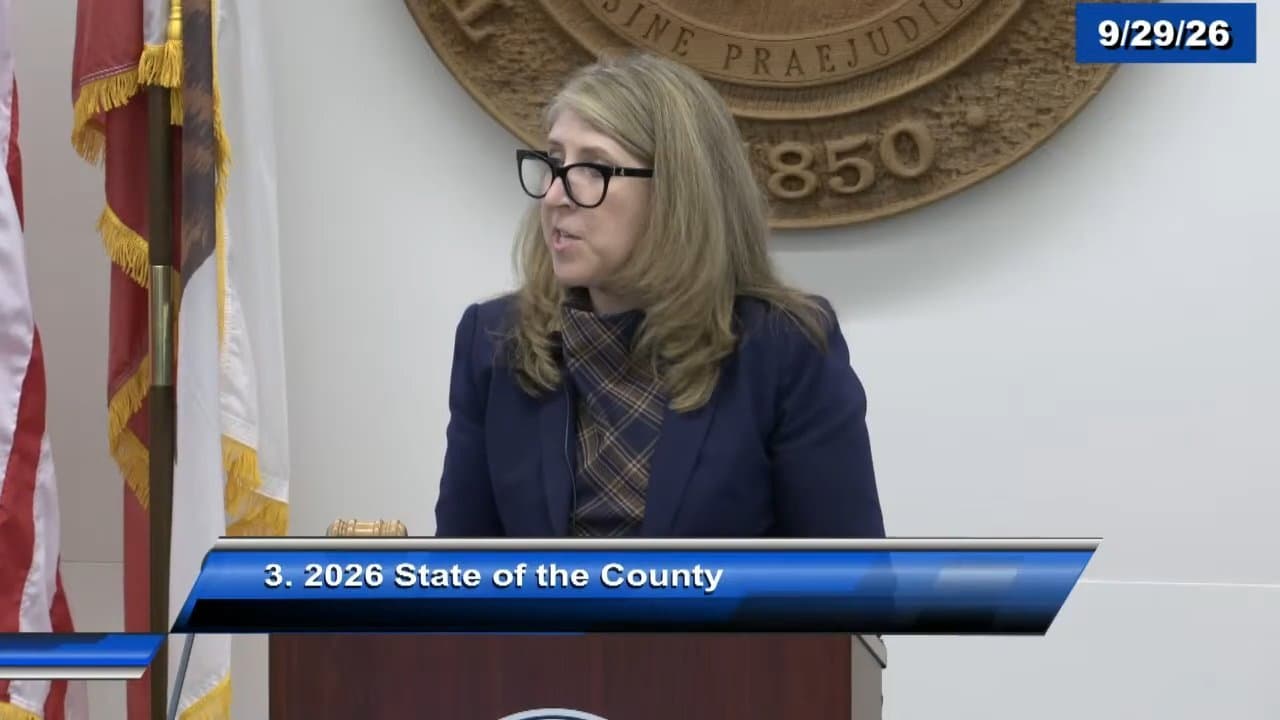
Santa Cruz County's first State of the County address on Sept. 29, 2026, paired a list of new behavioral health facilities and parks with a blunt fiscal warning: a $30 million general fund gap next year and about $285 million over six years. The special meeting was presentation-only, with no motions or votes. It set the financial baseline that voters and advocates will carry into the Nov. 3 Measure E sales tax vote.
- $30M shortfall projected next year, about $285M over six years if operations continue unchanged
- Federal changes could cost county programs about $25M a year, more than $200M countywide
- Watsonville Community Hospital has about eight days of cash, losing nearly $86,000 per day
- Measure E framed as a temporary bridge, not a structural fix; public commenter calls it campaigning
- Residents press on roads and parks as El Niño looms and backlogs mount
Budget Balanced on One-Time Money
Why it matters: Costs are growing faster than revenue. That means cuts or new revenue will shape every spending decision the board makes from here.
Where things stand: County Executive Officer Nicole Coburn described a roughly $1.4 billion adopted FY2026-27 budget that includes an $861M general fund. It is balanced, but only with more than $44M in one-time resources. Those include about $30.5M from general fund reserves, and roughly $21M of that reserve draw supports Health and Human Services programs affected by federal changes. The budget also eliminated nearly 62 vacant positions.
“$30 million is the general fund shortfall that we currently project for next year,” said Coburn.
The gap is structural, not a one-year blip. “We project expenses will grow about 6.1% a year while revenues grow about 5%,” Coburn said. Left unchanged, that difference compounds to roughly $285M over six years.
The county's response: Coburn listed hiring and travel restrictions, efficiency reviews, service consolidation, aligning the budget with strategic plan goals, and revenue and economic development strategies.
Decisions and stakeholder impacts: The board took no action. Still, the numbers put county employees, contracted nonprofits and service recipients on notice. Vacant positions are already being cut, and reserves are being spent down to hold services steady. Groups that depend on general fund dollars should expect tighter competition in the next budget cycle.
What's next: Coburn's task now is to connect the board's priorities to policy, budgets and performance measurement. The fiscal baseline she presented is the one residents should track.
Federal Cuts Hit Medi-Cal, Food Aid and Watsonville's Hospital
Why it matters: About a third of residents rely on Medi-Cal. Officials warned that Watsonville Community Hospital could close within six to 12 months without action.
Where things stand: Board Chair Monica Martinez, who represents District 5, said federal changes are squeezing Medi-Cal, behavioral health, food assistance and homeless services. She recalled the county's $500,000 allocation to Second Harvest Food Bank during the federal shutdown, part of commitments totaling $1.1M.
Coburn put the direct annual hit to county programs at about $25M, with more than $200M in impacts countywide. Medi-Cal enrollment has dropped 12% since December 2024. Coburn said new work requirements could push that decline to 32%, or about 25,000 people.
The sharpest warning was about the hospital. “Watsonville Community Hospital is running with approximately 8 days cash on hand and has an operational shortfall of almost $86,000 per day,” said Coburn.
Decisions and stakeholder impacts: Both Martinez and Coburn said the county cannot backfill federal losses. That leaves South County patients, safety-net providers, food banks and the Pajaro Valley Healthcare District most exposed. Families losing Medi-Cal coverage are likely to show up first at hospital and clinic doors.
What's next: No specific action on the hospital was announced at the meeting.
Measure E: A Bridge, Not the Fix
The basics: “Measure E is a temporary half-cent countywide transaction and use tax,” said Coburn. It is estimated to raise about $27M a year for five years. Listed priorities include emergency medical services, behavioral health, food security and housing stability.
Where things stand: Coburn said Measure E is not built into the forecast as the answer to the structural imbalance. She also noted it is far smaller than the $200M-plus federal impact. She cited past local measures G, K and Q as context.
The other side: Public commenter Becky Steinbrunner said she opposes the measure. She objected to its place in the address: “I'm a little surprised that this was used as a forum to campaign for Measure E. I don't think that's legal,” said Steinbrunner.
Steinbrunner said the track records of measures G and K give her reason to distrust the county. She also took aim at the measure's general-fund structure. “If you were serious about funding medical help, it would be a special dedicated tax that would take two-thirds approval,” she said. Under California law, special taxes dedicated to a specific purpose require two-thirds voter approval.
Why it matters: The county's case for Measure E rests on credibility about past measures. Opponents are already contesting that record.
What's next: Voters decide on Nov. 3.
Roads and Residents: "We Were Not Heard"
Why it matters: In mountain and rural areas, roads double as evacuation routes and the only path to services.
Where things stand: Martinez noted that NOAA forecasts a strong El Niño. She described vegetation clearing, culvert work and road strengthening. “We can't afford to think about road maintenance only when a road fails or outside funding becomes available,” said Martinez.
Coburn said Measure K directs $2M a year, or 20% of its revenue, to road repair and maintenance. That funding has increased summer roadside ditch clearing by 30%.
The other side: A public commenter identified as Kathy said she did not hear infrastructure addressed. She pointed to the slide on Mount Charlie Road and tied road conditions to residents' mental health. “Please consider that our roads are our safety net,” she said, adding that her community was not sought out. “We were not heard.”
Steinbrunner also cited road conditions in questioning whether Measure K has delivered.
Decisions and stakeholder impacts: Leadership and residents agree that roads need sustained funding. The tension is over whether the money and attention are reaching places like Mount Charlie Road.
New Beds Open, but Sustaining Them Is the Test
Where things stand: Martinez highlighted Hope Forward in Live Oak. The facility has an eight-chair stabilization unit and a planned 16-bed crisis residential program. “In just the first five months of being open, the facility has already served 145 youth under the age of 20,” said Martinez.
She also cited:
- Bridge House on Soquel Avenue, with 32 transitional beds
- Hope Village in the Pajaro Valley, with 34 beds
- Veterans Village in Ben Lomond and Park Haven Plaza in Soquel, both of which have moved forward after being stalled
The strategic plan: Martinez said the county's six-year strategic plan drew on broad input. “There were more than 4,500 points of community engagement,” she said, including a Felton town hall of more than 150 people. The plan sets six focus areas: housing and infrastructure, health, safety and justice, environment, access to basic needs, and economy and job growth. Its 2032 targets include permitting at least 2,541 housing units and increasing behavioral health step-down beds by 50%. Martinez warned that difficult decisions are ahead and highlighted the county's new Youth Commission.
Why it matters: Coburn stressed that grants expire. She said capital funding does not cover ongoing staffing, and the real measure of success is what the county can sustain.
Community voices: Public commenter Richard Lewis, 89, said he wants help staying in his home. “Please, you who are like me, senior power, let's see what we can do to work with the team, particularly behavioral health,” he said.
Public commenter Anna Brantley praised the county's long-term vision and its bike lanes. She urged better-coordinated, funded programs such as homeless projects and In-Home Supportive Services.
- SHIELD Subcommittee: Martinez and Supervisor Hernandez created a panel to set procedures if federal immigration agents come to county facilities.
- Streamline Santa Cruz County: Coburn outlined a unified permit center, simultaneous reviews and clearer permitting timelines.
- Enhanced infrastructure financing districts: The county is joining one in Scotts Valley and pursuing another in the unincorporated area. “It does not increase the property tax rate or reduce the county's existing baseline property tax revenue,” said Coburn. The county receives only about 13.5 cents of each property tax dollar.
- Parks: Martinez cited Valle del Pajaro, a Pinto Lake bike park and $2.74M in Measure Q awards to 18 projects.
- Parks backlog claim: Public commenter Terry Stockwell said the county has $90M in deferred parks maintenance and criticized parks leadership. He requested a meeting with Coburn and Supervisor Koenig. His claims were not addressed at the meeting.
Looking ahead: The board's next regular meeting is 9 a.m. Tuesday, Oct. 6, in the board chambers. Measure E goes to voters Nov. 3.