
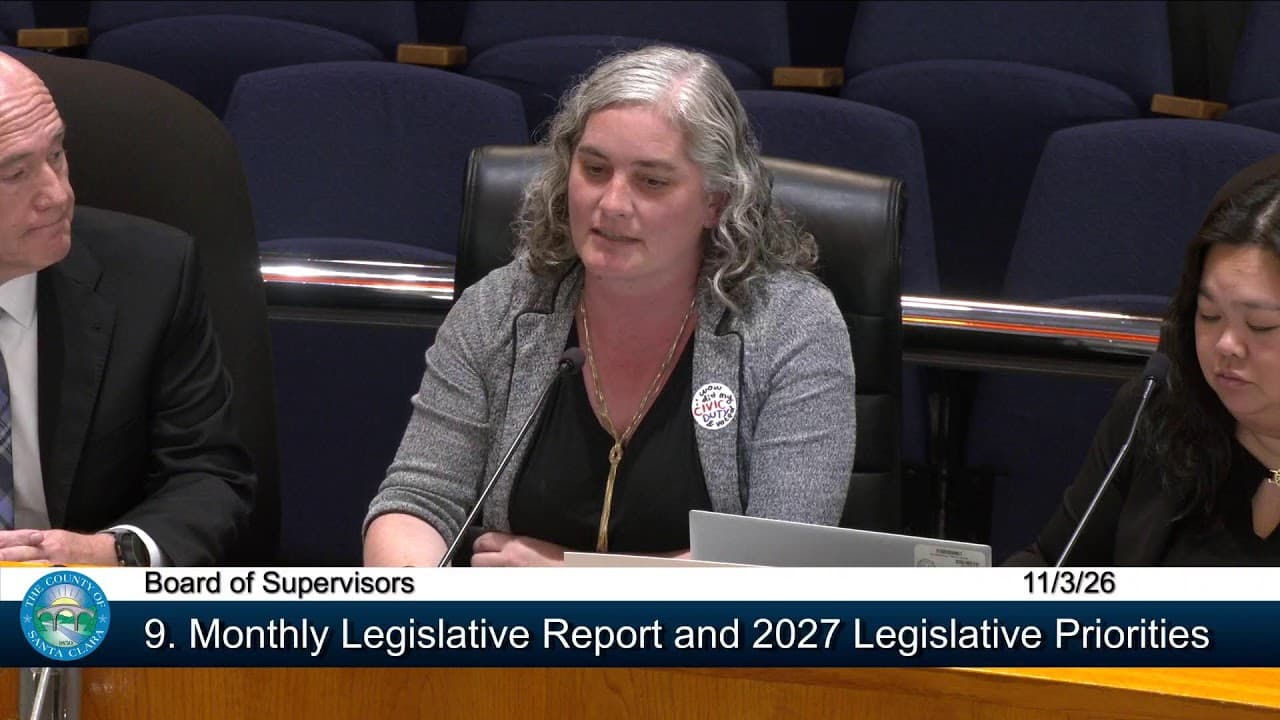
Supervisors Confront $260M Deficit, Order Equity Lens on Cuts
Board of Supervisors • Santa Clara CountyNovember 3, 2026
Locunity is an independent informational service and is not an official government page for this commission. All information is sourced from public footage and an analysis of official agendas with the aid of responsible, fact-checked AI. to report an error or omission.
Santa Clara County is headed into its fifth straight deficit year. County Executive James R. Williams forecast a $260M gap for fiscal 2027-28, driven largely by federal and state health care changes. On Election Day, Nov. 3, 2026, supervisors accepted the forecast 5-0 and added two guardrails: a geographic equity lens on proposed cuts and a board priority-setting step before the recommended budget arrives. The same meeting showed what the county can still build, with a housing bond that beat its goal and a 77-bed behavioral health pavilion that opened to patients that morning.
- $260M deficit forecast for FY2027-28; cumulative reductions near $1.5 billion
- Equity filter added: Cuts must show geographic impacts where relevant and feasible
- Behavioral health beds up 350 since 2022 as new pavilion opens
- Measure A tops 6,800 approved units against a 4,800-unit goal; all bond funds allocated
- Foster youth housing becomes a county priority after nine advocates testify
- Legislative platform adopted 4-0, with new direction on child welfare partnership
A Fifth Straight Deficit, Blamed on Washington
Why it matters: The county is losing about 47,000 Valley Health Plan members on Jan. 1, 2027, a 20% drop in membership. The cuts that follow will land on services residents use every day.
Where things stand: "We are forecasting today, based on our current best available information, a deficit for the upcoming fiscal year of $260 million," said James R. Williams, County Executive.
Williams walked through prior gaps of $120M, $280M, $40M and $787M, totaling $1.227 billion. The new gap started near $500M. It shrank because of about $100M in excess ERAF property tax revenue and $170M in health system revenue.
He blamed two forces. The first is HR 1, the federal law. The second is the state's shift of Medi-Cal enrollees with unsatisfactory immigration status into fee-for-service on Jan. 1, 2027. Without those changes, Williams said, "We would have no deficit here at the county."
Departments have been asked for $350M in reduction proposals as a planning range. Williams stressed that figure is not a cut list: "A target number does not equal a specific reduction or what's gonna be in the recommended budget."
The other side: Supervisor Sylvia Arenas, Board Vice President, pressed on who absorbs the cuts. She asked "what guidance or explicit geographic equity filter is provided by administration to ensure that there is not additional reductions in areas that have had historically lack of investment." Williams offered to describe geographic impacts where proposals have a geographic component.
Supervisor Margaret Abe-Koga, District 5, warned the county is running out of room. "I think we are getting close to, if not at the limit of how much we can cut without really affecting services," she said. She urged counting seniors in equity analysis and paying attention to reserves and pension prepayment.
Supervisor Susan Ellenberg, District 4, praised the forecast and set a modest bar for the health system: "I think if we can maintain a flat general fund investment for next year, that would be an incredible accomplishment."
Board President Otto Lee thanked SEIU 521 for accepting a one-year pay freeze and noted other unions followed suit. Public commenter Lupita Torres, whose mother was killed as a pedestrian in Eastside San Jose, asked that next year's budget fund crosswalks, bike lanes and a safety awareness campaign.
Decisions and stakeholder impacts: Arenas moved approval with added direction, and Ellenberg seconded. The recommended budget must articulate geographic equity impacts "to the extent relevant and feasible," and the Board will hold a priority-setting process before the recommended budget is released. The motion passed (For: 5, Against: 0, Absent: 0). Voting yes were Abe-Koga, Duong, Ellenberg, Arenas and Lee. Historically underinvested neighborhoods gain a formal check on where reductions land. Departments now carry an added reporting burden. Labor's pay freeze is already part of the budget math.
What's next: The board priority-setting session comes before the County Executive's recommended budget. Departments are now building their proposals.
Pavilion Opens as Bed Gaps Persist
Why it matters: Nearly two-thirds of youth needing acute psychiatric care have been placed outside the county. The new pavilion is the county's main bet on bringing them home.
Where things stand: Behavioral Health Services Director Sherri Terao and her team reported that the 130-bed acute goal is now met with 53 San Jose Behavioral Health beds and 77 pavilion beds. Residential and withdrawal management beds are meeting or exceeding goals. Subacute and community residential beds still lag and need funding. The county has added 350 beds since its 2022 crisis declaration. In 2025, 2,600 more people received substance use treatment than in 2023.
Opioid tools like naloxone work, but stimulants are harder to treat. "When it comes to methamphetamine, we just don't have the same resources," said Dr. Sarah Rudman, Public Health Department.
The other side: Arenas pressed on waitlists for women and mothers and on stalled community residential capacity. "I know that they've remained 83 since April," she said of those beds. She also asked about equity in PERT, the county's crisis response program. Abe-Koga flagged a lingering gap: "I saw that 65% of youth are still being placed out of county." Lee asked about expanding Compass Clinic and adding a mobile NTP van.
Decisions and stakeholder impacts: The report was approved (For: 5, Against: 0, Absent: 0). Families of youth in crisis, mothers seeking treatment and providers of subacute care have the most at stake as the remaining bed gaps compete with a $260M deficit.
What's next: Supervisors will track whether the pavilion reduces out-of-county youth placements in future quarterly reports.
Housing Bond Overdelivers, Then Runs Dry
Why it matters: The 2016 Measure A bond is fully committed. Future affordable housing depends on new sources, such as a possible 2028 regional bond and state Prop 1.
Where things stand: Ten years in, the county has approved more than 6,800 units against a goal of 4,800. More than 4,900 homes are operating, under construction or fully financed. The approvals span 65 multifamily developments in 12 cities and total about $745M. Another $31M has helped 100 households buy homes, and $57M is reserved for three projects on county land.
About $30.5M in program income has come in, and roughly $7M is available to reprogram. The oversight committee recommended committing that income to housing and homelessness programs in perpetuity, with an annual reevaluation.
Arenas credited the bond's leverage: "we learned how to move money in a way that drew down $4.25 for every dollar of Measure A spent."
The other side: Ellenberg asked whether bond dollars could fund homelessness prevention. Office of Supportive Housing staff said no: "the 2016 Measure A dollars are restricted to the improvement of real property." Staff noted that a separate pilot to prioritize prevention is underway. Abe-Koga asked whether shifting homeownership money to multifamily rental housing would produce more units. She also asked about Prop 1.
Arenas requested breakdowns on Joe Serna farmworker housing and on homeownership demographics. Deputy County Executive Consuelo Hernandez proposed folding the farmworker data into quarterly ag worker housing updates to HULIT. Staff offered an off-agenda demographic report.
Decisions and stakeholder impacts: Ellenberg moved the item and Abe-Koga seconded. It passed (For: 5, Against: 0, Absent: 0). Lee called the results a rebuttal to critics: "we're actually putting literally thousands of families into housing because we're able to overdeliver the number of units." He floated the idea of another housing measure. Developers and nonprofit builders keep a small stream of program income, but the large pipeline now needs new money.
Foster Youth Push Housing Into County Policy
Why it matters: About 60 young adults age out of foster care in the county each year. Many leave without savings, rental history or family support.
Where things stand: Nine speakers backed Lee's Item 28 resolution. Most were Youth Impact Partnership members with lived foster care experience or leaders of Fostering Promise. Andre Chapman, Founder and CEO, Fostering Promise, said the county went from two housing vouchers for former foster youth three years ago to 130. He urged the county to be the first to end the foster-to-homelessness pipeline.
Hallie Matthews, a Youth Impact Partnership member and former foster youth, described leaving care with no finances, rental history or family support. Gerben Serafin of Fostering Promise asked for help for youth with out-of-state foster histories. Brendan, Youth Impact Partnership co-chair, said the group rarely backs non-binding resolutions but made an exception for this one.
"Every year, approximately 60 young adults age out of the foster care system in our county," said Board President Otto Lee. He said the county has Northern California's largest population of transition-age foster youth and framed the resolution as prevention. Arenas said it puts existing values in writing.
Decisions and stakeholder impacts: The resolution passed with the consent calendar (For: 5, Against: 0, Absent: 0). It is non-binding, so its value depends on future budget and voucher decisions made during a deficit year.
Legislative Agenda Adds Child Welfare Focus
Deputy County Executive David Campos said the item "essentially lays out the priorities, the legislative priorities for the Board of Supervisors for the coming session." Arenas moved items A through E and added direction to work with the County Welfare Directors Association on child welfare. "I thought we had already incorporated child welfare work," said Ellenberg. Staff said the direction simply allows partnership where interests overlap. Arenas also asked how the pending AI policy and data center decisions would affect the platform. Staff said policies can be updated during the year. Lee cited $250M in public hospital funding secured after county advocacy. The platform passed (For: 4, Against: 0, Abstain: 1). Supervisor Betty Duong, District 2, abstained after arriving late.
Minor Items
- Election and benefits: Over 355,000 ballots, or 32% turnout, were in by morning. Certification is due by Dec. 3. Employee open enrollment runs through Nov. 16. Health Net exits after 2027.
- Litigation authorized: In closed session on Nov. 2, the Board authorized one new lawsuit. Details will be disclosed once it is filed.
- Tributes: The meeting adjourned in memory of former County Librarian Nancy Howell. Supervisors also honored Dolores Huerta.
- Public comment: Park rangers protested the walk-through-only Fantasy of Lights, and a Gilroy teacher sought a data center and battery storage moratorium.
- Veterans funding: A veterans commissioner said the Stand Down and Veterans Day parade are each $15,000 short.
Looking ahead: The Peacock Court appeal in Cupertino (Item 8) and the generative AI policy (Item 16) return Nov. 17. The Sheriff's report on use-of-force demographics (Item 14) moves to the second meeting in January 2027.