
OVG Apologizes for Late Convention Center Reports; Electric Rates Rise 2%
City Council • Santa ClaraNovember 18, 2026
Locunity is an independent informational service and is not an official government page for this commission. All information is sourced from public footage and an analysis of official agendas with the aid of responsible, fact-checked AI. to report an error or omission.
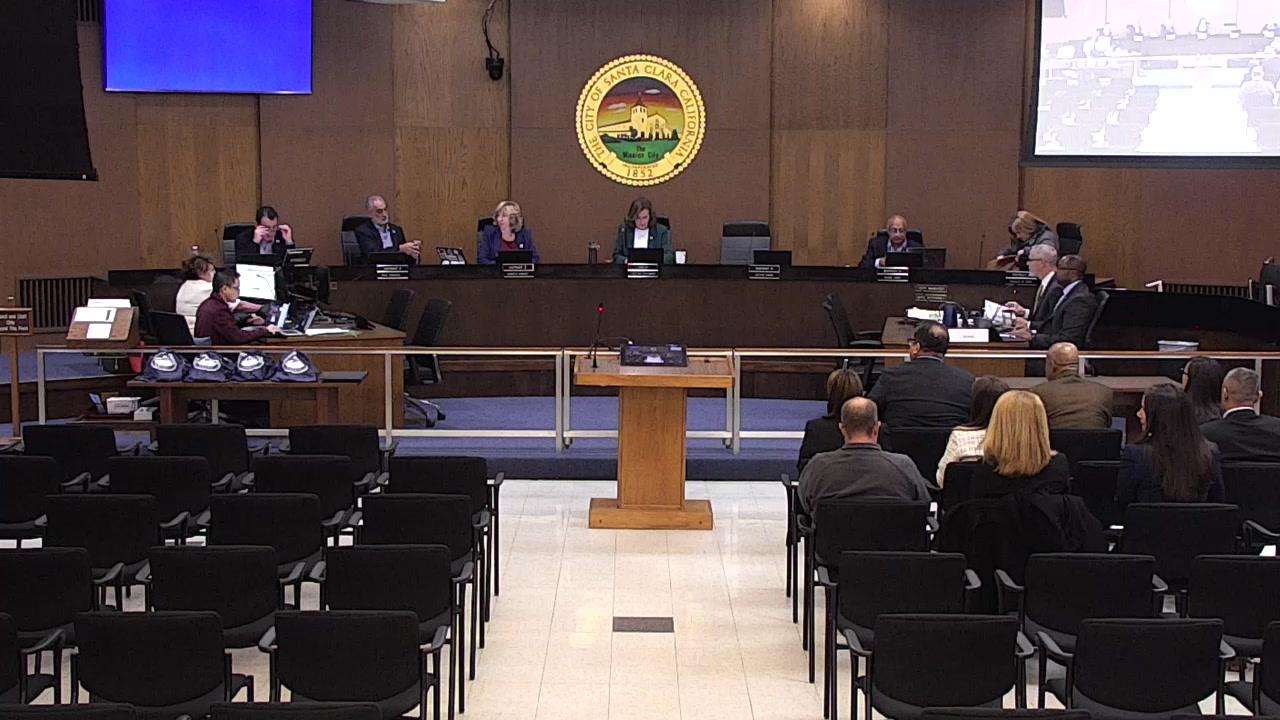
Santa Clara's City Council spent much of its Nov. 17, 2026, meeting checking the books at the two city-owned venues. Members demanded better reporting from the operator that delivered five quarters of convention center results late, then grilled stadium staff on stalled capital spending. The council also approved a 2% Silicon Valley Power rate increase on a 6-1 vote.
- Convention Center reports filed 7-0 after OVG apologized for five quarters of late financials
- 2% electric rate increase adopted 6-1, effective Jan. 1, 2027; Councilmember Kevin Park dissents
- Stadium Authority reports approved 7-0 after members flagged 1.9% capital spending at the halfway mark
- No motion to reconsider AgriHood townhome approval despite objections from residents and advocates
- Council travel under scrutiny as members disclose $2,700-per-person China trip cost
Late Reports, Hard Questions at the Convention Center
Why it matters: The city owns the Santa Clara Convention Center and relies on its operator, OVG, for the numbers. The center faces a capital deficit that City Manager Jovan Grogan estimated at roughly $80M.
Where things stand: OVG presented reports covering fiscal 2024-25 Q4 through fiscal 2025-26 Q4 in a single sitting. OVG blamed the delays on a new financial system, staff turnover and preparations for Super Bowl 60 and the FIFA World Cup. It reported net income of about $2.6M for fiscal 2024-25 and about $3.3M for fiscal 2025-26.
“I just want to acknowledge our regret and to apologize for the delays in providing the financial reports expected by the city,” said Samuel Thomas, Senior Vice President of Convention Center, OVG.
Councilmember Raj Chahal pressed for specifics: “What are the major corrective actions?” OVG listed the following steps:
- A dedicated finance director and an accounting manager
- Biweekly meetings with city staff and a 20th-of-the-month internal deadline
- Cross-training of staff
- An agreed-upon-procedures review of cash
Councilmember Suds Jain questioned why economic impact figures were inconsistent. “There was a typo in the formula of our worksheet so that there was an error there,” said Raul Gutierrez, General Manager, Santa Clara Convention Center. Gutierrez said OVG uses Destination International's methodology.
“This raises a lot of red flags,” said Councilmember Kelly Cox, who also asked about expense savings, the FIFA quarter result and how partner revenue is reported.
Follow the money: Jain asked where the center's profits go. “Any net surplus in the convention center O&M fund is available primarily for capital needs,” said Grogan. Grogan said the city bears all of the center's capital costs. Staff gave these details:
- The chiller was financed by the general fund.
- The kitchen refresh used Levy funds.
- Roof replacement is estimated at more than $2M.
- About $3.2M in fund balance is expected to be recommended for the center.
Public commenter Anthony Becker said an infrastructure bond would have covered convention center and stadium repairs. He blamed the mayor and a former councilmember for narrowing the measure. “I actually voted against the makeup of the bond,” said Councilmember Park.
Decisions and stakeholder impacts: The council voted to note and file the reports. Councilmember Karen Hardy made the motion, and Vice Mayor Albert Gonzalez seconded it. Members asked for annual reports, capital and reserve data, and a format that matches the stadium reports. “I would like these reports to be modeled similar to what we get from the 49ers,” said Jain. Vote: For: 7, Against: 0, Absent: 0.
What's next: Staff will return at the next meeting with $7M in convention center capital funding.
Power Bills Climb 2% as Cost Study Lags
Why it matters: Every Silicon Valley Power customer will pay more starting Jan. 1, 2027. Residential customers will see an increase of about $1 to $3.65 per month. A cost-of-service study that could change how costs are split among customer classes has not been done yet.
Where things stand: “That's the lowest level of annual increase that has been requested in the last 7 years,” said Grogan. Staff cited four drivers: materials costs, infrastructure, reserves and turbine replacement.
Members questioned several cost pressures:
- The engine failure at the Donald Von Raesfeld (DVR) plant and its insurance coverage
- Transmission access charges, which have risen about 82% for high voltage and about 150% for low voltage over 10 years
- Why small commercial customers pay more than residential customers
Jain defended the city's utility tax. “If we just eliminated the utility tax, we would have to come up with $33 million extra to maintain the same level of service,” said Jain.
The other side: Park said rate increases are outpacing the cost of living.
A public commenter named Eric said he was not necessarily opposed to an increase. He argued that Proposition 26, the state rule limiting local fees to the cost of service, requires a cost-of-service study and fair allocation among customer classes.
A public commenter named Wanda said bills rise too often. She also questioned whether data centers benefit residents and how the rate tiers are structured. Becker called the increase badly timed for struggling residents.
Cox asked whether the vote could wait for the cost-of-service study. “I think that probably will take an additional 4 to 6 months,” said Nico Prokos, Director, Silicon Valley Power.
Decisions and stakeholder impacts: Jain moved the resolution, and Hardy seconded it. Vote: For: 6 (Gillmor, Gonzalez, Chahal, Hardy, Jain, Cox), Against: 1 (Park), Absent: 0. All rate schedules rise 2%. Questions about the burden on each customer class remain open.
What's next: Staff said the cost-of-service study will follow a review of the load development fee.
Stadium Capital Spending Stalls at 1.9%
Why it matters: The Santa Clara Stadium Authority may face tens of millions of dollars in capital needs while projecting about $10M for the city's general fund.
Where things stand: Cox pulled the two quarterly reports from the consent calendar. One of them had already been deferred on Oct. 6 and Oct. 20, 2026. Cox noted that only 1.9% of a $19.5M capital budget had been spent at the halfway point of the year. She also said shared operating costs were nearly used up and staffing had surged.
Staff pointed to some gains:
- Stadium debt fell below $200M for the first time.
- Non-NFL activity brought in $11M.
- An independent facility condition assessment vendor is being finalized.
“I think our first priority is really to complete that facility condition assessment so we know what that outstanding amount is gonna be,” said Kenn Lee, Acting Assistant City Manager and Chief Financial Officer.
The other side: Mayor Lisa M. Gillmor raised several concerns:
- Delays in recovering public safety costs
- A buffet audit fee
- About $1.4M in unreconciled FIFA costs, plus $1.75M in administrative costs
Grogan said the agreement does not make those costs eligible for reimbursement, and the mayor disputed that reading. On stadium staffing, Gillmor said, “This budget cycle will be the 3rd year in a row asking about that.”
A Manco vice president said many capital projects are complete but not yet paid for. The vice president attributed the staffing growth to bringing security in-house.
Decisions and stakeholder impacts: Hardy moved approval, and Jain seconded it. Vote: For: 7, Against: 0, Absent: 0. Capital spending and reimbursement disputes are expected to resurface during budget season.
AgriHood Townhome Approval Stands
Why it matters: The council's earlier decision to replace AgriHood's final apartment building with for-sale townhomes remains in place. Some residents had objected over senior housing commitments and site upkeep.
Where things stand: Kirk Vartan cited project cost figures that rose from $104M to $120M, along with a $128M study. He said there was no documented effort to offer the site to other builders and urged the council to keep the plan's activated paseo.
Deborah Williams, a resident of the AgriHood Senior Apartments, described neglected landscaping and security problems. She asked the council to hold CORE accountable. Becker and a public commenter named Linda also backed reconsideration, citing past commitments and the need for senior housing.
The other side: Chris Neal of CORE Companies said no new information had been presented. He said CORE remains committed to the senior project.
Decisions and stakeholder impacts: “Any motion to reconsider must be made by a councilmember on the prevailing side,” said Glen Googins, City Attorney. Under Council Policy 042, only Gonzalez, Chahal, Hardy or Jain could have made that motion. None did.
Travel Costs and Union Concerns Surface
A public commenter asked the council to restore the policy requiring council approval before council members and the mayor book travel. Gillmor noted that the China trip report would come later in the meeting.
When it did, Cox laid out the cost of the Hangzhou and Beijing trip: “So in total, that means about $2,700 per person paid for by the city for this 9-day trip.” The trip included a mayors' conference on AI and a visit to Unitree Robotics. Gillmor and Cox also discussed possible friendship-city steps.
Gillmor said Harvard covered her Cambridge trip: “They paid every cent of my trip, for the record.” Jain said his Vienna social housing tour “didn't cost the city anything.”
Leon Alcantar, Unit 3 Chairman, IBEW Local 1245, asked the council to meet periodically with Unit 3 officers about safety practices and compliance with their labor agreement. He described the union's relations with senior Silicon Valley Power management as adversarial.
A commenter named Akos cited crash data to argue for repealing pedestrian prohibitions on expressways.
Minor Items
- 2610 El Camino Real: The 590-unit mixed-use project was deferred indefinitely at the developer's request and must be renoticed (7-0).
- Industrial hauling: The council granted non-exclusive franchises through December 2031 to 13 haulers, up from 11. The city collects a fee of about 12.3%, and Gillmor declared the vote unanimous.
- Subdivision maps: The council approved a data center parcel map at 3580 Juliette Lane and a 24-unit commercial condo map at 3501 and 3511 Thomas Road (both 7-0).
- Consent calendar (7-0): Approvals included up to $3.96M in fleet purchases, a $448,139 HVAC contract for the Senior Center Natatorium, a waiver of about $35,900 in library fines and a $210,000 police spending plan. Chahal announced a recusal on item 4.H.
- Westside Little League: The council honored the 11U All-Stars, Northern California state runners-up.
Looking Ahead
The $7M convention center capital item returns at the next meeting. A Hangzhou delegation is expected to visit in December. The El Camino Real project will need a new public notice before any hearing.