
City Council - Jul 14, 2026 - Meeting

City Council - Jul 14, 2026 - Meeting

City CouncilSan RamonJuly 14, 2026

Sources:

Locunity is a independent informational service and is not an official government page for this commission.We use AI-assisted analysis and human editorial review to publish information.

San Ramon's 10-Year Forecast Warns of Fiscal Cliff When Sales Tax Expires

San Ramon's first comprehensive long-term financial model delivered a sobering message Tuesday night: without voter renewal of Measure N's 1% sales tax before its April 2035 expiration, the city faces negative fund balances by FY2037 — and replacing that revenue through retail growth alone would require, in the city manager's words, "eight Costcos." The council also closed out a 30-year regional traffic fee program, approved a $2 million federal grant for smart traffic infrastructure, and heard residents push for climate polluter accountability.

  • New 10-year forecast projects severe fiscal cliff when Measure N sales tax expires in 2035, with consultant warning city would face "traumatic" service cuts without renewal
  • Council sunsets 30-year regional traffic fee after completing all listed freeway improvements, while keeping sub-regional collections for a $14 million Crow Canyon Road widening
  • $2 million federal grant approved for nearly 7 miles of fiber optic cable connecting traffic signals to a countywide smart signal network
  • Three residents urge council to back Make Polluters Pay bill; city manager says no active legislation exists to support
  • First meeting under SB 707 restores remote public comment, which had been disabled since October 2023

The Measure N Question: Eight Costcos and a Ticking Clock

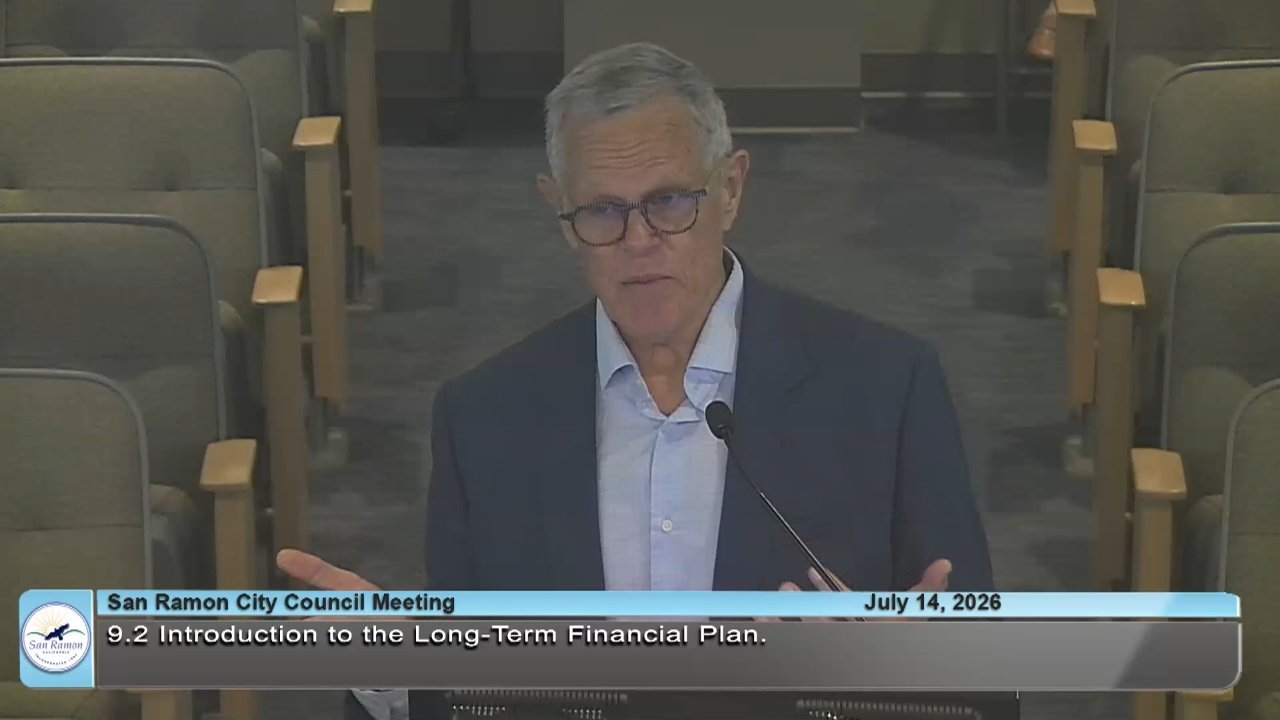
Finance Director Jennifer Wakeman introduced the city's first comprehensive 10-year general fund forecast as a product of the financial resiliency framework adopted in October 2025. Consultant Russ Branson of Russ Branson Consulting walked the council through a model spanning FY2020 through projections beyond FY2035 — a sprawling, data-heavy presentation that consumed more than an hour of council time and drew pointed questions from every member and multiple public commenters.

The basics: Measure N is a 1% sales tax approved by voters in 2024 and effective in 2025. It generates millions in annual general fund revenue supporting core services. It expires April 2035.

Why it matters: The forecast shows that if Measure N lapses without renewal, the city faces deficit periods starting around FY2028 from smaller revenue losses — a $1.3 million state retail theft grant disappearing by FY2028, a $1.9 million drop in solid waste franchise fees from an overcharging correction — and then a severe fiscal cliff in FY2035-36 when the sales tax sunsets entirely. "You'd have a negative fund balance by FY37. The reality is you'd cut expenses. That's you — you wouldn't let that happen, but it would be a very traumatic event for the city," said Russ Branson, consultant.

Where things stand: The model identified several key cost pressures: CalPERS pension costs growing 6-9% annually through 2029 before flattening; personnel costs consuming 65% of the general fund; and a $3.8 million apparent jump in health benefit costs that Branson explained was actually an accounting correction — those costs had previously been funded off-book from reserves. Property taxes, the city's largest revenue source, grow at roughly 4% annually, providing a stable but insufficient base to replace Measure N.

Branson recommended identifying which specific services Measure N supports so voters understand what's at stake, continuing the financial resiliency framework, reducing costs where possible, and updating the model at least twice yearly. "The services you're providing now, the level of staff you have now, are very reasonable for a city of your size. And you don't have a lot of room, especially given where we've seen some of these revenues go," he said.

City Manager Steve Azevedo drove the point home with an analogy that landed hard in the room: "To avoid that drop off, that'd be equivalent of eight Costcos opening up in San Ramon. And all eight Costcos being just as busy as if there was no other Costco in the area."

The other side: Council members pushed for a more sophisticated tool. Councilmember Sridhar Verose requested the model incorporate future development impacts on both revenues and expenses, investment income, and technology and AI workforce augmentation. "We are a growing city and that can have a significant impact on both the revenue side as well as the expense side. So I would like to see that as part of the model," he said.

Vice Mayor Marisol Rubio asked about recession stress testing, whether remaining traffic fee funds could support public transit operations, and how AI might change staffing needs. She also suggested inverting the analysis: "Is there any way to look at it from the other side of, say, asking how much do we need in sales to be solvent in this projected time?"

Mayor Mark Armstrong requested that presentation materials be shared with the council ahead of future meetings and emphasized that voter expectations must guide any planning. "Our residents, they did vote for Measure N and with that, they expect a certain level of service from the city. And we, with Measure N, were able to provide that service — not service cuts, but services that they said they wanted," he said.

Public commenters engaged substantively. Johannes Tillihan acknowledged improvements in financial accounting and the model's value but identified four gaps: future development impacts, deferred maintenance beyond 2031, investment income, and technology staffing. He noted the city's net financial position moved from $39 million positive to negative $10 million over the past decade, driven by pension obligations, and requested balance sheet analysis. Brian Swanson called the item "at least one-plus years late" and "a slap in the face to generous voters," recommending baselines with and without Measure N plus a recession scenario. Brian F. urged the city to model less favorable economic conditions beyond the midpoint forecast.

What's next: The item was informational with no formal action. Staff will refine the model and return with revenue and expenditure options in future presentations. The timeline for those next steps was not specified, but the urgency is clear: the city likely needs to place a renewal measure before voters by 2034 at the latest, and making the case requires knowing precisely which services are on the line.


30-Year Traffic Fee Sunsets After Completing Freeway Improvements

Why it matters: A joint agreement among San Ramon, Danville, and Contra Costa County has collected developer traffic mitigation fees since 1996 — triggered by the 11,000-home Dougherty Valley development — funding tens of millions of dollars in freeway and arterial improvements. All regional projects are now complete, and the council voted unanimously to stop collecting those fees while preserving sub-regional collections for critical remaining road work.

Where things stand: Staff presenter Brian Borenstein detailed the completed projects: Alcosta Boulevard on/off ramps, Interstate 680 auxiliary lanes from Diablo Road to Bollinger Canyon Road, and other capacity improvements. The lone incomplete regional project — Stone Valley Road in Alamo — falls under the county's jurisdiction. Consensus among the three parties was to stop collecting regional fees and roll remaining funds into the Contra Costa Transportation Authority's Innovate 680 program, which includes six projects: part-time transit lanes, express lane completion, the 680/24 interchange, advanced technology deployment, coordinated adaptive ramp metering, and shared mobility hubs.

Sub-regional fees will continue for two unfinished projects: Crow Canyon Road Phase 2 widening from St. George Road to Dougherty Road, estimated at $14 million, and 680/Crow Canyon interchange improvements.

Councilmember Richard Adler praised the 30-year collaborative effort. "I like this story. Thirty-year story and I think it's a good example of how government can be effective. It gets dinged a lot for doing bad things or incorrect things. But it seems like we had the parties all working towards a common goal," he said.

Vice Mayor Rubio asked whether remaining funds could support local bus frequency — specifically County Connection Route 35 on Bollinger Canyon Road, which runs only every 30 minutes. "There's a chance that if we don't have funding, it's going to get even longer than that," she warned. Staff and the city manager clarified the funds are restricted to capital infrastructure and cannot be used for transit operations.

Mayor Armstrong confirmed with staff that the fees are paid by developers, not residents through property taxes.

Decisions: Resolution 2026-105 passed unanimously (For: 5, Against: 0, Absent: 0). Motion by Councilmember Verose, seconded by Councilmember Adler.

What's next: Sub-regional fee collection continues. The Crow Canyon Road Phase 2 widening is expected to take 5-10 years to complete.


Residents Push for Climate Polluter Accountability; City Says No Bill Exists

Three public commenters — Catherine GR, Sarah Lashenloh, and Nick Harvey — used general public comment to urge the council to support the proposed California Polluters Pay Superfund Act, which would require fossil fuel companies to finance climate disaster repairs and infrastructure upgrades.

Catherine cited research on heat-related deaths and hospitalizations, noting San Ramon has experienced days exceeding 100 degrees. Sarah defined the initiative as shifting climate costs from taxpayers to polluters and asked the council to send a letter of support to the state legislature. Harvey, who identified as a public policy researcher and lifelong San Ramon resident, cited support from organizations including 350 Contra Costa and Indivisible Tri Valley.

During council comments, Vice Mayor Rubio asked for clarification on the city's ability to act. City Manager Steve Azevedo explained the city follows a Tri-Valley legislative platform for supporting legislation. "What they are referring to with the Make Polluters Pay act, that's not a current active piece of legislation. It keeps starting and stopping at different phases because there are a lot of questions behind it," he said. The council has never supported something not yet formally proposed as a bill. Individual council members may write personal letters of support but cannot officially represent the city without an agendized vote.

Rubio also noted that "investing in climate-resilient infrastructure significantly reduces long-term costs," citing the World Economic Forum, and suggested climate action plan costs be incorporated into the long-term financial model.


Minor Items

  • Consent calendar approved unanimously (For: 5, Against: 0, Absent: 0) covering 11 items. Motion by Councilmember Verose, seconded by Vice Mayor Rubio.
  • $2 million federal HUD grant authorized for intelligent transportation system improvements, including nearly 7 miles of fiber optic cable across Bollinger Canyon Road, Crow Canyon Road, Alcosta Boulevard, Camino Ramon, and San Ramon Valley Boulevard. The project replaces aging traffic signal communications, connects to the countywide smart signal system covering 1,000+ signals, provides high-speed internet to public facilities, and links automatic license plate readers.
  • July 2026 proclaimed Parks Make Life Better Month. Parks Director Henry Presalonso announced the grand opening of Critter Crossroads, the city's 59th park, with a 60th coming soon. Commissioner Kyle Levy said: "If parks make life better, then life is better here than in a lot of other places."
  • City bridge project won its eighth award — the American Society of Civil Engineers Outstanding Bridge Award.
  • Community Planning Academy begins in September; applications due July 31.
  • First meeting under SB 707 hybrid rules. Remote commenter Chirag Kathrani tested the restored Zoom access, noting remote public comment had been disabled since October 2023.
  • July 28 council meeting cancelled. Starting Aug. 11, meetings will begin at 6:30 p.m. instead of 7 p.m.