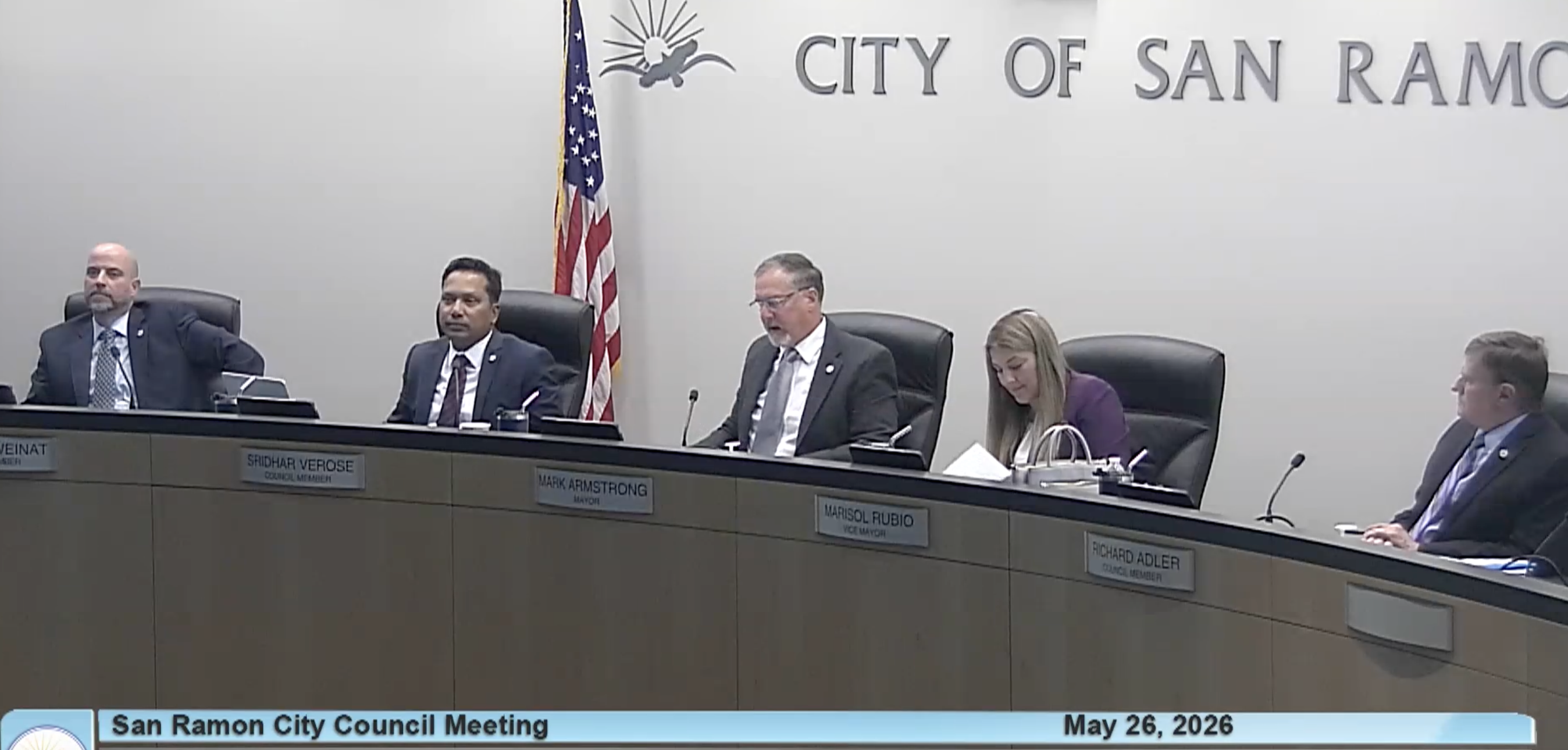
City Council - May 26, 2026 - Meeting

City Council - May 26, 2026 - Meeting

City CouncilSan RamonMay 26, 2026

Sources:

Locunity is a independent informational service and is not an official government page for this commission.We use AI-assisted analysis and human editorial review to publish information.

Council Adopts $158M Budget, Overhauls Flag Policy After Emotional Pride Debate

San Ramon's City Council unanimously adopted a $158 million budget that remains tethered to a sales tax measure to close a $14 million structural deficit, then spent more than an hour navigating an emotionally charged overhaul of the city's commemorative flag policy — landing on annual reviews that will require the Pride flag and other commemorative flags to earn renewed approval each January. The meeting also locked in a four-year labor deal and set new rules to end the council's pattern of midnight sessions.

  • $158M budget adopted, but a $14M structural deficit persists — Measure N sales tax revenue is the only thing keeping the city in the black

  • Flag policy overhauled amid emotional testimony — Pride flag now subject to annual January vote rather than permanent approval; LGBTQ+ advocates call the change "painful"

  • Four-year SEIU contract approved — 55 maintenance workers get 3% annual raises through 2030 at a total cost of $860K

  • Council shifts to 6:30 p.m. start time — a 10 p.m. extension threshold aims to end the era of midnight meetings

  • Resident's seven-year financial analysis sounds alarm — city's asset-to-liability ratio has dropped from 8.72 to 3.83 in a decade


Budget Balances — but Only Because of Measure N

San Ramon's City Council unanimously adopted the FY 2026-27 operating and capital budget via Resolution 2026-066, setting total revenues across all 70 operational funds at approximately $158 million. The general fund accounts for 55% of operations. Total expenditures stand at $115.7 million, producing a net increase of $7.5 million across all funds — roughly $1 million of that in the general fund. General fund reserves remain above the 36% target at approximately 40%.

Why it matters: The balanced budget masks a structural deficit that would leave the city nearly $14 million in the red without $14.9 million in Measure N sales tax revenue. That one-time money has a shelf life: the measure sunsets in nine years. Without a plan to grow revenue or cut costs, the city is on a countdown.

Where things stand: Finance Program Manager Yuliya Elbo presented the budget, noting it was built on projected actuals rather than prior-year budgets.

"Without the use of Measure N, the city is going to be in a deficit about almost $14 million," she said, adding that the one-time revenue allows "a balanced budget and have net increase to our fund balance."

She outlined a fiscal resiliency framework coming in the months ahead, focused on reducing Measure N dependence.

Councilmember Robert Jweinat praised staff for taking a pragmatic approach.

"It's really easy to just look at the bottom line and say, there's the mistake, there's the error, and let's just cut everything. But I'm glad that we're taking a pragmatic approach, an intelligent approach to this," he said.

Councilmember Sridhar Verose urged the council to prioritize revenue generation over cuts.

"We don't want to cut to the bones where we'll lose all the quality, high quality services that we are providing. So at this point I would rather focus on how we can build more revenues," he said.

Vice Mayor Marisol Rubio asked about future revenue growth from downtown development, noting that as the community grows there will be an increase in people which could spark additional business activity and tax revenue tied to the higher-density downtown core.

Mayor Mark Armstrong expressed satisfaction with the current position.

"We've got a balanced budget and while we still have a structural deficit, Measure N is covering it for now and our reserve is in good shape," he said. "We're well, well over our 36% policy."

The other side: Public commenter Johannes Tullahan delivered a pointed seven-year analysis of the city's audited financial statements, warning that the budget's surface-level balance obscures deteriorating fundamentals.

"Five of those seven moved in the wrong direction over the decade. The total asset to total liability ratio — this compares everything the city owns to everything it owes. In fiscal year 2016, the ratio was 8.72. By 2025 it was 3.83," he said.

He urged the council to incorporate balance sheet analysis into the July 14 resiliency framework discussion. The Gann Appropriation Limit was calculated at $114.4 million against $56 million in subject revenues, leaving the city well under the limit by $58.1 million. Written public comments were also received from Pranav and Dayan and Brian Swanson.

Decisions: Resolution 2026-066 passed 5-0 (For: Armstrong, Rubio, Adler, Verose, Jweinat; Against: none; Absent: none).

What's next: Staff will bring the fiscal resiliency framework to a future meeting, covering reserve policy, purchasing policy, and other mechanisms to chart a path toward financial independence from Measure N before it sunsets.


Pride Flag's Fate Now Rests on Annual Vote

The council's longest and most emotional debate centered on a comprehensive overhaul of the city's 2021 flag policy. Deputy City Manager Christina Franco presented proposed changes developed by a policy committee of Vice Mayor Marisol Rubio and Councilmember Richard Adler. The revisions included clarifying that commemorative flags include U.S., California, and San Ramon flags; strengthening half-staff protocols; requiring a simple majority for flag approvals; requiring flag requests to appear under new business rather than consent; and limiting the commemorative flagpole to no more than two flags at a time.

Why it matters: The central question — whether previously approved flags should fly in perpetuity or face annual renewal — directly determines the Pride flag's future on city property. Under the policy the council chose, every commemorative flag must earn a fresh majority vote each January.

Where things stand: Two major questions came before the full council. The first: whether approved flags should remain in perpetuity (Option 1) or be reviewed annually each January (Option 2). The council chose Option 2, with ad hoc additions possible throughout the year.

The second: how to handle overlapping flags on a single commemorative pole.

Mayor Armstrong argued against flying two flags simultaneously, warning it would create a hierarchy.

"You can't make somebody not going to feel that they're the winner. Somebody's going to feel like they're the loser. Their flag, that they're not appropriately represented because the higher position typically in flag policy and flag etiquette designates a position that's higher and more important," he said.

Councilmember Sridhar Verose proposed a midpoint rotation:

"How about 15 days we rotate? Why don't we just rotate? In 15 days, one will go top, one will go bottom, then in 15 days, just rotate it."

The council directed staff to develop rotational language where flags swap positions at the midpoint of any overlap period.

Rubio noted the discussion carries particular weight in the current political climate.

"This administration has removed all forms of recognition of diversity, equity and inclusion. We can't strictly rely on state and national commemorative flags right now as we speak," she said.

She proposed adding language about "historically and commonly celebrated commemorative flags," but the council ultimately did not adopt that broader language — agreeing instead to truncate the provision at "nationally state designated awareness and heritage months."

Councilmember Robert Jweinat pushed to add U.S. Constitution, California Constitution, and Government Code citations to the policy's prohibition sections.

"I want the citations in the policy beyond just why we can't fly it. I want people to know why we can't fly it," he said, referring to restrictions on religious, for-profit, political, and foreign nation flags.

City Attorney Martin provided guidance on government speech doctrine throughout the discussion.

Community Voices: "Painful" vs. "Good Governance"

Five public commenters weighed in, most advocating for explicit and permanent inclusion of the Pride flag. Anuradha (Anu) Gupta, president of PFLAG Danville-San Ramon Valley, speaking also on behalf of the San Ramon Valley Diversity Coalition, was direct:

"We do not support the draft policy until this change is added and we request this edit. We also request the Pride flag be raised in perpetuity for future years without requiring a new harrowing approval each year."

Yamini Dixit, Co-founded of Rewire Community, which has served domestic violence and sexual assault survivors for 13 years, acknowledged that reviewing policy is sound governance but questioned the timing and signal.

"Reviewing policy is certainly very good governance. But I hope it is applied systematically across all city policies and this one is not being singled out because of what it has stood for," she said.

Riza, a student from Bollinger Canyon Elementary, spoke in support of the Pride flag as a symbol of safety and inclusion. Dan Frank connected the flag issue to anti-LGBTQ+ violence, citing statistics on trans murders and broader marginalization.

On the other side, Gary Chapin, a 47-year San Ramon resident, argued that only the U.S., California, and city flags should fly, expressing concern about the lack of limitations on what can be displayed.

Decisions: No formal vote was taken; the council gave direction to staff via straw polls on five key changes. The updated policy will return on consent for final approval.

What's next: Staff will bring the revised flag policy back on a future consent calendar. Under the new framework, all commemorative flags — including the Pride flag — will require renewed council approval each January.


Four-Year SEIU Deal Locks In Raises Through 2030

The council unanimously adopted Resolution 2026-067, approving a four-year memorandum of understanding with SEIU Local 1021 covering 55 city maintenance employees — including maintenance technicians, specialists, coordinators, and electricians.

Why it matters: The deal provides four years of predictable labor costs during the city's budget stabilization period, with first-year costs already baked into the just-adopted FY 2026-27 budget.

Where things stand: Key terms include 3% salary range increases effective July 1 each year through June 2030, creation of a CDL (commercial driver's license) differential payment to retain specialized drivers, clarification of the safety shoe program, and refinement of the alternate work schedule program. SEIU membership ratified the tentative agreement on May 20. The total four-year cost is just over $860,000, with first-year costs of approximately $150,000.

Vice Mayor Marisol Rubio asked who negotiated the 3% rate. Staff praised SEIU as "an incredible partner at the table."

Decisions: Resolution 2026-067 passed 5-0 (For: Armstrong, Rubio, Adler, Verose, Jweinat; Against: none; Absent: none). No public comment was received.


No More Midnight Meetings: Council Shifts Schedule

Councilmember Robert Jweinat initiated a discussion — first raised at a prior meeting — about the toll of late-night sessions on staff, public participation, and decision quality. Deputy City Manager Christina Franco presented data showing that of 22 meetings in the prior year, 12 ended after 10 p.m., three after 11 p.m., and three after midnight. She outlined options for end-time thresholds and mechanisms for handling unfinished business, along with time-saving measures including standardizing staff presentations to 15 minutes, limiting council report-outs, and pre-meeting briefings.

Why it matters: Late-running meetings push important votes into hours when few residents are watching, and staff members face long commutes home after midnight.

Jweinat framed the issue broadly:

"How we run a public meeting is an expression of how we run a city. And if we're efficient — I'm not saying dismissive — efficient in running a meeting and efficient with our time, we can be better efficient with how we run the city."

Decisions: The council reached consensus on starting at 6:30 p.m. (accommodating Councilmember Verose's commute), beginning 30-minute extension votes at 10 p.m., keeping closed sessions flexible, and capping council member report-outs at four minutes. An ordinance amendment will be required for the start time change, expected to take effect around August. The council agreed to treat the changes as a pilot and revisit.


Minor Items

  • Consent calendar (items 5.1-5.12) approved unanimously 5-0 without discussion.

  • BAPS Charities youth volunteers promoted a June 6 walkathon at Don Biddle Park in Dublin benefiting Save the Bay; speakers included Soha Dalla from Gale Ranch Middle School and Jerna Adalia from California High School.

  • Sue Bach urged support for the Polluters Pay Climate Superfund Act, noting California has experienced 46 extreme weather events since 1980 and that insurance premiums in high-risk Danville zones jumped from $1,500 in 2015 to over $12,500 in 2025.

  • Olu Oduwole, a 40-year Gale Ranch resident, expressed frustration about a non-functioning fountain between Crow Canyon and Doherty Roads despite paying annual GHAD taxes; the city manager offered to follow up, noting the feature may not be part of the GHAD.

  • Councilmember Jweinat congratulated Captain Tammy Williams on her promotion and announced a new seventh-period bus route for Monte Vista High School subsidized 50% by Contra Costa County.

  • Mayor Armstrong initiated a future agenda item to fill the Planning Commission vacancy left by Max Zhang's departure to city staff.

Council Adopts $158M Budget, Overhauls Flag Policy After Emotional Pride Debate | City Council | Locunity