
San Ramon Readies Immigration-Access Rules as Council Seeks Public Workshop
City Council • San RamonNovember 24, 2026
Locunity is an independent informational service and is not an official government page for this commission. All information is sourced from public footage and an analysis of official agendas with the aid of responsible, fact-checked AI. to report an error or omission.
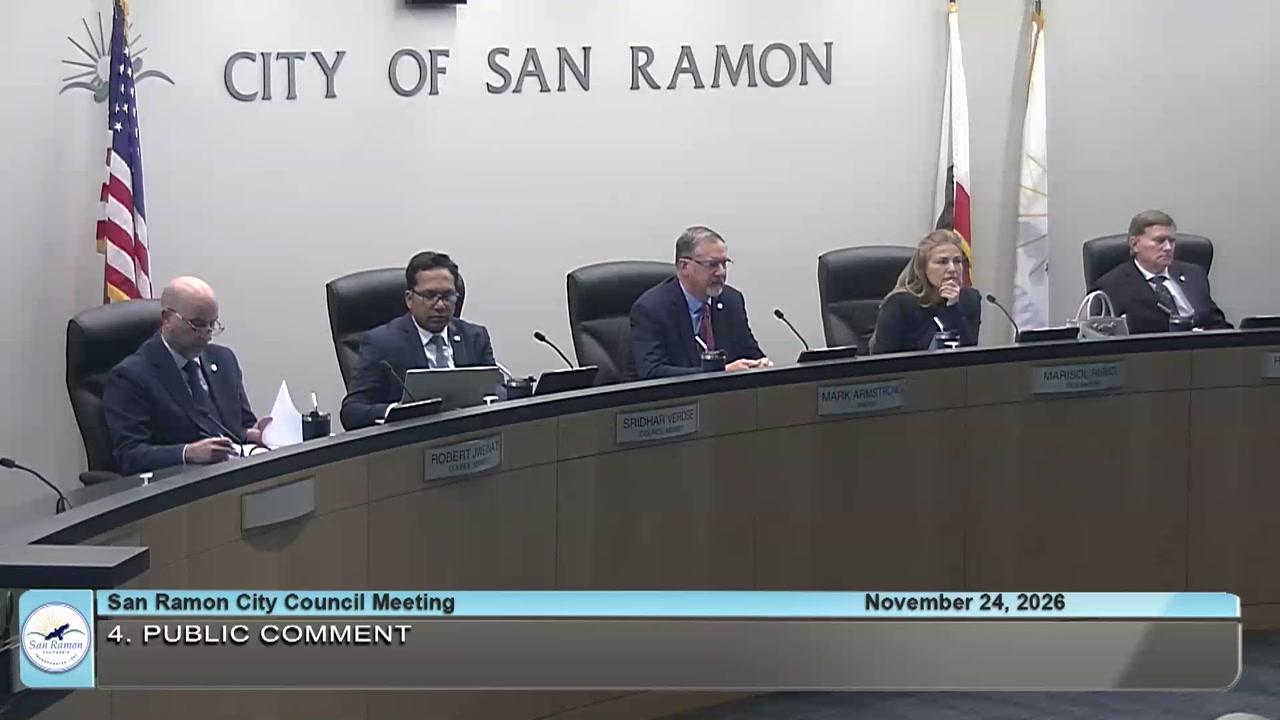
San Ramon's City Council spent more time on immigration than on any other item at its Nov. 24, 2026, meeting. Staff presented two state-mandated policies that govern how city employees respond to federal immigration authorities. No vote was required because the City Manager can adopt the policies administratively, but council members asked for edits and a public training workshop ahead of a Jan. 1, 2027, deadline.
The council also approved raises for the city's two top executives and for itself, and adopted long-range fiber and traffic-signal master plans.
- SB 580 immigration policies advance with council edits and a planned public training workshop
- City Attorney gets a 5% raise, City Manager 3%, plus a wider pay gap over other staff
- Council's code-set pay increase passes, then a 4-1 vote orders Tri-Valley comparison data
- Updated traffic signal plan maps about $8.46M in projects, and near-term camera replacement is unfunded
- $33.1M fiber optic master plan adopted as a framework, with about $30M still unfunded
Immigration Policies: Edits, Training and a Workshop
The basics: Under SB 580, California Government Code 12532.5 requires cities to adopt policies governing interactions with immigration authorities.
Why it matters: The policies set rules for how city staff handle ICE requests at city facilities and demands for city records. Public speakers said recent enforcement activity in the Tri-Valley made the rules urgent.
Where things stand: City Attorney Martin Lysons said San Ramon split the attorney general's model policy into two documents. One covers access to city facilities. The other covers demands for information. The core principles are:
- Limit assistance to immigration authorities
- Require judicial warrants where no legal duty exists
- Route requests to trained designees or the city clerk
- Document every interaction
"The state's deadline for the city to adopt the policy is January 1st, 2027," said Lysons. He acknowledged a timing gap on facility designations: "I think technically there's a gap in the compliance."
The City Manager outlined the rollout:
- Name designees within 10 days
- Issue desk guides by Jan. 31
- Complete staff training by March 31
- Update vendor contracts by June 30
- Conduct the first audit by Dec. 31, 2027
The City Manager said implementation costs will come from the existing budget.
Council edits: Councilmember Robert Jweinat proposed adding a sentence to the facilities policy: "Nothing in this policy restricts communications protected by 8 USC 1373 or 1644." He also asked to restore language on data use agreements and to use "member of the public" wording. Lysons agreed to the changes.
Vice Mayor Marisol Rubio asked about:
- Whether the policies are enforceable
- Whether they should be a policy or an ordinance
- Using "should" versus "shall"
- Training for council members, with a Jan. 30 target
On enforceability, Lysons described the limits of a personnel policy: "We can really only control our own personnel."
The other side: Public speakers mostly pushed the city to do more.
"The tremendous urgency of implementing something is really evidenced by the rapid escalation that we've seen of aggressive ICE activity in the Tri-Valley area over the past two weeks," said public commenter Douglas Medlin. He urged strong staff training and suggested a broader non-cooperation policy later.
"We need to do some kind of workshop to educate people how they can legally seek help from the city staff," said public commenter Chirag Kothrani.
Public commenter Greg Carr offered mixed views. He backed the proposed edits and council training, and suggested the city verify its employees' work authorization.
Decisions and stakeholder impacts: The council took no motion but supported a public workshop. "We could have the training in the form of a workshop if the council wants to do that," said Lysons. The policies will be carried out by front-line staff, designees and the city clerk. Immigrant residents and vendors will feel their effects.
What's next: Staff will incorporate the edits and schedule the workshop. The policies must be adopted before Jan. 1, 2027.
Raises for Top Executives, and for Council Itself
Why it matters: The council approved higher pay for its two top appointees over public objections about the city's deficit. It then started a review of how its own pay is set.
Where things stand: Items 5.5, 5.6 and 5.7 were pulled from the consent calendar. The council salary schedule in 5.5 lists the compensation set in the attorney and manager contracts. The City Attorney and City Manager recused themselves and left the room.
Deputy City Manager Scott Cole presented corrected figures. "We apologize for the error that we have made," he said, adding that staff had identified a gap in its process.
The City Attorney contract includes:
- A 5% raise to $27,978.02 per month, or $335,739.77 a year, effective Sept. 25, 2026
- Three additional management leave days, for three weeks total
- A city deferred-compensation match of up to $16,250 for 2026
The City Manager contract (Resolution 2026-131) includes:
- A 3% raise to $31,434.96 per month, or $377,219.60 a year
- A larger differential over the next-highest classification, rising from 9.5% to 12.5%
- Annual vacation cash-out doubled from 80 to 160 hours
The other side: Public commenter Sharad Kathrani cited the deficit and called the "5% raise exorbitant." A repeat public commenter also opposed the raises and made unsupported personal accusations.
Councilmember Sridhar Verose said the council reviewed market comparisons in closed session. "The key reason why we move forward with this is to make sure we retain top talent," he said.
Council pay: Under Municipal Code A4-3J, council pay rises every two years, and the mayor receives $100 more than council members. Effective Dec. 1, 2026, council members will earn $1,140.24 per month and the mayor $1,240.24. The increase costs $1,950 in fiscal 2026-27.
Rubio cited higher monthly pay in Danville ($1,525) and Dublin ($1,730.56). "The CPI in California just in August 2026 was 3.7%. This is not even close," she said, comparing the 5% two-year increase to inflation.
Verose said low pay "creates a barrier that keeps working-class residents, hourly wage earners, and parents" from serving. Carr backed pulling the item for more data: "The ultimate determiner of your pay raise is and should always be the people."
The City Manager said the council had to approve or reject the item that night. Any change would require a municipal code amendment with two public hearings. Councilmember Richard Adler preferred to vote: "I just don't think it's a lot of money."
Decisions and stakeholder impacts:
- City Attorney contract (5.6): moved by Verose, seconded by Adler. For: 5, Against: 0, Absent: 0.
- City Manager contract (5.7): moved by Verose, seconded by Adler. Passed unanimously.
- Council pay (Resolution 2026-129): moved by Rubio. Passed unanimously.
- Motion to bring the pay item back with comparison data: moved by Rubio, seconded by Verose. For: 4, Against: 1, Absent: 0. The dissenting member was not identified.
What's next: Staff will return with an informational item comparing pay in Tri-Valley and Bay Area cities. The council will then give direction on a possible ordinance.
Traffic Signal Plan Updated, Funding Still Open
Why it matters: Verose said "one of the biggest things that within our community came up during the election is traffic congestion." The updated ITS (Intelligent Transportation System) Master Plan guides future signal upgrades and grant requests.
Where things stand: Senior Civil Engineer Deborah Fehr described the current system:
- 109 signals, 103 owned by the city and six by Caltrans
- Two adaptive corridors installed in 2010
- 53 intersections on automated signal performance measures
- Seven CCTV cameras
The plan lists 12 projects totaling about $8.46M, four of them near-term. One is a $360,000 camera replacement at 18 adaptive-corridor intersections, which has no identified funding. Recurring costs exceed $313,000 a year. Adaptive signal control costs about $15,000 per intersection, plus $1,300 a year.
The other side: Jweinat asked, "Who is the custodian of the data?" Fehr said signal timing data is held by the city and is public. "The video feeds are just live feeds. We don't record any of the video," she said.
Council members also raised cybersecurity, pedestrian safety, side-street signal behavior and sharing measurable congestion results. A repeat public commenter made unsupported conflict-of-interest allegations.
Decisions and stakeholder impacts: Resolution 2026-133 passed unanimously. It was moved by Verose and seconded by Rubio. Drivers and pedestrians are the main beneficiaries, but near-term projects still depend on future budgets and grants.
$33.1M Fiber Plan Adopted as a Framework
The basics: Dark fiber is installed fiber optic cable that is not yet in use. Shadow conduit agreements let the city place its own conduit alongside telecom company projects.
Why it matters: The 2018 ITS plan focused on traffic signals. A standalone fiber plan connects city facilities, reduces leased-line costs, adds redundancy through network loops and opens grant options beyond transportation.
Where things stand: "The total estimated investment is $33.1 million for everything that I showed you on that map," said Fehr. Key details:
- A 288-strand backbone across 38 segments
- About $380,000 for a connection to the joint public safety complex, the top priority after three corridors already in design
- Planning-level 2026 prices that exclude building equipment
- About $2M in federal funds already spent
About $30M remains unidentified. Fehr stressed that adoption "does not approve or authorize construction of any individual projects in this plan."
The other side: Jweinat asked whether the county or 911 partners would help cover maintenance costs. Staff did not yet have an answer. "Once they're in the ground, there's very little to no maintenance," said the City Manager.
Verose criticized the slow pace of relying on federal funding. Council members also asked about public Wi-Fi, seismic resilience and using developer agreements instead of impact fees. Carr supported the plan but asked for a seismic assessment and a detailed cost breakdown. He also opposed the city acting as a public utility or hosting 5G.
Decisions and stakeholder impacts: Resolution 2026-132 passed unanimously. It was moved by Rubio and seconded by Verose. Written comments from Robert Vanderlip and Brian Swanson were noted.
Minor Items
- Consent calendar items 5.1–5.4 passed 5-0 on a motion by Verose, seconded by Rubio.
- Youth soccer coach James Downs asked the city to explore a drop-in indoor soccer pilot at an existing facility or an underused warehouse.
- A public commenter criticized scheduling the meeting during Thanksgiving week.
Looking Ahead
The council's next regular meeting is Dec. 8.