City Council - Apr 14, 2026 - Meeting
City Council • San RamonApril 14, 2026
Locunity is a independent informational service and is not an official government page for this commission.We use AI-assisted analysis and human editorial review to publish information.
San Ramon Strips Contested Fees, Approves Pride Flag 3-1 as Revenue Growth Stalls
San Ramon's City Council tackled a sprawling April 14 agenda that exposed fault lines on government expression, fee transparency and the city's fiscal outlook. A Pride flag resolution drew the council's first-ever dissenting vote, a 1,013-item fee schedule was adopted only after two new charges were stripped out under public pressure, and a budget workshop revealed general fund revenue growth has slowed to a fraction of its historical pace—setting up a high-stakes expense debate later this month.
Master fee schedule adopted 4-0 after council removes firearm storage and collection agency fees for insufficient public documentation; remaining 1,011 fees take effect July 1
Pride flag resolution passes 3-1, the first no vote on the annual display, as council sends the five-year-old flag policy to committee for review
General fund revenue growth stalls at 0.45%—a $1.3M Measure N shortfall from weak auto sales and a 30% franchise fee decline leave the city far below its 4% historical average
City reports just 2.5% voluntary turnover and 28 internal promotions in 2025, running roughly 100 fewer employees than comparable Walnut Creek
San Ramon Valley Islamic Center launches biweekly food distribution for 150 families through a new Contra Costa Food Bank partnership
Fee Schedule Adopted, but Not Before Council Pulls Two Charges
The second reading of the FY 2026-27 master fee schedule (Resolution 2026-047) became the night's longest public hearing, drawing seven speakers and pointed questions from every seated council member over a document covering 1,013 individual fees.
The basics: Budget Manager Julia Elbow reported that 521 fees were adjusted—424 by a 2.82% consumer price index increase, 30 by a 0.6% construction cost index—with 12 new fees proposed. Two of those new fees, a collection agency administration charge and a $30-per-month firearm storage fee, were added after the March 10 first reading, fueling the night's sharpest criticisms.
Why it matters: The fee schedule funds everything from park rentals to building permits. Residents and business owners warned that opaque additions, aggressive rounding practices and a $2,500 appeal deposit—far above the roughly $280 average in comparable I-680 corridor cities—are eroding public trust and deterring civic participation.
Where things stand: Public commenter Paschalis Ntatsos walked the council through his own math, demonstrating that rounding fees up to the nearest dollar on top of the CPI adjustment produces effective increases of 8% to as much as 15% on some pool rentals. He also flagged a discrepancy between the $341 business license renewal fee listed in the schedule and the $353 shown on the city's website.
Susie Ferris argued the firearm storage fee lacked the cost justification and statutory notice required under Government Code 66016 and urged the council to defer both new fees for proper review. Chirag Kathrani acknowledged the council had already cut the appeal deposit from $4,500 to $2,500 but said the "deposit" language effectively makes costs unlimited. He urged a fixed $300 fee, comparable to neighboring cities. Anthony Deangelis warned fee increases would hurt small businesses and nonprofits serving youth sports.
The other side: The city attorney confirmed the 10-day public notice requirement under Government Code 66016 had been met. Mayor Mark Armstrong characterized the two contested fees as having negligible budget impact:
"This to me is sort of an academic drill with no real impact on the budget," he said, proposing the fees simply be deferred to next year's schedule.
Decisions: Councilmember Robert Jweinat moved to strip both new fees:
"I think it makes sense. We pull the firearm and we pull the collection agency fee and have a discussion later on."
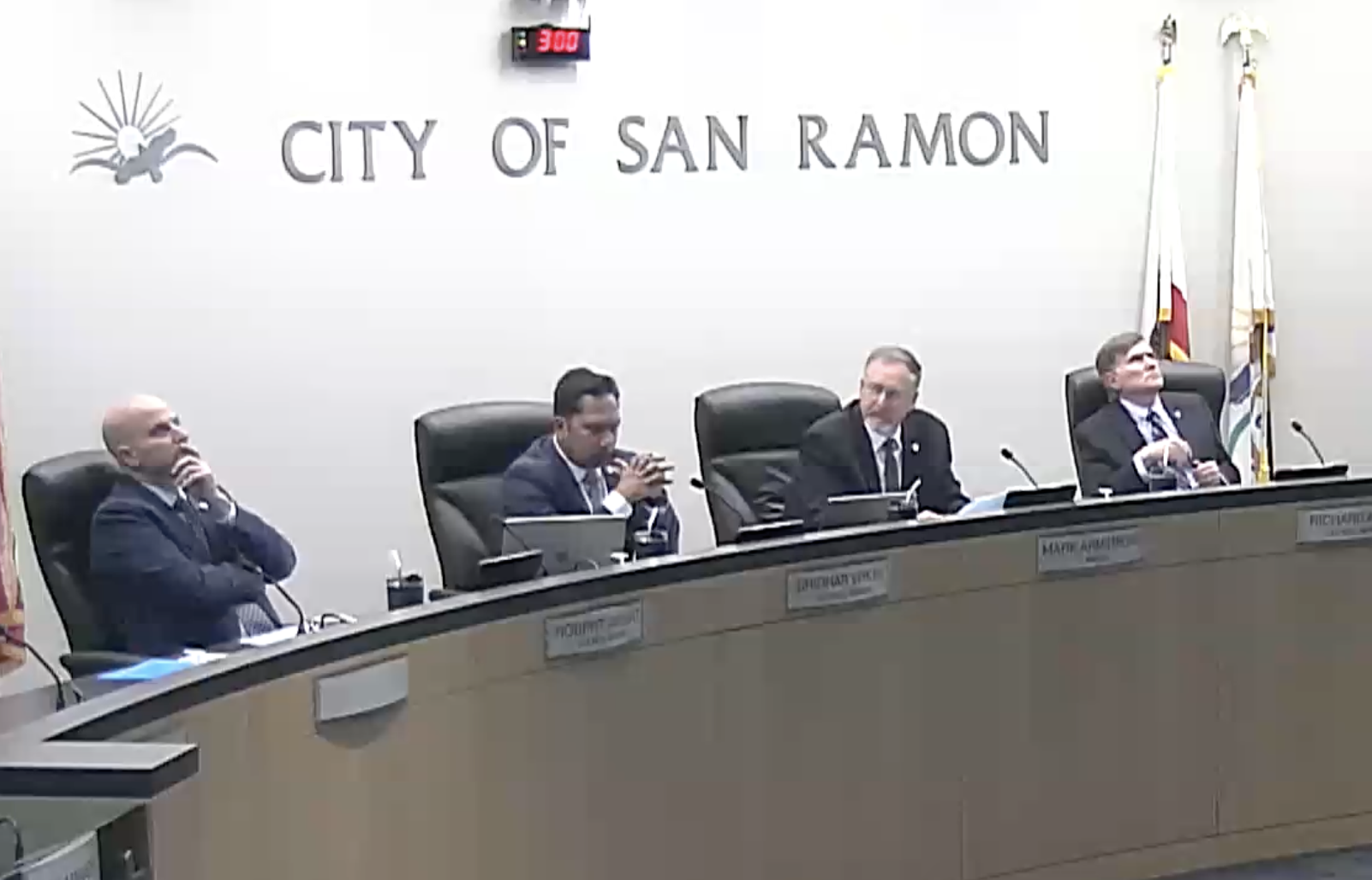
The council voted 4-0 (For: Armstrong, Adler, Jweinat, Verose; Absent: Rubio), with staff directed to clarify nonprofit language for parks fees and the city attorney setting an effective date of July 1, 2026.
What's next: The $2,500 appeal deposit remains unchanged despite sustained public opposition. Residents who want to challenge planning decisions will continue to face one of the highest appeal costs in the Tri-Valley. The removed fees may return in a future fee schedule cycle with additional documentation.
Pride Flag Approved 3-1 in Council's First Dissenting Vote on Annual Display
A resolution that has passed without opposition in prior years became the meeting's most politically charged moment after Councilmember Robert Jweinat asked to pull it from the consent calendar.
The basics: Resolution 2026-041 authorizes the display of the Progress Pride flag on the city's commemorative flagpole—a pole distinct from the official flagpoles at City Hall—during June 2026.
Why it matters: The lone dissenting vote and the council's decision to send the underlying flag display policy to committee for its first review since 2021 signal growing tension over how San Ramon uses government expression to recognize community groups.
Where things stand: Three public speakers during general comment previewed the debate. Greg Carr argued that all flag requests should come before the full council as new business rather than appearing on the consent calendar. Susie Ferris cited a federal "One Flag All Act" she said prohibits certain flag displays on public buildings—though the city attorney later clarified that no federal statute restricts local jurisdictions in this way.
Councilmember Sridhar Verose, who sponsors the resolution annually as a member of the San Ramon Valley Diversity Coalition steering committee, framed the display as a civil rights obligation:
"If we deny their privilege to be part of this community, then it's pretty much we are denying their basic civil rights, which is not acceptable."
The other side: Jweinat stated his position plainly:
"I have a long standing belief that city facilities, public facilities, should only really fly three flags. The state flag, the city flag and our country's flag."
He advocated sending the broader flag display policy to the policy committee rather than voting down the resolution outright.
Councilmember Richard Adler cited the gay community's history of persecution as justification for the display:
"What we are trying to do here is just say, you're welcome in our community. We're not going out and giving speeches, but we are just saying we care about you as members in our community."
Mayor Mark Armstrong drew a legal distinction:
"Our flag poles, they're not public forums. They're a form of government expression. So when we raise a flag, it represents the city of San Ramon and the values that we choose to communicate."
He agreed the five-year-old policy is due for review.
Decisions: The resolution passed 3-1 (For: Armstrong, Adler, Verose; Against: Jweinat; Absent: Rubio). City Manager Steven Spedowfski confirmed he had direction from at least three council members to bring the flag display policy to the policy committee.
What's next: The policy committee review could reshape how all commemorative flag requests—not just the Pride flag—are handled in future years. The Progress Pride flag will fly on the commemorative flagpole in June 2026.
Revenue Growth Limps to 0.45%, Setting Up Tough Budget Choices
The first of two FY 2026-27 budget workshops delivered a sobering revenue picture that will dominate the expense discussion scheduled for April 28.
Why it matters: General fund revenue is projected to grow just 0.45%, or $370,000—a fraction of the city's historical 4% average. Two major revenue lines are in decline simultaneously, and the structural cost of subsidizing Dougherty Valley services continues to consume roughly $4 million annually.
Where things stand: Budget Manager Julia Elbow reported that property tax, the city's largest source, is trending 3% above budget and projected to grow another 3%, adding roughly $1.6 million. Bradley Burns sales tax shows a 6.4% increase.
But those gains are largely wiped out. Measure N, the city's transaction and use tax, is expected to decline 9.6%—a $1.3 million hit attributed to lower auto sales after the expiration of EV rebates and the effects of tariffs. Franchise fees are expected to drop roughly 30% due to renegotiated agreements.
City Manager Steven Spedowfski explained the Dougherty Valley drag:
"As a result of the lawsuit, 60% of the property tax goes to the county. That would normally come to the city." The legacy settlement from a county lawsuit forces an annual general fund transfer of approximately $4 million to maintain services in the area.
Councilmember Sridhar Verose flagged the concentration risk:
"One thing I'm really worried or concerned is about our heavy dependencies on the property tax."
Councilmember Richard Adler raised concerns about the fog of tariff and geopolitical uncertainty:
"There's just so many unknowns with the tariff situation and the goal and the war going on and how goods are going to be impeded from getting to the customers."
Spedowfski noted San Ramon is one of few Tri-Valley cities without a business tax.
"More cities with what's going on with online sales, the economy, property taxes, more and more cities are turning to revenue measures like we did with Measure N," Spedowfski said.
He added that diversifying revenue would likely require a tax measure, as retail-based strategies have limited impact given the city's small sales tax base. The council directed staff to explore small business surveys through a forthcoming economist hire.
What's next: The expense workshop is scheduled for April 28. The revenue squeeze will force decisions about service levels, capital projects and whether to begin public discussions about new revenue measures.
City's Lean Workforce Posts 2.5% Turnover, 28 Internal Promotions
HR Director Megan O'Donoghue presented the city's second annual public hearing on staffing vacancies required by AB 2561, painting a picture of a lean operation that is retaining talent at a notably high rate.
Why it matters: San Ramon runs approximately 100 fewer full-time employees than comparable Walnut Creek, making retention and internal advancement critical to maintaining service levels.
Where things stand: The average vacancy rate in calendar year 2025 was 9.2%, with 46 vacancies filled. Of 59 new vacancies, 28—47%—were created by internal promotions. Only seven employees left voluntarily, producing a 2.5% turnover rate, alongside 13 retirements and two involuntary separations. Budgeted FTEs dropped from 287.75 to 279.75 between June and July 2025 through intentional position-control cleanup. The current vacancy rate as of March 2026 is 8.9%.
O'Donoghue underscored the retention numbers:
"Voluntary separation—seven people in a calendar year that are not retiring and ending their careers is kind of amazing to me. I think that's really a win for us." Application volumes roughly doubled, from 1,500 to about 3,000 in calendar year 2025.
City Manager Steven Spedowfski noted the city has never used a professional recruiting firm for executive positions, saving approximately $40,000 per recruitment:
"Our neighboring cities are typically 100 or more employees than what we have. And our most closely comparator city that we have within the vicinity is Walnut Creek."
Councilmember Sridhar Verose praised the 47% internal promotion rate:
"I see 47% around 28 people, internal promotion that says the culture that we have reputation as one of the best service providing cities."
SEIU and POA labor groups were notified of the hearing and did not request to speak. No council action was required.
Minor Items
Consent calendar (items 5.1–5.3, 5.5–5.9) approved 4-0 with Vice Mayor Rubio absent; item 5.4 (Pride flag) pulled for separate discussion.
National Library Week (April 19–25) proclaimed; Senior Library Manager Dr. Francis Adebola Wilson reported 600 daily visitors at the San Ramon Library and highlighted new zoom booths for virtual meetings. Dougherty Station Library Manager Elaine Pedley Daugherty noted staff visit 12 elementary and two middle schools under SB 321 to ensure every student has a library card by third grade.
Arts, Culture and Creativity Month proclaimed for April; James Daly of the San Ramon Academy of Music described growing from a single piano class to a year-round program with 100-plus students per semester, including a chamber ensemble, string orchestra, choir and music production program at Dougherty Station Community Arts Center.
American Muslim Appreciation and Awareness Month proclaimed; Ibrahim of the San Ramon Valley Islamic Center Youth Committee announced SRVIC has donated 1,000 repaired bikes, distributed 240 coats with the Interfaith Council of Contra Costa County, and is launching a new biweekly food distribution partnership with the Contra Costa and Solano Food Bank targeting 150 families, with a soft launch planned for the following weekend.