
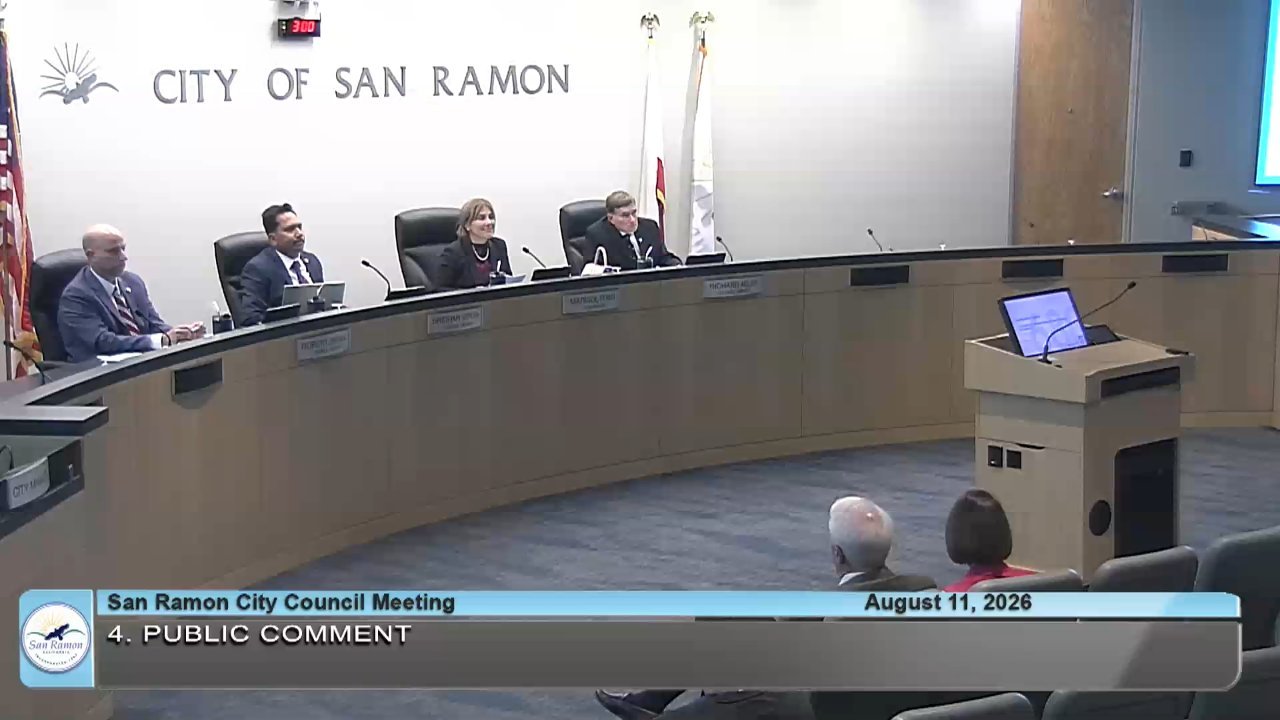
City Council - Aug 11, 2026 - Meeting
City Council • San RamonAugust 11, 2026
Locunity is a independent informational service and is not an official government page for this commission.We use AI-assisted analysis and human editorial review to publish information.
San Ramon Joins Regional I-680 Smart Ramp Metering Partnership at No Cost to City
San Ramon's City Council unanimously approved joining a first-of-its-kind regional agreement to coordinate freeway ramp metering across the I-680 corridor, giving the city a governance seat in a system that treats 19 northbound ramps as a single, real-time traffic brain — with no financial obligation. The Aug. 11 meeting also surfaced growing resident frustration over illegal Airbnb conversions, climate inaction and the city's still-missing revenue growth strategy.
Council approves MOU for coordinated ramp metering on I-680, joining Caltrans, CCTA and neighboring cities in a 3-year demonstration targeting 10% travel-time savings on the Bay Area's 7th most congested corridor
Residents report single-family home illegally converted into four Airbnb units on Pineapple Court, with police calls for domestic violence and questions about planning department oversight
Climate activists press council to begin implementing its year-old Climate Action Plan and support the Make Polluters Pay resolution
Public commenter demands revenue growth strategy, noting that replacing expiring Measure N sales tax through retail alone would require eight new Costco-equivalent stores
Council levies property tax lien on home that refused mandatory garbage service for two years after six of seven notified properties voluntarily paid
New Sustainability Advisory Committee tasked with studying gas-powered leaf blower ban enforcement before council considers an ordinance
A Smarter Freeway: San Ramon Signs On to Coordinated I-680 Ramp Metering
The basics: Resolution 2026-109 authorizes the mayor to sign a memorandum of understanding between San Ramon, Caltrans, CCTA and other local jurisdictions for two complementary ramp metering systems on I-680. Caltrans will install Adaptive Ramp Metering (ARM) on southbound ramps and select northbound ramps, while CCTA will deploy Coordinated Adaptive Ramp Metering (CARM) on 19 northbound ramps from Alcosta to Willow Pass/Burnett as a three-year demonstration.
Why it matters: I-680 ranks as the seventh most congested corridor in the Bay Area. Unlike ARM, where each ramp operates independently, CARM links all 19 ramps as a single coordinated system that recalculates metering rates every 20 seconds based on real-time freeway conditions. Early results from similar deployments elsewhere have shown roughly 10% travel-time savings. San Ramon bears no financial cost — CCTA funds the demonstration entirely.
Where things stand: Three agency presenters — Stephanie Hu, CCTA Director of Projects and Innovate 680 Program Manager; Sam Woldensmot, Caltrans District 4 Innovate 680 Corridor Manager; and Darren Henderson, GHD Senior Technical Director and CARM Technical Lead — walked the council through the system's architecture. Henderson described the core innovation: "All of the ramps in the CARM system are working together as a single unit. So that way it's allowing if one ramp is backing up or is being stressed because there's a lot more traffic at that location" — the system shifts green time to less congested ramps in real time.
Physical improvements at Crow Canyon and Bollinger Canyon ramps will merge two existing entry points into one and add storage lanes. Henderson explained that the system includes queue override protections: "If it sees that a ramp queue is getting excessively long, like more than 80% of the ramp is occupied, it will accelerate the metering rates in order to help control that ramp and prevent it from backing up onto the arterial street."
Councilmember Sridhar Verose pressed staff on specific queue thresholds and fallback plans. Henderson said the rollout would be phased: "We don't turn the system fully on 100% on day one. We kind of slowly roll it out so we have less aggressive ramp metering rates" — starting with 12 weeks of baseline data collection followed by a soft launch.
Councilmember Robert Jweinat clarified for constituents that the project is not a toll lane or fast-track system: "I've received some emails from constituents and what this is not, this is not the high occupancy vehicle fast track metering."
Hu emphasized the governance significance of the MOU: "This is the first time we're doing an MOU for ramp metering for Contra Costa County. We had experience ramp metering being implemented without being able to voice concerns, especially for the local jurisdictions like yourself." She also confirmed the agreement carries no hidden costs: "It's clear in the MOU that there is no funding request monetarily, monetary expectations or requests from the cities for either ramp metering systems."
Councilmember Richard Adler was upbeat about the timing: "This is really exciting. I'm optimistic. We have a lot of building in our city."
The other side: One remote public commenter, Susie Ferris, asked the council to delay approval to review safeguards and allow more public participation, citing written concerns submitted by resident Brian Swanson. The council acknowledged the comments but proceeded.
Decisions: The council adopted Resolution 2026-109 on a 4-0 vote (For: Rubio, Adler, Jweinat, Verose; Absent: Mayor Mark Armstrong). The MOU establishes a Technical Committee and Working Group, giving San Ramon a formal seat. If the CARM demonstration fails after three years, those ramps revert to standard ARM operation.
What's next: Construction is underway with completion targeted for late 2028 or early 2029.
Pineapple Court Residents Sound Alarm on Illegal Airbnb Hotel Conversions
Why it matters: A resident described what he called a systematic breakdown in city planning enforcement — a property owner who purchased a single-family home and converted it into four compartmentalized apartments, all rented concurrently on Airbnb, with the same owner operating a similar setup on a nearby court.
Where things stand: Sharib Shahid, speaking on behalf of Pineapple Court residents, told the council that the property now has five front doors, makeshift kitchens, and has generated multiple police calls, including for domestic violence. "Someone has deliberately flouted the planning and zoning laws of the city to create a mini hotel, Airbnb hotel on our small court," he said, questioning how the city's planning department signed off on construction that produced the current configuration and how short-term rental licenses were issued despite resident complaints.
Former Mayor Greg Carr urged the council to direct residents with specific enforcement complaints to appropriate staff contacts. The City Manager confirmed both locations are active code enforcement cases.
What's next: The matter remains under active code enforcement investigation, but residents' frustration with the pace of action was clear.
Resident Challenges City to Present Revenue Growth Plan
Why it matters: With San Ramon's Measure N sales tax revenue facing expiration and 18 months of deficit discussions behind it, a resident argued the city still lacks a concrete strategy for growing revenue — and is hiring the wrong kind of help.
Where things stand: Public commenter Johannes Tillehan praised the quality of a July 14 long-term financial plan presentation by consultant Ross Branson but argued it was diagnostic rather than prescriptive. "When a city is running a structural deficit, the priority should be bringing in a consultant who helps you grow revenue. Instead, to me, I felt we brought in a modeling consultant," he said. Tillehan cited Branson's own finding that replacing Measure N revenue through retail sales tax alone would require the equivalent of eight busy Costco stores.
The other side: During council comments, Councilmember Jweinat pushed back, noting the Finance Advisory Committee is preparing a budget-to-actuals analysis to define the problem before jumping to solutions. "You can't really solve a problem that you don't really know what the question or the problem is," he said.
Climate Activists Urge Council to Act on Year-Old Plan
Two public commenters pressed the council on climate accountability. Dawn Normandy of the Indivisible Tri Valley Climate Group advocated for the Make Polluters Pay Superfund resolution, which would require fossil fuel companies to fund climate damage. Katherine Grant delivered an impassioned plea, noting the city has fewer than 19 years to meet its 2045 Climate Action Plan goals but has not begun implementation after a full year. She urged the council to start executing the plan and support making polluters pay. No council action was taken during the meeting.
Council Levies Tax Lien After Two-Year Garbage Standoff
Why it matters: Resolution 2026-108 demonstrates the city's willingness to use property tax liens as a last-resort enforcement tool — and the threat alone proved effective for six of seven notified property owners.
Where things stand: Code enforcement staff member Josh explained that one residential property has failed to maintain mandatory garbage service with hauler ACI for approximately two years, despite courtesy notices, posted orders, and notices of cost with appeal opportunities. Of seven properties initially notified of potential special assessment in May, six paid voluntarily. The remaining owner has been responsive to staff but repeatedly fails to follow through.
Councilmember Adler asked about the nature of the violation and drew a comparison: "It kind of reminds me of being on the HOA board and you have little things like that in your neighborhood where maybe they didn't take care of the lawn." Staff clarified this was specifically about failing to maintain required garbage pickup, not a cosmetic issue. Vice Mayor Marisol Rubio confirmed the county assessor charges a flat $250 fee plus $0.76 per line item to process the lien.
Decisions: The public hearing drew no public comment. The council adopted Resolution 2026-108 on a 4-0 vote (For: Rubio, Adler, Jweinat, Verose; Absent: Mayor Armstrong), directing the city clerk to forward the certified assessment to the Contra Costa County Auditor-Controller.
Leaf Blower Ban Heads to Sustainability Committee
Councilmember Jweinat asked the newly formed Sustainability Advisory Committee to research how other California cities enforce gas-powered leaf blower bans, including enforcement costs, timelines, outcomes and whether code enforcement or police handle complaints. "I don't think I want to know the obvious, that it's loud and polluting. I want to know from understanding, from what other cities do, how do they enforce," he said. Vice Mayor Rubio supported the referral. The City Manager confirmed San Ramon currently has no leaf blower policy beyond existing noise ordinances and committed to providing a summary to the committee before bringing recommendations back to council.
Minor Items
Consent calendar approved 4-0 with Mayor Armstrong absent for the entire meeting.
Elaine Cortez Shroth of 333 Arts I promoted the Great Elephant Migration coming to the Tri Valley (Oct. 10–Dec. 6), featuring 30 life-size elephant sculptures handcrafted by indigenous artisans in South India, citing a 52% foot traffic increase and 20% retail sales increase at prior installations.
Councilmember Verose reported the MCE Board formed an ad hoc committee to search for a new CEO after a contentious late-night meeting.
National Night Out participation nearly doubled, from 14 to 30 hosts year over year.
Councilmember Adler reported on the Tri Valley Mayors Summit (300+ attendees) and the first meeting of the Sustainability Advisory Committee.
The City Manager announced the Police Community Academy starting Aug. 19, the Third Thursdays arts event on Aug. 20, and a Sports Field User Survey open through Oct. 4.