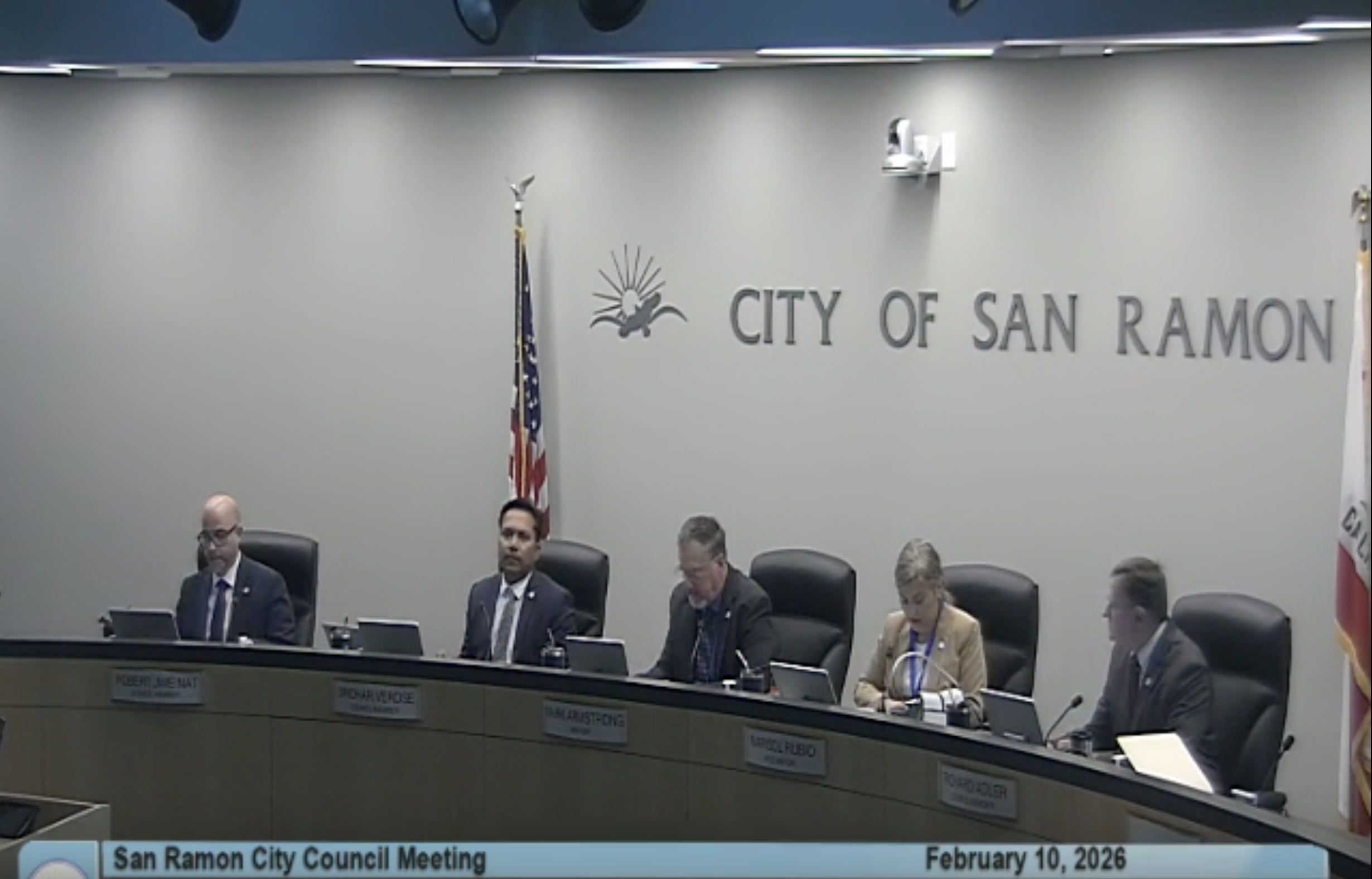
City Council - Feb 10, 2026 - Meeting
City Council • San RamonFebruary 11, 2026
Locunity is a independent informational service and is not an official government page for this commission.We use AI-assisted analysis and human editorial review to publish information.
San Ramon Builds Its First Communications Playbook as Council Queues Up Housing, Zoning and Emergency Talks
San Ramon's City Council spent the bulk of its Feb. 10 meeting wrestling with a deceptively simple question: How should a city of roughly 84,000 people talk to its residents — and listen back? The answer, it turns out, touches everything from AI chatbots and fake ICE photos circulating among students to whether the council itself is accessible enough. Meanwhile, four new policy discussions were teed up for coming months, signaling a busy stretch ahead on housing, zoning, emergency preparedness and transportation.
City's first-ever strategic communications plan takes shape with council pushing for a mobile app, AI tools, misinformation strategy and town halls
Affordable housing policy direction requested by Planning Commissioner and council; staff presentation on rental vs. for-sale units and RHNA progress coming
Zoning and development standards review initiated unanimously to clarify objective vs. subjective rules under evolving state housing law
Emergency preparedness town hall in the works as earthquake swarms and fire season prompt coordination with new fire chief and USGS
Housing and transportation town hall proposed by vice mayor to help residents understand San Ramon's development vision
$166M Innovate 680 mega grant and Valley Link rail among priorities on mayor's DC advocacy trip
San Ramon's Communications Overhaul: Mobile App, AI and the Fight Against Misinformation
The basics: San Ramon has never had a citywide communications program. Each department has historically managed its own outreach — a "decentralized model" that the city is now trying to unify under its first strategic communications plan. Communications Program Manager Simone Finney, the city's first-ever dedicated communications hire six years ago, presented a roadmap with four core objectives:
building a consistent citywide brand
redesigning the city website (targeted for fiscal year 2027)
increasing awareness of how to participate in public meetings
evaluating technology including AI
Why it matters: The discussion revealed a council deeply aware that residents increasingly get — and misunderstand — city information through social media platforms the city cannot control. The plan will shape how San Ramon communicates on housing development, emergency alerts, parks programming and basic city services for years to come, with budget implications likely landing in the FY2027 cycle.
A Mobile App Takes Center Stage
Two council members made detailed pitches for a dedicated city mobile app. Councilmember Robert Jweinat argued a single app could consolidate alerts from parks, recreation, and emergencies into one channel, replacing the current patchwork of platforms.
Vice Mayor Marisol Rubio went further, proposing a model based on Concord's citizen-reporting app — featuring photo uploads, geolocation, and department-specific drop-down menus to auto-route issues to the right staff.
Councilmember Jweinat also suggested timestamping YouTube meeting videos to agenda items so viewers can jump directly to items of interest — a low-cost improvement that could boost accessibility.
The Misinformation Problem
Councilmember Sridhar Verose raised what may be the thorniest piece of the puzzle: misinformation spreading on Nextdoor and Facebook.
Councilmember Verose flagged a recent incident in which a fake AI-generated image of ICE agents circulated among school students and parents.
Finney explained that Nextdoor's platform architecture sharply limits the city's ability to respond.
City Manager Steven added a layer of strategic caution, noting that Nextdoor's terms of service prohibit local government from participating in neighborhood chats — and that publicly rebutting false claims can backfire, accidentally amplifying misinformation through engagement.
Vice Mayor Rubio offered a middle path, suggesting staff monitor pages and offer objective information.
Councilmember Verose offered to connect city staff with the AI Foundry, a local tech community group where he is a founding member, and specifically mentioned Planning Commissioner Santhosh Kanjula as a resource.
Balancing Consistency With Speed
Mayor Mark Armstrong zeroed in on the operational tension at the heart of any centralized plan, asking if a new process will slow down getting information to the public. He also pitched an AI chatbot for the city website to help residents navigate information.
City Manager Steven Spedowfski flagged the resource question, noting the plan will likely require additional staffing and budget.
The Public Weighs In
Six residents spoke on the communications item, underscoring how much demand exists for better city outreach:
Jim Blickenstaff highlighted SB 707, a new state law requiring cities to provide remote access for viewing and participating in public meetings by July, drawing a direct link to the communications plan and urging the city to prepare.
Yohannes Tilahun called communications one of San Ramon's top three weaknesses and praised Simone as the right person for the job, but cautioned that the presentation showed a vision, not an execution plan. He urged the council to provide adequate funding and staffing, noting his own company replaced its India-based marketing team with AI at minimal cost.
Greg Carr endorsed the goal of increasing meeting participation and strongly advocated for quarterly town halls where the council handles Brown Act business, then steps off the dais for informal exchanges with residents.
Chirag Kathrani was more pointed, criticizing the council for not engaging with residents on Nextdoor and referencing the Measure G open space issue where 25 people spoke but the matter was handled on the consent calendar.
Joyce Carr, a retired elementary school teacher who formerly brought third graders to city hall for council simulations, suggested creating monthly or bimonthly educational videos for elementary school students about civic engagement.
Richard Jarrett shared a personal anecdote about using AI to quickly generate a meeting outline and recommended AI training for city staff.
What's next: Staff will incorporate council and community input into a draft plan to return for additional feedback. The full website redesign is budgeted for FY2027. No formal vote was required.
Zoning Standards Under the Microscope
Why it matters: As state housing law increasingly limits cities' ability to reject housing projects that meet objective standards, the distinction between objective and subjective development rules has become one of the most consequential questions in California land use. San Ramon is now joining a growing number of cities proactively reviewing their codes.
Where things stand: Councilmember Robert Jweinat initiated a formal request for a study session to distinguish which current zoning and design standards are objective versus subjective, and to evaluate whether additional form-based standards — building envelopes, lot coverage, facade length, step-backs — should be adopted prospectively.
He emphasized any updates would apply only to future applications and remain consistent with the certified housing element and state law.
City Manager Steven Spedowfski noted a similar presentation had previously been given to the Planning Commission but agreed to bring it to council. Vice Mayor Rubio suggested folding the discussion into a planned council-planning commission joint workshop. All five council members indicated support.
What's next: Staff will schedule the study session, potentially as part of a joint workshop with the Planning Commission.
Emergency Preparedness Town Hall Planned
Why it matters: Recent earthquake swarms in the region and the approaching fire season have heightened public concern about disaster readiness in the Tri-Valley.
Where things stand: Mayor Mark Armstrong requested the council host a community emergency preparedness event.
City Manager Steven disclosed he was already coordinating with new Fire Chief Jonas Aguilar of the San Ramon Valley Fire Protection District for a joint community meeting that could feature a U.S.G.S. representative. Mayor Armstrong said the existing planning could satisfy his request, and three or more council members agreed add the discussion to a future agenda.
What's next: A joint community meeting with the fire district and potentially U.S.G.S. is in early planning stages.
Affordable Housing: Council Wants Clarity on Rental vs. For-Sale Mix
Why it matters: As major residential projects move through the pipeline, the question of whether affordable units are for-sale or rental — and built on-site or off-site — shapes who benefits and how long affordability lasts.
Where things stand: During public comment, Planning Commissioner Santhosh Kanjula asked the council to provide clearer policy direction on affordable housing requirements for upcoming developments, specifically whether affordable units should primarily be for-sale or rental, and on-site versus off-site. He noted this guidance would be helpful for the Planning Commission and residents alike.
During council comments, Councilmember Sridhar Verose formalized the request, asking staff to prepare a presentation on the current mix of affordable housing rental versus for-sale units. Vice Mayor Rubio expanded the scope to include the city's progress toward its Regional Housing Needs Allocation zoning obligations under the current cycle.
City Manager Steven noted that while zoning status is clear, actual housing production is a moving target outside the city's direct control. Three or more council members supported adding the presentation to a future agenda.
What's next: Staff will prepare a presentation on affordable housing policy and RHNA progress for a future council meeting.
DC Trip, Transit Funding and a Busy Regional Calendar
Mayor Mark Armstrong reported on his recent trip to Washington, D.C., with the Tri-Valley Cities Coalition and the U.S. Conference of Mayors:
"Our primary discussions were about things like transportation funding, how to improve the 580, 680 interchange, as well as emphasizing that we need to shake free the $166 million mega grant that was approved about 14, 16 months ago for Innovate 680 projects."
The delegation also advocated for Valley Link rail and discussed PFAS water treatment funding and an affordable housing bill from Senators Warren and Scott.
Armstrong highlighted a micro-transit plenary featuring models from Arlington and Memphis that combine reduced fixed bus routes with rideshare-style options — a concept with potential relevance as County Connection evaluates Tri-Valley service.
Vice Mayor Rubio reported from the Tri-Valley Transportation Committee, where funds were allocated to Innovate 680 for Danville ramp improvements. She also flagged two state transit bills: AB 1421, which would establish a road user charge/mileage fee, and AB 1599, which would create a statewide transit stop data app.
Vice Mayor Rubio also initiated a request for a future town hall on housing and transportation. Three council members supported the idea.
Public Comment Highlights
Richard Jarrett raised concerns about the BART board considering closing stations like Dublin-Pleasanton — possibly as a scare tactic for funding — deteriorating Highway 680 road conditions between Danville and San Ramon, and continued noise and air pollution from gas-powered leaf blowers despite a state ban that went into effect two years ago.
Jim Blickenstaff urged the council to prioritize park acquisition, arguing San Ramon is falling behind on comparable parks relative to new development as required by the general plan. He proposed creating "park opportunity sites" analogous to housing opportunity sites and warned that developer impact fees may not be restricted to park purchases and that available land will disappear without early action.
Greg Carr criticized the consent calendar wording of "approve" as implying rubber-stamping and said agenda item 9.1 lacked a brief description as required by open meeting law.
Chirag Kathrani announced his candidacy for State Assembly District 16.
Minor Items
City Manager Steven announced the draft Trails Master Plan has been released for public input, a Summer Recreation Showcase on Feb. 28, and free monthly PEP emergency preparedness classes through the San Ramon Valley Fire Protection District.
Mayor Armstrong reported on SB 959, a draft state bill that would protect school district funding when classes are canceled due to imminent fire danger.
The council convened to closed session to hear an appeal of an employee dismissal under Government Code Section 54957(b).
What to Watch
San Ramon's council has stacked its near-term calendar with consequential policy sessions. The zoning standards review could reshape how future housing projects are evaluated — and how much design discretion the city retains under state law. The affordable housing presentation will force the council to articulate preferences that developers and the Planning Commission have been waiting for. An emergency preparedness town hall with the fire district and potentially USGS could arrive within weeks. And the strategic communications plan, targeting a draft by end of 2026, will test whether the city can match its ambition on digital engagement, misinformation response and public access with the staffing and budget to deliver. Residents and advocates should watch for scheduling of the joint council-planning commission workshop and the housing and transportation town halls — both will be key moments to shape outcomes.