City Council - May 12, 2026 - Meeting

City Council - May 12, 2026 - Meeting

City CouncilSan RamonMay 12, 2026

Sources:

Locunity is a independent informational service and is not an official government page for this commission.We use AI-assisted analysis and human editorial review to publish information.

San Ramon's $85.3M Budget Reveals Growing Dependence on Measure N as Structural Deficit Looms

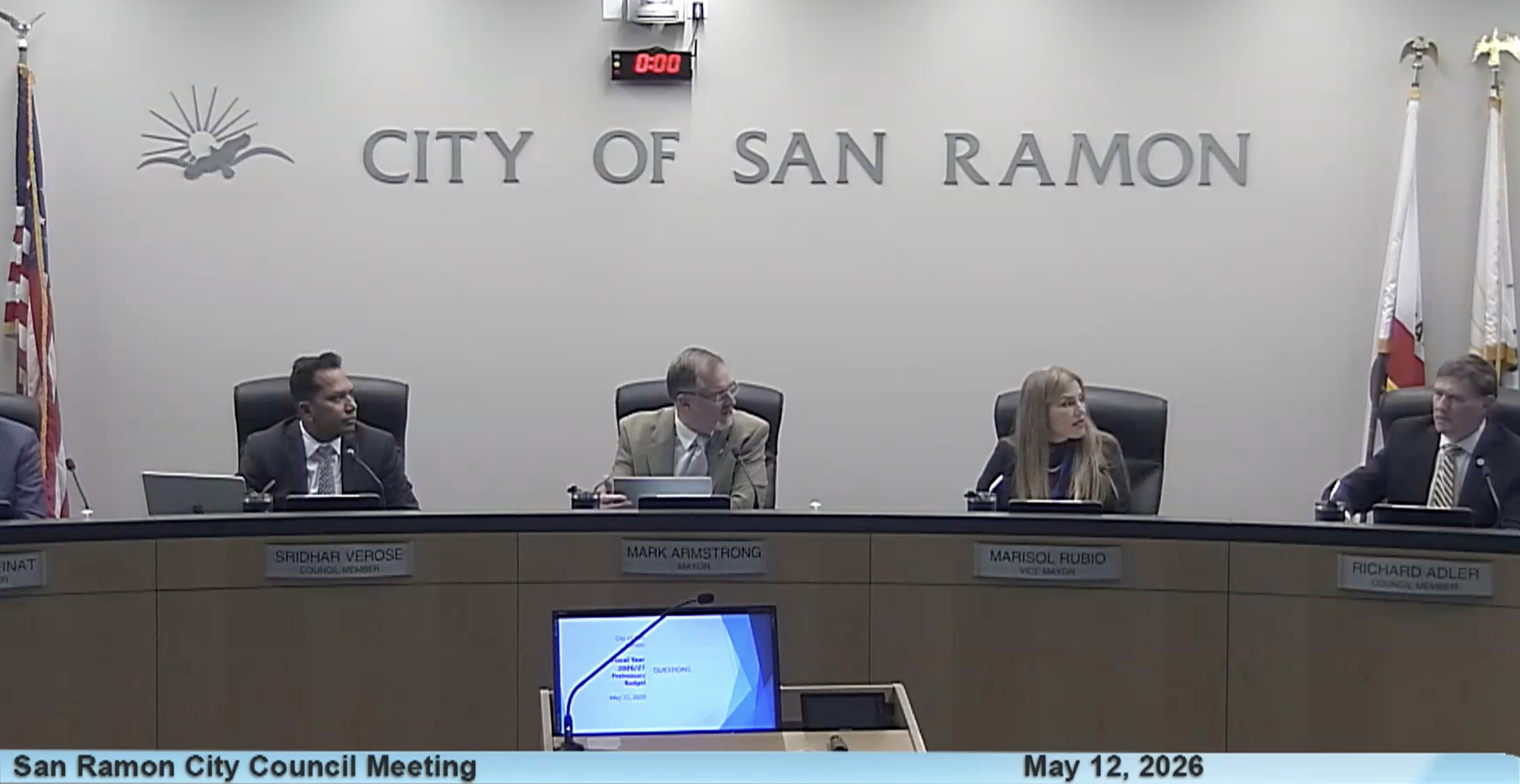
San Ramon's City Council got its clearest look yet at the fiscal tightrope ahead: a preliminary budget that projects $85.3 million in general fund revenue against $76.8 million in expenditures — numbers that look healthy only because Measure N sales tax revenue is papering over a $13.7 million structural deficit. In a separate debate, the council brokered a compromise to split July's commemorative flagpole between the America 250 and Disability Pride flags.

  • Preliminary budget exposes $13.7M structural deficit without Measure N; expenditure growth at 6.6% still outpaces the 2.3% target needed for long-term sustainability

  • City Manager warns a voter-approved revenue measure may be the only path to closing the gap before Measure N expires in FY 2035

  • $10.2M capital improvement program scrutinized as tree maintenance gets zeroed out and EV charging station costs draw fire

  • Council splits July flagpole between America 250 (July 1–15) and Disability Pride (July 16–Aug. 17) flags after public speakers and written comments push for disability representation

  • Public commenters challenge budget strategy, calling sales taxes regressive and demanding real cost cuts over cost containment

  • Public works team honored with National Public Works Week proclamation as staff shifts to reactive maintenance under tighter budgets


Measure N Is Propping Up the Budget — and the Clock Is Ticking

The basics: Staff presented the FY 2026-27 preliminary budget projecting $85.3 million in general fund revenue (up 5.35% over FY 2026) and $76.8 million in expenditures (up 6.6%). Revenue growth is driven by $1.6 million in new property tax and $1.9 million in new sales tax. Expenditures are rising from contractual obligations, insurance and pension cost increases, minimum wage adjustments, new park maintenance in Doherty Valley, expanded library hours, animal control, and cybersecurity upgrades. The city also lost $1.8 million in garbage franchise fees.

Why it matters: Strip away Measure N's sales tax revenue and San Ramon would face a $13.7 million operational deficit. With Measure N, the city posts a positive $1.2 million net fund balance change and a projected year-end reserve of $33 million — about 4.4% above the 36% reserve target. But the trend line is moving the wrong way.

Where things stand: Finance Director Jennifer Wakeman told the council the reliance on the voter-approved sales tax is deepening, not shrinking.

"Our excess at the end of the year is going down, which means that we are relying more heavily on Measure N this year than we did in fiscal year 26, which is not going in the right direction," she said.

Expenditure growth has been reduced from a historical 9% pace to 6.6% — a significant improvement, but still far above the 2.3% target staff says is necessary to reach fiscal sustainability by the time Measure N sunsets in FY 2035.

Mayor Mark Armstrong pushed staff to accelerate work on the Financial Resiliency Framework, a set of policy tools covering reserves, pensions, retiree health obligations, and revenue generation.

"We are two years in the Measure N … we don't want to get to the end of Measure N and we're still working on a resiliency framework," he said.

Wakeman distinguished between a one-time balanced budget and the deeper goal of resilience:

"Fiscal sustainability is a moment in time when our operating budget is balanced and we are not creating liability somewhere else. But financial resilience is really this set of philosophies and decisions and processes that we build into our organization that helps us to maintain fiscal sustainability."

Revenue Ceiling: Why the City Manager Says a New Measure May Be Inevitable

City Manager Stephen Spedowfski delivered the meeting's starkest fiscal assessment, telling the council there is no realistic path to closing the structural gap through economic development alone.

"The only item that would move the needle in a significant way … would be another revenue measure. There is no other methodology or guaranteed way to bring in more revenue other than going to the voters for some type of revenue measure," he said.

He illustrated the challenge in concrete terms: each car dealership generates roughly $1 million per year in sales tax revenue, but San Ramon has no freeway-visible land to site multiple dealerships. The city was planned as a bedroom community by the county, with limited retail zoning. Spedowfski credited the city core plan with preserving remaining retail centers and noted the downtown project is bringing more than 300,000 square feet of new retail — but cautioned that alone will not close the gap.

On the Measure N renewal timeline, Spedowfski outlined the standard playbook:

"What cities do with measure renewals is you go out in year eight and you present to the public. Here's the situation and here's what we've done with the money for Measure N. And here are the list of cuts that would need to be made if Measure N does not get renewed."

Vice Mayor Marisol Rubio noted that even with Measure N's 1% sales tax, San Ramon's combined rate of 9.75% remains half a cent below neighboring Tri-Valley cities including Pleasanton, Livermore, and Walnut Creek, underscoring the city's relatively low revenue-raising posture.

Councilmember Sridhar Verose pressed on the arithmetic, expressing concern about the persistent spread between 4.3% revenue growth and 6.6% expenditure growth.

"That worries me that where we will land as we keep growing and eventually after 10 years, forget about getting out of Measure N, we may end up with new measure," he said.

Public Pushback: Sales Taxes Called Regressive, Cost Cuts Demanded

Three public speakers challenged the council's fiscal strategy from different angles.

Jim Blickenstaff cautioned against continued reliance on sales taxes, calling them regressive, and warned that replacing commercial and retail land with housing produces net revenue losses. He urged the city to explore alternatives.

Pascalis Datros criticized the budget presentation for emphasizing expenses over revenue generation strategies and questioned why the city's investment income appeared extremely low, calling for more transparency on how city funds are invested.

Verose responded to that concern, explaining that the city's investment guidelines prioritize safety above all else:

"All our investments follow safety. Protecting public funds and preserving principle is the highest priority. And then liquidity, ensuring sufficient cash flow is available to meet cities operational needs. The third one is yield and return."

Johannes Tillahan was the most pointed, calling for actual cost cuts rather than cost containment and arguing that a private equity approach would demand immediate $2 million reductions. He warned that Measure N is a temporary fix and demanded concrete revenue increase plans.

Councilmember Robert Jweinat pushed back on the cost-cutting argument:

"One of the dangers that I believe we don't want to fall in is you start cutting staff and start cutting folks out. Because then if you cut somebody that's responsible for services and those services start to go down, then you have a death by a thousand paper cuts."

$10.2M Capital Program Under the Microscope

The $10.2 million capital improvement program covers 32 projects, with only $1.4 million drawn from the general fund and $200,000 from grants. The balance comes from gas tax, Measure J, and SB1 funds.

Verose probed several line items. The Doherty Valley Tree Management Program has been zeroed out, shifting the city from proactive to reactive tree care. Spedowfski confirmed:

"That was a victim of the budget cuts … right now we're more of a reactionary."

The council also scrutinized $258,000 spent on EV charging stations that leveraged only a $30,000 grant. The City Manager recommended against future city investment in EV infrastructure, noting the private sector is filling the gap. A $2 million Citywide Intelligent Transportation System upgrade, funded by a federal earmark from Congressman Mark DeSaulnier, is now moving forward after a federal grant freeze.

Staff presented one new position — a CIP Program Manager in Finance — and one reclassification from Recreation Technician to Recreation Supervisor. The City Manager said he plans to restructure CIP categories to clarify what is truly capital versus ongoing maintenance.

What's next: The full budget document is expected May 26 for adoption. The July 14 council meeting will feature a detailed 10-year financial model and long-term fiscal sustainability plan. Wakeman said staff will begin FY 2028 budget preparation immediately after wrapping FY 2027.


Council Splits July Flagpole Between America 250 and Disability Pride

Why it matters: Two competing requests for the city's single commemorative flagpole in July — one from Vice Mayor Marisol Rubio for the Disability Pride flag and another from Mayor Mark Armstrong and Councilmember Robert Jweinat for the America 250 flag — tested the council's flag display policy and required a creative compromise.

Where things stand: Under the city's existing policy, only one flag can fly on the commemorative pole at a time for up to 31 days. Jweinat initially proposed flying the America 250 flag under the U.S. flag on the main pole, but City Attorney Martin Lysons advised that current policy designates the main pole for congressionally recognized flags only.

Armstrong brokered the solution: America 250 flies on the commemorative pole July 1–15 to cover the Fourth of July period, then the Disability Pride flag flies July 16 through Aug. 17 — a full 31-day display. Both flags appear on the city hall digital marquee throughout July.

Rubio gave an extended speech on disability statistics, noting one in four U.S. adults has a disability, that disabled youth face three to six times higher suicide attempt rates, and that people with developmental disabilities experience elevated rates of sexual assault.

"One in four U.S. adults, over 70 million people have a disability. That's staggering. That's not a little number," she said.

The other side: Four public speakers weighed in. Katherine Grace argued the Disability Pride flag should take priority, criticizing the America 250 flag design and noting the existing U.S. flag already commemorates the nation's birthday. Sue Bach supported flying both, framing them as complementary: the 250th anniversary flag represents national ideals, while the Disability Pride flag tells community members "you matter here." Larry Brickell also supported both. Alex Rubio, speaking as a person with disabilities who was bullied, asked the council to fly the Disability Pride flag to uplift marginalized communities. Five written comments from organizations including Choice in Aging, Invisible Resisters Contra Costa, Lift Up Public Schools, and the California Siblings Leadership Network supported the Disability Pride flag.

Decisions: The motion, made by Rubio and seconded by Jweinat, passed 5-0 (For: Armstrong, Rubio, Verose, Adler, Jweinat; Against: none; Absent: none). Resolution 2026-054 authorizes the Disability Pride flag display July 16–Aug. 17; Resolution 2026-055 authorizes the America 250 flag July 1–15.

What's next: A broader flag policy revision from the council's policy committee is expected in the coming months.


Minor Items

  • National Public Works Week proclaimed for May 17–23 under the theme "Rooted in Service, Powered by Community." Staff filling in for Public Works Director Brian Bornstein highlighted ongoing maintenance of parks, sports fields, and the new downtown development. Councilmember Jweinat praised the citizen request management system for rapid response to traffic and road incidents; staff announced a new CRM system is forthcoming.

  • Art of Living Foundation volunteers Pallavi and Rajesh requested the city partner on an International Yoga Day community event, citing mental and physical health benefits. Rajesh, a Salesforce engineering leader and certified yoga and meditation instructor, described his own mental health journey. No council action was taken.