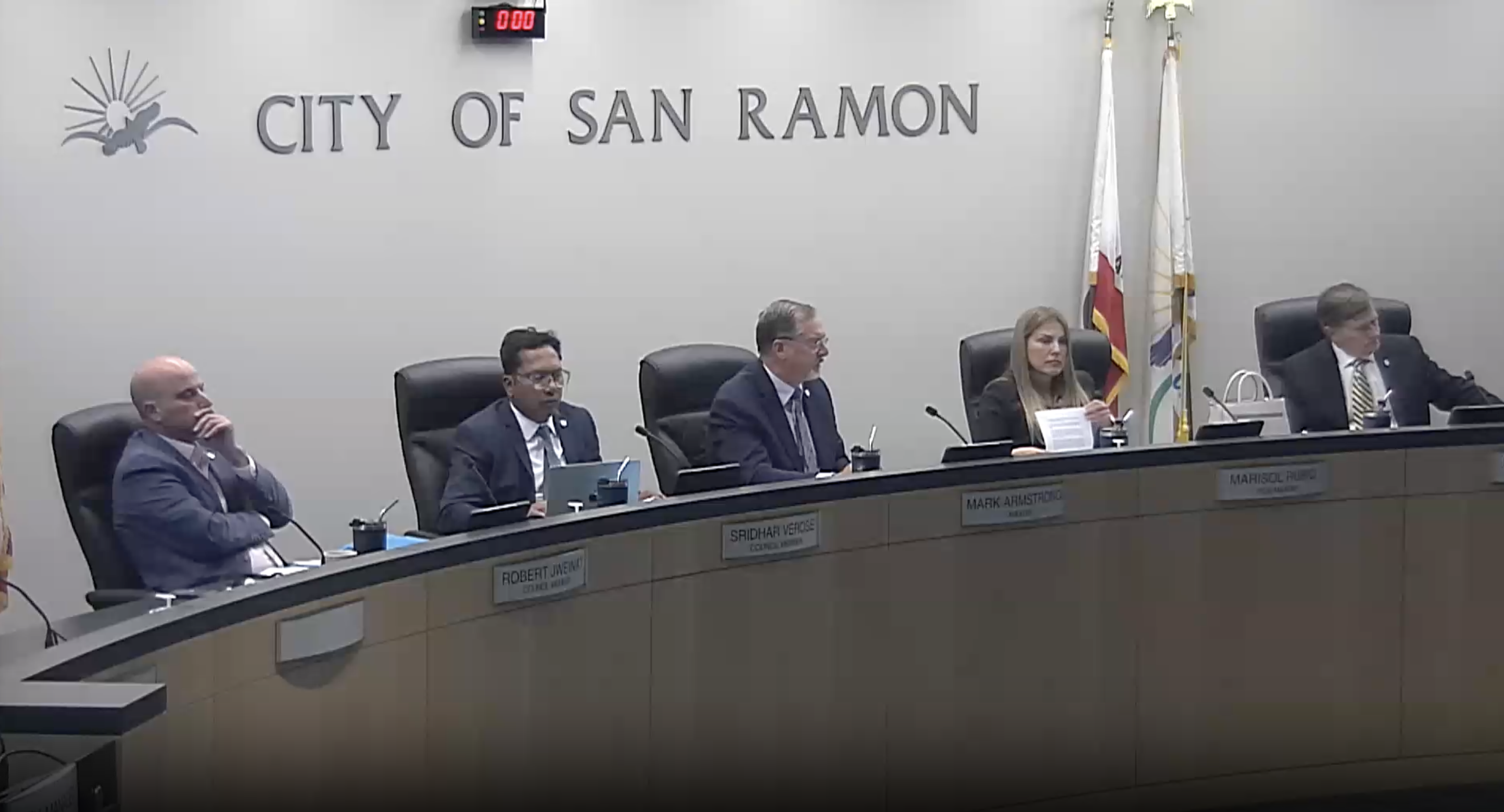
City Council - Apr 07, 2026 - Special Meeting

City Council - Apr 07, 2026 - Special Meeting

City CouncilSan RamonApril 7, 2026

Sources:

Locunity is a independent informational service and is not an official government page for this commission.We use AI-assisted analysis and human editorial review to publish information.

San Ramon Council Unanimously Approves 2,510-Home Orchards Project, Rejects CEQA Challenge

San Ramon's City Council voted 5-0 to deny a resident's environmental appeal and greenlight the Orchards, a 92-acre mixed-use development that will transform the former Chevron Park office campus into the city's largest residential community over the next two decades. The three-plus-hour special meeting saw sharp exchanges between the appellant and council members, impassioned public testimony about traffic and neighborhood character, and a unified council that found no evidence the city's environmental review fell short.

  • 2,510-home Orchards project approved on the former Chevron Park campus at 6001 Bollinger Canyon Road after unanimous 5-0 vote

  • Resident's eight-point CEQA challenge rejected — council found no specific evidence of new environmental impacts beyond what the General Plan 2040 EIR already analyzed

  • Affordable housing exceeds city requirements at 16.2%, with 99 units of very low and low income housing developed by Eden Housing including free childcare

  • Residents raise alarms over Bollinger Canyon traffic, tree removal, building heights, and stretched police and park resources

  • Vice Mayor Rubio links housing to school crisis — 200 school district employees recently discharged due to declining enrollment


The Orchards: A 20-Year Bet on Downtown Density

The basics

The Orchards development at 6001 Bollinger Canyon Road will replace the vacant Chevron Park office campus — acquired by Sunset Development in 2022 — with a phased mixed-use community of 2,510 homes organized into three districts: a mixed-use district (619 homes above 125,000 square feet of ground-floor retail), a multifamily district (1,465 homes including 300 for-sale condominiums), and a neighborhood district (368 for-sale homes plus 58 optional accessory dwelling units). The project includes 99 units of affordable rental housing developed by Eden Housing at a dedicated site with free childcare, pushing the overall affordability rate to 16.2% — above the city's 15% inclusionary requirement.

Why it matters

This is the largest residential development in San Ramon's history and a direct response to the city's state-mandated Regional Housing Needs Allocation obligations across multiple cycles. It will fundamentally reshape the city's downtown core, adding housing at all income levels to a community that has seen declining school enrollment and aging commercial office stock. Vice Mayor Marisol Rubio drove the stakes home:

"We just had 200 employees discharged from the school district because they don't have enough money. They depend on something called the local control funding formula and it is very dependent on enrollment and we're under enrolled."

Where things stand

Stephanie Hill of Sunset Development presented the project's evolution through two years of community engagement. The plan includes a 2.5-acre central park, heritage oak tree parks, a perimeter greenway averaging 75 feet wide adjacent to Inverness Park, paseos, and connections to the Iron Horse Trail. Retail will be concentrated in the mixed-use district with neighborhood-serving tenants such as food and beverage establishments and a small grocer.

Hill described how resident feedback shaped the layout:

"One of the things that we really heard from the Inverness Park residents who are just to the south of Orchards was they didn't want to have tall buildings directly along that property line."

She also emphasized that the affordable component goes well beyond requirements:

"Eden Housing's development increases the neighborhood district's affordable commitment by 44 homes, an 80% increase over the city's requirement."

The first phase will demolish existing office buildings and construct the Neighborhood District and the Eden Housing affordable community. Critically, each future phase must return individually for development plan approval, architectural review, and independent CEQA analysis. Planning Division Manager Cindy Yee confirmed that "each future project will have its own map and identify architecture, design, landscaping, etc."

Design guidelines specific to the Orchards will replace citywide objective standards to ensure architectural coherence across the 20-year build-out. A development agreement governing the full timeline and community-wide benefits will be addressed separately at a future meeting.

Decisions

The council adopted Resolution 2026-040 on a motion by Councilmember Robert Jweinat, seconded by Councilmember Richard Adler. The vote was unanimous (For: 5, Against: 0, Absent: 0) — Armstrong, Rubio, Jweinat, Adler, and Verose all voting yes.

What's next

Demolition and construction of the first-phase Neighborhood District and Eden Housing community can proceed. The development agreement covering the full 20-year build-out will come before the council at a future meeting. Each subsequent district will require its own entitlement approvals and environmental review.


CEQA Appeal Falls Flat as Council Demands Evidence

Why it matters

The council's rejection of the appeal on all grounds establishes that the General Plan 2040 EIR — certified in December 2023 — provides sufficient CEQA coverage for phased developments consistent with the plan. The precedent could deter future environmental challenges to projects within Bishop Ranch and similar infill sites.

Where things stand

Appellant Brian Swanson raised eight grounds challenging the Planning Commission's use of CEQA Guidelines Section 15183, which allows streamlined environmental review for projects consistent with a general plan whose EIR has already been certified. His central argument was that the consistency checklist inadequately addressed four statutory questions: peculiar effects, effects not previously analyzed, off-site and cumulative effects, and whether substantial new information shows previously identified effects may be more severe.

Swanson focused heavily on vehicle miles traveled analysis, arguing the VMT screening memo by Fehr & Peers was insufficient:

"The VMT memo from Fehr & Peers was like 20-plus pages, significantly less, with three 'note to reviewer' warnings on the peculiar determination."

He also contended that post-December 2023 regulatory changes — including updated Climate Action Plan greenhouse gas thresholds, new parking standards, FAR changes, and project-specific design guideline substitutions — altered the analytical setting and required fresh cumulative analysis. When asked whether any of these changes were incorporated into the CEQA review, he responded bluntly: "None of them. Zero."

Staff pushed back firmly. Environmental consultant Mary Bean of FirstCarbon Solutions confirmed the Section 15183 analysis covered all CEQA topics and found no project-specific impacts requiring further review. Mayor Mark Armstrong read from the conditions of approval:

"Development Plan and Architectural review applications are required for each building or phase of the Orchards master plan. Those developments will be subject to the standard staff review process, including development review by city departments, outside agencies and utilities."

The other side

Council members pressed Swanson repeatedly for concrete evidence of new environmental harm — and came up empty. Councilmember Robert Jweinat was the most direct:

"Mr. Swanson, this is your appeal. Do you have anything at all? Any piece of evidence besides just what may happen?"

Councilmember Sridhar Verose challenged the practicality of the appellant's VMT framework for a two-decade project:

"So you are telling that for 20 years we need to have a crystal ball and figure out how the transportation evolves. Based on that we need to come out with an analysis and show you how — is that expectation?"

Vice Mayor Marisol Rubio cited recent state legislation — AB 130 and SB 131 — that provides additional CEQA streamlining for infill urban development, further undermining the appellant's argument that more analysis was required.

In his closing statement, Swanson accused the city of creating financial barriers to accountability:

"What you've done here is created an appeal cost moat, a financial moat, and have allowed Sunset to implement its development program fast and furious without any regard to CEQA."

Decisions

Armstrong framed the council's role narrowly:

"My role is not to prove whether the project is perfect, only that I'm here to determine whether or not the Planning Commission made an error or whether the city followed the appropriate law and process. And I do believe that the city did follow the appropriate law and process."

Jweinat was blunter in his assessment of the appeal's intent:

"This is what it felt like tonight — was we don't want housing. That's what it felt like tonight."

All five council members concluded there was no specific evidence of new or peculiar environmental impacts warranting additional review beyond the certified General Plan 2040 EIR. The appeal was denied unanimously.


Residents Sound Off on Traffic, Trees, and Tall Buildings

Six members of the public spoke during the hearing, offering a window into the anxieties that rapid growth is generating across San Ramon — even among residents who don't oppose housing in principle.

Kirsten Dunatov, a longtime resident and former Chevron employee, described dangerous walking conditions on Bollinger Canyon Road and traffic that already takes 20 minutes to drive two miles to Costco. She asked the council to consider more space for trees and provide details on traffic management.

Susan Clayton came armed with a review of roughly 400 pages of project documentation. She challenged the traffic study's reliance on 2021–2022 COVID-era traffic patterns as a baseline, questioned the parkland math — a 2.5-acre park for 2,500 families — and flagged police staffing at 0.82 officers per 1,000 residents. She urged reducing building heights by one or two stories to preserve the valley's aesthetics.

Jim Blickenstaff, former city council member, cautioned the council on the distinction between program-level EIRs and project-level EIRs, arguing one cannot substitute for the other, and urged members not to rush a final decision.

Susie Ferris-Inderkum of Responsible Growth San Ramon drew a direct line to ongoing litigation over the Marketplace project's CEQA notice of exemption:

"This won't be the only appeal. If you deny it, there will be others because the process of evaluation and approval for staff giving notices of exemption is a problem. It's a serious problem."

One young resident, Charayes, offered a counterpoint, speaking in favor of the project and arguing that the Orchards will provide opportunities for people looking for a fresh start and a brighter San Ramon.

The public testimony underscored a tension that will likely intensify as future phases come forward: state housing mandates are driving densification at a pace that many long-time residents feel is outstripping the city's infrastructure, parkland, and public safety capacity.