City Council - Jun 09, 2026 - Meeting
City Council • San RamonJune 9, 2026
Locunity is a independent informational service and is not an official government page for this commission.We use AI-assisted analysis and human editorial review to publish information.
Landscape District Assessments Approved as $850K Fountain Debate Drags On
The San Ramon City Council cleared a packed agenda Monday night, unanimously advancing landscape assessments, election-season rules, and a state-mandated remote meeting policy — but it was a broken step fountain and a 12% survey response rate that drew the sharpest questions from the dais.
- Council approves landscape district assessments while pressing staff to resolve Zone 6's non-operational fountain by October
- PFLAG president delivers emotional Pride Month acceptance, warning against "sliding back into darkness" on LGBTQ rights
- Voluntary campaign spending caps rise to $91,453 for the mayoral race ahead of November 2026 election
- Teen Council reports on mental health outreach, ambassador program, and a restructured goal framework
- Climate activists urge council to back statewide Polluters Pay bill, citing local crop damage and water concerns
Zone 6's Broken Fountain Tests the Limits of a Self-Funded District
Why it matters: A signature step fountain in the 1984-1 Landscape and Lighting District has been off since 2022, and the 704 households responsible for funding it can't agree on what to do next — a stalemate that could trigger a Prop 218 ballot by fall.
Where things stand: Gary Manuel, Public Services staff, told the council that full repair — pump replacement, leak repair, and resealing — would cost approximately $850,000. A survey sent to all 704 households in Zone 6, located at Crow Canyon and Doherty near the Danville border, drew only 85 responses, a 12.1% return rate.
The results were contradictory. "The consensus was keep the fountain, but don't raise our assessment," said Manuel. He noted that landscaping the fountain site would be cheaper long-term but that residents have not rallied behind that option either.
The zone comprises four HOAs and one non-HOA neighborhood, Altamira, with 161 homes. Communication among the groups has been poor. Vice Mayor Marisol Rubio suggested text-banking outreach and asked whether fixed-income residents could absorb an increase: "Some people may be on a fixed income of some sort and they may not be able to respond to changes as easily."
Councilmember Sridhar Verose pushed for urgency. "This whole Zone 6 is going on forever," he said. "A lot of that community members, they keep asking the same question to us about what is the final step."
Staff also flagged a broader pressure point: nine of the district's 19 zones are at or near their maximum assessment rate, meaning any future increase would require a Prop 218 ballot — a formal vote of property owners.
Decisions: Resolution 2026-077, levying assessments for the full 1984-1 district for fiscal year 2026-27, was adopted unanimously (For: 4, Against: 0, Absent: 1 — Councilmember Robert Jweinat). Several zones received incremental increases.
What's next: Staff committed to additional public meetings in Zone 6 and is targeting a Prop 218 vote by October or before year's end. The outcome will set a precedent for how the city handles aging infrastructure in self-funded assessment districts.
Pride Month Proclamation Draws Emotional Call for Continued Inclusion
Councilmember Verose read a proclamation declaring June 2026 as LGBTQ Pride Month in San Ramon. Anuradha Gupta, president of PFLAG Danville San Ramon Valley, accepted the proclamation and delivered a data-driven, emotional speech.
One in three LGBTQ youth are rendered homeless, she said. Eight in ten are bullied in school. They face four times the violence of their peers. But inclusivity from even one adult, she told the council, can make a measurable difference: "That inclusivity from even one adult can reduce the probability of an LGBTQ youth attempting suicide by 40%."
Gupta warned against complacency amid a wave of anti-LGBTQ legislation nationally. "We may have to debate the very existence of our LGBTQ community," she said. "Are we going to be on the right side of history with our policies today?" She closed by telling the council: "Somewhere, someone who knows you issued this proclamation feels safe tonight."
Vice Mayor Rubio thanked community partners including PFLAG, Rewire, Discovery Counseling Center, and the San Ramon Valley Diversity Coalition. "I think this is about respecting people's authenticity, who they are as they come," she said.
Mayor Mark Armstrong affirmed the city's commitment: "We do have that sign out on the marquee. Everyone is welcome here. And it's a heartfelt slogan. It's not just words."
Campaign and Election Rules Set for November 2026
The council adopted two resolutions establishing the rules of engagement for the November 2026 municipal election, covering the mayor's seat and council Districts 2 and 4.
Candidate statements: Resolution 2026-080 maintains the 400-word limit for voluntary candidate statements in the official voter guide, consistent with 2020, 2022, and 2024 elections. California Elections Code allows up to 400 words, but Contra Costa County's standard fee covers only 250 words. Going to 400 doubles the cost — $2,436 for the mayor's race, $922 for District 2, and $876 for District 4.
Mayor Armstrong called the voter guide one of the most cost-effective outreach tools: "For many candidates, this is one of the most cost effective ways to reach the most amount of people with your qualifications."
Spending caps: Resolution 2026-081 sets voluntary campaign expenditure limits at $1.75 per registered voter for the mayoral race and $2.75 per voter for district races — a 25-cent increase over 2024 to account for inflation, particularly in postage. That translates to a $91,453 cap for mayor (52,259 registered voters), $39,938 for District 2 (14,523 voters), and $36,597 for District 4 (13,308 voters).
Councilmember Richard Adler noted that historical data shows higher spending doesn't guarantee more votes. The limits are voluntary; whether each candidate participates will be posted on the city website.
Both resolutions were adopted unanimously (For: 4, Against: 0, Absent: 1 — Councilmember Jweinat).
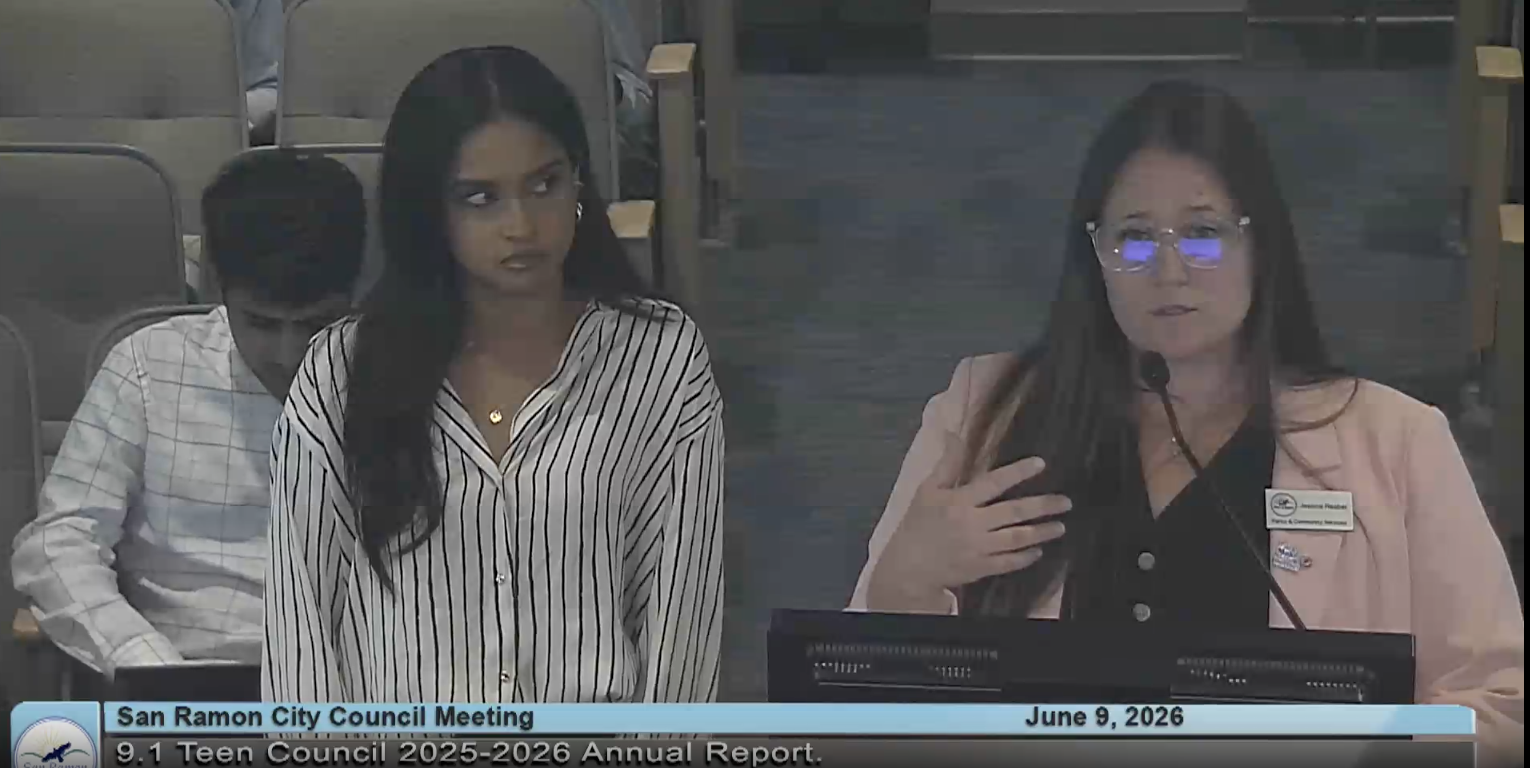
Teen Council Reports on Mental Health, Ambassadors, and $400K Nonprofit
Varsha Janagada, chair of the San Ramon Teen Council, presented the 17-member body's annual report, covering work across four ad hoc committees.
The Teen Wellness committee developed peer-led freshmen transition programs and proposed a student mental health survey. Senior Tech Days held four events at Al Costa Senior Center with expanded cybersecurity workshops. The Ambassador Program selected 19 ambassadors from 50 applicants across the San Ramon Valley to mentor middle schoolers on topics ranging from financial literacy to environmental concerns.
The Outstanding Teen Citizenship Award went to Dania Percais of Cal High. "Through her nonprofit Humanities in Focus, she helped raise over $400,000 and she expanded the organization internationally, with more than 40 student officers across the globe," Janagada told the council.
A key structural change: the Teen Council reduced its recommended goals from 11-13 specific targets to six broader ones — including bylaws review, partnership expansion, middle school outreach, and continued mental health and intergenerational work. "In previous years, our goals were a little bit more specific and limiting, which sometimes made it harder for the council to adapt and take initiatives on new ideas," Janagada explained.
Vice Mayor Rubio called it the best-run committee and praised the shift to flexible goals. Councilmember Adler highlighted the mental health and financial literacy initiatives.
Graduating seniors were recognized: Nishka (UC San Diego), Ava Brooks (public policy), Maya (UC Riverside), and Varsha (UC Berkeley, data science).
Climate Activists Push Polluters Pay Bill; Resident Challenges Housing Crisis
Two members of the Tri Valley Indivisible Climate Group urged the council during public comment to back the California Polluters Pay Superfund Initiative, a bill before the state legislature that would shift climate mitigation costs from taxpayers to fossil fuel companies.
Don Normad, a 60-year San Ramon resident, described crop damage in his own yard: "My apples and olives are getting so sunburned in their early development that they rot before they're even fully mature. This has only been occurring the last two years." He reported that 30 cities and school boards statewide have already passed supporting resolutions.
Katherine Grace framed the issue through an analogy: "Imagine if someone set their neighbor's house on fire, stood by as the flames spread, and then refused to help pay for the damage. It's exactly what big oil companies have done worldwide, including here in California."
Separately, Jim Blickenstaff challenged the premise of a housing crisis, citing a newspaper article reporting that California's population is stagnating due to low birth rates, declining immigration, and outmigration — and that the state may lose three to four congressional seats in the next census. He argued vested interests have used the "crisis" label to justify overdevelopment.
No council action was taken on any of the non-agenda public comment items.
Minor Items
- Consent calendar: All 12 items (5.1 through 5.12) approved unanimously 4-0 with Councilmember Jweinat absent.
- Preserve Landscape District assessments: Resolution 2026-078 adopted 4-0, raising per-parcel assessments from $295.99 to $315.15 — a $19.16 increase — to fund native coast live oak tree plantings replacing wind- and rodent-damaged ginkgo trees and repair of decomposed granite pathways on Faria Preserve Parkway.
- SB 707 technology disruption policy: Resolution adopted 4-0 requiring meetings to pause up to one hour if Zoom-based remote access drops. The title was amended from "Disruption" to "Technology Disruption" for clarity. Assistant City Attorney Alicia Poon clarified: "This does not have anything to do with disruptive individuals at meetings. This is solely about the technological aspect of it." The policy must be adopted by July 1, 2026.
- Meeting start time: An ordinance changing the regular council meeting time from 7 p.m. to 6:30 p.m. was introduced and continued to June 23, 2026, for formal adoption. Approved 4-0.
- Central San anniversary: Emily Barnett, communications manager for the Central Contra Costa Sanitary District, invited the community to the district's 80th anniversary celebration on June 13 in Martinez.
- Red flag fire warning: City Manager Scott reported a National Weather Service red flag warning for the East Bay hills, Wednesday 11 p.m. through Thursday 9 a.m., and promoted the San Ramon Valley Fire Protection District's PEP emergency preparedness class on June 25.
- E-bike safety: Multiple council members highlighted ongoing e-bike safety work, including Councilmember Verose's mention of AB 1557 to tighten e-bike speed classifications and Councilmember Adler's report on the Street Smarts Advisory Committee's plans for a 2026 community bike festival. Adler also noted CERT's 20th anniversary, with 1,200 active emergency volunteers in San Ramon.
- Regional meetings: Vice Mayor Rubio reported on County Connection's Youth Ride Free program. Mayor Armstrong highlighted the CCTA transportation expenditure plan and White Pony Express food recovery, which distributes 12,600 pounds of food daily.